
From July 1st, 2025, the tumble dryer label is rescaled from A to G, and the A class today is effectively empty: eight heat pump models read in the official specifications stop between C and E. Here you will find the declared data on consumption, duration and noise, the rule for choosing the right capacity and the euro cost of what separates one class from another.
If you're looking at dryers now, the first thing to know is that the measurement standard has recently changed. From 1st July 2025 the energy label for domestic tumble dryers is rescaled from A to G: the old A+, A++ and A+++ classes no longer exist, and a model that until yesterday was sold as A+++ now appears on the shelf with a C or a D.
It's not a downgrade in quality, it's a change in the scale. But it has an immediate practical consequence: looking for A class on a dryer in 2026 means almost always buying nothing. We read the official information sheets of eight models actually on the market, the ones that manufacturers are required to publish under Delegated Regulation (EU) 2023/2534: the best one stops at C.
This guide starts from those data and not from brochures. Let's see what really matters when you choose: how much capacity you need, how much class costs in your bill, how long a cycle takes, how much noise it makes and what dimensions you need to measure before ordering.
The short answer
For a family of three or four people, the sensible choice today is a heat pump dryer of 8 or 9 kg in C class. Capacity should match your washing machine, not increased for safety: in current ranges going from 8 to 9 kg doesn't change dimensions by a centimetre, so the right question isn't how much space you have, but how much laundry you do at once.
Energy class is the lever that really matters: between the best and worst model among those we analysed, with the same brand and external dimensions, consumption per cycle goes from 0.95 to 1.32 kWh. That's almost twenty euros a year difference for normal use, or around two hundred euros over the appliance's lifespan.
But there's a price to pay, and nobody writes it on the shelf: the most efficient model is also the slowest. Again in the official data, the one that uses the least takes 4 hours and 20 minutes for a full load, compared to 2 hours and 45 minutes for a model that uses just 2% more. If you need laundry in a day, that number matters as much as the class.
In brief: what you'll find in this guide
What has changed on the label
Tumble dryers were among the last families of appliances to switch to the single A to G scale. Delegated Regulation (EU) 2023/2534 replaced the old 2012 regulation: the new label appeared on products from 1st March 2025 and from 1st July 2025 it is the only one permitted for sale. In parallel, Regulation (EU) 2023/2533 redesigned the ecodesign rules, setting mandatory minimum requirements and requiring manufacturers to declare information on spare parts and repairs.
Three practical consequences.
All values refer to the eco programme. Consumption, duration, noise and condensation efficiency are measured on that programme and not on rapid cycles. If you always use the quick cycle, the label numbers don't describe your bill.
Consumption is declared per cycle in the information sheet and per 100 cycles on the label. They are the same thing written two ways, just move the decimal point.
Class A is effectively empty. The rescaling was deliberately designed to leave room for future products. If you wait for A, you'll be waiting years.
If you want the complete picture of the scale and symbols, we've reconstructed it in how to read the energy label.
Today's classes and where models on sale stop
The class derives from a number called the energy efficiency index, abbreviated as IEE: the lower it is, the better. These are the thresholds of the new scale.
| Class | Energy Efficiency Index (EEI) |
|---|---|
| A | up to 43 |
| B | over 43 and up to 50 |
| C | over 50 and up to 60 |
| D | over 60 and up to 70 |
| E | over 70 and up to 85 |
| F | over 85 and up to 100 |
| G | over 100 |
We tested this table instead of copying it: the eight models analyzed declare an EEI equal to 52.0, 57.0, 60.0 (three times), 70.0 (twice) and 78.0, and the classes printed on their respective official datasheets are C, C, C, C, C, D, D and E. Each value falls exactly within the expected range, including the two cases at the upper limit. The cross-check holds up.
What strikes you is something else: eight heat pump dryers from a premium manufacturer and not a single one reaches B. The top of the scale is empty today, and the bottom is empty for opposite reasons, because the ecodesign regulation keeps the worst models off the market. In practice, the real choice is played out between C, D and E.
Eight real models, data in hand
They are all heat pump dryers with free installation from the same manufacturer, selected to have a clean comparison: same brand, same external dimensions, same refrigerant. The values come from the product information sheets published pursuant to Delegated Regulation (EU) 2023/2534, not from sales sheets. Portos has not physically tested these appliances: what follows is an analysis of the declared data.
| Model | kg | EEI | Class | kWh per cycle | Full load duration | Half load duration | Noise |
|---|---|---|---|---|---|---|---|
| WQB246D0IT | 9.0 | 52.0 | C | 0.95 | 4:20 | 2:36 | 57 dB(A), class A |
| WQG233D0IT | 8.0 | 57.0 | C | 0.97 | 2:45 | 1:48 | 64 dB(A), class B |
| WQG235C0IT | 8.0 | 60.0 | C | 1.02 | 2:59 | 1:59 | 61 dB(A), class B |
| WQG243D6IT | 9.0 | 60.0 | C | 1.10 | 3:00 | 1:52 | 63 dB(A), class B |
| WQG245D0IT | 9.0 | 60.0 | C | 1.10 | 3:15 | 2:05 | 61 dB(A), class B |
| WTH8521EII | 8.0 | 70.0 | D | 1.19 | 3:25 | 2:05 | 62 dB(A), class B |
| WQG24200IT | 9.0 | 70.0 | D | 1.28 | 3:50 | 2:12 | 62 dB(A), class B |
| WQG23100IT | 8.0 | 78.0 | E | 1.32 | 3:31 | 2:15 | 64 dB(A), class B |
A detail that surprises anyone reading the datasheets for the first time: under technology all eight come out as condensation type. It's not a mistake and it's not reverse marketing. The heat pump is a way of condensing moisture, so it falls into that category; the only field in the datasheet that reveals the heat pump is the refrigerant gas, which in these models is R290, namely propane. If you look for the words heat pump on the energy label, you won't find them.
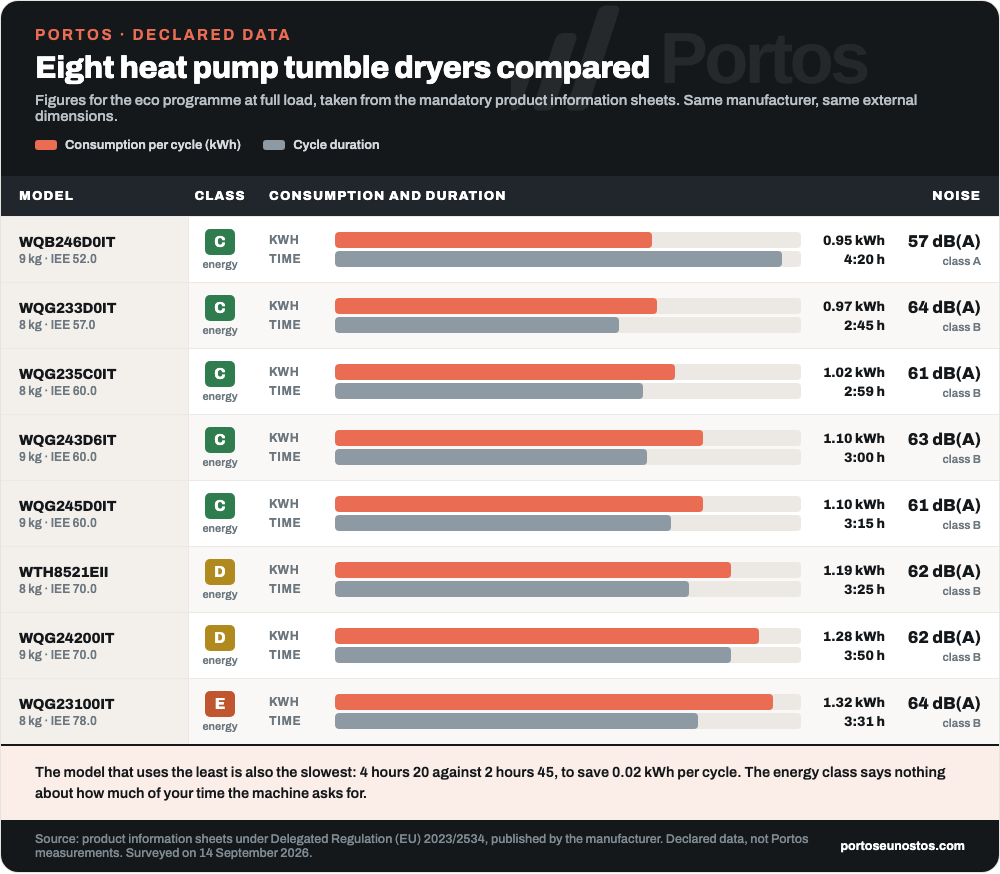
The eight models ordered by efficiency: consumption drops, but time does not follow the same curve.
The consumption, time and noise triangle
The table above shows the real purchase reasoning, and it's not what you might expect.
Consumption goes down and time goes up. The most efficient model in the group, with IEE 52.0, finishes the eco program in 4 hours and 20 minutes. The second, with IEE 57.0, uses 0.02 kWh more per cycle and finishes in 2 hours and 45. Translated: 95 minutes more to save the equivalent of six thousandths of a euro per cycle. It's a legitimate choice, but you should make it knowing what you're buying.
Noise doesn't follow the class. Seven out of eight models are in sound emission class B, between 61 and 64 dB(A). Only the most efficient drops to 57 dB(A) and reaches class A. If the tumble dryer goes in the kitchen, corridor, or in a bathroom adjacent to a bedroom, seven decibels are a difference you can hear, because the scale is logarithmic and that jump corresponds to a perception of about half the noise.
Capacity is not the lever for consumption, class is. If we divide consumption by kilos of load, models in class C are between 0.106 and 0.128 kWh per kilo, while the one in class E reaches 0.165. That is: an efficient 9 kg dryer works each kilo of laundry spending a third less than an 8 kg in class E. Buying smaller to consume less doesn't work.
How much capacity you really need
The nominal capacity of a tumble dryer refers to dry cotton, just like that of a washing machine. This is why the practical rule is simple: same capacity as your washing machine, or at most one kilo more. If you wash 8 kg at a time and dry 7, every load becomes two cycles.
In the models analyzed, going from 8 to 9 kg doesn't cost space: the external dimensions are identical, 84.2 cm height by 59.8 cm width by 61.3 cm depth, across the entire range. The drum changes, not the casing. The extra kilo, when the two models have the same class, is almost always money well spent.
Two warnings that the big number on the display doesn't tell you:
Delicate programs have a maximum capacity lower than the nominal one, indicated in the manual. A 9 kg dryer doesn't dry 9 kg of synthetics.
Filling to the brim lengthens the cycle and worsens the result. The drum must be able to tumble the clothes: if the laundry stays compacted, air doesn't pass through and the sensors struggle to understand when it's finished.
If the doubt is about the washing machine, we've covered the size reasoning in washing machine 8, 9 or 10 kg and in the washing machine buying guide.
Which technology to choose
There are three technologies on the market: air exhaust, condenser with electric resistance, and condenser with heat pump. The first expels humid air outside and requires a hole in the wall; the second heats with a resistance and condenses the moisture; the third recovers heat from the outgoing air and for this reason consumes much less, working at lower temperatures and treating fabrics better.
For those buying today, the heat pump is the de facto standard in the mid and high range, and you can see it right from the scale: without heat recovery it's very difficult to stay in the high classes of the new label. Resistance versions still make sense when the initial budget is the main constraint and use is occasional.
We've already carried out the full comparison, with pros, cons and scenarios, in heat pump or condenser tumble dryer. Here we're interested in one point that remained in the background in that article: once you've chosen the heat pump, the work isn't finished, because within that same technology consumption differences reach 39%.
Condensation efficiency, the data almost no one looks at
Next to the energy class, the label shows a second class from A to G: condensation efficiency. It tells you what percentage of moisture extracted from the clothes ends up in the tank instead of in the room's air. In the models analyzed it ranges from 85% (class C) to 91% (class B).
It seems like a detail, until you translate it. Let's take a load that at the end of spinning still holds four liters of water, a realistic order of magnitude for a full load of cotton. With a model at 91% around 360 grams of water end up in the environment; with one at 85%, around 600. Every cycle. Over one hundred and sixty cycles a year the difference is almost forty liters of water released into the home.
This is why a tumble dryer in a windowless storage room or in a bathroom without a window can create condensation on walls. If the room is small and poorly ventilated, condensation efficiency matters more than half an energy class.
Space and installation: the centimeters that matter
The standard width is 60 cm and holds no surprises. The two numbers that cause deliveries to fail are different.
The depth. In the models analyzed it is 61.3 cm, to which you must add the duct, the plug and breathing space at the back. A space designed for a thin washing machine won't accommodate it.
Door opening. A tumble dryer's door is large and opens forward, often to the side. Measure the free space in front and verify the opening direction before ordering, not after.
For stacked drying, that is a dryer on top of a washing machine, here's a clarification that prevents damage: simply placing it on top is not enough. You need the stacking kit from the manufacturer, which secures the two units and absorbs the vibrations from the spin cycle. Without the kit, sooner or later the dryer will walk around.
One last thing, seemingly obvious but worth mentioning: the room must have air circulation. Even a heat pump, which doesn't expel hot air outside, slightly heats the environment and releases the moisture that wasn't condensed.
Tank or direct drain
The condensed water ends up in a removable tank, which needs to be emptied after each cycle or so. However, almost all condensation dryers allow you to connect a tube to the kitchen sink or washing machine drain, and then you won't need to touch the tank anymore.
If you have a drain available, that's the first modification to make: it costs just a few euros for a tube and eliminates the only mandatory daily task. If you don't have a drain, keep in mind that forgetting a full tank means finding the cycle stopped halfway through, with clothes still damp.
The condensation water, it should be said, is distilled water: many people reuse it for their iron. It's a small real convenience, not a sales pitch.
Humidity sensors and programs
The biggest practical difference between an inexpensive dryer and a mid-range one is not the energy class: it's how it decides when to stop.
Time-based models dry for the minutes you set, that's it. Sensor-based models measure the residual humidity in the drum and stop once the required level is reached, which you select by choosing between iron-dry, cupboard-dry, or extra-dry. The advantage is twofold: you don't waste energy by continuing to dry already dry clothes and you don't bake the fabrics.
For programs, the advice is to look at a few important ones. Wool and delicates with alternating drum movement, a quick cycle for emergencies, a program for bulky laundry like duvets. The dozens of specialized cycles that fill product datasheets almost always go unused in real life.
Remember that all label data applies to the eco program. The quick cycle dries in less time because it raises the temperature and ventilates more: it consumes significantly more and stresses the clothes.
Noise: where you put it matters more than you think
Among the models analyzed, the declared noise ranges from 57 to 64 dB(A). These are normal values for a rotating appliance, and on paper they seem close. In your home they are not.
The rule to keep in mind is that the decibel scale is logarithmic: three decibels less corresponds to half the sound power, and about ten decibels to a halved noise sensation. A model at 57 dB(A) and one at 64 dB(A) are not the same machine, especially if the cycle lasts four hours and starts in the evening.
If the dryer is in a garage or a distant storage room, the specification is secondary and not worth a premium price. If it's in an open-plan kitchen or bathroom, it's one of the three main parameters along with energy class and capacity.
How much it costs to use in a year
Let's do the calculation for realistic use: 160 cycles per year, which is just over three per week. The consumption is as declared for the eco program at full load. We give two price columns because energy prices are not uniform: 0.25 euros per kWh, the convention we use in other Portos articles to compare appliances with each other, and 0.3163 euros per kWh, the reference value set by ARERA for protected customers from 1 July 2026.
| Energy class and consumption | kWh per year | Cost at 0.25 euro/kWh | Cost at 0.3163 euro/kWh |
|---|---|---|---|
| C, 0.95 kWh per cycle | 152 | 38.00 euro | 48.08 euro |
| C, 1.10 kWh per cycle | 176 | 44.00 euro | 55.67 euro |
| D, 1.28 kWh per cycle | 205 | 51.20 euro | 64.78 euro |
| E, 1.32 kWh per cycle | 211 | 52.80 euro | 66.80 euro |
So between the best class C and class E the difference is 15 to 19 euros per year. Over ten years of life that's 150-190 euros: a figure that repays a premium at that level, but not a much higher one. It's the calculation that lets you understand, faced with two price tags, whether the price difference makes sense or not.
Two minor items, for completeness and to wrap them up. The standby mode declared is between 0.30 and 0.50 W: even leaving it plugged in all year you're talking about just a few euros. Delayed start, on the other hand, consumes 4 W: scheduling twelve hours of waiting adds about 48 watt-hours, that is 5% of the consumption of a whole cycle. Not much, but not zero, and it's worth knowing if you use it every time.
For the overall laundry bill, the companion piece on washing consumption is how much a washing machine consumes.
Half load: the numbers tell a different story
The label declares the eco program duration for both full load and half load, and the comparison is instructive. In the models analyzed, half load takes between 57% and 67% of the full load time, never half.
Concrete example. A model that completes a full load in 2 hours and 45 minutes takes 1 hour and 48 minutes for half load: two half loads make 3 hours and 36 minutes, or 51 minutes more than the same laundry dried all at once. The same logic applies to energy, because in each cycle a portion goes into bringing the machine up to operating temperature and not into drying the clothes.
From this comes an operating rule: fill the drum without compressing it. Half-load is neither more delicate nor more economical, it is simply less efficient.
Maintenance: filters, condenser, tank
The dryer is the appliance that loses performance fastest if neglected, because all its work depends on air flow. Three actions cover 90% of the problem.
The lint filter, every cycle. It's in the door window or just below. A thin layer of lint that seems harmless reduces air flow and lengthens cycles: it's the number one cause of the classic "it doesn't dry as well as it used to."
The second filter, every few weeks. Under the lower panel, it protects the heat exchanger. Rinse it under water and reinstall it only when completely dry.
The heat exchanger or condenser. In resistance models it's removable and should be washed periodically. In heat pump models it's often declared self-cleaning and should not be disassembled: in that case the only care is to keep the upstream filters clean.
Add emptying the tank, if you haven't connected the drain, and check the door seal every so often. That's all. Those who maintain this pace see cycles that remain the same duration as when the machine was new; those who don't end up with times increased by 30% and blame the appliance.
Why a washer-dryer is not a dryer
The temptation is strong when space is lacking: a single appliance that washes and dries, the same footprint as a washing machine. It works, but with a structural compromise that should be understood before, not after.
The drying capacity of a washer-dryer is always less than its washing capacity. This means that a load washed at maximum capacity cannot be dried all together: at the end of washing you have to open it, remove part of the laundry, and restart the drying cycle on the rest. If the idea was precisely not to think about it, the benefit is cut in half.
A washer-dryer makes sense when drying is occasional and space is truly the only constraint. If you dry three times a week, two appliances stacked cost less to run and last longer.
Spare parts, repair and warranty
It's the least discussed aspect of the new regulations and perhaps the most useful in the long run. The information sheets of the models analyzed report, as required by the regulation, the link to information on spare part availability for professional repairers and end users, the link to repair instructions and the link to indicative prices for spare parts net of taxes. All declare a minimum warranty of 24 months.
Before buying it's worth opening those links. A dryer is a machine with moving parts, filters and a refrigeration circuit: the real question is not whether it will break, but how much it will cost to get it working again in six years. A manufacturer that publishes accessible spare part lists is already useful information.
The refrigerant declared in these models, R290, is propane: a natural gas with low climate impact, replacing the old fluorinated gases. It is used in very small quantities and is the reason why you find indications in the manual about the minimum volume of the room.
Errors to avoid
Looking for class A. It doesn't exist today. The right question is how much you're paying to go from E to C.
Comparing the consumption of an 8 kg with that of a 9 kg. They should be compared relative to capacity: a lower number on a smaller drum is not an advantage.
Forgetting about duration. Four hours and twenty minutes are a constraint on daily life, not a technical detail.
Measuring only the width. It's the depth and the door opening that make installation impossible.
Stacking it without a kit. Saving on an accessory is paid for with vibrations, noise, and in the worst cases, with a fall.
Always using the quick cycle. It consumes more than the declared values and stresses fabrics. The long eco program is not a makeshift: it's the one the appliance was designed for.
Ignoring the filter. It's the only maintenance that's really mandatory and takes thirty seconds.
Choosing based on the number of programs. Humidity sensors matter, not the length of the list.
The Portos choice
If we had to reduce everything to a sequence of three decisions, it would be this.
First, capacity, aligned with the washing machine. It's the only parameter you can't make up for later: a machine that's too small doubles your cycles forever.
Second, the class, choosing C if the additional price compared to D or E is under two or three hundred euros. The calculations made above say that, with normal use, that difference pays back within the appliance's lifespan; beyond that threshold it doesn't pay back and D becomes a rational choice.
Third, the personal constraint, which is different for everyone. If the problem is time, look at the eco program duration before the class and accept paying a few euros more per year. If the problem is noise or the room is small and blind, look at the sound emission class and condensation efficiency. If the problem is budget, a well-maintained class D model costs less over ten years than a neglected class C model.
What we never recommend is choosing based on the label alone. The class measures the eco program at full load, which is a way of using the machine that almost no one always follows. Your bill depends more on how you load and how you clean the filters than on the letter printed in the window.
Once you've set capacity, class and maximum acceptable time, the comparison becomes a matter of price: you can compare prices and availability of dryers on SniffaPrezzi and consult the models available on OpportunityCommerce. However, always take technical data from the manufacturer's product sheet: it's the only document that is accountable for what it writes.
Sources
Product information sheets pursuant to Delegated Regulation (EU) 2023/2534, published by the manufacturer: WQB246D0IT and WQG233D0IT, as well as sheets for WQG235C0IT, WQG243D6IT, WQG245D0IT, WQG24200IT, WQG23100IT and WTH8521EII.
Commission Delegated Regulation (EU) 2023/2534, energy labelling of household tumble dryers, repealing Regulation (EU) No. 392/2012: official text.
Commission Regulation (EU) 2023/2533, ecodesign specifications for household tumble dryers, repealing Regulation (EU) No. 932/2012: official text.
EPREL, the European product database for energy labelling, also accessible from the QR code printed on the label.
Manufacturer technical documentation on dryers, on bosch-home.com.
ARERA, reference price of electricity for customers under protection from 1 July 2026, equal to 31.63 cents per kWh taxes included.
Methodological note. Portos has not physically tested the devices mentioned: the tables report data declared by the manufacturer in the mandatory information sheets. Class thresholds were verified by cross-referencing eight independent official sheets, and each index value falls within the intended range. Data collected on 14 September 2026.
If your only doubt is about size: between 8 and 9 kg the footprint doesn't change and the bill changes by little more than six euros per year. The complete comparison, with ten sheets in hand, is in dryer 8 or 9 kg: which one to really choose.
The complete calculation of the exercise: how much it really weighs on your bill depends above all on how many cycles you run in a week. The cost grid by class and by habit, with updated energy prices, is in how much it costs to use a dryer in a year.