Two technologies compared: consumption, drying time, fabric care and price, to understand which dryer makes sense for your habits.
When you're looking for a dryer, you'll almost immediately face the same question: is a heat pump model or a condenser model better? They are two different technologies to achieve the same result — dry laundry without hanging it to dry — but with concrete differences in energy consumption, time, fabric care and purchase price.
The difference in one line: traditional condensation heats air with an electric heater and works at higher temperatures; a heat pump recycles hot air in a closed circuit, consumes much less and treats clothes more gently, but costs more upfront and generally takes longer.
There is no model that works for everyone: it depends on how many times a week you dry, how much you can invest upfront, and how much space you have. Let's see how they really work, so you can understand which one makes sense for your habits before even looking at brand and price.
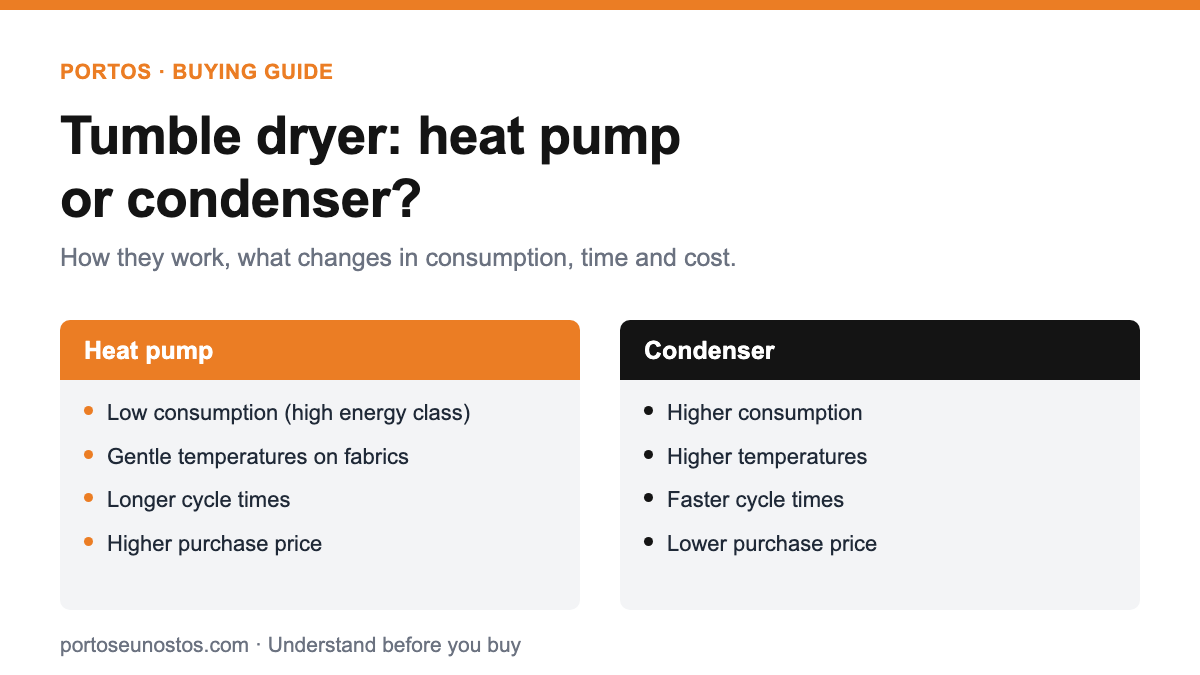
Heat pump and condensation compared: consumption, gentleness on fabrics, times and purchase price.
The short answer
If you use the dryer regularly — multiple loads a week, large family, little space for hanging — a heat pump is almost always the most sensible choice: the concrete advantage is a much lower electricity bill and clothes treated at mild temperatures. Plan for a higher purchase price and cycles that are generally longer.
If instead you'd use it rarely, as a supplement to hang-drying in humid months, and want to keep the initial cost down, a condensation model is more than sufficient: it costs less upfront and is faster. The main limitation is electrical consumption, which over many cycles a year adds up noticeably.
At a glance: what you'll find in this guide
Three technologies, not two
Before comparing heat pump and condensation, it's worth clarifying that dryers fall into three categories:
Exhaust (or vented). These are the oldest: they blow humid air out through a tube, which requires a hole to the outside. Today they've almost disappeared from the market because they're impractical and energy-hungry.
Condenser. They transform moisture into water collected in a tank (or drained directly). No hole in the wall is needed.
Heat pump. These are an evolution of condensation: they recover heat instead of dispersing it, greatly reducing consumption. Again, no tube to the outside.
In practice, today's purchase comparison is almost always between the latter two. For this reason we focus on them.
The heat pump: how it really works
The heat pump uses a refrigeration circuit similar in principle to that of an air conditioner or refrigerator. Hot air passes through the drum, picks up moisture from the clothes, then is cooled to condense the water and finally reheated and recirculated. Heat, in other words, is not thrown away at each step but reused.
The concrete advantage is twofold: much less energy is consumed and it works at lower temperatures, usually around 40-50°C. The moisture goes into a tank to empty (or, if provided, into a fixed drain). The main limitation is the higher purchase price and cycles that tend to be longer, because mild temperature dries more gradually.
Condensation: how it really works
In a traditional condenser dryer an electric heater heats the air that passes through the laundry; the humid air is then cooled and the moisture condenses into water, collected in the tank. It's the same result as a heat pump, but without heat recovery: the energy used for heating is largely dispersed.
This results in two characteristics opposite to the heat pump: higher working temperatures and often faster cycles, but significantly higher electrical consumption. It's indicated especially for those looking for the lowest purchase cost and use the appliance infrequently.
Consumption, energy label and costs
This is where the two technologies differ most. With the same load, a heat pump can consume significantly less electricity compared to traditional condensation: independent estimates indicate, roughly, reductions of up to about 60% of electricity. Over many cycles a year, the difference in your bill becomes important and, over time, offsets the higher purchase price.
To objectively compare models, look at the energy label. From July 1st, 2025, with Regulation (EU) 2023/2533, dryers will also adopt the new A to G scale instead of the old A+, A++ and A+++ classes. Watch out for one point that causes confusion: a model previously labeled A+++ may now fall into class C or D without becoming less efficient — it's the scale that is more stringent, to leave room for future innovations.
On the label, consumption is shown in kWh per 100 cycles, calculated based on the ECO program: use that value to compare two models, not your feelings. The ECO program, by the way, is now a mandatory benchmark of the new regulation. To understand how to translate the class into euros in your case, it's useful to first read how to read the energy label of appliances and our in-depth analysis on how much a washing machine consumes, with the same method applicable to the dryer.
Drying times and fabric care
The lower temperature of the heat pump has two opposite consequences. On one hand, it extends drying times: a cycle can take longer compared to condensation, which heats more and dries faster. On the other hand, it treats your clothes more delicately, reducing thermal stress on cotton, synthetics and delicate fibers. If you have many technical or delicate items, it's an advantage that counts.
Condensation, by contrast, gives you your laundry ready sooner, but with higher temperatures it's less suitable for heat-sensitive fabrics. In both cases, a practical rule applies: spin well in the washing machine before drying to shorten times and reduce consumption, because the dryer has to remove less water.
When a heat pump makes sense
It makes sense to buy one if you recognize yourself in these cases:
you use the dryer often, with multiple loads per week;
you want to keep your electricity bill under control and think about cost over time, not just the initial price;
you dry delicate or technical items and prefer mild temperatures;
you don't have an outlet for venting and are looking for an appliance you can place freely.
The concrete advantage is energy savings cycle after cycle; the main limitation is the higher purchase cost and longer times.
When condensation makes sense
It's especially suitable for those who:
would use the dryer occasionally, as help during humid months;
want to keep initial spending down;
prioritize cycle speed over consumption.
However, there are more appropriate alternatives when usage is intensive: in that case the lower purchase price is quickly eaten away by consumption, and the heat pump becomes the more rational choice again.
What capacity and space you need
Choose capacity in line with your washing machine: if you wash loads of 7-8 kg, a dryer with similar capacity avoids having to dry in two batches. The reasoning is the same as we use for laundry: you can start from our guide on which washing machine capacity to choose and on how to choose a washing machine, applying the same criteria to the dryer.
On the space front, remember that neither condensation nor heat pump require a vent hole to the outside: you can also place them where a vent doesn't reach. If you have little space, consider the stacked solution (dryer above the washing machine with appropriate kit) or washer-dryer models, keeping in mind that the latter are a compromise and do not replace two dedicated machines.
Mistakes to avoid
Looking only at the purchase price. With a heat pump the initial cost is higher, but the real account is calculated on consumption over years of use.
Comparing energy class between old and new label. After July 2025 the A-G classes are not comparable to the old A+++: compare only labels of the same type, preferably in kWh/100 cycles.
Neglecting spin speed. Well-wrung laundry in the washing machine reduces drying time and consumption, regardless of technology.
Forgetting maintenance. Filters and condenser should be cleaned regularly: if neglected, consumption and times increase and performance drops.
Choosing based on technology alone. Capacity, programs, noise level and humidity sensors also matter: the heat pump is one criterion, not the only one.
Portos' choice
In Portos' assessment we start from habits, not from the data sheet. If the dryer becomes part of your weekly routine, the heat pump almost always repays the extra expense with years of low consumption and gentler treatment of your clothes. If instead it's an occasional help and initial budget is the priority, a good condensation model does its job, provided you know it asks more in terms of consumption.
The practical advice is not to let technology alone decide: first identify the capacity and space you need, then, within that range, read the label in kWh/100 cycles and choose the most efficient model that fits your budget. This way you avoid both paying for features you won't use and ending up with a higher-than-expected electricity bill.
Sources
Regulation (EU) 2023/2533 of the Commission, energy labeling of tumble dryers (new A-G scale in effect from July 1, 2025; consumption in kWh/100 cycles on the ECO program).
Altroconsumo — New energy label for tumble dryers (timing and criteria of the new label).
Technical documentation from tumble dryer manufacturers regarding heat pump and condensation operation; consumption values, temperature and times are indicative and vary by model and program.
Technology chosen, everything else remains: capacity, class, cycle duration, noise and centimeters to measure. The complete path is in how to choose a tumble dryer, with declared data from eight real models.
Technology chosen, size remains: eight or nine kilos affect your bill much less than the energy class, but they decide how many cycles you run in a week. The numbers are in tumble dryer 8 or 9 kg: which one to really choose.
How much is technology worth on your bill: we put the declared consumption of eleven models in an annual cost grid, crossed with five real usage habits. You'll find it in how much it costs to use a tumble dryer in a year.