The Bosch WQB245B0IT is a top-tier 9 kg heat pump tumble dryer: 1.10 kWh per cycle, 74.53 euros of energy a year and a condenser that needs no manual cleaning. Its EU information sheet, reissued in September 2026, carries for the first time the repairability index that becomes mandatory on the label from 1 January 2027. An analysis of the declared figures, the limits and the real alternatives in the catalogue.
The Bosch WQB245B0IT is a 9 kg freestanding heat pump tumble dryer sold as a Series 8, the top of the range. On OpportunityCommerce it costs 930.00 euros as of 5 October 2026, 71 per cent more than the 8 kg Series 4 from the same manufacturer. So there is really only one question: what do those 386 euros of difference buy.
The answer is not on the electricity bill. It is in four legal thresholds this model sits right on, in a new field that will appear on every label from 2027, and in a maintenance detail that changes daily life for anyone who dries three times a week. Every figure in this analysis comes from the model's EU product information sheet, reissued on 21 September 2026, and from the official Bosch product page. Portos has not physically tested the machine.
| Product | |
|---|---|
| Type | Heat pump tumble dryer, freestanding |
| Rated capacity | 9.0 kg (eco programme) |
| Energy class | C (energy efficiency index 60.0) |
| Energy per cycle | 1.10 kWh, weighted eco programme |
| Noise | 61 dB(A), class B |
| Dimensions | 84.2 x 59.8 x 61.3 cm (height x width x depth) |
| Repairability | Class A, index 9.43 |
| Price observed | 930.00 euros, 5 October 2026 |
| Verified on | 5 October 2026 |
In short
It dries 9 kg using 1.10 kWh in 3 hours and 15 minutes, costs 74.53 euros a year in energy at three cycles a week and has a self-cleaning condenser, which is the biggest practical difference from the Series 4. You do not buy it to save on the bill: for the same amount of laundry, over ten years it still costs more than the 544-euro model. You buy it for the extra kilo, the 2 dB less, the class B condensation and for never having to rinse a condenser by hand.
What this analysis covers
What it actually offers
It is a heat pump dryer with R290 refrigerant, 59.8 cm wide and 61.3 cm deep, which becomes 110.5 cm with the door open at 90 degrees: that is the figure to measure before buying, because in a narrow utility room it is what blocks the passage, not the closed depth. It weighs 56.7 kg, has feet adjustable up to 15 mm and a 145 cm power cable.
The equipment declared by the manufacturer includes the self-cleaning condenser, Home Connect Wi-Fi with remote diagnostics, SmartDry, which receives the data of the last wash from the washing machine and suggests the drying programme, AutoDry with humidity sensors, the extra basket for wool and trainers, two-way drum rotation, interior lighting, a clogged filter and full tank indicator, the Super40 quick programme and the option of stacking it on the washing machine. The door hinge is reversible.
What is missing, and it is fair to say so: there is no steam anti-crease programme, no dedicated duvet programme, no manual drying time selection and the worktop is not removable.
The four thresholds this model sits on
This is the most interesting figure in the whole analysis, and you cannot see it by looking at the label. Delegated Regulation (EU) 2023/2534 sets three fixed-threshold scales for tumble dryers, and a fourth regulation added one more in 2025. The WQB245B0IT sits on the edge of all four.
| Parameter | Declared value | Legal threshold | Distance |
|---|---|---|---|
| Energy efficiency index | 60.0 (class C) | class C ends at 60.0, then it is D | exactly the ceiling |
| Condensation efficiency | 88 per cent (class B) | class B starts at 88 | exactly the floor |
| Noise | 61 dB(A) (class B) | class A ends at 60 dB(A) | 1 decibel |
| Repairability index | 9.43 (class A) | class A starts at 9.00 | 0.43 points |
It is neither a coincidence nor a flaw: it is how an appliance gets designed when classes come in steps. You tune the product just inside the band you want to declare, because every extra tenth costs components. We found the same pattern on fridges, where five models out of six declared an identical index of 100.0, that is the exact limit of class E.
The practical consequence for a buyer is twofold. On one hand the C is real, not generous: one tenth more and it would be a D, like the 725-euro Series 4. On the other hand the class does not say how much the appliance actually uses, because the index is a ratio: to know the spend you have to look at the kilowatt-hours, which is the next section.
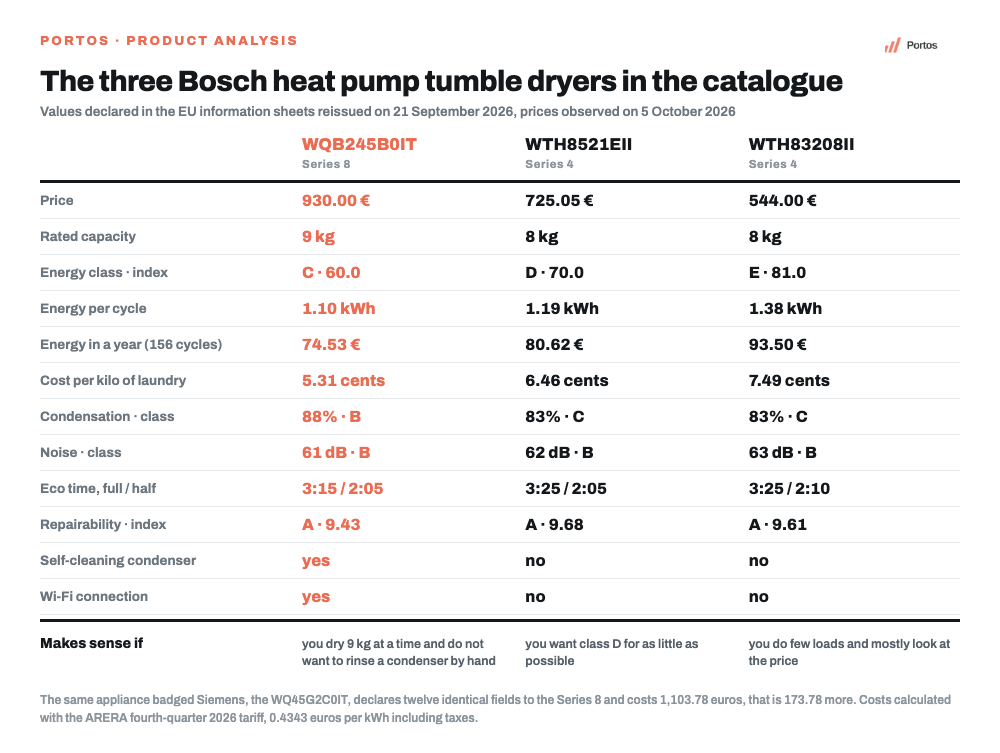
The three Bosch models in the catalogue on 5 October 2026: the most expensive one is not the most efficient per euro spent.
Consumption and real running cost
The sheet declares 1.10 kWh per cycle on the eco programme at full load, a value weighted between full and half load. Since 1 October 2026 the ARERA tariff for vulnerable customers on the regulated service is 0.4343 euros per kWh, taxes included: that is the price we use in every Portos calculation until it changes.
| Use | Cycles a year | Energy | Annual cost |
|---|---|---|---|
| 2 cycles a week | 104 | 114.4 kWh | 49.68 euros |
| 3 cycles a week | 156 | 171.6 kWh | 74.53 euros |
| 5 cycles a week | 260 | 286.0 kWh | 124.21 euros |
A single full cycle costs 47.8 cents, that is 5.31 cents for every kilo of laundry dried. Over ten years, at three cycles a week, the energy is worth 745.26 euros: 80 per cent of the purchase price. This is not an appliance that pays for itself, it is an appliance that adds to the bill for its whole life, which is why the difference in consumption against a cheaper model has to be calculated, not imagined.
There is one item almost nobody considers. The sheet declares 2.00 W of networked standby: that is what the machine uses while it stays connected to the Wi-Fi. If the Home Connect link is always on, that is 17.52 kWh a year, meaning 7.61 euros, 10.2 per cent of what drying costs. Off mode, by contrast, is 0.30 W, barely one euro a year: irrelevant. If the connection is of no use to you, switching it off is the only free saving available on this machine.
The new field on the label: repairability
The product information sheet for this model, in the version reissued on 21 September 2026, contains a section that did not exist until recently: repairability information. It declares class A and an index of 9.43, broken down into four scores: disassembly depth 9.18, type of fasteners 9.11, type of tools 10.00, repair information 10.00.
Those figures come from Delegated Regulation (EU) 2025/1353, which amended 2023/2534 precisely to add them. The index is calculated by aggregating the scores across eight priority parts: water pump, drum bearing, drum belt, door, motor, main printed circuit board, fan and motor capacitor. If a part is present more than once, the one with the worst score counts. The class scale is this:
| Repairability class | Index R |
|---|---|
| A (highest repairability) | R above 9.00 |
| B | from 7.00 to 9.00 |
| C | from 5.00 to 7.00 |
| D | from 3.00 to 5.00 |
| E (lowest repairability) | R below 3.00 |
The score becomes mandatory on the label of every tumble dryer placed on the market from 1 January 2027. The regulation explicitly allows suppliers to bring it forward, and that is what BSH did by reissuing its sheets in September 2026. It means that between now and Christmas you will see labels in shops with and without the score: its absence does not mean the appliance cannot be repaired, it means the sheet is the previous version.
Two observations are worth making, because they are not the ones you would expect. First: on this model the two full scores are the ones that depend on documentation and tools, that is on company choices, while points are lost on disassembly depth and the type of screws, that is on the mechanical design. Second: among the three Bosch models in the catalogue, the Series 8 has the lowest index. The 725-euro Series 4 declares 9.68 and the 544-euro one 9.61, both class A like the Series 8. More technology on board means more parts to remove before you reach the priority ones.
Ecodesign Regulation (EU) 2023/2533 also requires the supplier to publish the list of spare parts and their indicative pre-tax prices. BSH does this in a single document covering all the group's tumble dryers, updated on 30 June 2025, which lists component by component what stays available: gaskets and seals, knobs, condensate pump, motors and brushes, belts, fans, drums and bearings, piping, cabling, circuit boards, doors and hinges, filters and the condensate tank. It is a boring document and it is worth more than many reviews: it tells you what you will be able to replace six years from now.
Performance and declared times
The eco programme at full load takes 3 hours and 15 minutes. At half load it drops to 2 hours and 5 minutes, that is 64 per cent of the full time and not half of it. This is why two half loads always cost more than one full load, in time and in energy: the heat pump has a warm-up phase that is paid once per cycle, regardless of how much laundry is inside.
Anyone coming from a conventional condenser dryer has to factor in these times. It is not a flaw of this model: it is the trade-off of the heat pump, which works at lower temperatures to use less energy and therefore takes longer. The full comparison between the two technologies is in heat pump dryer or condenser.
Condensation: how much water stays in the room
The declared condensation efficiency is 88 per cent, class B. It means 88 per cent of the water taken out of the laundry ends up in the tank or the drain, and the rest leaves the appliance as vapour into the air of the room.
One concrete number helps. A full 9 kg load comes out of the washing machine with roughly 51 per cent residual moisture, that is just under 4.6 kg of water: at 88 per cent condensation, around 0.56 kg per cycle stays in the room. The Series 4, which declares 83 per cent on an 8 kg load, leaves around 0.70 kg. The difference is half a glass of water, and it sounds like nothing, but in a windowless bathroom or a utility cupboard, multiplied by three cycles a week, it is exactly what separates a dry wall from one with mould in the corner.
The regulatory context is worth stating too: the 2023 ecodesign regulation raised the mandatory minimum condensation efficiency from 70 to 80 per cent. The 83 per cent of the Series 4 is not a poor figure, it is three points above the legal requirement. The 88 per cent of the Series 8 is the minimum to get into class B.
Noise
61 dB(A) on the eco programme at full load, class B. The regulation's scale puts everything at 60 dB(A) or below into class A: this model misses it by one decibel. Across the three Bosch models in the catalogue the spread is narrow, 61, 62 and 63 dB(A), all in class B.
It matters if the machine sits in a room next to a bedroom, or if you run it at night on an evening tariff. It matters almost not at all if it lives in a garage or a laundry room. One decibel of difference cannot be heard; three can, but they stay inside the same class.
Ease of use
The controls are mixed: a dial for programmes, touch keys for options and the Home Connect app for the rest. The official page lists thirteen items between programmes and options: cotton and eco cotton, synthetics, mixed, shirts, sheets, towels, sportswear, delicates, wool with the basket, the 40-minute quick cycle and the timed programme. AutoDry manages the drying level with humidity sensors, delayed start is available and the add-laundry function lets you open the door mid-cycle.
SmartDry is the most interesting part of the connected package, because it is the only one that does something concrete: a connected Bosch washing machine passes on the data of the last wash and the dryer suggests the matching programme. It only makes sense if the washing machine is in the same family and connected to the Wi-Fi: otherwise it stays a feature paid for and never used, and in that case the Series 4 deserves a look.
Maintenance
This is where the biggest practical difference between this model and the tier below lies, and it appears in no energy class. The WQB245B0IT has a self-cleaning condenser: the manufacturer states that it requires no manual cleaning and is washed automatically during drying. The two Series 4 models in the catalogue do not have it, and on those the condenser has to be pulled out and rinsed by hand, typically every few weeks depending on use.
Anyone who has owned a heat pump dryer with a manual condenser knows this is the job you put off, and that when you put it off too long drying times get longer and consumption rises. The rest of the maintenance is identical on every model: the lint filter to clean at or near every cycle (there is a clogged filter indicator), the condensate tank to empty, or a direct drain hose, which is the option to prefer whenever the connection is possible because it removes the job entirely.
Strong points
9 kg in the same footprint as the 8 kg models: the cabinet is identical, only the drum changes.
Self-cleaning condenser, that is one periodic maintenance job fewer.
Class B condensation: less moisture released into the room.
Class A repairability with full marks on tools and repair information.
5.31 cents per kilo of laundry against 7.49 for the entry model.
Ready for stacking on the washing machine, with a reversible door hinge.
Limits
The price does not pay for itself in energy: the full calculation is in the alternatives section.
Efficiency index 60.0, that is the exact limit of class C: this is not a record-breaking machine on consumption.
61 dB(A), one decibel outside the class A noise band.
Networked standby costs 7.61 euros a year if the Wi-Fi stays connected all the time.
A repairability index lower than both Series 4 models from the same brand.
3 hours and 15 minutes at full load: anyone in a hurry has to use programmes other than eco, with figures other than the declared ones.
110.5 cm of clearance with the door open: check it before buying.
Who we recommend it to
To a household of four or five people doing at least three loads a week and owning a 9 kg washing machine: in that case the dryer's 9 kg genuinely matter, because the rated capacity of the two appliances is measured in the same unit and a dryer smaller than the washer forces you to split every load in two.
To anyone installing it in a small, poorly ventilated room, where class B condensation and the five percentage points over the Series 4 are the real reason to buy.
To anyone who hates periodic maintenance and would rather pay once not to have a condenser to rinse.
To anyone who already owns a connected Bosch washing machine and will genuinely use SmartDry.
Who we do not recommend it to
To anyone after the lowest possible consumption: within class C there are models with an index of 52.0 and 0.95 kWh per cycle, that is 64.36 euros a year instead of 74.53. As of 5 October 2026 the Bosch WQB246D0IT, which declares exactly those figures and 57 dB(A) in noise class A as well, is not listed in the OpportunityCommerce catalogue: it is a documentary reference, not a purchase you can make today.
To anyone doing one or two loads a week. At 104 cycles a year the energy difference against the 544-euro model is worth 12.65 euros: the premium has no chance of being recovered.
To anyone living alone or as a couple who will never fill 9 kg. Two half loads cost more than one full load, so an oversized machine almost always works at its worst point.
To anyone who will never connect the Wi-Fi: a sizeable part of what separates the Series 8 from the Series 4 is the connected package.
Real alternatives in the catalogue
These are the three concrete alternatives, verified in the catalogue on 5 October 2026, with prices observed the same day. Consumption figures come from their respective EU information sheets.
| Model | Price | Capacity | Class and index | kWh per cycle | Energy in a year |
|---|---|---|---|---|---|
| Bosch WQB245B0IT, Series 8 | 930.00 euros | 9 kg | C, 60.0 | 1.10 | 74.53 euros |
| Bosch WTH8521EII, Series 4 | 725.05 euros | 8 kg | D, 70.0 | 1.19 | 80.62 euros |
| Bosch WTH83208II, Series 4 | 544.00 euros | 8 kg | E, 81.0 | 1.38 | 93.50 euros |
| Siemens WQ45G2C0IT | 1,103.78 euros | 9 kg | C, 60.0 | 1.10 | 74.53 euros |
Against the 544-euro Series 4
The price difference is 386 euros. At the same number of cycles the Series 8 saves 18.97 euros a year: 20 years to break even. But the correct comparison is not at the same number of cycles, it is at the same amount of laundry: 156 full 9 kg loads are 1,404 kg a year, which an 8 kg machine gets through in 175.5 cycles, that is 105.18 euros of energy against 74.53. The saving becomes 30.65 euros a year and the payback 12.6 years. Over ten years the total, purchase plus energy, is 1,675.30 euros for the Series 8 and 1,595.80 for the Series 4: the 544-euro machine stays 79.50 euros cheaper even counting everything.
This is the honest point of the analysis: the Series 8 is not justified by the bill. It is justified by the extra kilo, the self-cleaning condenser, class B condensation, the 2 dB less and the Wi-Fi. If those four things are of no use to you, the 386 euros have no economic justification.
Against the 725-euro Series 4
Here the price jump is 204.95 euros for 6.09 euros a year of energy saved. On consumption alone it is the weaker of the two comparisons. It only makes sense for someone who wants the 9 kg and the self-cleaning condenser while spending as little as possible to get them.
The Siemens twin
The Siemens WQ45G2C0IT, also in the catalogue, declares exactly the same values in its EU information sheet: 9 kg, index 60.0, class C, 88 per cent condensation in class B, 61 dB(A), 3:15 and 2:05 programme times, 1.10 kWh, repairability 9.43 in class A. Twelve fields out of twelve match, because Bosch and Siemens belong to the same group and in more than one case share the platform. It costs 1,103.78 euros, that is 173.78 euros more, 18.7 per cent. Anyone who prefers the Siemens styling already knows it; anyone looking at the numbers has no reason to pay for it.
The Portos assessment
It is a well-built and well-documented machine, but one that lives on the border: class C by a tenth, condensation B by a point, noise class B by a decibel. Its value is not in efficiency, where it sits at the bottom of its own class, but in the bundle of things that take effort away: a real 9 kg, a self-cleaning condenser, less moisture in the room, good declared repairability.
The verdict therefore depends on one question, and it is not the one about consumption: how much laundry actually gets dried in a week. Above three loads, and with a 9 kg washing machine next to it, the 930 euros are well spent. Below two loads, the same money buys a machine that will almost always run at half load, that is in the condition where it is least efficient.
To frame the choice before picking a model we suggest the guide how to choose a tumble dryer, and for the capacity question the comparison clothes dryer 8 or 9 kg. The full calculation of what it costs to run one for a year, with habits in place of classes, is in how much it costs to use a tumble dryer in a year.
Price and availability
The price observed on 5 October 2026 is 930.00 euros, in stock. Appliance prices move week by week: in ten days, on a fridge from the same catalogue, we saw a 14 per cent swing. It is always worth checking again before deciding.
Check the specifications and availability of the WQB245B0IT on OpportunityCommerce, or compare offers on Bosch Series 8 tumble dryers on SniffaPrezzi. The whole category is on OpportunityCommerce, tumble dryers.
Documentation
Sources
Product information sheet, Delegated Regulation (EU) 2023/2534, model WQB245B0IT, version of 21 September 2026. Same sheets for the WTH8521EII, WTH83208II and Siemens WQ45G2C0IT.
Delegated Regulation (EU) 2023/2534, Annex II, tables 1, 2 and 3: energy efficiency, noise and condensation classes.
Delegated Regulation (EU) 2025/1353: repairability index and class, priority parts, mandatory on the label from 1 January 2027.
Regulation (EU) 2023/2533: ecodesign requirements, minimum condensation efficiency at 80 per cent, obligations on spare parts and repair information.
ARERA, fourth quarter 2026 press release: 0.4343 euros per kWh, taxes included.
EPREL, the European product database for energy labelling.
Prices and availability observed on OpportunityCommerce and SniffaPrezzi on 5 October 2026.
This is a Portos editorial assessment based on manufacturer documentation, EU information sheets and current regulation. The product has not been physically tested.