The three built-in washing machines from the BSH group on sale all declare exactly the same efficiency index, 68.6, which means class C, and all three stop at 8 kg. The six freestanding models from the same brands are all in class A, and the best one uses less than half the energy.
We read nine EU product fiches and surveyed the catalogue: the cabinet door costs around 612 euros over ten years, a class and a half of efficiency and the option of stacking a dryer. In exchange it gives ten decibels less during the wash, the largest gap in the whole comparison.
A built-in washing machine and a freestanding one are not the same appliance in two different outfits. They are two different designs, and the difference shows up in the figures declared by the manufacturer long before it shows up in your home.
As of 28 September 2026, the three built-in washing machines from the BSH group in the catalogue we examined all declare exactly the same energy efficiency index, 68.6, which means class C, and all three stop at 8 kg. The six freestanding models from the same two brands are all in class A, and one of them reaches 9 kg while using less than half the energy.
That does not make the built-in a bad choice. It means the cabinet door has a price you can put a number on, and a benefit you can measure: ten decibels less during the wash. Let us look at both sides of the ledger.
The answer in one line. Choose built-in only if the machine has to sit in a kitchen or a bathroom that is on show and quietness matters more than anything else: it costs around 600 euros more over ten years, gives up a class and a half of efficiency and rules out stacking a dryer on top. In every other case, freestanding wins across the board.
In short: what this guide covers
Installation type is a field on the label, not a furnishing choice
Why built-in loses a class and a half: the 48 degrees of the eco programme
In the built-in segment the badge weighs more than the technology
Installation type is a field on the label, not a furnishing choice
It is worth starting here, because it is the point almost nobody makes. The product information sheet required by Commission Delegated Regulation (EU) 2019/2014, the one that governs the energy label of washing machines, contains an entry called Type, and only two values are allowed: built-in or freestanding.
This is not marketing copy written by the retailer. It is a regulated field, declared by the manufacturer under its own responsibility and filed in the European product database. When you read Built-in on that line, you are reading a legally binding declaration.
The practical consequence is that the comparison between the two families can be made properly, field by field, without depending on what the shop's catalogue says. And when you do that, a regularity emerges that we did not expect to be so clear-cut.
The catalogue: eleven built-in models against sixty-four
Before consumption there is a problem of choice. On 28 September 2026 we surveyed the washing machine catalogue of an Italian general retailer, OpportunityCommerce, separating the two families.
Fully integrated, that is built-in, machines numbered 11. Freestanding machines, including slim versions, numbered 64. Almost six to one.
The eleven built-in models are spread across nine different brands, with one or two references each: Bosch, Siemens, AEG, Electrolux, Smeg, Beko, Candy, De Longhi. All 60 cm wide. There are no slim built-in versions, no larger sizes, no colour variants: the cabinet door covers them all.
That alone is useful to the decision. In the built-in segment you do not choose between ten alternatives weighing price, class and capacity: you choose between very few references, and often the real constraint is which of them your retailer happens to have in stock.
The three built-in machines declare exactly the same index
We downloaded and read the EU product fiches of the three built-in models from the BSH group in the catalogue: Bosch WIW24342EU, Bosch WIW28542EU and Siemens WI14W542EU. These are the three for which official technical documentation is accessible and comparable line by line.
The outcome is more uniform than we expected. All three declare:
an energy efficiency index of IEEW 68.6, that is class C;
0.624 kWh per cycle on the eco 40-60 programme, or 62 kWh per 100 cycles;
45 litres of water per cycle;
a rated capacity of 8.0 kg;
a maximum temperature inside the textiles of 48 degrees;
an eco programme duration of 3 hours 26 minutes;
spin-phase noise of 66 dB(A);
dimensions of 82 x 60 x 54 cm.
The only differences between the three are the spin speed (1200 rpm on the WIW24342EU, 1400 on the other two) and, as a result, the residual moisture. On everything else the three fiches are interchangeable.
One detail makes the figure even more telling. The thresholds in Regulation 2019/2014 set class C between 60 and 69 inclusive, and class D from 69 upwards. An index of 68.6 sits four tenths away from class D: this is not a comfortable class C, it is the very edge of class C.
Nine models compared, figure by figure
Alongside the three built-in models we placed six freestanding models from the same two brands, taken from the catalogue on the same day. Every value comes from the manufacturers' EU product fiches, not from retailers' commercial sheets.
| Model | Type | kg | IEEW | Class | kWh/cycle | Litres | rpm | dB | Eco time | Price 28/09 |
|---|---|---|---|---|---|---|---|---|---|---|
| Bosch WIW24342EU | Built-in | 8.0 | 68.6 | C | 0.624 | 45 | 1200 | 66 | 3:26 | €832.89 |
| Bosch WIW28542EU | Built-in | 8.0 | 68.6 | C | 0.624 | 45 | 1400 | 66 | 3:26 | €1,085.34 |
| Siemens WI14W542EU | Built-in | 8.0 | 68.6 | C | 0.624 | 45 | 1400 | 66 | 3:26 | €1,362.43 |
| Bosch WGE03200IT | Freestanding | 8.0 | 50.7 | A | 0.461 | 47 | 1200 | 71 | 3:33 | €544.00 |
| Bosch WAN282E8IT | Freestanding | 8.0 | 50.7 | A | 0.461 | 47 | 1400 | 71 | 3:33 | €607.15 |
| Siemens WU14UT48IT | Freestanding | 8.0 | 50.7 | A | 0.461 | 47 | 1400 | 70 | 3:33 | €811.15 |
| Bosch WGG244ZRIT | Freestanding | 9.0 | 51.4 | A | 0.489 | 50 | 1351 | 70 | 3:48 | €779.00 |
| Siemens WG44G2ZIT | Freestanding | 9.0 | 51.4 | A | 0.489 | 50 | 1351 | 70 | 3:48 | €869.43 |
| Bosch WGB24402IT | Freestanding | 9.0 | 26.1 | A | 0.248 | 47 | 1400 | 71 | 3:40 | €1,192.00 |
Read column by column, the table says one thing: the two families do not overlap. No built-in model comes anywhere near class A, and no freestanding model drops to class C. The most instructive row is the last one: the WGB24402IT declares 0.248 kWh per cycle, that is less than half the 0.624 kWh declared by all three built-in machines, and with a kilo more of load.
Put in comparable units: the built-in uses 78.0 Wh per kilo of laundry, the 8 kg freestanding models 57.6 Wh, and the 9 kg Series 8 27.6 Wh. The best freestanding model uses less than a third of the energy per kilo of the best built-in one.
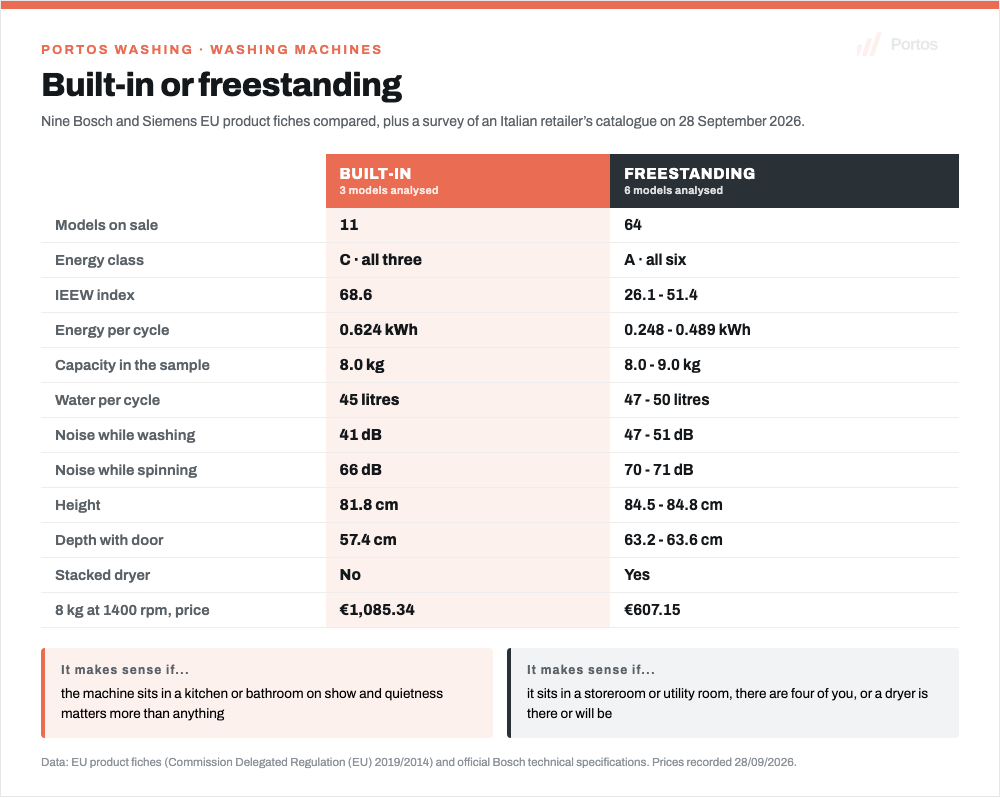
Twelve parameters compared: on the left the three built-in machines analysed, on the right the six freestanding ones from the same two brands.
Why built-in loses a class and a half: the 48 degrees of the eco programme
The EU product fiche contains a field that almost never makes it onto commercial sheets and that explains nearly everything: the maximum temperature reached inside the textiles during the eco 40-60 programme.
Here is how it lines up across the nine models, ordered by index:
| Model | IEEW | Temperature in the textiles |
|---|---|---|
| Bosch WGB24402IT | 26.1 | 27 °C |
| Bosch WGE03200IT | 50.7 | 36 °C |
| Bosch WAN282E8IT, Siemens WU14UT48IT | 50.7 | 37 °C |
| Bosch WGG244ZRIT, Siemens WG44G2ZIT | 51.4 | 38 °C |
| The three built-in models | 68.6 | 48 °C |
The relationship is monotonic: the worse the index, the higher the temperature. This is not a coincidence, it is the physical mechanism. Heating water is by far the biggest item in a washing machine's consumption; efficient machines make up for a low temperature with time and with the mechanics of the drum.
Here, though, the paradox closes in on itself. The eco programme of the built-in machines lasts 3 hours 26 minutes, that is the shortest of the nine: shorter than the 3:33 of the 8 kg freestanding models, shorter than the 3:40 of the Series 8, shorter than the 3:48 of the 9 kg Series 6. The least efficient machine is also the one given the least time to be efficient, so it has to heat more.
Why not give it more time? Because efficiency in a washing machine is bought mainly with drum volume and with mass: a larger drum moves the laundry with less water, and more generous counterweights and dampers allow longer cycles without vibration. Under a worktop, with 3 centimetres less in height and 5 less in depth, that volume is not there. The designer makes up for it with temperature, and the class drops.
Capacity stops at 8 kg, and that is no accident
All three built-in machines we analysed declare 8.0 kg. None of the eleven in the catalogue, from any brand, is offered in a larger size. On the freestanding side, by contrast, 9 kg is the norm in mid-range series and the catalogue comfortably reaches 10 and 11 kg.
The reason is the same as before, and it is geometric. The body of a built-in machine has to fit within 81.8 cm of height and 54.4 cm of depth against 84.5-84.8 and 59.0 for a freestanding one. That is about 3 centimetres in height and 4.6 in depth: on a cylinder, those centimetres count for far more than they seem, because volume grows with the square of the radius.
The practical consequence deserves to be stated plainly, because it is the real risk in this choice. If there are four of you at home and you run full loads, 8 kg can mean one extra cycle a week compared with 9 kg. In that case the energy saved per cycle counts for nothing: what counts is the number of cycles. We have written a dedicated guide on choosing between 8, 9 and 10 kg, and it is worth reading before settling on the cabinet door.
What built-in gains: 41 dB during the wash
So far built-in has lost on everything. Here is where it wins, and wins clearly.
The energy label only declares the noise of the spin phase, and even there the gap is visible: 66 dB(A) for the three built-in models against 70-71 dB(A) for the six freestanding ones. Five decibels less means, in sound power, a little over one third.
But the interesting figure is another one, and it sits in the manufacturer's technical sheets rather than on the label: the noise during the wash phase, that is what you hear for three hours out of three and a half.
| Model | Wash | Spin |
|---|---|---|
| Bosch WIW24342EU and WIW28542EU (built-in) | 41 dB | 66 dB |
| Bosch WGB24402IT (Series 8) | 47 dB | 71 dB |
| Bosch WAN282E8IT and WGG244ZRIT | 50 dB | 70-71 dB |
| Bosch WGE03200IT (Series 2) | 51 dB | 71 dB |
41 dB against 51 is ten decibels, that is one tenth of the sound power. It is the largest gap in the whole comparison, in either direction. And these are figures declared with the appliance bare: the cabinet door comes on top of that.
Where does it come from? From weight. The WIW24342EU declares 76.1 kg empty, against 67.9 kg for the freestanding Series 4 of the same capacity: 8.2 kg more of counterweights and insulation on a smaller machine. That weight does not help it wash better. It helps it stay still and quiet inside a cabinet, where a vibration becomes a noise that resonates through the whole kitchen.
One honest note on the noise class: the regulation sets class A below 73 dB. Both the 66 dB of the built-in machines and the 71 dB of the freestanding ones are all class A. In this case the letter on the label is no help in deciding: you have to look at the decibels.
The measurements that matter: 81.8 cm high and 54.4 cm deep
If you are considering built-in because of a space constraint, these are the numbers that really count, all declared by Bosch for the WIW24342EU and for the freestanding models compared.
| Measurement | Built-in | Freestanding |
|---|---|---|
| Height | 81.8 cm | 84.5-84.8 cm |
| Width | 59.6 cm | 59.8 cm |
| Depth without door | 54.4 cm | 59.0 cm |
| Depth with door | 57.4 cm | 63.2-63.6 cm |
| Footprint with door open at 90° | 95.6 cm | 104.9-109.0 cm |
| Power cable length | 210 cm | 160 cm |
The 81.8 cm of height is the whole reason this category exists: it is what lets the appliance slide under a continuous worktop and lets the run of cabinet doors close without a break. A freestanding machine 84.5-84.8 cm tall simply does not fit under a standard worktop.
The other two interesting numbers are at the bottom. The footprint with the door open drops from about 105 to 95.6 cm: that is nearly ten centimetres less clearance needed in front of the machine, and in a narrow bathroom it is the difference between loading comfortably and dancing around it. And the cable goes from 160 to 210 cm, because the appliance ends up inside a cabinet and the socket is usually further away.
The technical sheet of the built-in model adds two entries the others do not have: reversible cabinet-door hinges and a base adjustable up to 15 cm in height and 6.5 cm in depth. These are the adjusters that align the door with the rest of the kitchen. If your recess is not perfectly square, they are what saves the installation.
What the door takes away: the stacked dryer
There is one entry in Bosch's official specifications that deserves a section of its own: stacked installation. On the built-in models the declared value is No. On all six freestanding models it is Yes, with the wording «stacked installation using a stacking kit compatible with the dryer».
This is not a technical detail. It is a door closing. Under a worktop, with 81.8 cm of available height, stacking a dryer is impossible, and the catalogue confirms it: in the same survey of 28 September 2026 we found not a single fully integrated built-in tumble dryer. Built-in washer-dryers exist, washing and drying in the same drum, but separate dryers do not.
So if you think you may want to add a dryer in a few years, choosing built-in today leaves you three routes, each with a cost:
put the dryer somewhere else, in another cabinet or another room;
replace the washing machine with a built-in washer-dryer, which dries less laundry than it washes and costs more than a washing machine;
give up on the dryer.
If a dryer is already in the plan, it is worth starting from the right end: we have collected the criteria and the real figures in our guide to choosing a tumble dryer.
What the cabinet door costs over ten years
Now let us put the two items together. The method is stated openly: consumption per cycle from the EU fiche, 260 cycles a year (five washes a week, the rhythm of an average household), energy price €0.3163/kWh, which is the ARERA figure for the third quarter of 2026 for vulnerable customers on the regulated tariff. As of 28 September 2026 the fourth-quarter update had not yet been published. On the free market your own bill applies: if it differs, the figures below scale in proportion.
The fairest comparison is at equal spin speed. Take the two 8 kg, 1400 rpm models, one from each family:
| Item | WIW28542EU (built-in) | WAN282E8IT (freestanding) | Difference |
|---|---|---|---|
| Price recorded 28/09/2026 | €1,085.34 | €607.15 | +€478.19 |
| Energy, 10 years at 260 cycles | €513.17 | €379.12 | +€134.05 |
| Total over ten years | €1,598.51 | €986.27 | +€612.24 |
About 612 euros over ten years, of which 478 are paid on the day of purchase and 134 on the electricity bill. Running the same calculation on the two 1200 rpm models (WIW24342EU against WGE03200IT) the difference falls to 422.94 euros, because the cheapest freestanding model costs 544 euros.
The energy share alone is worth 13.40 euros a year at 260 cycles. At three washes a week it drops to 8.04 euros, at seven it rises to 18.77. Put that way, the bill is not why built-in costs more: most of the difference is the purchase price, and it should be judged for what it is, namely the cost of a niche product built in small numbers.
If you want to redo the sums on your own cycles and tariff, the full method is in how much energy a washing machine uses per cycle and per year.
On water the balance tips the other way
There is one column in the table that runs against all the others, and it would be wrong not to say so.
The three built-in machines declare 45 litres per cycle. The 8 kg freestanding models declare 47, the 9 kg ones 50. At 260 cycles a year that is 520 litres of water less than an 8 kg freestanding machine, and 1,300 litres less than a 9 kg one.
The reason is the same one that penalises consumption: a smaller drum fills with less water. So the design constraint becomes, on the water side, a small advantage. It needs context: half a cubic metre a year, on Italian domestic water tariffs, is a figure of the order of a few euros, and it does not offset the 612 euros above. But it exists, and it is measured.
A second point in favour of built-in is residual moisture. The WIW28542EU at 1400 rpm leaves the laundry at 51.4% moisture, against 53.0% for the WAN282E8IT at the same declared speed. Less water in the laundry means less work for the dryer or the airer, as we showed when calculating what a tumble dryer costs over a year. Curiously, the advantage goes to a machine that cannot have a dryer on top of it.
One built-in model out of three is already discontinued
During our checks we came across a figure that changes the picture. The official Bosch page for the WIW28542EU, the 1400 rpm built-in model, shows «This product is no longer available» in place of the commercial name. The pages of the WIW24342EU and of every freestanding model compared show the product name normally.
The model is still on sale at the retailer for 1,085.34 euros, and that is not wrong in itself: you are buying real stock, not an empty box. But it should be known, because it changes two things.
The first is that there is no guarantee of continuity: if in a year you need the same machine for a second home or as a replacement, it may no longer be there.
The second is more reassuring than people think. Regulation (EU) 2019/2023 on the ecodesign of washing machines requires the manufacturer to make spare parts available for at least ten years from the placing on the market of the last unit of the model, with delivery within fifteen working days. The list is detailed: motors, motor-to-drum transmission, pumps, dampers and springs, drum and bearings, heating elements, hoses and aquastop devices, printed circuit boards, displays, pressure switches, thermostats, sensors and software. End users are also entitled to the door, door hinges and seals, and the detergent dispenser. The warranty declared on the fiche remains 24 months.
Put differently: a discontinued model is not an appliance to avoid, it is an appliance to buy knowing what you are buying. In a segment with eleven references in total, narrowing the field further carries weight.
In the built-in segment the badge weighs more than the technology
One last comparison, worth making because it can be verified line by line.
The EU product fiche of the Siemens WI14W542EU and that of the Bosch WIW28542EU are identical in every field: same capacity, same index of 68.6, same class C, same 0.624 kWh, same 45 litres, same residual moisture of 51.4%, same 1400 rpm, same 66 dB, same 3:26 duration, same dimensions, same supplier, BSH Hausgerate GmbH, at the same address in Munich.
The prices recorded on 28 September 2026 were 1,362.43 euros against 1,085.34: 277 euros of difference, 25% more, for two technical fiches that do not differ at any point.
The same pattern repeats on the freestanding side, where the choice is wide and the comparison makes itself: the WGG244ZRIT and the WG44G2ZIT have identical fiches and 90 euros of difference; the WAN282E8IT and the WU14UT48IT differ only by one declared decibel (71 against 70) and 204 euros.
This is not a criticism of the two brands: they belong to the same group, they are positioned in different tiers, and the real differences often lie in the interface, the programmes and the service network, which the label does not measure. We have discussed this at length in Bosch or Siemens: what are the real differences. The point here is different: in the built-in segment, where there are three alternatives, the badge premium is worth more than the jump in energy class you are giving up.
When built-in makes sense
Let us summarise in concrete scenarios. A built-in washing machine is the right choice when at least one of these conditions applies.
The machine sits in the kitchen, on show, within a continuous run of doors. This is the classic case: a straight-line kitchen where breaking the front with a white appliance spoils the whole. Here built-in is not a whim, it is the only way to have that kitchen.
The room is small and noise is a real problem. Studios, one-bedroom flats, open-plan spaces, flats with thin walls, homes where the machine runs while someone is sleeping or working a few metres away. The 41 dB during the wash is the real argument for this category.
You need reduced depth. In a narrow bathroom, 57.4 cm of footprint with the door against 63.2-63.6 for a normal machine, and ten centimetres less clearance with the door open, can decide whether the room is liveable.
The weekly laundry fits comfortably into 8 kg. One or two people, at most three with partial loads.
A dryer is not in the plan, or it already has its own place elsewhere.
If you recognise yourself in two or more of these points, the 400-600 euros of difference over ten years are the price of something you genuinely need, and they should be spent without regret.
When freestanding makes sense
In every other case, and they are the majority.
The machine sits in a storeroom, a utility bathroom, a laundry room or an enclosed balcony. Nobody looks at it: the cabinet door buys nothing.
There are four or more of you. Nine kilos is not a luxury, it is one cycle less per week. And in this family they exist.
A dryer is there or will be. Stacking is the only way to put one on top of the other without taking up a second square metre.
You want the best energy class. In our sample, freestanding models range from 0.461 down to 0.248 kWh per cycle. In the built-in segment there is one value only, 0.624, and it is not negotiable.
You want to be able to choose. Sixty-four models against eleven means being able to compare price, capacity, noise, programmes and brand instead of taking what is available.
One practical observation worth more than many specifications: a freestanding machine can still be slid under a worktop if the worktop is high enough, that is at least 85-86 cm of clearance, or if its lid can be removed. Many modern kitchens are already designed that way. Before paying for the built-in version, measure the recess you have: you may find you do not need it.
Mistakes to avoid
Choosing built-in and then expecting class A. It does not exist in the segment, at least not among the models we were able to document. If energy class is your main criterion, built-in is not your category.
Comparing the noise class instead of the decibels. The class A threshold is 73 dB, so every machine in this comparison is class A, including the 71 dB ones. The letter does not discriminate: the numbers do.
Forgetting about the dryer. This is the irreversible decision in the whole choice. Everything else can be corrected by changing machine in ten years; stacking cannot, because it depends on the cabinetry.
Measuring only the width of the recess. You need three numbers: clear height under the worktop, usable depth of the cabinet, and space in front to open the door. The third is the one always forgotten.
Paying for the badge and thinking you are paying for the technology. In the built-in segment two of the three fiches are identical and 277 euros apart. Before deciding, compare the EU product fiches, not the price lists.
Buying the cheapest built-in model to save money. At 544 euros there is a freestanding class A machine of the same capacity. If the aesthetic constraint is not there, the comparison is not between two built-in machines but between two categories.
The Portos verdict
The built-in washing machine is an honest product that solves a specific problem, and solves it well: hiding and staying quiet. On both counts it has no alternative. On everything else it loses, and loses measurably: a class and a half of efficiency, a kilo of capacity, the option of stacking a dryer, and around 600 euros over ten years compared with an equivalent freestanding model.
Our advice is to treat it the way you treat a built-in oven or an extractor hood: a choice you make when designing the cabinetry, not when buying the appliance. If the kitchen or the bathroom is already drawn to accommodate it, it is the right solution and the figures in this article are simply the bill to budget for. If instead you are just looking for a washing machine and the idea of the cabinet door came from looking at photographs, the data say clearly that freestanding gives you more for less.
One final recommendation, valid for both families: before choosing the model, download the EU product fiche and look at three fields, the efficiency index, the consumption per cycle and the temperature in the textiles. They are free, they are declared under the manufacturer's responsibility and they say more than any catalogue page. How to read them is explained step by step in how to read the energy label.
If the starting point is still open, our general guide to choosing a washing machine collects every criterion in order of importance. For two full analyses of real freestanding models, we have published those of the Bosch Series 6 WGG244ZRIT and the Bosch Series 8 WGB24402IT, which in this comparison are respectively the reference model and the most efficient one.
Price and availability
The prices quoted in this article were recorded on 28 September 2026 and change frequently: read them as an order of magnitude for the gap between the two families, not as a price list.
To see how many alternatives really exist in the two categories and at what prices, you can start here: browse the washing machine category on OpportunityCommerce, which separates fully integrated machines from freestanding ones, or compare prices and availability of built-in washing machines on SniffaPrezzi, where 57 listings were showing on 28 September 2026.
The two models used as references in this comparison are the built-in Bosch WIW24342EU and the freestanding Bosch WAN282E8IT.
Sources
EU product fiches of the nine models quoted, published by the manufacturer under Commission Delegated Regulation (EU) 2019/2014: Bosch WIW24342EU, Bosch WIW28542EU, Siemens WI14W542EU, Bosch WAN282E8IT.
Energy labels of the same models, used to cross-check consumption per 100 cycles: bosch-home.com/energylabel.
Commission Delegated Regulation (EU) 2019/2014 on the energy labelling of washing machines: IEEW class thresholds, noise classes, spin-drying classes and the mandatory content of the product fiche.
Commission Regulation (EU) 2019/2023 on the ecodesign of washing machines: ten-year availability of spare parts and delivery deadline.
Official technical specifications of the models, for wash-phase noise, weight, stacked installation and footprint: bosch-home.com.
EPREL, the European product database for energy labelling.
ARERA, reference electricity price for the third quarter of 2026.
Prices and availability recorded on OpportunityCommerce on 28 September 2026.
Portos editorial assessment. Portos does not physically hold the appliances discussed: every value reported comes from the manufacturers' technical documentation and from the regulatory texts indicated, not from laboratory testing.