Between an 8 kg and a 9 kg clothes dryer, the footprint doesn't change, as it's identical, and the energy costs change by little more than six euros per year. We reviewed ten product information sheets to understand which variable really makes the difference: it's not the kilograms, it's the energy rating. And there's only one practical criterion: the capacity of the washing machine you have at home.
Between an 8 kg and a 9 kg dryer, much less changes than you might think. The footprint doesn't change, because the casing is identical. Energy bills barely change: with the same energy class, an extra kilogram costs just over six euros a year. And speed doesn't change either, because 9 kg models aren't systematically slower than 8 kg ones.
One thing changes, but it's the one that matters: how much laundry you can dry in a single cycle. And that's why the right question isn't "8 or 9?", but "how big is the washing machine I have at home?".
To answer with numbers rather than impressions, we read ten product information sheets published by the manufacturer under Delegated Regulation (EU) 2023/2534: five 8 kg models and five 9 kg models, all heat pump dryers, all the same brand, all with the same external dimensions. The values you'll find below are those declared in those sheets, not measurements we made ourselves.
The answer in one line. Choose 9 kg if your washing machine is 9 kg or larger, or if there are four or more people in the household. Choose 8 kg only if your washing machine is 7 or 8 kg and width isn't a problem. In both cases, invest the difference in energy class rather than in kilograms.
In brief: what you'll find in this guide
The short answer
The nominal capacity of a dryer, just like that of a washing machine, is expressed in kilograms of dry laundry. It means that a 9 kg washing machine can produce, at full load, laundry that an 8 kg dryer cannot dry in a single cycle.
From this comes the practical rule: the dryer should never be smaller than the washing machine. Not because you "need margin", but because otherwise every full wash turns into two drying cycles, with all the consequences in time and management.
If the washing machine is 7 or 8 kg, an 8 kg dryer is properly sized. If it's 9 kg or larger, or if the household is four people or more, the sensible choice is 9 kg. Everything else, as we'll see, matters much less than you'd think.
What doesn't change: the footprint is identical
This is the point that surprises people most. On all ten models we reviewed, whether 8 or 9 kg, the declared external dimensions are the same: 84.2 cm height, 59.8 cm width, 61.3 cm depth.
This isn't an isolated case: it's the industrial logic of the 60 cm format. What changes between 8 and 9 kg is the internal drum, not the casing. Choosing 8 kg to "make the machine fit" makes no sense, because the installation space required is identical. If space is really the constraint, the solution isn't to reduce the kilograms: it's to consider a stacked washer-dryer or a slim model, which is a separate category.
This also applies to stacking: a stacking kit that works with an 8 kg model works with the corresponding 9 kg model from the same series, because the external profile doesn't change.
How much an extra kilogram really costs
The sheet declares the weighted energy consumption per drying cycle, based on the eco programme at full load. To translate this into euros requires a stated assumption: here we use 156 cycles a year, which is three loads a week, and two energy prices — €0.25/kWh, the convention we use in all Portos guides, and €0.3163/kWh, the value set by ARERA for the third quarter of 2026 for customers still under default tariff.
| Declared consumption per cycle | Size and class | Energy in a year | Cost at €0.25/kWh | Cost at €0.3163/kWh |
|---|---|---|---|---|
| 0.95 kWh | 9 kg, class C | 148.2 kWh | €37.05 | €46.88 |
| 0.97 kWh | 8 kg, class C | 151.3 kWh | €37.83 | €47.86 |
| 1.02 kWh | 8 kg, class C | 159.1 kWh | €39.78 | €50.33 |
| 1.10 kWh | 9 kg, class C | 171.6 kWh | €42.90 | €54.28 |
| 1.19 kWh | 8 kg, class D | 185.6 kWh | €46.41 | €58.72 |
| 1.28 kWh | 9 kg, class D | 199.7 kWh | €49.92 | €63.16 |
| 1.32 kWh | 8 kg, class E | 205.9 kWh | €51.48 | €65.13 |
| 1.38 kWh | 8 kg, class E | 215.3 kWh | €53.82 | €68.10 |
Take the two most representative rows, namely an 8 kg and a 9 kg both in class C: you go from 0.97 to 1.10 kWh per cycle. In a year that's 20 kWh of difference, or about €5 at €0.25/kWh and about €6.40 at ARERA prices.
Six euros a year. That's the real price of the extra kilogram, everything else being equal. Less than what many people spend on fabric softener in a month.
Ten models in line by consumption
We've arranged the ten models in order of increasing consumption and colored each bar according to size. The result is more eloquent than any reasoning.
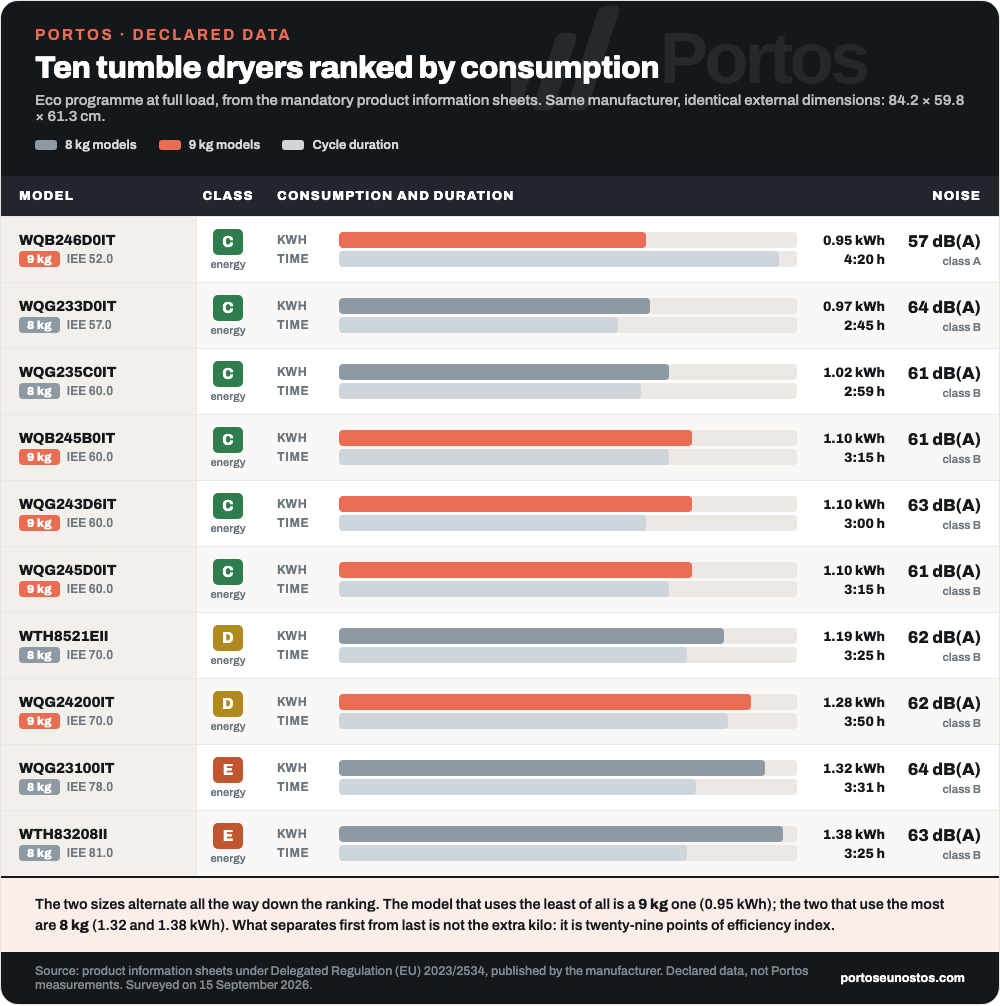
The two sizes alternate throughout the entire ranking. Data declared by the manufacturer pursuant to Delegated Regulation (EU) 2023/2534.
The model that consumes the least of all is 9 kg and stops at 0.95 kWh per cycle. The two that consume the most are 8 kg and reach 1.32 and 1.38 kWh. Between the first and last on the list there's not a kilogram of difference: there are twenty-nine points of energy efficiency index, from 52.0 to 81.0.
Class matters three times more than size
Let's put the two jumps side by side, with the same 156 cycles per year and the same ARERA price.
| Comparison | Difference per cycle | Difference in a year | Difference in euros |
|---|---|---|---|
| From 8 kg class C to 9 kg class C | +0.13 kWh | +20.3 kWh | +€6.42 |
| From 8 kg class E to 9 kg class C | −0.43 kWh | −67.1 kWh | −€21.22 |
The first comparison is the one everyone makes at the moment of purchase: 8 or 9 kilos. It's worth just over six euros a year. The second is the one almost no one makes: by switching from an 8 kg class E to a 9 kg class C you save over twenty euros a year and dry one more kilogram.
To put it directly: the class jump matters more than three times the size jump, and goes in the opposite direction to what is feared. If the budget allows only one choice between «larger capacity» and «more efficient», the second is the one that pays for itself.
Consumption per kilogram: the two sizes are equal
There's an even cleaner way to look at the same numbers: divide the consumption per cycle by the nominal capacity. You get how much it costs to dry a kilogram of laundry, which is the unit that really matters.
| Model | Size | Class | Consumption per kilo |
|---|---|---|---|
| WQB246D0IT | 9 kg | C | 0.106 kWh/kg |
| WQG233D0IT | 8 kg | C | 0.121 kWh/kg |
| WQG245D0IT | 9 kg | C | 0.122 kWh/kg |
| WQG235C0IT | 8 kg | C | 0.128 kWh/kg |
| WQG24200IT | 9 kg | D | 0.142 kWh/kg |
| WTH8521EII | 8 kg | D | 0.149 kWh/kg |
| WQG23100IT | 8 kg | E | 0.165 kWh/kg |
| WTH83208II | 8 kg | E | 0.173 kWh/kg |
In class C, the values for the two sizes overlap: from 0.121 to 0.128 kWh per kilo on the 8 kg, from 0.106 to 0.122 on the 9 kg. The difference is in the order of thousandths of kilowatt-hours, which is nothing. Moving down a class, you reach 0.173 kWh per kilo: 63% more than the best on the list.
Size is not a variable of efficiency. Class is.
The real criterion: dryer capacity
Let's return to the point that really matters. In product sheets, nominal capacity is defined for the eco programme, and is expressed in kilograms of dry laundry. It applies to the washing machine and applies to the dryer, with the same unit of measurement.
This leads to a simple and verifiable rule: if the washing machine declares 9 kg and the dryer declares 8 kg, a full load wash won't fit in a single drying cycle. It's not a matter of caution: it's arithmetic.
The most common combination today in Italian homes—8 or 9 kg washing machine—thus leads to a precise conclusion:
7 kg washing machine: 8 kg dryer, with margin.
8 kg washing machine: 8 kg dryer, exact; 9 kg if you want never to think about it again.
9 kg washing machine: 9 kg dryer. An 8 kg forces you to split full loads.
10 kg or larger washing machine: 9 kg is the most common maximum in the 60 cm format; plan on dividing larger loads, or look at larger sizes.
If you still need to buy a washing machine, we've developed the reasoning about its capacity in detail in Washing machine 8, 9 or 10 kg: which capacity to choose.
Splitting the load in two: how much time it costs
Here the declared numbers help understand what it concretely means to undersized a dryer. The sheets show the duration of the eco programme in two conditions: at nominal capacity and at half load.
Let's stay in the same class C and the same price list. An 8 kg model declares 1 hour and 48 minutes at half load: two half loads make 3 hours and 36 minutes. A 9 kg model declares exactly 3 hours for a full cycle. Splitting the laundry in two passes, instead of one, thus costs 36 minutes more, each time.
On another pairing in the same class the calculation is even clearer: 1 hour and 59 twice makes 3 hours and 58, versus 3 hours and 15 for the 9 kg model. That's 43 minutes more for the same laundry.
To this must be added what the numbers don't say: you have to remember to start the second cycle, and in the meantime the wet laundry sits still in the drum. It's the real cost of undersizing, and it appears on no label.
Half load doesn't halve anything
Anyone thinking of buying large to then use little should look at one specific figure. On all ten models reviewed, the half load programme takes between 57% and 67% of the time of a full load, averaging 63%. Never half.
The reason is physical: part of the cycle is needed to bring the machine and the fabric up to temperature, and that part doesn't halve with the laundry. From this two practical consequences follow.
The first: two half loads always cost more than one full load, in time and in energy. The second: buying 9 kg to then always fill it halfway isn't a cautious choice, it's waste paid twice, on the purchase price and on every cycle.
If instead you really do full loads, the larger size works at its best and is the right choice.
Times: 9 kg isn't slower by definition
It's a widespread belief: bigger, slower. The declared data say something else. Among the ten models, a 9 kg in class C completes the full cycle in exactly 3 hours, which is before three 8 kg models that take 3 hours and 25, 3 hours and 25 and 3 hours and 31.
It's true that the longest cycle in the entire range is a 9 kg model, at 4 hours and 20 minutes. But that model is also the most efficient of all, at 0.95 kWh: the slowness doesn't come from the capacity, it comes from the drying strategy chosen to achieve that consumption. It's the same trade-off found on all high-end heat pump dryers, and we've covered it in detail in the main guide.
Cycle duration depends on the class and design of the machine, not on the kilos of the drum.
Noise: no connection with capacity
The datasheets declare airborne noise emission in dB(A) and the relative class. On the five 8 kg models the values range from 61 to 64 dB(A), all in class B. On the five 9 kg models they range from 57 to 63 dB(A), and the only model in the entire range that achieves class A noise rating, at 57 dB(A), is actually a 9 kg.
Here too, then, no penalty for the larger capacity. If the dryer is in the kitchen, bathroom or an open-plan area off the living room, the parameter to look at is the noise class, not the kilos.
When to choose 8 kg
Your washing machine is 7 or 8 kg and you don't plan to replace it soon.
There are one or two people in your home and you do a maximum of two or three loads a week.
In the price range you have in mind, the 8 kg model is in a better class than the 9 kg: in that case the extra kilo is well compensated.
You dry mostly light and synthetic fabrics, where the real limit is the drum volume and not the weight.
Watch out for one thing: don't choose 8 kg for space reasons. As we've seen, the external dimensions are the same.
When to choose 9 kg
Your washing machine is 9 kg or larger: this is the main reason, and it's enough on its own.
You're a family of four or more, or there are small children and you do laundry daily.
You regularly dry bulky items: bath towels, light quilts, double bed sheets, fluffy towels.
You want to reduce the number of weekly cycles: fewer full-load runs cost less than more partial-load runs.
In the range you're looking at, class C models are mostly found in the 9 kg size, as often happens in higher-end ranges.
What the datasheet doesn't tell you
It's worth pointing out, because it's a real limitation of the comparison. The mandatory product information sheet declares the capacity in kilograms, but it doesn't declare the drum volume in litres. Two 9 kg models can therefore have drums with different capacities, and with bulky items the difference is noticeable.
If you often dry quilts or duvets, the drum capacity in litres should be found on the manufacturer's commercial datasheet, not on the energy label. It's data that exists, but it's located elsewhere.
Second limitation: nominal capacity refers to the eco programme, i.e. cotton. On programmes for synthetics or delicates the recommended load is lower, and you'll find that value in the instruction manual.
Mistakes to avoid
Choosing 8 kg to fit the machine in a narrow space. It doesn't work: width, height and depth are identical. If the space is really tight, you need a slim model, which is a different category.
Buying 9 kg and always loading it halfway. You pay more at purchase and don't recover it, because a half load takes almost two-thirds the time of a full load.
Pairing a 9 kg washing machine with an 8 kg dryer. This is the most frequent mistake and the most annoying to deal with: every full wash becomes two drying cycles.
Choosing kilos instead of class. Between the two factors, class is worth more than three times the energy bill. A 9 kg in class C beats an 8 kg in class E both in absolute consumption and in capacity.
Giving up on delay start for fear of standby consumption. The datasheets declare around 4 W in delay start mode: eight hours of waiting costs just over 0.03 kWh, that's about a cent in euros. That's not where you save, and that's not where you waste.
Portos' choice
Between 8 and 9 kg there's no universally better capacity: there's one that matches your washing machine. What the analysis of the ten datasheets clearly shows is that the extra kilo is a variable far less expensive than people think, and energy class far more decisive.
If you're undecided and your washing machine is 8 kg, our advice is to look first at the price list in class C and then decide the capacity with what's left of your budget. In most cases you'll find that a 9 kg in class C costs less to run than an 8 kg in class D or E, and it solves the problem of split loads for the next ten years.
If your washing machine is already 9 kg, the decision is made: 9 kg, and the discussion shifts entirely to class, noise and cycle duration. We've explained step by step how to navigate those three parameters in How to choose a dryer: capacity, class and real times.
Where to compare models
Once you've settled on the size, the comparison comes down to price and class. You can compare prices and availability of 9 kg dryers on SniffaPrezzi, or check the dryers available on OpportunityCommerce to see which models are actually in stock.
For technical data, the source remains the manufacturer: on the official Bosch website each model has its own downloadable product information sheet, and that's where all the figures in this guide come from.
Also read
Sources
Product information sheets pursuant to Delegated Regulation (EU) 2023/2534, published by the manufacturer: WQB246D0IT, WQG233D0IT, WTH83208II.
Delegated Regulation (EU) 2023/2534, energy labelling of household tumble dryers.
Regulation (EU) 2023/2533, ecodesign requirements for household tumble dryers.
EPREL, European product registry for energy labelling.
ARERA, reference economic conditions for electricity, third quarter 2026.
Bosch Home Appliances Italy, technical sheets and product documentation.
Portos editorial assessment based on analysis of specifications declared by the manufacturer. The data reported is from mandatory product information sheets, collected on 15 September 2026; these are not measurements made by Portos. Energy prices are stated scenarios, not forecasts.
But before size, cycles matter: on the same machine, going from two to five dries per week costs more than twice as much as the gap between the best and worst class. The full calculation is in how much it costs to use a dryer in a year.