
An 8 kg washer-dryer does not dry 8 kg: it dries 5, and the same label carries two energy classes calculated on different scales. We read seven EU product fiches for Bosch and Siemens washer-dryers, recorded prices from a real catalogue and built the calculation that actually matters: how much laundry you have to dry before the 628 euros saved at purchase disappear into the electricity bill. The answer is a precise threshold, and below it the washer-dryer is the right choice.
An 8 kg washer-dryer does not dry 8 kg. It dries 5. This is not the shortcoming of one unlucky model: it is the figure the manufacturer declares on the product fiche, and it is the same on all seven machines we read. It is also the thing almost nobody checks before buying, because price lists show capacity as a single number.
The second thing nobody checks is that a washer-dryer carries two energy classes, not one: one for the washing cycle and one for the complete wash-and-dry cycle. The two letters are calculated on different scales, so they are not comparable with each other, and on the machines we examined the gap between them reaches four positions.
This article does not tell you that a washer-dryer is a bad idea. It tells you under which conditions it is the right choice, using the declared figures from seven EU product fiches, prices taken from a real catalogue and a calculation that depends on a single variable: how much of your laundry actually ends up being tumble dried.
The short answer
If you dry less than about a fifth of your laundry, the washer-dryer wins: it costs less to buy, it takes up one slot only, and the extra running cost never catches up with the price difference. If you dry everything or nearly everything, two separate machines recover their higher purchase price in a little over two years and then keep saving you money for the rest of the appliance's life.
With the prices and consumption figures set out below, the break-even point falls at around 33 dried loads out of 156 washes a year: two dried loads every three weeks. Above that threshold the numbers favour the washing machine plus tumble dryer pair; below it they stay with the washer-dryer.
There is also one case in which the choice does not exist at all, and it is the most interesting one: in a fully integrated kitchen the built-in washer-dryer is the only way to dry behind a door, because built-in tumble dryers are not on the catalogue.
What you will find in this guide
What a washer-dryer actually declares
Washing machines and washer-dryers sit in the same regulation, Commission Delegated Regulation (EU) 2019/2014, but a washer-dryer's product fiche is longer than a washing machine's, because it has to describe two different cycles performed by the same appliance.
The first is the washing cycle, measured on the eco 40-60 programme, exactly as on any washing machine. The second is the wash-and-dry cycle, that is the machine washing and then drying without you touching anything. Every parameter appears twice: capacity, efficiency index, class, energy consumption, water consumption, duration.
The way the regulation tells the two families of data apart is a detail worth knowing, because it is what lets you read a fiche without going wrong. Washing-only parameters carry note (d), complete-cycle ones carry note (e). The indices are called EEIW (washing) and EEIWD (complete cycle); the washing efficiency indices are called IW and JW.
The practical consequence is simple: when a listing shows one capacity and one class for a washer-dryer, it is leaving out half the fiche. And the half left out is almost always the one about drying.
Two capacities on the same rating plate
Let us start with the figure that changes daily life. On all seven machines examined, drying capacity is always lower than washing capacity, and not by a little.
| Model | Washes up to | Washes and dries up to | Kilos left out | Dryable share |
|---|---|---|---|---|
| Bosch WKD28490EU | 8.0 kg | 5.0 kg | 3.0 kg | 62.5% |
| Siemens WK14D543EU | 7.0 kg | 4.0 kg | 3.0 kg | 57.1% |
| Bosch WNA13400IT | 8.0 kg | 5.0 kg | 3.0 kg | 62.5% |
| Bosch WNA14400IT | 9.0 kg | 5.0 kg | 4.0 kg | 55.6% |
| Bosch WDU8H541IT | 10.0 kg | 6.0 kg | 4.0 kg | 60.0% |
| Bosch WNC254A0IT | 10.5 kg | 6.0 kg | 4.5 kg | 57.1% |
| Bosch WNG25401IT | 10.5 kg | 6.0 kg | 4.5 kg | 57.1% |
The spread is narrow and consistent: from 55.6% to 62.5%. A washer-dryer dries a little over half of what it washes, always, across every size and both installation types.
And there is an effect that runs against intuition: the bigger the machine, the more kilos are left out. The 8 kg leaves 3 behind, the 10.5 kg leaves 4.5 behind. Anyone buying a large washer-dryer expecting to solve the problem of large loads ends up with the widest gap, not the narrowest.
In practice this means a full wash load cannot be dried in one go. Either you load the machine half full so you can go all the way through, or you wash full and then take part of the laundry out before starting the drying phase. The manufacturer states this plainly: the official description of the WKD28490EU says it washes and dries up to 5 kg in a single cycle, or washes up to 8 kg.
Two energy classes, two different scales
There are two letters on a washer-dryer's fiche. The first refers to washing only and is read on the same scale as washing machines. The second refers to the complete cycle and is read on a completely different, far stricter scale.
| Class | Washing cycle (EEIW) | Complete cycle (EEIWD) |
|---|---|---|
| A | EEIW ≤ 52 | EEIWD ≤ 37 |
| B | 52 < EEIW ≤ 60 | 37 < EEIWD ≤ 45 |
| C | 60 < EEIW ≤ 69 | 45 < EEIWD ≤ 55 |
| D | 69 < EEIW ≤ 80 | 55 < EEIWD ≤ 67 |
| E | 80 < EEIW ≤ 91 | 67 < EEIWD ≤ 82 |
| F | 91 < EEIW ≤ 102 | 82 < EEIWD ≤ 100 |
| G | EEIW > 102 | EEIWD > 100 |
The two columns are not the same thing in disguise. To earn an A on washing you need an index no higher than 52; to earn one on the complete cycle you need an index no higher than 37. The same number, 66, is a D on the complete cycle and would have been a C on washing.
We also used this table as a check on the data extracted from the fiches, applying the same cross-verification method we always use: the seven EEIWD values we read (66.4 / 66.8 / 66.9 / 66.9 / 78.7 / 81.6 / 81.9) all fall within the bands expected for the declared classes, four Ds and three Es. No inconsistency.
The overall result is this: five washer-dryers out of seven are class A on washing, and none of the seven goes beyond D on the complete cycle. The best of the group stops at 66.4, that is nearly twice the threshold required for an A on the complete cycle.
We are not saying a class A complete cycle cannot exist: the European EPREL registry has a dedicated filter for that class, so the box is provided for. We are saying that none of the seven we read reaches it, and that when a listing advertises a single letter, it should always be traced back to one of the two cycles before it is believed.
The seven fiches side by side
This is the full picture, read directly from the EU product fiches published by the manufacturer. The dates in the last column are fiche issue dates, not our survey dates.
| Model | Type | Washing | Wash class | Complete cycle | Complete class | kWh washing | kWh complete | Litres wash | Litres complete | Wash time | Complete time | Fiche |
|---|---|---|---|---|---|---|---|---|---|---|---|---|
| Bosch WKD28490EU | Built-in | 8.0 kg | A (51.9) | 5.0 kg | E (81.6) | 0.472 | 3.240 | 48 | 80 | 3:38 | 9:20 | 24.03.2026 |
| Siemens WK14D543EU | Built-in | 7.0 kg | E (89.8) | 4.0 kg | E (81.9) | 0.774 | 2.662 | 44 | 68 | 2:50 | 5:30 | 13.12.2025 |
| Bosch WNA13400IT | Freestanding | 8.0 kg | C (68.9) | 5.0 kg | E (78.7) | 0.626 | 3.126 | 41 | 70 | 3:32 | 7:30 | 31.08.2024 |
| Bosch WNA14400IT | Freestanding | 9.0 kg | A (51.8) | 5.0 kg | D (66.9) | 0.493 | 2.656 | 49 | 74 | 3:46 | 8:35 | 09.06.2026 |
| Bosch WDU8H541IT | Freestanding | 10.0 kg | A (50.0) | 6.0 kg | D (66.9) | 0.494 | 3.072 | 50 | 74 | 3:55 | 8:00 | 13.09.2024 |
| Bosch WNC254A0IT | Freestanding | 10.5 kg | A (52.0) | 6.0 kg | D (66.4) | 0.522 | 3.050 | 50 | 75 | 4:00 | 8:20 | 18.12.2025 |
| Bosch WNG25401IT | Freestanding | 10.5 kg | A (51.8) | 6.0 kg | D (66.8) | 0.520 | 3.070 | 50 | 89 | 3:58 | 8:59 | 09.06.2026 |
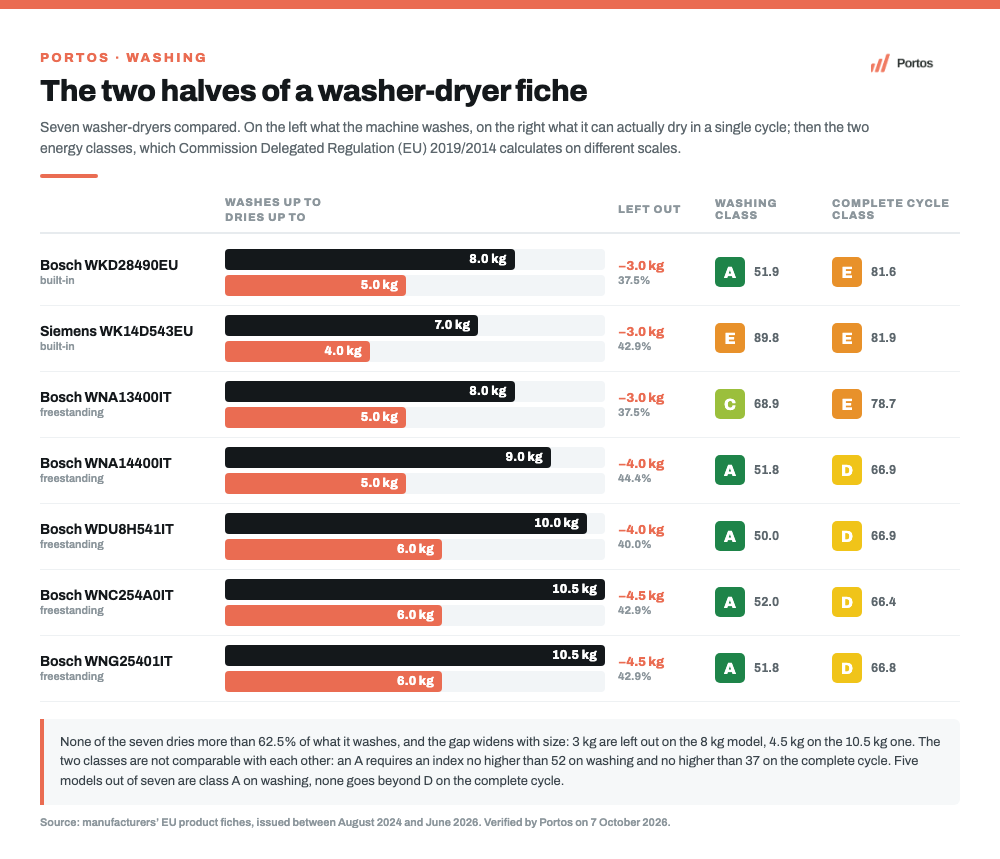
The two halves of a washer-dryer's fiche: on the left what it washes, on the right what it can actually dry, with the two energy classes the regulation calculates on different scales.
All seven declare the same spin speed, 1,400 revolutions per minute (1,390 on one model), and the same spin-drying efficiency class, B, with residual moisture content between 52.0% and 53.0%. On that front, therefore, there are no differences between the seven models.
Energy: the complete cycle costs almost four times as much
The honest way to compare appliances with different capacities is not consumption per cycle but consumption per kilo of laundry. Otherwise you reward the smaller machine simply for doing less at a time.
Across the seven washer-dryers the complete cycle costs between 0.508 and 0.666 kWh per kilo. Now take the reference separate pair, a 9 kg class A Bosch WGG244ZRIT washing machine (0.489 kWh per cycle) and a 9 kg class C Bosch WQB245B0IT heat pump tumble dryer (1.10 kWh per cycle): washing and drying 9 kilos costs 1.589 kWh, that is 0.177 kWh per kilo.
| Operation | Energy per kilo | Cost per kilo | Ratio |
|---|---|---|---|
| Washer-dryer WKD28490EU, complete cycle | 0.648 kWh | 0.2814 euros | 3.67 times |
| Best washer-dryer in the group (WNC254A0IT) | 0.508 kWh | 0.2208 euros | 2.88 times |
| Washing machine plus heat pump dryer | 0.177 kWh | 0.0767 euros | reference |
The gap is not a nuance: drying inside a washer-dryer costs three to almost four times more than drying in a heat pump tumble dryer. And the reason is technical, not commercial: a heat pump recovers the latent heat released when vapour condenses and feeds it back into the circuit, while a washer-dryer's drying system throws that heat away together with the water.
A minor but consistent detail: in delay start the washer-dryer declares 4.00 W, against 0.60 W for the reference washing machine. It does not move the annual total, but it tells you there is a more complex appliance under the panel, doing two jobs with one motor and one drum.
Water: the entry a tumble dryer does not have
Here is the figure that most often escapes attention, and it reads without interpretation because the fiche declares water consumption twice.
| Model | Water, washing only | Water, complete cycle | Difference |
|---|---|---|---|
| Bosch WKD28490EU | 48 litres | 80 litres | +32 litres |
| Siemens WK14D543EU | 44 litres | 68 litres | +24 litres |
| Bosch WNA13400IT | 41 litres | 70 litres | +29 litres |
| Bosch WNA14400IT | 49 litres | 74 litres | +25 litres |
| Bosch WDU8H541IT | 50 litres | 74 litres | +24 litres |
| Bosch WNC254A0IT | 50 litres | 75 litres | +25 litres |
| Bosch WNG25401IT | 50 litres | 89 litres | +39 litres |
On all seven, water increases when drying is added, by 24 to 39 litres per cycle. And it increases during a phase in which, intuitively, water should only be coming out of the laundry.
The comparison that settles the matter is with a tumble dryer's fiche: the product fiche of a household tumble dryer, governed by Commission Delegated Regulation (EU) 2023/2534, has no field for water consumption. This is not an omission by the manufacturer: the parameter is not provided for, because in a heat pump the moisture condenses in a refrigerant circuit and ends up in the tank or the drain, with no mains water drawn in.
Translated into a year of laundry, using the figures set out below: washing and drying everything with the built-in washer-dryer uses 22,464 litres against 7,800 for the separate pair. That is 14,664 extra litres every year, almost three times as much, and this entry appears in no energy class.
Time: nine hours and twenty minutes
The third cost is time, and this too is declared. Across the seven machines the complete cycle lasts 1.9 to 2.6 times as long as washing alone.
The extreme case is precisely the built-in washer-dryer: 9 hours and 20 minutes to wash and dry 5 kilos, against 3 hours and 38 minutes to wash 8 kilos. At half load it drops to 6 hours and 30, which is still more than a full wash plus a full drying cycle on two separate machines (3:48 plus 3:15, that is 7:03 for 9 kilos instead of 2.5).
There is then a constraint that appears in no table but weighs heavily: a washer-dryer is a single machine. While it is drying it cannot wash. With two appliances the second load goes into the washing machine while the first is tumbling, and the queue clears in parallel; with a washer-dryer the queue is necessarily single file.
Expressed as hours of annual occupancy, in the scenario where everything is dried: 2,621 hours for the washer-dryer against 1,100 hours in total for the two machines, of which only 593 on the washing machine. That is 109 days of running time against 46.
As a washing machine, though, it is a good washing machine
Here is the point usually missing from articles on this comparison, and one the data obliges us to make. A washer-dryer is not a poor washing machine with an extra function.
The WKD28490EU washes 8 kilos using 0.472 kWh, that is 0.0590 kWh per kilo. The reference washing machine, a class A Series 6, uses 0.0543. The difference is 8.6%, which over a year of washing alone is worth less than three euros.
Five of the seven washer-dryers examined are class A on the washing cycle, with indices between 50.0 and 52.0, that is in the same band as good washing machines on the catalogue. The washing efficiency index (1.03-1.04) and the rinsing effectiveness (5.0 grams per kilo of dry textile) are identical to those of washing machines too.
The conclusion, then, is not that a washer-dryer washes badly. It is that the entire extra cost is concentrated in the drying. And that is exactly why the decision does not depend on the machine, but on how much you will use it to dry.
The full calculation, year by year
We set the same annual laundry volume for every option, 1,404 kilos, corresponding to 156 full 9 kilo loads, that is three a week. The comparison is per kilo washed, not per cycle: counting cycles would have skewed the result, because the capacities differ.
There is only one variable: the share of laundry that is also machine dried. The rest is hung out. Tariff: 0.4343 euros per kWh, the ARERA reference for the fourth quarter of 2026, in force since 1 October 2026.
| Laundry dried | Washer-dryer, kWh/year | Washer-dryer, euros/year | Two machines, kWh/year | Two machines, euros/year | Annual difference | Water, washer-dryer | Water, two machines |
|---|---|---|---|---|---|---|---|
| None | 83 | 35.98 | 76 | 33.13 | +2.85 euros | 8,424 l | 7,800 l |
| A quarter | 290 | 125.76 | 119 | 51.76 | +74.00 euros | 11,934 l | 7,800 l |
| Half | 496 | 215.55 | 162 | 70.39 | +145.16 euros | 15,444 l | 7,800 l |
| Three quarters | 703 | 305.34 | 205 | 89.02 | +216.31 euros | 18,954 l | 7,800 l |
| All of it | 910 | 395.12 | 248 | 107.66 | +287.47 euros | 22,464 l | 7,800 l |
The row to look at first is the last one: anyone who always dries spends 287.47 euros more a year with the washer-dryer. Over ten years that is 2,875 euros in energy alone, far more than the price of both machines put together.
The row to look at second is the first one: anyone who never dries spends 2.85 euros more a year, a difference that does not exist. But anyone in that row has paid for a function they do not use.
Where the break-even point falls
The prices recorded on 7 October 2026 on the OpportunityCommerce catalogue are these: the built-in Bosch WKD28490EU washer-dryer costs 1,080.65 euros; the Bosch WGG244ZRIT washing machine costs 779.00 euros and the Bosch WQB245B0IT tumble dryer costs 930.00 euros, for a total of 1,709.00 euros.
The washer-dryer therefore starts with a 628.35 euro advantage. The right question is not which costs less, but how much laundry you have to dry for those 628 euros to disappear into the electricity bill.
| If you keep the machines for | Break-even falls at | That is |
|---|---|---|
| 8 years | 26.6% of the laundry | 41 dried loads out of 156 |
| 10 years | 21.1% of the laundry | 33 dried loads out of 156 |
| 15 years | 13.7% of the laundry | 21 dried loads out of 156 |
Over a realistic ten year horizon the threshold is therefore a little over a fifth of the laundry: about two dried loads every three weeks. Below that, the washer-dryer stays ahead for the whole life of the appliance. Above it, the two machines pay for themselves and then move into profit.
Read in years, the same thing sounds like this: if you dry everything, the two machines recover the price difference in 2.2 years; if you dry half, in 4.3 years; if you dry a quarter, in 8.5 years, that is right at the edge of their useful life.
The case where the washer-dryer has no alternative
There is one situation in which the whole calculation above becomes secondary, and it concerns anyone with fully integrated kitchen or bathroom units.
When we compared built-in and freestanding washing machines we found something that weighs more than many parameters: built-in tumble dryers are not on the catalogue, and built-in washing machines declare stacking installation: No in their specification. Choosing built-in, in other words, means giving up machine drying, and that is hard to correct later.
The built-in washer-dryer is the only exception to that rule. The WKD28490EU also declares stacking installation: No, but it does not need it: it dries on its own, behind the door, in 60 centimetres of width and 53 of depth, with 967 millimetres of clearance with the door open and 57.6 kilos of weight.
For this reader the comparison is no longer between one machine and two: it is between drying behind a door or not drying at all. In that case the higher consumption stops being a disadvantage and becomes the price of a function they would not otherwise have. It is the situation in which a washer-dryer makes more sense than anything else.
Freestanding, the picture changes. There stacking is possible: the WNG25401IT declares stacking installation: Yes, and so do ordinary washing machines. If there is a metre eighty of free height over 60 centimetres of width, two stacked machines take up the same floor area as one.
The one-hour programme and its maximum load
Almost every washer-dryer advertises a fast programme that washes and dries in an hour. On the WKD28490EU it is called Wash & Dry 60 and it genuinely exists. In the manufacturer's official description, however, there is a line that never appears in price lists: maximum load 1 kg.
One kilo is a shirt and little else. To cover a nominal drying load of 5 kilos you would need five one-hour runs, that is five hours and five separate loadings: far worse than the 9 hours and 20 of the normal cycle, which at least happens in one go.
This is not a hidden defect, it is physics: in sixty minutes you can only remove water from a very small quantity of textile. It is worth knowing beforehand, though, because that programme is often presented as the answer to the long-cycle problem, and it is not.
The catalogue's borderline case
The seven fiches also tell a story worth keeping in mind about prices. The two built-in machines in the group both belong to the same industrial group and look very similar, but on the fiche they are nothing alike.
| Bosch WKD28490EU | Siemens WK14D543EU | |
|---|---|---|
| Price recorded | 1,080.65 euros | 1,499.65 euros |
| Washing capacity | 8.0 kg | 7.0 kg |
| Drying capacity | 5.0 kg | 4.0 kg |
| Washing cycle class | A (51.9) | E (89.8) |
| Energy per washing cycle | 0.472 kWh | 0.774 kWh |
| Complete cycle class | E (81.6) | E (81.9) |
| Spin noise | 68 dB(A) | 72 dB(A) |
The machine costing 419 euros more washes one kilo less, dries one kilo less, sits four classes lower on the washing cycle and is 4 dB louder when spinning. It is the most expensive of the 23 washer-dryers on the catalogue and, on washing, also the least efficient of the seven we read.
This is not a pricing error by the retailer: the Siemens fiche dates from December 2025 and the Bosch one from March 2026, so it is plausible that these are two different generations still being sold alongside each other. And that is exactly the point: within the same category, at the same moment, price does not rank quality. The fiche does.
When to choose the washer-dryer
A washer-dryer is the right choice in these cases, and they are solid ones:
You have only one connection point. If there is room for one machine and no way of making a second, there is no comparison to be made: the washer-dryer is the only way to dry.
You have a fully integrated kitchen or bathroom. Built-in tumble dryers are not on the catalogue and built-in washing machines cannot be stacked: behind a door the washer-dryer is the only route.
You dry rarely. Below 30 to 40 dried loads a year the higher running cost never eats up the price difference within the appliance's lifetime.
You dry small, urgent loads. One garment needed for the evening is exactly the job the complete cycle at reduced load is good for.
You are renting or in a temporary home. One appliance to move, one connection to find and a lower upfront outlay matter more than savings spread over ten years.
When to choose two separate machines
Two machines are the right choice in these other cases:
You dry routinely. From roughly a fifth of the laundry upwards, over ten years, the pair pays for itself and then gains.
You run full loads. A 9 or 10 kilo washer-dryer dries 5 or 6: if you genuinely fill the drum, every load has to be split.
You are in a hurry on laundry days. With two machines the second load washes while the first dries; with one the queue is single file.
You have 180 centimetres of free height. A stacked column takes up the same floor area as a single machine, and at that point the washer-dryer's space advantage disappears.
You want to be able to replace one piece at a time. If the washing machine fails, the dryer keeps working. In a washer-dryer one fault stops both functions.
Mistakes to avoid
Reading a single capacity. If a listing shows one capacity for a washer-dryer, it is the washing one. The drying capacity is 37% to 44% lower and has to be looked up on the fiche.
Comparing a washer-dryer's class with a washing machine's. If the letter refers to the complete cycle, it sits on a different scale and is not comparable.
Assuming a washer-dryer washes worse. Five of the seven examined are class A on washing: the cost is all in the drying.
Forgetting the water. The complete cycle uses 24 to 39 litres more than washing alone, and no energy class tells you so.
Counting on the one-hour programme. It exists, but at one kilo of load.
Buying big to be safe. On washer-dryers, the larger the size the more kilos are left out of drying: from 3 on the 8 kg to 4.5 on the 10.5 kg.
Using price as a proxy for quality. In the group examined the most expensive machine is also the one with the worst classes.
The Portos verdict
If you have the space and you dry regularly, two separate machines, with a heat pump tumble dryer, are the rational choice: they cost more to buy but pay for themselves in two or three years of full use, consume a third per kilo, draw no extra water and work in parallel.
If there is only one slot, a washer-dryer is not a fallback and it is a good washing machine: choose it by looking first at the drying capacity, then at the complete cycle class, and knowing that drying will cost you three to four times what it would in a dedicated tumble dryer. That is an acceptable price if you dry rarely, and it is the price of a function you would not otherwise have if you are in a fully integrated kitchen.
The parameter to decide on, in one line: count how many loads you dry in a month. If it is fewer than three, buy the washer-dryer. If it is more than three, buy two machines.
Method, conventions and declared limits
The consumption figures, capacities, durations and classes in this article all come from the EU product fiches published by the manufacturer, not from tests of our own. Portos has not physically tested any of these machines: we compared them on declared data, which is measured using regulated procedures and can be verified by market surveillance authorities.
The calculation conventions are stated in the open: 1,404 kilos of laundry a year, comparison per kilo and not per cycle, electricity tariff 0.4343 euros per kWh (ARERA, fourth quarter 2026). Anyone on a different tariff can rescale the euro columns proportionally; the kWh and litre columns do not change.
Three limits are worth declaring. First: the sample is seven washer-dryers from the same industrial group, chosen because their fiches are readable and verifiable; the market holds many others and figures from other brands may differ. Second: the complete cycle consumption declared on the fiche is a value weighted between full and half load, so it is a comparable order of magnitude, not the consumption of a single drying run. Third: we used one washing machine plus dryer pair as the reference; with a more efficient dryer the gap widens, with a less efficient one it narrows, but the sign does not change.
One figure we looked for and did not write: the maximum temperature reached inside the textiles during the complete cycle. The fiche declares it, but in the PDF the values of the two columns alternate in a way that does not allow them to be attributed with certainty, and a number we cannot stand behind does not go on the page.
One last useful note. Tumble dryer fiches issued after the summer of 2026 also carry a repairability class (the WQB245B0IT declares class A with an index of 9.43). Washer-dryer fiches, which follow a different regulation, have no such field: on that front a direct comparison is not possible today.
Prices and availability
The catalogue we used as a reference holds 23 washer-dryers, 9 built-in and 14 freestanding, with prices recorded on 7 October 2026 ranging from 500.00 to 1,499.65 euros. The proportion says something: 9 washer-dryers out of 23 are built-in, that is 39%, while in the same survey built-in washing machines are 18 out of 63, that is 29%. Built-in weighs more in this category than in the one next door, confirming that the washer-dryer exists above all to solve a space problem.
Of the machines cited in this article, the built-in Bosch washer-dryer and the comparison pair are on the catalogue. The five freestanding Bosch washer-dryers we read exist in the manufacturer's fiche archive but were not on the catalogue at the time of our survey: we used them for the technical comparison, not as a purchase suggestion.
See specifications and availability of the Bosch WKD28490EU on OpportunityCommerce
See the Bosch WGG244ZRIT washing machine used in the comparison
Compare washer-dryer prices and availability on SniffaPrezzi
Appliance prices move from week to week: those reported here are valid at the date of the survey and should always be rechecked before deciding.
Documentation and sources
Also worth reading, within the same decision path:
How to choose a washing machine: capacity, consumption and the features that matter
How to choose a tumble dryer: capacity, efficiency class and real times
Primary sources used for this article:
Commission Delegated Regulation (EU) 2019/2014, energy labelling of washing machines and washer-dryers: EEIW and EEIWD class tables and the product fiche template
Commission Delegated Regulation (EU) 2023/2534, energy labelling of household tumble dryers
EU product fiche, Bosch WKD28490EU (24.03.2026)
EU product fiche, Bosch WNC254A0IT (18.12.2025)
EU product fiche, Bosch WGG244ZRIT, reference washing machine
EU product fiche, Bosch WQB245B0IT, reference tumble dryer (21.09.2026)
Bosch WKD28490EU product page, for declared capacities, dimensions, weight and the maximum load of the Wash & Dry 60 programme
EPREL, the European product registry for energy labelling
ARERA, reference electricity price for the fourth quarter of 2026
Data recorded on 7 and 8 October 2026. Next check of prices, catalogue and tariff by 6 January 2027.