From 1 January 2027 the energy label on tumble dryers carries one more letter, and it is not about consumption but about how easy the machine is to repair. We read the formula in the regulation and downloaded all 6,077 models in the European registry: 1,708 already declare the index, and 98 per cent of them sit in class A.
From 1 January 2027 the energy label on tumble dryers will carry one more letter. It has nothing to do with consumption: it tells you how easy the machine is to repair. It is called the repairability class, it runs from A to E, and it comes from a numerical index the manufacturer has to calculate using a method written into the regulation, not one of its own choosing.
This is the first time a major household appliance carries, on its label, a figure that is not about energy, water or noise, but about what happens when it breaks. And it is not a label arriving fifteen months from now: part of the market has already moved. In the European product registry, 1,708 tumble dryers out of 6,077 already declare the index, with no obligation to do so.
We downloaded that registry in full, read the calculation method in the text of the regulation and re-applied the formula to every model that has declared. The result says two things at once: the new figure is useful, and the scale is already crowded at the top, because 98 per cent of those who have declared sit in class A. Here is what that means if you are buying a dryer.
The short answer
From 1 January 2027 every tumble dryer placed on the market must show the repairability class on its label, on an A-E scale, and the index with its four partial scores on the product information sheet. Anyone who wants to can do it already: the voluntary window opened on 24 November 2025.
The figure is real and verifiable, but it should not be read as a mark for how long the appliance will last. The index measures one very specific thing: how quickly you can reach eight parts considered critical, what fasteners hold them, what tools you need, and whether the manufacturer publishes repair information free of charge. It does not measure what those parts cost, it does not measure how long the machine lasts, and it does not consider the heat pump at all, which on five machines out of six is the most expensive component.
In practice: today the repairability class is mainly useful for ruling things out. If a model declares B or C, there is a reason. If it declares A, you are in the company of 98 per cent of the sample and you need to look elsewhere. The paragraphs below give the figures behind that conclusion, all drawn from official sources.
In brief: what you will find here
What exactly changes on the label
The change comes from Commission Delegated Regulation (EU) 2025/1353, published in the Official Journal of the European Union on 20 November 2025 and in force since 24 November. It does not rewrite the tumble dryer label: it adds to it. The reference text remains 2023/2534, the one that brought in the A-G scale and the condensation efficiency class.
In concrete terms the label gains one more pictogram, with a vertical A-to-E scale and the model's letter in bold. The energy class, the consumption per 100 cycles, the condensation class, the noise in decibels, the capacity and the duration of the eco programme all stay where they are. The regulation goes down to typographic detail: the applicable letter in bold 12 pt, the others in regular 8 pt.
On the product information sheet, the PDF every manufacturer must publish and the most precise source there is on an appliance, a new block appears headed "Repairability information", with six lines: the class, the index and the four partial scores. Plus three mandatory links: to spare parts availability, to repair instructions for end users, and to indicative pre-tax prices.
One important difference from the previous label change: there is no rescaling. On 1 July 2025, when the new tumble dryer label came into application and the scale went back from A+++ to A-G, products on sale had to adapt. Not this time: the regulation allows distributors to keep selling, with no time limit, appliances placed on the market before 1 January 2027, carrying the old label without the index. In 2027 and 2028, shops will stock machines with the figure and machines without it, and the absence of the figure will say nothing about the quality of the product.
How the index is calculated: the full formula
The repairability index, written R, is an aggregate score from 0 to 10 built from four parameters. The regulation uses abbreviations you will find unchanged on the product sheet:
SDD, disassembly depth score: how many steps it takes to reach the part;
SF, fasteners score: what holds it in place;
ST, tools score: what you need to take it out;
SRI, repair information score: whether the manufacturer publishes it free of charge.
The formula, in Annex IV section 5 of the regulation, is this:
R = 0.450 × SDD + 0.225 × SF + 0.225 × ST + 0.100 × SRI
The result is rounded to two decimals. Almost half the weight, 0.450, sits on disassembly depth. Repair information, the only parameter assessed at product level rather than part by part, carries one tenth.
The formula genuinely works. Take the EU product sheet of the Bosch WQB245B0IT, reissued on 21 September 2026, which declares SDD 9.18, SF 9.11, ST 10.00 and SRI 10.00. Applying the coefficients: 0.450 × 9.18 + 0.225 × 9.11 + 0.225 × 10 + 0.100 × 10 = 9.4308, which rounds to 9.43, exactly the index printed on the sheet. A simple average of the four scores would have given 9.57: this is a weighted average, and the coefficients change the answer.
The eight priority parts and how much each one weighs
The first three scores are not assessed on the machine as a whole but on eight components the regulation calls priority parts, chosen on the basis of spare part sales rates and failure rates. Each part gets a mark from 0 to 10 on each of the three criteria, then the marks are aggregated as a weighted average. The coefficients are identical for SDD, SF and ST:
| Priority part | Code | Coefficient | Mean disassembly steps (MDS) |
|---|---|---|---|
| Main printed circuit board | MB | 0.28 | 13.7 |
| Drum belt | DB | 0.25 | 40.9 |
| Water pump | WP | 0.14 | 16.1 |
| Drum bearing | B | 0.09 | 18.9 |
| Door | D | 0.08 | 3.0 |
| Motor capacitor | MC | 0.06 | 24.9 |
| Motor | M | 0.05 | 49.4 |
| Fan | F | 0.05 | 7.7 |
Two coefficients alone make up 53 per cent of the score: the electronic board and the belt. That is consistent with failure data, but it has a practical consequence. The motor, which the regulation itself recognises as the most deeply buried part of all with 49.4 mean disassembly steps, weighs 0.05: one twentieth. A machine can have a virtually unreachable motor and still land comfortably in class A, as long as the board and the belt come out quickly.
The mean-steps column deserves attention, because it is the yardstick each model is measured against. A part's score does not depend on the absolute number of operations but on the comparison with the European mean for that part. Reaching the door in 2 steps scores top marks because the mean is 3; reaching the motor in 40 steps scores top marks because the mean is 49.4.
If a priority part appears more than once in the same appliance, the worst-scoring one is taken. If it is absent altogether, it is removed from the formula and the remaining coefficients are rescaled so they still sum to 1.
How the points are awarded, item by item
Here the regulation is unusually concrete, and it is worth reading because it explains why certain scores move in steps rather than continuously.
Disassembly depth. You count the steps needed to extract the part from a fully assembled machine, upright, disconnected, maintained as the manual says. The score is stepped against the mean for that part: 10 points up to 70 per cent of the mean, 7 points up to 90, 4 points up to 110, 1 point up to 130, zero beyond. Fasteners do not count as parts, picking up or putting down a tool does not end a step, but cleaning or heating does. And there is a clause that wipes everything out: if the spare part needs remote serial-number authorisation to work, that part scores zero.
Fasteners. Four flat levels: 10 points if they are reusable, 7 if the manufacturer resupplies them free, 4 if it resupplies them at a cost, 0 if they are non-removable. If different types turn up during disassembly, the worst one counts.
Tools. Three levels: 10 points if basic tools or no tools are enough, 5 if tools supplied with the spare part are required, 0 otherwise. Again, the worst one counts.
Repair information. Only two possible values, 10 or 0: ten if the manufacturer makes repair information available free of charge to professional repairers, zero if it charges for it. There is no middle ground, which is why this score is almost always a flat 10.00 in the registry.
From index to letter: the thresholds
Table 3a of the regulation turns the index into a letter:
| Repairability class | Index R |
|---|---|
| A (highest repairability) | R > 9.00 |
| B | 7.00 ≤ R ≤ 9.00 |
| C | 5.00 ≤ R < 7.00 |
| D | 3.00 ≤ R < 5.00 |
| E (lowest repairability) | R < 3.00 |
It is worth noting exactly where the boundaries fall. An index of 9.00 flat is class B, not A: class A requires passing the threshold, not reaching it. An index of 7.00 flat is B, a 5.00 flat is C. These details matter when a manufacturer stops one hundredth short of the jump.
There is also an arithmetic constraint the regulation does not state but which follows from the formula. With SDD at zero, even taking the other three scores to the maximum you reach 0.225 × 10 + 0.225 × 10 + 0.100 × 10 = 5.50, which is class C. Without a good disassembly score, class A is mathematically out of reach: with the other three at a flat 10.00, SDD has to be at least 7.80 to clear 9.01.
What the European registry already says: 6,077 models
To understand what will happen on labels in 2027 there is no need to wait for 2027. Every model on sale in the Union is registered in EPREL, the European Commission's database, and since 24 November 2025 suppliers have been allowed to enter repairability information there. We downloaded the entire "household tumble dryers" group under Regulation 2023/2534: 6,077 models as of 11 October 2026.
| Item | Value |
|---|---|
| Models registered in the group | 6,077 |
| Models already declaring the index | 1,708 (28.1%) |
| Organisations that have declared | 102 out of 196 |
| Declarations filed in the last five months | 1,614 out of 1,708 (94.5%) |
| Share of new October 2026 registrations carrying the index | 75.3% (350 out of 465) |
The curve is clear. Up to March 2026 declarations numbered a few dozen in total; in June there were 232, in July 256, in September 656, and another 350 in the first ten days of October. The market is adapting fourteen months early, and it is doing so mainly on new registrations: among models entering the registry in October 2026, three out of four already carry the index.
That adaptation is not uniform, though. Two manufacturers that between them account for nearly 2,400 models behave in opposite ways:
| Organisation | Models in registry | With index | Share |
|---|---|---|---|
| Midea Europe GmbH | 29 | 28 | 97% |
| Haier Iberia | 121 | 90 | 74% |
| Candy Hoover Group | 571 | 371 | 65% |
| Gorenje | 232 | 142 | 61% |
| Asko Appliances | 46 | 26 | 57% |
| Miele | 164 | 85 | 52% |
| Electrolux | 1,136 | 516 | 45% |
| Beko Europe | 1,209 | 18 | 1% |
| BSH (Bosch, Siemens, Neff, Gaggenau) | 624 | 0 | 0% |
The BSH figure needs care, because it is the more interesting of the two: zero models with an index in the public registry, yet the group's PDF product sheets have carried the index since September 2026. We come back to this below, because it is the clearest sign of how out of step this transition period is.
Ninety-eight per cent in class A
Here is the point that changes how this label should be used. Of the 1,708 models that have declared:
| Repairability class | Models | Share |
|---|---|---|
| A | 1,674 | 98.0% |
| B | 28 | 1.6% |
| C | 6 | 0.4% |
| D | 0 | 0% |
| E | 0 | 0% |
There is not a single tumble dryer in class D or E in the registry. For now, the lower end of the scale is empty. And within class A the concentration is even tighter than the letter suggests: 580 models out of 1,708, 34 per cent, declare the maximum index of 10.00, and 578 of those have all four partial scores at a flat 10.00. Across 1,708 models there are just 42 distinct index values.
The class A boundary is crowded on the right side: 305 models sit between 9.00 and 9.10, within one tenth of the threshold. On the other side there are 65 models at or below 9.00. The distribution is not a bell curve: it is a spike at 10.00 and a cluster just above the threshold.
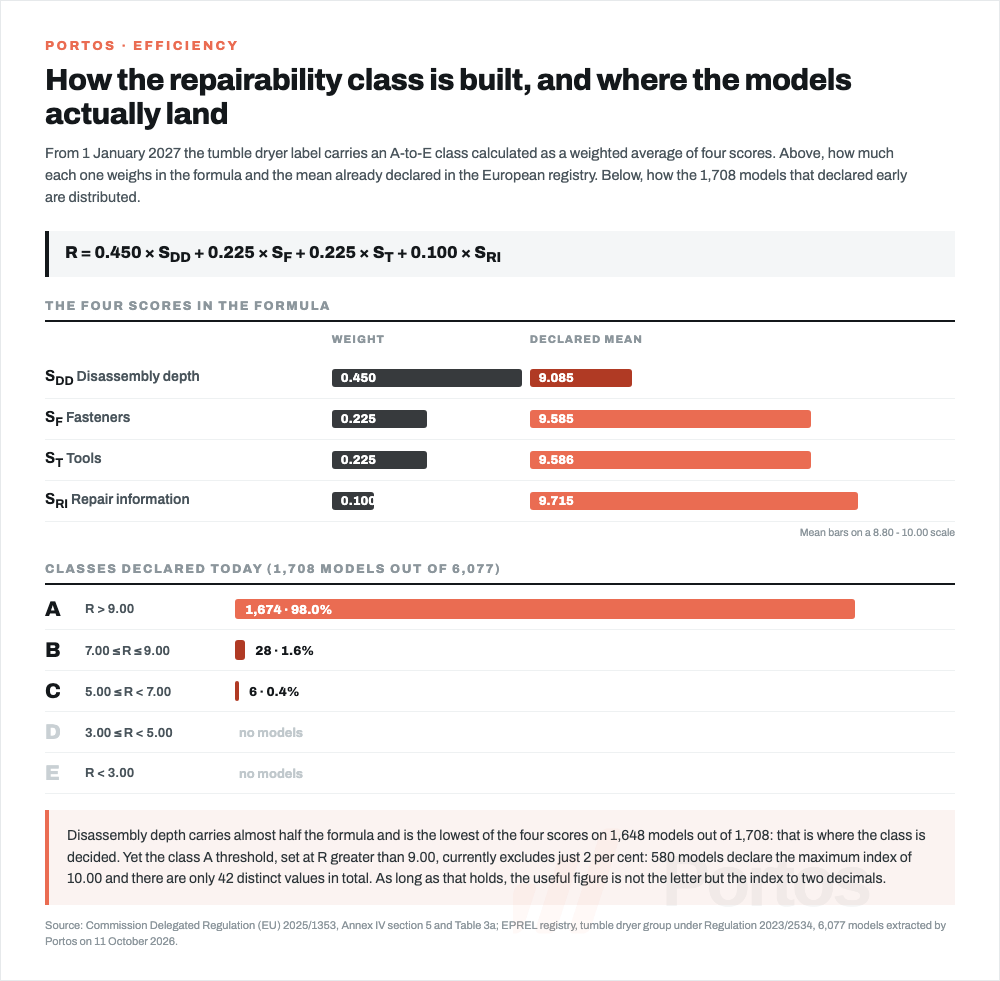
The formula in the regulation, the class thresholds and how the models that have already declared actually spread out: 98 in 100 in class A.
There is a precedent. On built-in ovens we had already found the same phenomenon on a different parameter: fifteen models out of twenty declared the identical efficiency index, 81.2, less than a point from the class threshold. When a parameter goes onto the label, industry positions itself quickly just above the threshold that counts. It holds for energy and, it seems, it will hold for repairability.
Be careful not to invert the conclusion, though. The fact that almost everyone sits in A does not mean the index is useless: it means that today it identifies the exceptions rather than ranking the market. Of 1,708 models, 34 declared something other than A, and in 28 cases out of 34 the reason is written plainly in the partial scores.
The bottleneck is disassembly
The four scores do not behave alike. Here are the means across the 1,708 declaring models:
| Score | Weight in the formula | Declared mean |
|---|---|---|
| SDD disassembly depth | 0.450 | 9.085 |
| SF fasteners | 0.225 | 9.585 |
| ST tools | 0.225 | 9.586 |
| SRI repair information | 0.100 | 9.715 |
Disassembly is simultaneously the heaviest score and the lowest one. Across 1,708 models it is the worst of the four in 1,648 cases, 96.5 per cent. Median of the other three: a flat 10.00. Median of disassembly: 9.18.
That translates into something operational. Taking SDD to the maximum across the whole sample would lift the mean index from 9.373 to 9.785: +0.412. Doing the same on the other three would gain +0.093, +0.093 and +0.029 respectively. In class terms: raising disassembly would move 89 models up a letter, raising repair information would move 21.
The reading for a buyer is simple. A model in class B or C almost never has a documentation or tooling problem: it has a mechanical architecture problem, meaning you have to take too much machine apart to reach the parts that fail. That is a flaw no manual update can fix.
The 86 entries that do not add up
With the formula and all the partial scores in hand, you can run a check nobody had reason to run before: recompute every model's index and compare it with the declared one. The regulation's formula reproduces the declared index on 1,625 models out of 1,708, that is 95.14 per cent, to the hundredth. That confirms the coefficients read in the annex are the right ones and that almost every manufacturer applies them correctly.
That leaves 83 models where the declared index does not follow from the declared scores, plus further cases where the letter does not follow from the index. In total 86 entries contain at least one internal inconsistency. Some are glaring:
| Model | Declared index | Index from the formula | Declared scores |
|---|---|---|---|
| MD110H80/W-IT (Midea Italia) | 10.00 (class C) | 1.00 | 1.00 / 1.00 / 1.00 / 1.00 |
| LHP10W25R (Currys Ireland) | 9.88 (class A) | 3.08 | 4.38 / 2.25 / 2.25 / 1.00 |
| Twelve Beko Europe models | 9.50 (class A) | 2.91 | 4.00 / 2.25 / 2.25 / 1.00 |
| BHP10WH (Glen Dimplex) | 1.00 (class A) | 2.00 | 2.00 / 2.00 / 2.00 / 2.00 |
| Three Gorenje models | 9.20 (class A) | 10.00 | 10.00 / 10.00 / 10.00 / 10.00 |
The largest gap is 9.00 points on a scale of 10. Caution is needed here: from the outside it is impossible to establish which of the two figures is wrong. The index could be wrong, the partial scores could be wrong, or there could be a different data-entry convention in which the values 1.00 and 2.00 mean something else. What can be said with certainty is that those entries are not consistent with the regulation's method, and that the registry accepts them as they stand.
Three cases run strikingly in the opposite direction: three Gorenje models declare all four scores at a flat 10.00, the absolute maximum, and then report an index of 9.20 instead of 10.00. There the manufacturer has declared itself worse than its own figures would make it.
This is not something a buyer should be alarmed by: it is 86 entries out of 1,708, 5 per cent, and none of them is currently visible to the public. It does say a good deal about the state of the transition, and it is worth remembering a year from now, when these numbers reach shop-floor labels.
What the index ignores: the heat pump
Missing from the list of eight priority parts is the component that costs the most on a modern dryer and defines the product: the heat pump circuit, with its compressor, heat exchangers and refrigerant gas.
That is not an oversight on our part, it is a gap the regulation itself acknowledges. Regulation 2025/1353 adds a specific point to the review already provided for in 2023/2534: to assess "the appropriateness of including the heat pump in the list of priority parts for the purpose of calculating the repairability index". Today it is not there.
The size of the gap can be measured on the registry. Of the 6,077 tumble dryers registered, 5,524 are heat pump machines, that is 90.9 per cent, and 1,625 of those have declared the index. Conventional condenser dryers number 373 and air-vented ones 180. So for nine machines out of ten the index rates the repairability of everything except the most expensive assembly.
This is not a theoretical objection. In our analysis of the Bosch WQB245B0IT we had already seen that the heat pump circuit is the subsystem that sets both the price of the machine and its energy class. An index that measures how easy it is to reach the belt, and not how easy it is to work on the compressor, tells part of the story.
What the parts actually cost
The index measures effort, not expense. To gauge how much that distinction matters we downloaded the list of indicative pre-tax spare part prices that BSH publishes for its tumble dryers, the very document the mandatory link in the product sheet points to. It contains 875 priced codes. Setting them alongside the formula's coefficients, it is immediately clear the two scales do not talk to each other:
| Priority part | Weight in the index | Median spare part price | Range |
|---|---|---|---|
| Main board | 0.28 | €115.12 | €12.00 - €226.30 |
| Drum belt | 0.25 | €16.55 | €14.92 - €18.17 |
| Water pump | 0.14 | €45.91 | €32.18 - €66.88 |
| Drum bearing | 0.09 | €15.43 | single code |
| Door (latches and switch) | 0.08 | €7.49 | €5.77 - €14.87 |
| Motor | 0.05 | €178.91 | €161.69 - €188.94 |
| Fan | 0.05 | €30.06 | €8.53 - €47.76 |
The comparison between the first two rows is the heart of the matter. The electronic board and the belt carry almost identical weight in the formula, 0.28 against 0.25, and prices that differ sevenfold. At the opposite end, the motor weighs 0.05 and costs more than the board.
Electronic boards deserve a line of their own, because they are 648 of the list's 875 codes and because the spread within them is wide: power modules have a median price of €178.80, control modules €104.27, and the dearest item on the list reaches €226.30.
To put a number on it: the Bosch WQB245B0IT sells today at €916.71. A power module at the list's top price is 24.7 per cent of the machine, one at the median price 12.6 per cent. And these are prices before tax and before labour: with VAT and a technician's visit, the point at which replacing beats repairing comes a good deal closer.
This is why the repairability class should be read for what it is: it tells you how easy it is to get there, not what it costs once you have. Those are two different pieces of information and both are needed. The first is now on the label; the second sits in the spare parts price list, which the manufacturer must publish and almost nobody opens.
The machines you can buy today
From theory to practice. We took the tumble dryer catalogue at OpportunityCommerce, isolated the 43 actual dryers (excluding stacking kits, shelves and accessories) and matched the model codes against the EPREL registry. Thirty-three match a registration; twelve already have a declared index. Prices recorded on 11 October 2026.
| Model | Price | Energy class | Repairability class | Index | SDD |
|---|---|---|---|---|---|
| Hisense DHQE900UWDC | €457.00 | D | A | 9.80 | 9.55 |
| Hisense DH7S107BW | €900.00 | C | A | 9.80 | 9.55 |
| Asko T 108 HW | €914.09 | C | A | 10.00 | 10.00 |
| Asko T 308 HCW | €1,097.09 | C | A | 10.00 | 10.00 |
| Asko T 309 HCW | €1,280.09 | C | A | 10.00 | 10.00 |
| Asko T 509 HRW | €1,463.09 | B | A | 10.00 | 10.00 |
| Asko T 709 HUW | €1,829.09 | B | A | 10.00 | 10.00 |
| Asko T 711 HUXLW | €2,195.09 | C | A | 10.00 | 10.00 |
The table says something clear: repairability is not a premium feature. In this sample the cheapest machine, a €457 Hisense, and the dearest, a €2,195 Asko, both declare class A, and the difference in index between them is two tenths. Across the ten Asko models, ranging from €914 to €2,195, the index is identical in all ten: 10.00 with all four scores at the maximum. It is a platform decision, not a market-segment one.
Conversely, the index and the energy class do not move together. The €457 Hisense is energy class D and repairability A; the €2,195 Asko T 711 HUXLW is energy class C and repairability A. Across the whole registry it is even starker: among declaring models, 151 are energy class A and all 151 are repairability A, but 426 models in energy class D also come out as repairability A. There is no link between how much a dryer consumes and how easy it is to repair, which is precisely why a second indicator was needed.
If you want to compare prices and availability across sellers, you can compare heat pump dryer offers on SniffaPrezzi, which currently lists fifteen offers with a catalogue range between €536 and €2,195.
Bosch and Siemens: same index, two brands
The BSH case deserves its own section, because it is the most instructive part of the whole transition and because it concerns the models most widely stocked in Italian shops.
The group reissued the EU product sheets for its tumble dryers on 21 September 2026, adding the "Repairability information" block. We re-downloaded seven of those sheets on 11 October 2026 and decoded them one by one:
| Model | Brand on sheet | Energy class | Rep. class | Index | SDD | SF | ST | SRI |
|---|---|---|---|---|---|---|---|---|
| WTH8521EII (Serie 4) | Bosch | D | A | 9.68 | 9.70 | 9.16 | 10.00 | 10.00 |
| WTH83208II (Serie 4) | Bosch | E | A | 9.61 | 9.55 | 9.16 | 10.00 | 10.00 |
| WQB245B0IT (Serie 8) | Bosch | C | A | 9.43 | 9.18 | 9.11 | 10.00 | 10.00 |
| WQG245D0IT | Bosch | C | A | 9.43 | 9.18 | 9.11 | 10.00 | 10.00 |
| WQ45G2C0IT | Siemens | C | A | 9.43 | 9.18 | 9.11 | 10.00 | 10.00 |
| WQB246D0IT | Bosch | C | - | field empty | - | - | - | - |
| WQG233D0IT | Bosch | C | - | field empty | - | - | - | - |
Three observations, all verifiable by opening the PDFs linked at the end.
First: Bosch and Siemens declare the identical index. The Bosch WQB245B0IT, the Bosch WQG245D0IT and the Siemens WQ45G2C0IT all show 9.43 and the same four partial scores, along with the same energy figures. Three codes, two brands, one mechanical platform. It is the most direct confirmation of what we wrote in our comparison of the two brands: under the badge there is often the same machine, and now there is one more number proving it.
Second: the cheap Serie 4 is more repairable than the Serie 8. The WTH83208II costs €536.23 and declares 9.61; the WQB245B0IT at €916.71 declares 9.43. The whole difference sits in the disassembly score, 9.55 against 9.18: the simpler machine opens up faster. Paying €380 more buys two energy classes, E against C, and eighteen hundredths less index.
Third: two sheets out of seven have the block but not the numbers. On the WQB246D0IT and WQG233D0IT sheets the "Repairability information" table is present with all its rows and the value cells are empty. They are also the two models with the best energy figures in the group, efficiency index 52.0 and 57.0 against 60.0 for the others. We do not know why the figures are missing, and we are not going to assign an intention: the prudent reading is that the reissue of the sheets is still in progress.
The main mismatch remains: none of these seven models has the index in the EPREL registry, where all 624 BSH models come up without it. The figure exists in the manufacturer's PDF and not in the public European database. Anyone looking for it in the institutional place will not find it; anyone opening the PDF on the Bosch site will.
Where you can read this figure today
Here comes the most practical conclusion of the whole piece, and also the most awkward. We opened the public EPREL pages of eight models: six chosen among those that do have the index in the registry, across different brands, and two that do not. On all eight, the "Repairability information" section does not appear. The page shows energy class, consumption, condensation, noise, standby, refrigerant gas and the spare parts links. Of repairability, nothing.
So the figure lives in three places with three different levels of accessibility:
The manufacturer's PDF product sheet: this is where it can actually be found today. On Bosch, for instance, at
media3.bosch-home.com/Documents/eudatasheet/it-IT/followed by the model code.The EPREL database, internal layer: the figure is registered for 1,708 models, but the public page does not display it yet.
The energy label in the shop: arriving on 1 January 2027, and only on models placed on the market from that date onwards.
It is worth knowing that for now this figure applies to tumble dryers only. In the European registry's own field dictionary, the repairability class exists for two product groups and no others: tumble dryers under Regulation 2023/2534, and smartphones and tablets. For washing machines, dishwashers, refrigerators and ovens the field does not exist, and the block does not appear on those products' EU product sheets: the six Bosch washing machine and washer-dryer sheets we decoded stop at the energy parameters. Anyone looking for the same number on a washing machine will not find it anywhere today.
For now, if you want to check a model's repairability, only one route works: find the EU product sheet for that exact code on the manufacturer's site and open the last page. It is the same PDF that gives you consumption, noise and programme duration, and the one every analysis we publish starts from.
The dates that matter
| Date | What happens |
|---|---|
| 20 November 2025 | Regulation 2025/1353 is published in the Official Journal of the European Union |
| 24 November 2025 | It enters into force. From this day suppliers may voluntarily enter repairability information in the database and on the label |
| 21 September 2026 | BSH reissues its tumble dryer product sheets with the repairability block |
| 31 December 2026 | Last day on which the product sheet without repairability remains valid |
| 1 January 2027 | It becomes mandatory: every tumble dryer placed on the market must carry the repairability class on label and sheet |
| after 2027 | Distributors may keep selling, with no time limit, appliances placed on the market earlier, with the label that has no index |
That last row is the most relevant for anyone buying in 2027. No rescaling means no forced label replacement: for years shops will carry machines with the pictogram and machines without, and the absence will not be a bad sign. It will simply be the date the model was placed on the market.
Mistakes to avoid
Reading the repairability class as a reliability score. It is not. A machine can be very easy to take apart and break often, or the other way round. The index measures access to parts, not the likelihood that they fail.
Comparing the repairability A with the energy A. They are different scales, populated differently. On energy, class A on tumble dryers is still rare: 292 models out of 6,077, 4.8 per cent, against the 35.6 per cent that sit in C. On repairability, A is the norm: 1,674 out of 1,708 declaring models. An energy A is information; a repairability A, today, is close to a prerequisite.
Assuming that no index means a worse product. Until 31 December 2026 declaring is voluntary. Seventy-two per cent of the registry has not done it yet, and within that 72 per cent there are manufacturers who have already calculated the index and publish it only on their own PDF.
Stopping at the letter without looking at the four scores. Two machines both in class A can have 9.05 and 10.00. The product sheet carries all four partial scores, and that is where you see whether the model is genuinely well designed or sitting just above the threshold.
Ignoring the spare parts list. It is published by obligation, it is linked from the sheet, and it holds the information the index does not give: what the part costs. On a €900 machine, a €200 power module completely changes the repair-or-replace calculation.
Delaying a purchase to wait for the new label. There is no point: the figure is already on the product sheet of many models, and a dryer bought in 2026 has exactly the same repairability as the same dryer bought in 2027 with one more pictogram.
The Portos assessment
The repairability class is good news written on a scale that is already narrow. The method is serious: it is not a generic self-assessment, it is a calculation with fixed coefficients, defined priority parts and stepped scores. That the regulation's formula reproduces the declared index on 95.14 per cent of models proves it.
The limitation is that the class A threshold, set at R greater than 9.00, currently excludes only 2 per cent of the sample. For comparison, energy class A on the same machines covers 4.8 per cent of the registry: the same letter, on two scales, picks out excellence in one case and the norm in the other. As long as that holds, the useful information will not be the letter but the index to two decimals, which ranges from 9.01 to 10.00 among models all nominally in class A.
The second limitation is the one the regulation itself admits: without the heat pump among the priority parts, the index does not cover the most expensive assembly on 90.9 per cent of registered machines. The review will have to address it, and when it does the current ranking could shift considerably.
How to use it, in practice. Today the repairability class is a negative filter: if a model declares B or C, look at the four scores and you will see immediately where the problem lies, almost always in disassembly. If it declares A, move on to the index: above 9.60 you are in the good part of the distribution, between 9.00 and 9.10 you are just above the threshold alongside 305 other models. And in both cases, before deciding, open the spare parts list: that is where you find out whether in five years that machine will actually be repaired or thrown away.
If you are choosing right now, the full route is the usual one: the guide to choosing a tumble dryer for capacity and timings, the comparison between heat pump and condenser for the technology, and the calculation of what it costs to run for a year. Repairability is the missing piece, and from January 2027 you will find it next to the others.
Frequently asked questions
Short answers to the most common questions about this change are collected below.
Sources
Commission Delegated Regulation (EU) 2025/1353, which introduces the repairability index and class for household tumble dryers: formula, eight priority parts and their coefficients, scoring rules, Table 3a of classes, dates of application.
Commission Delegated Regulation (EU) 2023/2534, the base text on energy labelling of tumble dryers, amended by the above.
EPREL, household tumble dryers group, the European product database: the 6,077 models and their declared data were extracted from here on 11 October 2026.
EU product information sheets for the models cited, reissued on 21 September 2026: WQB245B0IT, WTH83208II, WTH8521EII, WQB246D0IT, WQG245D0IT, WQ45G2C0IT.
BSH list of indicative pre-tax spare part prices for tumble dryers, published under Regulation (EU) 2023/2533 Annex II 5.(1)(f): 875 priced codes, document dated 30 June 2025.
Official manufacturer pages: bosch-home.com, the energy labels and the service and spare parts pages.
OpportunityCommerce tumble dryer catalogue for the models actually available and the prices recorded on 11 October 2026.
More from Portos
How to read the energy label, to know what each box measures and where the new pictogram fits in.
How to choose a tumble dryer, the reference guide on capacity, class and real drying times.
Bosch Serie 8 WQB245B0IT, the analysis of the model where we first read a repairability index.
How often to clean the filter, condenser and tank, because routine maintenance affects lifespan more than any index.
Bosch or Siemens: what are the real differences, the comparison between the two BSH brands.
What it costs to run your appliances, with the current tariff and the figures for every appliance in the house.