A drying cycle costs between 30 and 44 cents. What changes your year-end bill is not the model, but how many times you press that button: from the information sheets of eleven tumble dryers on sale, and with ARERA's energy price for the third quarter of 2026, annual spending ranges from just over €15 to almost €160. Here's how to recalculate it with your numbers.
A drying cycle costs between 30 and 44 cents. This is the figure everything starts from, and it comes from the information sheet that every manufacturer is required to publish. What changes everything else is how many times you press that button in a year.
We read the information sheets of eleven tumble dryers actually on sale, all full-size 60 cm models, and we cross-referenced the declared consumption with the energy price set by ARERA for the third quarter of 2026. The result is a much wider range than what you usually read: from just over €15 to almost €160 a year, with the exact same product line.
The difference is not made by the model. It's made by usage. This is a calculation you can redo in two minutes with your numbers, and on this page we do it together, explaining where each figure comes from every time.
The short answer
With three cycles a week, that's 156 a year, a heat pump tumble dryer in class C costs between €47 and €54 of energy per year. The same amount of laundry dried with a class E model comes to €68. These are differences of €14 to €21 a year: real, but not dramatic.
The real jump is different. Going from two cycles a week to five, on the same class C machine, takes your bill from €31 to €78: €47 more, more than double the difference between the best class and the worst. Before looking at the label, it's therefore worth looking at your habits.
In brief: what you'll find in this guide
The figure it all starts from: consumption per cycle
From 1 July 2025, tumble dryers sold in Europe follow Delegated Regulation (EU) 2023/2534. The product information sheet, which the manufacturer must publish and keep updated, contains an item called weighted energy consumption per drying cycle and is expressed in kilowatt-hours.
Two things need to be understood clearly, because everything that follows depends on them.
The first: the value is weighted. It's not the consumption of a full load, it's a weighted average between the standard programme at full load and the same programme at half load. It's meant to make different models comparable, not to capture your individual cycle.
The second: it's declared per cycle, not per hundred cycles. Washing machines and dishwashers have a label that works on a hundred cycles, tumble dryers don't. There is therefore no official annual consumption reference: the regulation gives you the cost of one drying, the number of dryings is up to you.
On the eleven models we looked at, all heat pump models and all 60 cm wide, the declared consumption ranges from 0.95 kWh to 1.38 kWh per cycle. The capacities are 8 and 9 kg, the energy classes range from C to E. Below are the values, taken one by one from the manufacturer's information sheets.
| Model | Capacity | IEE Index | Class | kWh per cycle |
|---|---|---|---|---|
| WQB246D0IT | 9 kg | 52,0 | C | 0,95 |
| WQG233D0IT | 8 kg | 57,0 | C | 0,97 |
| WQG235C0IT | 8 kg | 60,0 | C | 1,02 |
| WQB245B0IT | 9 kg | 60,0 | C | 1,10 |
| WQG243D6IT | 9 kg | 60,0 | C | 1,10 |
| WQG245D0IT | 9 kg | 60,0 | C | 1,10 |
| WTH8521EII | 8 kg | 70,0 | D | 1,19 |
| WQG24200IT | 9 kg | 70,0 | D | 1,28 |
| WQG23100IT | 8 kg | 78,0 | E | 1,32 |
| WTR85V08IT | 8 kg | 78,0 | E | 1,32 |
| WTH83208II | 8 kg | 81,0 | E | 1,38 |
For the calculation that follows, we will use four of these values as a reference: 0,95 kWh (the most efficient in the group), 1,10 kWh (the most common value, three models out of eleven), 1,28 kWh (class D) and 1,38 kWh (the least efficient). They cover the entire heat pump dryer offering on the market today.
How many cycles do you really do in a year
There is no legal data here, and anyone presenting it as such is selling you an estimate disguised as certainty. The only honest way is to reason by scenarios.
A dryer is not used at every wash: it is used on items you need right away, in seasons when line drying doesn't work, and on loads that take up too much space at home. The habits we see most often are these.
One cycle a week (52 per year). One or two people, seasonal use, towels and bed linen. This is the case for those with a balcony who use it only from November to March.
Two cycles a week (104 per year). Couple without a balcony, or family that dries only part of the laundry.
Three cycles a week (156 per year). The most common case in a family of three or four people who use the dryer year-round but not on every wash.
Five cycles a week (260 per year). Four or five people, small children, sports, little space for line drying.
Seven cycles a week (364 per year). One cycle a day. Large family, or home with no outside space.
These are not data: they are reading scenarios, and we declare them as such. If you want your exact number, count the cycles in a typical week and multiply by 52. It's the only personalized data you need.
One year's bill, by class and by habit
By crossing the two variables you get the table that follows. The price used is 0,3163 euros per kWh, the reference price set by ARERA for vulnerable customers in Standard Protection from July 1, 2026, taxes included. We explain further why we chose this one and how to adapt it to your bill.
| Cycles | Class C, 0.95 kWh | Class C, 1.10 kWh | Class D, 1.28 kWh | Class E, 1.38 kWh |
|---|---|---|---|---|
| 1 per week (52) | €15.63 | €18.09 | €21.05 | €22.70 |
| 2 per week (104) | €31.25 | €36.18 | €42.11 | €45.40 |
| 3 per week (156) | €46.88 | €54.28 | €63.16 | €68.09 |
| 5 per week (260) | €78.13 | €90.46 | €105.26 | €113.49 |
| 7 per week (364) | €109.38 | €126.65 | €147.37 | €158.88 |
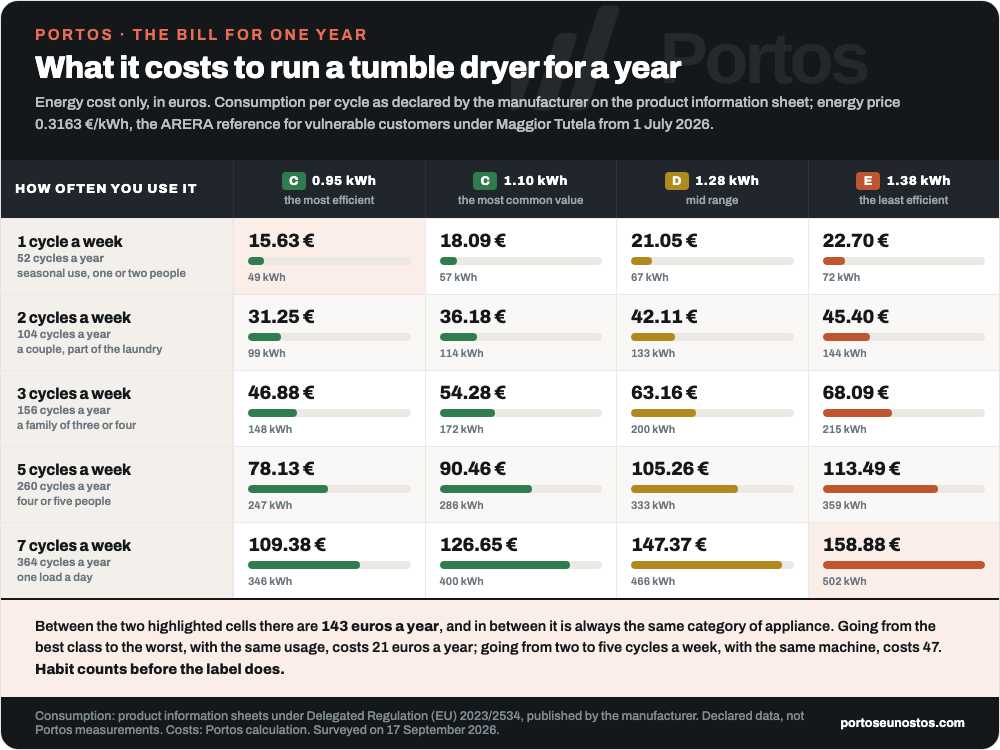
One year's bill: five usage habits for four declared consumption levels. ARERA price for the third quarter of 2026.
The first and last rows tell the whole story: between the upper left corner and the lower right corner there are 143 euros a year, and in between is the exact same type of appliance.
Why habits matter more than class
Let's put the two effects side by side, with everything else equal.
Class effect. At three cycles a week, going from the best Class C to the worst Class E costs just over 21 euros more a year (from €46.88 to €68.09). This is the difference between two different machines, with the same use.
Habit effect. With the same machine and taking the most efficient one in the group, going from two to five cycles a week costs 46.88 euros more a year (from €31.25 to €78.13). This is the difference between two ways of using the same machine.
The second effect is more than double the first. And the two add up: a Class E used five times a week costs €113.49, a Class C used two times costs €31.25. Almost four times as much, and it's not the machine that makes the difference.
Out of this comes a simple hierarchy, which is why this page exists: cycles matter first, then class, then capacity. We've already been precise about capacity elsewhere, with data to back it up: between an 8 and a 9 kg model there's barely more than six euros a year difference, which is last place in this ranking.
How much a single load costs
This is the number you need when you're in front of the machine and wondering whether it's worth turning it on now or waiting.
Class C model at 0.95 kWh: 30 cents per cycle.
Class C model at 1.10 kWh: 35 cents per cycle.
Class D model at 1.28 kWh: 40 cents per cycle.
Class E model at 1.38 kWh: 44 cents per cycle.
Calculated per load of laundry, the bill becomes even more concrete. The most efficient machine dries at about 3.3 cents per kilo, the least efficient at 5.5 cents per kilo. A full nine-kilo load of towels therefore costs thirty cents of electricity to dry: as much as a coffee at the bar every four loads.
To put it directly: a single cycle is not an expense worth postponing. It's the sum of cycles that shows up on your bill.
Which energy price to use
This is the variable most often left implicit, and that's wrong: changing the price changes the result in direct proportion.
The most solid public reference is the ARERA price for vulnerable customers in Standard Protection. From 1 July 2026 it amounts to 31.63 cents per kWh including taxes, up 4.6% from the previous quarter. It breaks down into 16.92 cents for supply, 2.11 for retail sales, plus transport, charges and taxes. The five items add up to exactly 31.63: this is the consistency check that allowed us to validate the data.
But pay attention to one point that almost no one mentions: this price applies only to vulnerable customers who remain under protection, about three million households. If you're on the open market, your price is that of your contract and can be significantly different, higher or lower.
For this reason Portos articles also use a second column at €0.25 per kWh: it's not a market price, it's a stable convention that serves to compare appliances without the result changing every quarter. With that convention the table values drop by about 21%: the €46.88 for three cycles a week in Class C becomes €37.05.
If you have a time-of-use pricing plan, finally, shifting drying to late evening or weekends really does make a difference, because the F3 time slot costs less than F1. How much, though, depends on your contract: the figure is on your bill, not on this page, and we don't make it up.
How much water should be removed from the laundry
To understand whether those numbers are high or low, you need to look at the physical work the machine has to do. This is a step you won't find on a product sheet, but it can be derived from declared data.
Washing machine datasheets, under Delegated Regulation (EU) 2019/2014, declare the residual moisture content at the end of the spin cycle, as a percentage of the weight of dry laundry. We read four datasheets for 9 kg washing machines from the same manufacturer: the declared values are 50.5%, 51.4%, 52.0% and 52.9%.
This means that a full 9-kilo load comes out of the washing machine with approximately 4.6 kilos of water on it. That's over four and a half liters that the dryer has to evaporate and collect.
To evaporate one kilo of water, approximately 0.63 kWh of latent heat is needed. For 4.6 kilos, that makes approximately 2.9 kWh of theoretical energy. The most efficient machine in the group declares 0.95: roughly a third.
It's not an error and it's not magic: it's exactly what a heat pump does. When humid air passes over the condenser, the heat released by the water as it condenses is not thrown away, it's recovered and recirculated. It's the technical reason why these appliances consume less than what the physics of evaporation would require from a heater, and it's why technology matters more than everything else. If you want the full comparison, we did it in our guide on heat pump and condensation.
A note on reading this ratio: the declared value is weighted between full and half load, while the 4.6 kilos of water refers to full load. The one-third ratio is therefore a correct order of magnitude, not a measure of efficiency.
The washing machine spin cycle counts
From those numbers follows a practical consequence that means real money: how much water the dryer has to remove is not decided by the dryer, it's decided by your washing machine.
Dividing the declared consumption by the kilos of water in the drum gives a unit cost of approximately 0.20 kWh for every kilo of water removed, that is just over 6 cents. Over 156 cycles a year, every extra kilo of water per load is therefore worth about 10 euros a year.
How much can it vary? The four washing machines we read are all in spin class B, with values between 50.5% and 52.9%: between the best and worst in the group there's a difference of 0.22 kilos of water on a 9-kilo load, that's just over two euros a year. Within the same class, therefore, the difference is negligible.
The story changes if the washing machine is old or low-end and leaves the laundry much wetter. With a residual moisture of 60% instead of 52%, on the same 9-kilo load there's 0.7 kilos more water: approximately 0.14 kWh and 4 cents per cycle, that is about 70 euros over ten years of use at three cycles a week. It's not the main item on your bill, but it's another reason not to overlook the spin cycle when changing your washing machine. The account for the other half of the laundry room is in how much a washing machine consumes.
The ten-year account: how much extra you might pay
A dryer is not changed every two years. The correct way to use these numbers, facing two different price tags, is to bring them to the appliance's lifetime horizon.
Let's take the difference between the most efficient model (0.95 kWh, class C) and the least efficient (1.38 kWh, class E) in our group, and see what it's worth over ten years.
| Cycles per week | kWh saved per year | Saving per year | Saving over 10 years |
|---|---|---|---|
| 1 | 22.4 | 7.07 euros | 71 euros |
| 2 | 44.7 | 14.14 euros | 141 euros |
| 3 | 67.1 | 21.22 euros | 212 euros |
| 5 | 111.8 | 35.36 euros | 354 euros |
| 7 | 156.5 | 49.51 euros | 495 euros |
Read backwards, this table tells you how much you can reasonably pay extra for the better class. If you do one cycle a week, a premium higher than 70-80 euros doesn't pay for itself: better to put that money into quietness or capacity. If you do five, a premium of 300 euros easily breaks even.
It's the same method we'd use in front of any appliance: the right price doesn't exist in absolute terms, it exists in relation to how often you use it. For all the other selection criteria, the complete guide is how to choose a tumble dryer.
How much it costs not to use one
The question always comes up, and it's legitimate: air drying costs nothing, so the most economical alternative is not to buy one. In part that's true, but the account needs to be looked at in full.
Air drying outdoors, when the weather allows it, genuinely costs nothing in energy and is the best option. There's no technical argument that could say otherwise.
Air drying inside the house is another matter. Those 4.6 kilos of water we counted don't disappear: they end up in the apartment's air. A full load hung up in the living room releases four and a half liters of water into a closed space, typically in winter, with windows shut and heating on. The result is moisture on the windows, extremely long drying times and, in houses more exposed to it, mold in cold corners.
At that point you open the windows or turn on a dehumidifier, and the cost is no longer zero: it's simply shifted to another item and spread across the whole house. By how much, exactly, depends on the appliance and the room, and we don't have a declared figure to derive it from: so we won't write it.
The honest conclusion is this. If you have outdoor space and a climate that lets you use it for a good part of the year, a tumble dryer is a convenience accessory and should be bought knowing there's no financial return. If you live in an apartment without a balcony, the comparison isn't between 47 euros a year and zero: it's between 47 euros a year and a humidity problem to manage anyway.
The items that don't move the balance
For completeness, and to settle them once and for all, here are the items you often read about that weigh little.
Power consumption when off. The datasheets declare 0.30–0.50 W when powered down. Leaving the machine plugged in all year you get about 4.4 kWh, that is 1.39 euros. Unplugging it is not a savings strategy.
Delayed start. It draws 4.00 W declared while waiting. Six hours of wait is 24 watt-hours, less than a cent. Even using it with every cycle, over a year you stay under two euros.
Maintenance. Filters and the condenser are cleaned with water, not replaced. There's no consumable material, unlike what happens with other appliances. Maintenance costs time, not money, and should be done because a clogged filter extends cycles and so raises actual consumption.
Water. A tumble dryer doesn't consume water. It produces it, in fact, and it needs to be emptied or drained.
Five practical ways to lower the bill
None of these is a trick: they're direct consequences of the numbers we've seen so far.
Fill the drum. On the models analyzed the half-load program takes 57% to 67% of the time of a full load, never half. Two half loads therefore cost more than one full load, in time and energy.
Increase the spin speed on items that can take it. Every kilo of water removed in the washing machine is roughly 0.20 kWh the tumble dryer doesn't have to spend, and the spin cycle removes that water at much lower cost.
Use the sensor program, not the timer. Modern models measure humidity and stop on their own: manually setting twenty more minutes is wasted energy and stressed fabrics.
Don't dry cotton and synthetics together. The cycle adjusts to the slowest item, so the synthetic stays in much longer than necessary.
Clean the filter with every load. It's the only truly daily maintenance and directly impacts cycle length.
Mistakes to avoid
Comparing the declared consumption of a tumble dryer with that of a washing machine. They're not the same unit: the washing machine declares consumption per hundred cycles, the tumble dryer per one. Comparing them directly leads to conclusions wrong by two orders of magnitude.
Choosing the class without counting cycles. It's the costliest mistake in the literal sense: paying 300 euros more for a better class while using it once a week means never breaking even.
Taking an annual cost found online at face value without knowing how many cycles and what kWh price is behind it. As the table shows, with the same appliances you can write any number between 16 and 159 euros. If these two variables aren't stated, the number means nothing.
Considering the tumble dryer an investment that pays for itself. It isn't, and shouldn't be: it's an appliance that buys time and space. What pays for itself, if anything, is the difference between one class and another.
Ignoring noise because it doesn't show up in your bill. If the machine is in the kitchen or near the bedroom, the declared decibels decide whether you can run it in the evening, that is whether you can use the hours when energy costs less.
The Portos choice
The annual cost of a tumble dryer is a function of two variables, and almost everyone tells only one. Energy class shifts the bill by up to 45% at equal use; the number of cycles shifts it by a factor of seven.
Our advice is therefore to work out the costs in this order. First estimate your actual cycles by counting for one week. Then find the corresponding row in the table and read the four columns: that is the range within which your bill will fall, whatever model you choose. Only then look at the price difference between two machines and ask yourself whether the delta over ten years justifies it.
If your use is occasional, less than two cycles a week, choose the machine that appeals to you for capacity, quietness and programs: the class is almost irrelevant, and the numbers prove it. If your use is daily, class becomes the first thing to look at and a surcharge of a few hundred euros for the more efficient model is money well spent.
In both cases it's worth checking that the capacity is at least equal to that of your washing machine, otherwise every full load will need to be split into two and the count of cycles, which is the variable that weighs most heavily, will double by itself.
Compare prices and availability of heat pump dryers on SniffaPrezzi, keeping the row of the table that matches your habits at hand.
Method and limitations of this calculation
Portos does not physically own these appliances and has not measured them. All consumption values, capacity and residual moisture mentioned are data declared by the manufacturer in mandatory product information sheets, downloaded and read one by one in September 2026.
Costs in euros are our calculations: declared consumption multiplied by the number of cycles, multiplied by the energy price indicated. The price used is ARERA's for the third quarter of 2026 for vulnerable customers in Enhanced Protection. It is not the free market price and it is not your price: it is a public and verifiable reference.
The actual consumption of a cycle depends on the program chosen, the type of fabric, the drying level set, the room temperature and the condition of the filters. The declared value refers to the standard program, which is also the most efficient: in daily use, with fast or high temperature programs, actual consumption is typically higher.
Finally, consumption per kilogram and the relationship with evaporation energy are obtained by dividing a weighted value between full and half load by nominal capacity. They are comparative indications, not measurements. Where a figure could not be verified from a primary source, it has not been written on this page.
Sources
Delegated Regulation (EU) 2023/2534, energy labelling of household tumble dryers.
Delegated Regulation (EU) 2019/2014, energy labelling of washing machines, from which the residual moisture data comes.
Manufacturer product information sheets: WQB246D0IT, WTH83208II, WTR85V08IT and WGG244Z0IT for the washing machine.
ARERA, reference electricity price for the third quarter of 2026.
EPREL, European product database for energy labelling.
Manufacturer's official website for technical documentation of the mentioned models.