The Bosch WIW24342EU costs 832.89 euros and declares class C. That is not a contradiction: it is a washing machine designed to disappear behind a cabinet door and to make itself heard as little as possible, not to use little energy. As of 29 September 2026 it is also the only built-in washing machine Bosch still keeps in its active catalogue.
We read the EU product fiche, the technical data sheet and the 64 specifications the manufacturer publishes, and compared them with the neighbouring models: 41 dB while washing against 51 for the equivalent freestanding Bosch, 0.624 kWh per cycle and 252.45 euros of difference with the 1400 rpm twin, which has exactly the same fiche apart from two points of residual moisture.
The Bosch WIW24342EU costs 832.89 euros and declares class C. Put like that it sounds like a contradiction, and instead it is the exact summary of what this machine is: a washing machine that was not designed to use little energy, but to disappear behind a cabinet door and to make itself heard as little as possible.
It is a Series 6, 8 kg, 1200 rpm, fully integrated. As of 29 September 2026 it is also the only built-in washing machine Bosch still keeps in its active catalogue: the other one, the 1400 rpm WIW28542EU, opens on the manufacturer's own site with the line This product is no longer available, while remaining on sale at retailers.
We read the EU product fiche, the Italian technical data sheet and the 64 specifications Bosch publishes on the product page, and we compared them with those of the neighbouring models. Three figures come out of it, and they decide the purchase: 41 dB during the wash, 0.624 kWh per cycle and 252.45 euros, which is what the identical model with 200 rpm more costs.
The answer in one line. It makes sense if the washing machine has to sit in a kitchen or in a bathroom on show and silence matters more than the electricity bill: 41 dB during the wash is ten less than the equivalent freestanding Bosch. It makes no sense if you are after efficiency, capacity beyond 8 kg, advanced features or the option of stacking a dryer on top, because that last one is not provided for.
In short: what you will find in this analysis
Why it declares class C: the 48 degrees of the eco programme
Noise: 41 dB during the wash, and this is where the price makes sense
Dimensions and installation: the millimetres that decide whether it fits
The specification at a glance
Every value in this table is taken from the product information sheet required by Commission Delegated Regulation (EU) 2019/2014, issued by Bosch on 11 December 2025, and from the Italian technical data sheet for the same model.
| Item | Declared value |
|---|---|
| Product | Bosch Series 6 WIW24342EU |
| Type | Front-loading built-in washing machine, fully integrated |
| Capacity | 8.0 kg |
| Energy efficiency class | C (EEIW index 68.6) |
| Eco 40-60 programme consumption | 0.624 kWh and 45 litres per cycle |
| Eco 40-60 programme duration | 3 hours 26 minutes at rated capacity |
| Spin | 400-1200 rpm, class B, residual moisture 53.4% |
| Noise | 41 dB(A) washing, 66 dB(A) spinning, class A |
| Product dimensions | 81.8 x 59.6 x 54.4 cm (57.4 cm deep including the door) |
| Net weight | 76.1 kg |
| Power supply | 2300 W, 10 A, 220-240 V, 210 cm cable |
| EAN code | 4242005348848 |
| Warranty declared by the supplier | 24 months |
| Portos verification date | 29 September 2026 |
We have not tested it. This is a Portos editorial assessment built by reading the official documents and comparing them with those of competing models: the data are declared by the manufacturer, the conclusions are ours.
The only Bosch built-in washing machine still in production
Let us start with a fact that changes the perspective. In its Italian catalogue Bosch today has two fully integrated washing machines: this 1200 rpm WIW24342EU and the 1400 rpm WIW28542EU. The product page for the second one, however, opens with the heading This product is no longer available.
That means anyone buying a built-in Bosch today effectively has one single reference in production, and this is it. That is no small detail when the machine has to be built into a made-to-measure unit: if in three years' time a replacement model with the same dimensions is needed, this will be the only benchmark.
On the spare parts front the risk is covered by law in any case. Regulation (EU) 2019/2023 requires manufacturers to guarantee spare parts for washing machines for ten years from the placing on the market of the last unit, with delivery within fifteen working days. A model declared out of production today therefore remains serviceable for a decade: that is why we do not consider the end of production, on its own, a reason to rule out an appliance.
What it offers
The WIW24342EU is a deliberately essential washing machine when it comes to features, and a very carefully built one mechanically. The equipment Bosch declares that genuinely affects everyday use comes down to five items.
SilentPowerDrive motor. A brushless motor, therefore without the parts that wear out through friction. It is the basis for the 41 dB during the wash.
AntiVibration Design. Shaped side panels and increased insulation, designed for stability. On a machine working boxed in between two cabinet panels this is not styling: it is what stops the door from rattling.
Automatic load recognition with ActiveWater. Sensors that estimate the amount and type of fabric and dose the water accordingly. Bosch declares up to 50% water saved on reduced loads, and that figure applies only to half loads: the value on the fiche, 45 litres, refers to the rated capacity.
AquaStop. A double-walled inlet hose, a safety valve and a base tray with a float switch. The technical data sheet specifies that Bosch's water damage warranty covers the entire life of the appliance, not the standard 24 months. On a machine shut inside a cabinet, where a leak is discovered late, this is the most important feature on the list.
Add laundry function. Press a button, open the door and slip in the garment you forgot. Behind a cabinet door, where opening up takes two movements instead of one, it gets used less than you might think, but it is there.
Completing the picture are the Wave drum, interior drum lighting, an LED display with a delay start of up to 24 hours, the AllergyPlus hygiene programme and the SpeedPerfect option, which Bosch declares can cut the duration of the Synthetics 40 degree programme by up to 65%.
The standard programmes listed on the Italian technical data sheet are Cotton, Synthetics, Delicates/Silk and Wool/Hand wash, plus the special programmes AllergyPlus, Shirts, Drain and spin, Mix, Rinse and Quick 15/30 minutes. We should flag a discrepancy in the manufacturer's own documentation: the specification table on the Bosch product page lists the Delicates/Silk programme as absent, while the technical data sheet lists it among the standard ones. If that programme is decisive for you, ask the seller in writing before ordering: this is exactly the kind of data point we are not prepared to confirm.
Why it declares class C: the 48 degrees of the eco programme
A washing machine's energy class comes from the EEIW index, and the scale in Commission Delegated Regulation (EU) 2019/2014 is this: A up to 52, B from 52 to 60, C from 60 to 69, D from 69 to 80. The WIW24342EU declares 68.6, which is class C four tenths of a point away from D. It sits at the bottom of its class, not at the top.
The reason is readable in one line of the fiche that hardly anyone looks at, the maximum temperature inside the treated textile. On the eco 40-60 programme at rated capacity this machine reaches 48 degrees. The freestanding 8 kg, 1200 rpm Bosch, the WGE03200IT, stops at 36. The freestanding Series 6 WGG244ZRIT at 38.
Heating water is almost all of a washing machine's consumption, so twelve degrees more explain the change of class on their own. But those twelve degrees are not wasted: the same fiche declares a washing efficiency index of 1.040, against 1.031 for both freestanding models we compared. It is the highest figure of the five.
And there is a third element pointing the same way. This machine's eco programme lasts 3 hours and 26 minutes, against 3:33 and 3:48 for the freestanding models. Hotter, quicker, with a better washing index and with less water: 45 litres against 47 and 50.
The correct reading, then, is not that this washing machine is badly designed. It is that its eco programme is tuned to a different compromise: it washes slightly better, half an hour quicker, with two to five litres less water, and it pays for all of that in energy. If you want to understand how the scale works and why two identical machines can sit in different classes, we wrote about it in our guide to the energy label.
Consumption: 0.624 kWh, 45 litres and 51.32 euros a year
The declared values are 0.624 kWh and 45 litres per cycle on the eco 40-60 programme at rated capacity. We use the same reference we apply across the whole site: 260 cycles a year, that is five washes a week, and 0.3163 euros per kWh, the ARERA price for the third quarter of 2026 for vulnerable customers on the regulated tariff.
| Item | Per cycle | Per year (260 cycles) | Over ten years |
|---|---|---|---|
| Energy | 0.624 kWh | 162.24 kWh | 1,622 kWh |
| Energy cost | 19.7 cents | 51.32 euros | 513.17 euros |
| Water | 45 litres | 11,700 litres | 117,000 litres |
The interesting number is the last one in the second row. Over ten years this washing machine uses 513.17 euros of electricity, that is 61.6% of its purchase price. It is not an isolated case, it is the rule in this product category, and it is the reason the energy class deserves attention even when the price difference looks small.
The comparison that really counts is with the equivalent freestanding Bosch: same brand, same capacity, same spin speed, the only difference being the type of installation.
| Parameter | WIW24342EU (built-in) | WGE03200IT (freestanding) |
|---|---|---|
| Capacity and spin | 8 kg, 1200 rpm | 8 kg, 1200 rpm |
| EEIW index and class | 68.6, class C | 50.7, class A |
| Energy per cycle | 0.624 kWh | 0.461 kWh |
| Water per cycle | 45 litres | 47 litres |
| Noise while washing | 41 dB(A) | 51 dB(A) |
| Noise while spinning | 66 dB(A) | 71 dB(A) |
| Net weight | 76.1 kg | 71.1 kg |
| Price recorded on 29/09/2026 | 832.89 euros | 544.00 euros |
| Energy over ten years | 513.17 euros | 379.12 euros |
| Total cost over ten years | 1,346.06 euros | 923.12 euros |
Choosing the built-in option, on this pair, costs 422.94 euros over ten years: 288.89 of purchase price and 134.05 of electricity. In exchange it gives ten decibels while washing, five while spinning, five centimetres less depth and 520 litres less water every year, which is the only parameter where the built-in wins.
If you are interested in the overall consumption picture for this category, including the difference between the rated figure and real consumption, we covered it in how much energy a washing machine uses.
The spin: class B, six tenths away from C
The spin class measures how much water is left in the laundry at the end of the cycle. The thresholds in the regulation are: A below 45% residual moisture, B from 45 to 54, C from 54 to 63. This machine declares 53.4%, which is class B six tenths of a point away from C.
Translated: on a full load of 8 kg of dry laundry, at the end of the spin roughly 4.3 kg of water remain in the fabrics. These are normal figures for a 1200 rpm machine, but they are not brilliant ones, and they need bearing in mind if the laundry then has to be dried indoors.
One figure struck us: the 544 euro freestanding Bosch, with the same maximum spin speed, declares 53.0%, so marginally better. On this parameter the 288.89 euros of difference buy nothing.
A useful note on reading the fiche. The declared speed stays 1200 rpm at rated capacity, at half load and at quarter load: the machine does not slow down when the drum is less full. What does fall is the temperature, from 48 to 38 and then to 25 degrees, and the duration, from 3:26 to 2:40 and then to 2:25. Anyone who often washes half loads, in other words, is using a machine that consumes appreciably less than the rated figure.
The 252.45 euros of those two hundred extra rpm
Here comes the most useful comparison in the whole analysis, and it does not involve the competition: it involves the two twin models from the same industrial group.
We placed the three EU product fiches of the BSH group's built-in washing machines side by side: the WIW24342EU, the WIW28542EU and the Siemens WI14W542EU.
| Declared parameter | Bosch WIW24342EU | Bosch WIW28542EU | Siemens WI14W542EU |
|---|---|---|---|
| EEIW index and class | 68.6, class C | 68.6, class C | 68.6, class C |
| Energy per cycle | 0.624 kWh | 0.624 kWh | 0.624 kWh |
| Water per cycle | 45 litres | 45 litres | 45 litres |
| Washing efficiency index | 1.040 | 1.040 | 1.040 |
| Rinsing effectiveness | 5.0 g/kg | 5.0 g/kg | 5.0 g/kg |
| Eco programme duration | 3:26 | 3:26 | 3:26 |
| Noise washing and spinning | 41 and 66 dB(A) | 41 and 66 dB(A) | 41 and 66 dB(A) |
| Dimensions and net weight | 818x596x544 mm, 76.1 kg | 818x596x544 mm, 76.1 kg | 818x596x544 mm, 76.1 kg |
| Maximum spin | 1200 rpm | 1400 rpm | 1400 rpm |
| Residual moisture and class | 53.4%, class B | 51.4%, class B | 51.4%, class B |
| Price recorded on 29/09/2026 | 832.89 euros | 1,085.34 euros | 1,362.43 euros |
The three fiches are identical line by line except in two cells. The 200 extra rpm of the WIW28542EU buy exactly two percentage points of residual moisture, and they do not even move the spin class, which stays B on all three.
Two points on a full 8 kg load is 160 grams of water per cycle, a little more than a glassful. Over 260 washes a year that is 41.6 kilos less water to evaporate. This is what 252.45 euros of price difference buys, on a model the manufacturer declares out of production.
The Siemens case is even starker: a fiche identical field by field to that of the 1400 rpm Bosch, and 277.09 euros more. In the built-in segment, where there are very few references and the chassis are shared, the badge weighs more than the technology. We found the same thing when comparing the two brands' freestanding ranges in Bosch or Siemens: what are the real differences.
The practical conclusion is simple: within the BSH group's built-in family, the WIW24342EU is the rational choice. It is the cheapest, it is the only one in production, and it gives up an advantage measured in a glass of water.
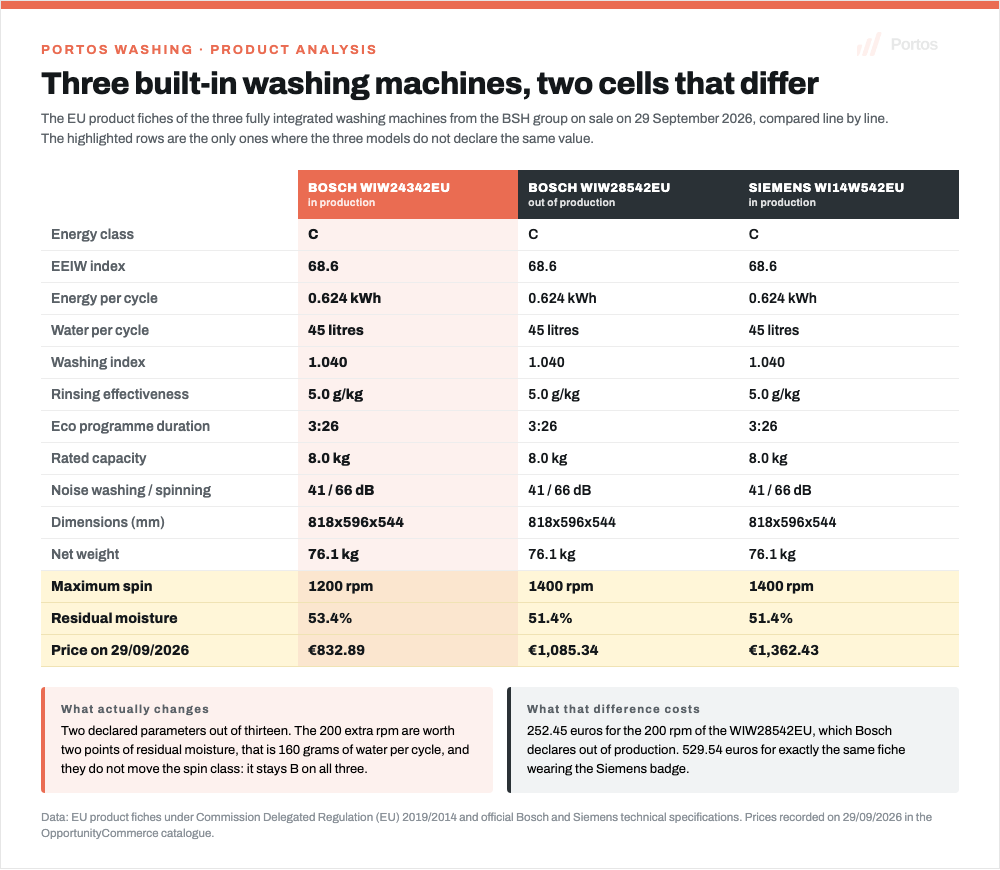
The BSH group's three built-in washing machines compared: out of thirteen declared parameters, only two cells change.
Noise: 41 dB during the wash, and this is where the price makes sense
Bosch declares two noise figures for this machine: 41 dB(A) during the wash phase and 66 dB(A) during the spin, with noise emission class A. The regulated figure on the label is the second one, the spin; the first appears only in the extended technical specifications, and it is the one that matters more in real life, because the spin lasts a few minutes while the wash lasts three hours.
The comparison with the equivalent freestanding Bosch says this: 41 dB against 51. Ten decibels correspond to one tenth of the sound power and, in terms of perception, to roughly halving the apparent volume. This is not a difference in shading: it is the difference between hearing the washing machine from another room and not hearing it.
During the spin the gap narrows to five decibels, 66 against 71, which is about one third of the sound power. It is worth noting that both are in noise class A: the class A threshold is set below 73 dB, so practically every washing machine on sale reaches it and the letter on the label distinguishes nothing. The figure in decibels does.
Where the quiet comes from can be read in two data points. The first is the SilentPowerDrive motor, without brushes. The second is the weight: 76.1 kg against 71.1 for the freestanding machine, which is larger. Five kilos more on a smaller body means more counterweight and more insulation per litre of volume, and that is the part of the engineering you pay for.
A necessary caveat: these values are measured on the bare appliance, following the procedure in the regulation. The cabinet door comes on top of that, and in a kitchen with a continuous plinth and side panels in contact the perceived result can improve further or get worse, if the structure starts to resonate. That is why AntiVibration Design matters more on a built-in model than on a freestanding one.
Dimensions and installation: the millimetres that decide whether it fits
On a built-in washing machine the dimensions are not a detail to check afterwards: they are the first thing to check, because the cabinet does not adapt to the machine. The values declared by Bosch are these.
Product dimensions: 818 x 596 x 544 mm (height, width, depth excluding the door).
Depth including the door: 574 mm.
Depth with the door open at 90 degrees: 956 mm. This is the figure you need to work out whether there is room in front of the machine to stand and load it.
Packed dimensions: 875 x 640 x 640 mm. That is for transport, not for the recess.
Foot adjustment: 12 mm.
Adjustable base: 15 cm in height and 6.5 cm in depth, with the rear feet adjustable from the front. On a machine that has to be slid into a recess, being able to set the rear feet without pulling it out is a real advantage during installation.
Reversible cabinet hinges, with the appliance door hinge on the left.
Power cable: 210 cm.
The 81.8 cm of height is the key figure: it fits under a standard worktop, which sits at around 90 cm, and leaves the margin for the plinth and for the worktop itself. The 54.4 cm of depth allow it to line up with a 60 cm kitchen base unit, where a normal washing machine, 58.8 cm deep, would stick out.
Beyond that, one rule does not change: the recess dimensions must come from the installation instructions, not from an article. What you need to know before going to the shop is that this machine goes into a recess of roughly 82 x 60 x 56 cm with tolerances of a few millimetres.
What you will not be able to do: stack a dryer
Among the 64 specifications Bosch publishes there is one worth more than many others, and no price list highlights it: stacked installation, No.
On the freestanding WGE03200IT the same item says Yes, with a stacking kit. On this one, no. And the geometry confirms it: with 81.8 cm of height under a worktop there is no physical room to place a second appliance on top.
The consequence is that the choice is irreversible as far as drying is concerned. If a tumble dryer is needed in two years' time, there will be three routes: find it a place of its own, replace the washing machine with a built-in washer-dryer, or drop the idea. There are no fully integrated built-in tumble dryers in the catalogue we surveyed.
This is the first point we suggest clarifying before ordering, because it is the one that cannot be put right afterwards. If a dryer is in the plans, it is worth reading how to choose a tumble dryer first and deciding the washing machine's installation afterwards, not the other way round.
Ease of use: what is on the panel and what is missing
Control is by programme dial, with touch buttons for Finish in, SpeedPerfect, Start and Add laundry, spin selection and spin cancel, and an LED display showing the current phase and the remaining time. Delay start goes up to 24 hours. There is interior drum lighting, useful on a machine sitting in shadow behind a door, and an end of programme buzzer.
What is not there, at 832.89 euros, deserves stating just as clearly. On the basis of Bosch's specifications this washing machine does not have:
Home Connect, so no app control and no notifications on your phone;
i-DOS automatic detergent dosing;
soil level detection, which is a different thing from the load sensor, which is present;
a dual hot and cold water inlet;
a cold wash programme, nor dedicated programmes for duvets, sportswear or technical fabrics;
a stain removal function;
a removable top, which on a built-in machine is consistent but worth knowing.
Put another way: the price does not pay for features, it pays for the mechanical engineering and the format. On a freestanding Bosch in the same price bracket you find automatic dosing and connectivity; here you do not, and that is not an oversight, it is the consequence of what it costs to fit a washing machine into 54.4 cm of depth.
One standby detail completes the picture: the fiche declares 0.12 W in off mode, 0.50 W in standby, 0.00 W in networked standby, consistent with the absence of Wi-Fi, and 1.00 W with delay start active. That last figure is almost double the freestanding models we compared, which declare 0.55 and 0.60 W. If you use delay start every day, leaving the machine waiting for eight hours, that is roughly 2.9 kWh a year, less than a euro: we flag it for completeness, not as an argument for choosing.
Maintenance and durability
Routine maintenance is the same as on any front-loading washing machine, with one complication: the cabinet door. The drain filter and the door seal sit behind the furniture panel, so jobs that take two minutes on a freestanding machine here require opening the door and working in a tighter space.
The practical consequence is not technical, it is behavioural: on a built-in machine maintenance tends to get put off, and the problems that come from putting it off are the same as ever. We described them in why your washing machine smells and in our guide on how to clean the filter and the gasket: on a built-in model they should be read as a reminder to put in the calendar, not as a job to do once the problem shows up.
On reliability, the two documented elements are the brushless motor, which removes the most predictable wear part, and AquaStop with Bosch's water damage warranty for the entire life of the appliance. This second point deserves attention precisely because of the type of installation: a leak behind a closed cabinet door is discovered once it has already soaked the unit.
The warranty declared on the EU product fiche, on the other hand, remains the statutory one, 24 months. The extensions advertised by retailers do exist, but they are services subject to registration and conditions: the figure certified by the manufacturer on the fiche is 24 months, and that is what we report.
Strengths
41 dB while washing. Ten less than the equivalent freestanding Bosch, that is one tenth of the sound power, on the phase that lasts three hours.
The cheapest and the only one in production of the BSH group's three built-in models, with fiches identical to the other two on every parameter except the spin.
Washing efficiency index of 1.040, the best of the five Bosch and Siemens models we compared, and the shortest eco cycle of the five at 3 hours 26 minutes.
45 litres per cycle, the lowest water consumption in the comparison group: 520 litres a year less than the equivalent freestanding Bosch.
AquaStop with Bosch's lifetime water damage warranty, which on an appliance hidden inside a cabinet is the most relevant protection there is.
Installation thought through properly: reversible cabinet hinges, a base adjustable by 15 cm in height and 6.5 in depth, rear feet adjustable from the front.
54.4 cm of depth, which lines it up with a standard kitchen base unit.
Limits
Class C, four tenths away from D. 0.624 kWh per cycle is 513.17 euros of electricity over ten years, 61.6% of the purchase price.
No stacked installation. A dryer on top is not provided for, and the decision cannot be reversed later.
Capacity capped at 8 kg, which is the limit of the whole built-in category, not of this model.
Residual moisture of 53.4%, class B six tenths away from C, worse than the 544 euro freestanding Bosch with the same spin speed.
Basic equipment for the price: no Home Connect, no i-DOS, no soil detection, no cold wash, no programmes for duvets or technical fabrics.
More awkward maintenance, because the filter and the seal sit behind the cabinet door.
A discrepancy in the manufacturer's documentation on the Delicates/Silk programme, present on the technical data sheet and absent from the online specification table.
Who we recommend it to
It makes sense to buy in three specific situations.
When the washing machine has to sit in a kitchen or in a bathroom on show. This is what it was made for: the door makes it disappear, the worktop stays continuous, the 54.4 cm of depth align it with the base units. If the kitchen design is already done and includes the recess, there is no sensible alternative within the Bosch range.
When quiet is the main criterion. In a studio flat, in a home with bedrooms next to the laundry area, or if the habit is to start the wash in the evening, those 41 dB change daily life more than an energy class does. With the 24 hour delay start and an evening time slot the machine works when nobody can hear it.
When you want a built-in Bosch without paying the twins' premium. If you have already settled on the BSH group and on a built-in machine, this is the reference to take: the other two cost 252.45 and 529.54 euros more for two points of residual moisture.
Who we do not recommend it to
There are more appropriate alternatives in four cases.
If the washing machine goes in a utility bathroom, a laundry room or a storage cupboard. There nobody sees it and nobody hears it: paying 288.89 euros more to make it disappear, plus 134.05 of electricity over ten years, has no justification. The WGE03200IT does the same job in class A.
If a tumble dryer is in the plans, even just as a possibility. Stacking is not possible and it will not become possible. Anyone thinking of adding one should choose two stackable freestanding appliances, or consider a built-in washer-dryer, of which the catalogue we surveyed has several references.
If you wash loads of more than 8 kilos. This is not a limit of the model, it is a limit of the category: every built-in washing machine stops at 8 kg. With a large family or with heavy linen the right format is a different one, and we worked through the sizing question in washing machine 8, 9 or 10 kg.
If you are after advanced features. At 832.89 euros, in freestanding form, you can buy automatic dosing, connectivity and class A. Here you are buying the format. They are two different purchases.
Alternatives
Three concrete alternatives, recorded on 29 September 2026, each answering a different objection.
Bosch WIW28542EU, 1,085.34 euros. The 1400 rpm twin. An identical fiche on every parameter except the spin, 51.4% residual moisture against 53.4, the same class B. It only makes sense if you dry your laundry indoors and those 160 grams of water per cycle genuinely matter to you. Bear in mind that the manufacturer declares it out of production.
Bosch WGE03200IT, 544.00 euros. A freestanding Series 2, 8 kg, 1200 rpm, class A with 0.461 kWh per cycle. It costs 288.89 euros less, uses 26% less energy and accepts a stacked dryer. In exchange it is ten decibels louder while washing, it is 58.8 cm deep and it stays in view. This is the alternative to consider seriously if the aesthetic constraint is not a real one.
Bosch Series 6 WGG244ZRIT, 779.00 euros. Nine kilos, 1351 rpm, class A. It costs less than this one and sits a tier above on capacity and efficiency, still freestanding. We analysed it in detail in our analysis of the WGG244ZRIT: it is the comparison that makes clear what the built-in format costs in performance.
In the 60 cm built-in segment there are then another eight references from other brands, from 402 to 1,362.43 euros. We are not putting them in a table alongside this one because we were unable to read their EU product fiches in verifiable form, and comparing prices without comparing declared data does not help anyone decide. If you want a sense of current prices across the whole category you can compare offers on built-in washing machines on SniffaPrezzi, where on 29 September 2026 there were 61 listings.
Portos assessment
The WIW24342EU is a machine consistent with its purpose, sold at a price that only makes sense if that purpose is yours. It is not an efficient washing machine and it does not try to be: it is a quiet washing machine, shallow in depth and designed to sit inside a cabinet.
The verdict splits in two. As a built-in washing machine it is the best choice in its family: the least expensive, the only one in production, with the same figures as the two dearer ones on everything except two hundred rpm of spin. On that count we recommend it without reservation.
As a purchase in absolute terms, on the other hand, it needs justifying. It costs 422.94 euros more than the equivalent freestanding Bosch over ten years, it loses a class and a half of efficiency and it closes the door on a stacked dryer for good. If the built-in recess already exists in the kitchen design, that money is the price of a solution with no substitutes. If the recess is an aesthetic preference that can still be changed, it is worth doing the sums again.
The question to ask is not whether it is a good washing machine, because within the limits of its format it is. It is whether the built-in format is genuinely a constraint, or just a design habit. The full comparison between the two families is in built-in or freestanding washing machine.
Price and availability
On 29 September 2026 the WIW24342EU was offered at 832.89 euros with declared availability in 15 to 20 working days. That is the eighth price out of eleven 60 cm built-in washing machines in the same catalogue, which range from 402 to 1,362.43 euros, with a middle value of 757.28 euros.
You can check the WIW24342EU listing on OpportunityCommerce for the current price and availability, or see all the fully integrated washing machines in the catalogue. For a wider price comparison, the built-in washing machine search on SniffaPrezzi remains useful.
A word of warning on prices: in this category the swings are wide and frequent. The values quoted throughout the article were recorded on 29 September 2026 and are there to reason about orders of magnitude, not to fix a price list. The relative differences between models, on the other hand, tend to hold.
Documentation
All the technical data in this analysis come from the manufacturer's official documents, which you can consult directly.
Bosch product page for the WIW24342EU, with the full specification table.
Product information sheet under Commission Delegated Regulation (EU) 2019/2014, in PDF, issued on 11 December 2025.
Bosch manual search, where the instruction booklet and the installation instructions can be downloaded by entering the model code.
Bosch component warranties, for the terms of the AquaStop warranty.
Bosch energy label area, indicated by the product information sheet itself as the source for the information required by Regulation (EU) 2019/2023.
Also worth reading
Built-in or freestanding washing machine: what really changes, the full comparison between the two families across nine models.
How to choose a washing machine, the general guide to capacity, consumption and features.
Bosch Series 6 WGG244ZRIT and Bosch Series 8 WGB24402IT, the two analyses of the freestanding models in the same range.
How much energy a washing machine uses, to understand the gap between the rated figure and real consumption.
Sources
Bosch, product information sheet for the WIW24342EU under Commission Delegated Regulation (EU) 2019/2014, issued on 11 December 2025. Same fiches for the WIW28542EU (11 December 2025), Siemens WI14W542EU (29 November 2025), WGE03200IT (8 February 2025) and WGG244ZRIT (29 November 2025).
Bosch, Italian technical data sheet for the Series 6 WIW24342EU, with programmes, installation dimensions and power supply data.
Bosch, product specification table published on the official WIW24342EU page, 64 items, consulted on 29 September 2026, and the corresponding pages for the WIW28542EU and WGE03200IT.
Commission Delegated Regulation (EU) 2019/2014, energy labelling of household washing machines and washer-dryers: thresholds for the energy efficiency, spin-drying and noise classes, and definition of the product fiche parameters.
Commission Regulation (EU) 2019/2023, ecodesign requirements for household washing machines: the obligation to make spare parts available for ten years and the delivery times.
EPREL, the European product database for energy labelling, where product information sheets are filed by manufacturers.
ARERA, reference electricity price for vulnerable customers on the regulated tariff, third quarter of 2026: 0.3163 euros per kWh, used for every cost calculation.
OpportunityCommerce catalogue, fully integrated washing machines category: survey of 11 references measuring 60 cm and price recording on 29 September 2026.
Portos editorial assessment based on the manufacturer's documentation. The appliance was not tested in a laboratory: we do not declare measurements of our own and we do not attribute to Portos tests we have not carried out. Next review scheduled by 28 December 2026.