How often you should clean the filter, the condenser and the tank of a tumble dryer is not a tip: it is information Regulation (EU) 2023/2533 obliges the manufacturer to put in the booklet. We read the booklets of five Bosch heat pump dryers and found that the table of contents alone tells you which maintenance awaits you for the next ten years. Plus the sums on how much water you are really handling and on the spare parts you are entitled to by law.
The question everyone asks after a few months with a heat pump tumble dryer is always the same: how often should the filter be cleaned, how often the condenser, how often should the tank be emptied. The answer circulates online in dozens of different versions, and almost none of them says where the number comes from.
That frequency is not a tip: it is a piece of information the manufacturer is legally obliged to put in the instruction booklet. Regulation (EU) 2023/2533, Annex II, requires the instructions to cover the cleaning of the filters including the optimal frequency, the procedure, and the main consequences of insufficient cleaning. So the place to look for the answer is not a blog: it is the manual you already own.
This guide does something the booklet does not do: it compares the booklets of five heat pump tumble dryers from the same manufacturer and shows that the maintenance required changes from model to model in a predictable way, that you can tell which is which from the table of contents before you even buy, and that how much water you are handling can be worked out from the label figures with two multiplications.
The short answer
The lint filter is cleaned at the end of every programme: it is the only genuinely daily task and the only one the booklet lists as an energy saving measure as well as a fire safety one. The condensate tank is emptied at the end of the cycle, or when the machine pauses the programme to ask you, unless you have connected the drain hose. The second filter, the one in the base unit, exists only on some models and is cleaned when the warning appears on the display: on current machines the booklet says explicitly that it does not need doing after every drying cycle.
The condenser itself, on the other hand, is not to be touched. On a heat pump dryer Bosch service states that the cleaning operation must be carried out by professionals. Every guide that explains how to pull out and rinse the condenser of a heat pump dryer is describing a different machine from yours.
What you will find in this guide
The lint filter: after every cycle, and it is not a suggestion
The spare parts you are entitled to by law, and what they cost
Why the right frequency is written in the booklet
Since 1 July 2025 household tumble dryers sold in Europe have been governed by Regulation (EU) 2023/2533 on ecodesign, which replaced the old Regulation 932/2012. Among the information obligations, Annex II lists the maintenance operations the instructions have to cover. One by one.
| Point | What the booklet has to explain |
|---|---|
| a) | Correct installation, levelling, electrical and water connections |
| b) | Cleaning of the filters, including the optimal frequency, the procedure and the main consequences of insufficient cleaning |
| c) | Emptying of the water tank, for condenser dryers not connected to a water outlet |
| d) | Periodic cleaning, including the optimal frequency |
| e) | Door opening between drying cycles, where appropriate |
| f) | Foreign object removal |
| g) | The meaning of errors and the action required, including those that need professional assistance |
| h) | How to access professional repair services |
Point b) also contains a requirement almost nobody knows about: the instructions must state that the lint should be thrown in the rubbish bin and not washed down the drain, in order to avoid spreading microplastics in the used water system. This is not somebody's good practice: it is written into a European regulation, and it duly appears word for word in the Bosch booklets we read, complete with the suggestion of filtering the washing water through a coffee filter.
The reason the European Union took an interest in maintenance is stated in the recitals of the regulation itself: the service life of household tumble dryers has fallen from 14 to around 12 years, and the trend is set to continue in the absence of incentives for proper maintenance and repair.
The lint filter: after every cycle, and it is not a suggestion
On all five machines we examined the lint filter is in two parts, housed in the door rim, and the booklet procedure is identical: open the door, remove the lint from inside, pull out the two filter parts one after the other, clear the filter cavity making sure the lint does not get into the air duct, open both filters and remove the lint, wash them thoroughly under hot running water and dry them before refitting.
The booklet asks you to do this at the end of every drying programme, or when the warning appears on the display during operation. There are three reasons, and all three are in the instructions.
The first is safety: under the warning risk of explosion the manual states that residues in the lint filter could catch fire during drying, and prescribes cleaning the lint filter regularly. The second is consumption: filter cleaning appears in the energy saving chapter, alongside spinning the laundry before drying and making full use of the load. The third is operation: if the appliance is not cleaned as described, its operation may be impaired.
One point of method is worth insisting on. Bosch states on its own official pages that only 50 per cent of dryer owners carry out this cleaning regularly after every load, and that this has a negative effect on drying results and on efficiency, because energy consumption is higher if the filters are not cleaned. That is a useful admission, but it remains qualitative: there is no published coefficient saying by how much consumption rises with a dirty filter, and we are not going to invent one.
The second filter, the one in the base unit
This is where the machines part company. Three of the five booklets have a chapter called base unit filter system: it is the filter material housed behind the lower service flap, in front of the heat exchanger. You clean it by opening the base unit, carefully removing the filter material from its holders, brushing the heat exchanger cover with a soft brush, making sure all dirt is removed from the seal, and washing the filter material under hot running water without detergents, wringing it out by hand.
And this is where the booklet says the most interesting thing of all. Verbatim: if a warning appears on the display during operation, clean the filter system at the end of the programme; you can clean the filter system regularly without the warning appearing; it does not need to be cleaned after every drying cycle.
There is no interval. There is no number of cycles. On current machines the optimal frequency required by the regulation is delivered by a sensor that lights a warning, not by a table. The figure still doing the rounds, every 20 loads or every 60 drying hours, is a number Bosch publishes for its own EasyClean filter and which rests on a declared basis: 160 cycles a year on the standard cotton programme under Regulation (EU) 392/2012, that is, a superseded labelling rule. Take it for what it is, an order of magnitude, not a prescription.
On the other two machines that chapter does not exist at all. There is nothing to clean because there is nothing to open.
The condenser: what you may clean and what you may not
The confusion comes from a naming problem. In older condenser dryers the condenser was a removable block, to be pulled out and rinsed under the tap from time to time: almost every guide in circulation describes that machine. In heat pump dryers the heat exchanger is part of the refrigerant circuit and is not removable.
What the booklet authorises you to do on the base unit is limited and precisely described: clean the heat exchanger cover with a soft brush, clean the opening with a soft damp cloth, and remove visible dirt. Alongside it, a risk of cuts warning: the sharp edges on the heat exchanger can cause cuts, do not touch the heat exchanger fins.
On everything else the manufacturer's position is unambiguous. The Italian service page on cleaning the dryer condenser states that the cleaning operation must be carried out by professionals and refers you to customer service. In other words: cleaning the heat exchanger fins of a heat pump dryer is not routine user maintenance.
One safety detail is worth adding, because few people connect it to maintenance. All five machines use R290 refrigerant, that is, propane. The booklet says so clearly under risk of fire: it is not harmful to the environment but it is flammable and, in contact with open flames or other ignition sources, it could catch fire. That is one more good reason not to improvise work inside the unit.
The self-cleaning condenser: what actually changes
Two of the models we examined declare a self-cleaning condenser. The manufacturer's official description says that these machines do not require manual cleaning of the condenser and maintain constant energy consumption, because the condenser is cleaned automatically during the drying process.
The practical difference, read in the booklets rather than the brochures, is this: on machines with a self-cleaning condenser the base unit filter system chapter disappears, and a new chapter takes its place, the condensate tank filter. During drying lint ends up in the water, and a filter inside the container protects the appliance. The booklet says that filter is cleaned automatically when the container is emptied, and only asks you to check it regularly and wash it when dirty, under hot running water or even in the dishwasher.
One clarification Portos considers necessary: a self-cleaning condenser is not a synonym for more efficient condensation. In our sample the machine with the best declared condensation efficiency, 91 per cent, is one of those with a base unit filter to be cleaned by hand, while one of the two with a self-cleaning condenser stops at 88. They are two different axes: one measures how much water stays in the tank rather than in the room, the other measures how much maintenance stays with you.
How to tell before buying what maintenance awaits you
This is the most concrete contribution of this guide. All Bosch booklets can be downloaded freely from each model's page, before purchase. The table of contents alone tells you what you will be cleaning for the next ten years. We checked five models, all heat pump, all with R290 refrigerant.
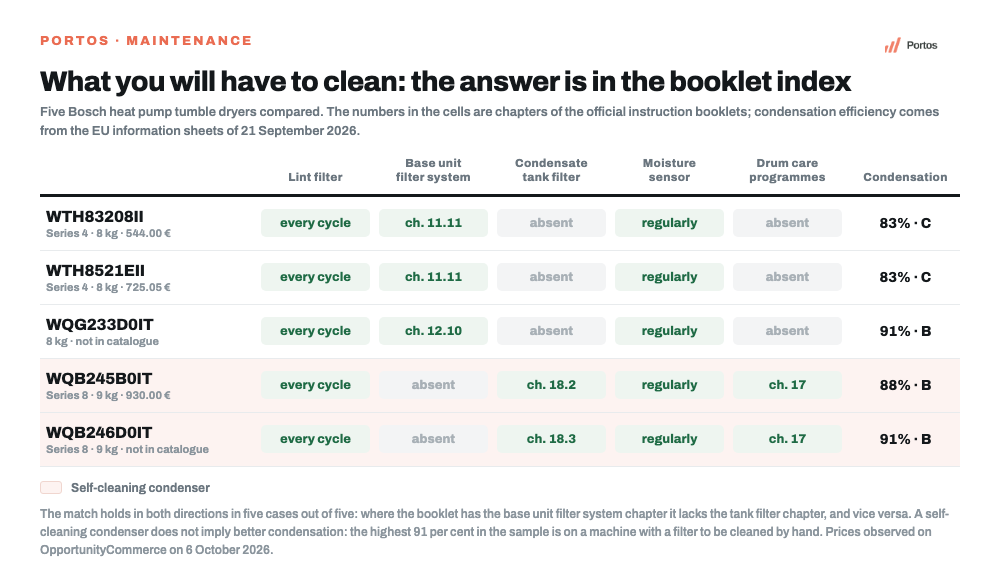
The same information can be read in the table of contents of the booklet, downloadable before purchase.
| Model | Self-cleaning condenser | Base unit filter system chapter | Tank filter chapter | Drum care programmes | Condensation |
|---|---|---|---|---|---|
| WTH83208II, Series 4, 8 kg | No | Yes, 11.11 | No | No | 83 per cent, class C |
| WTH8521EII, Series 4, 8 kg | No | Yes, 11.11 | No | No | 83 per cent, class C |
| WQG233D0IT, 8 kg | No | Yes, 12.10 | No | No | 91 per cent, class B |
| WQB245B0IT, Series 8, 9 kg | Yes | No | Yes, 18.2 | Yes, chapter 17 | 88 per cent, class B |
| WQB246D0IT, Series 8, 9 kg | Yes | No | Yes, 18.3 | Yes, chapter 17 | 91 per cent, class B |
The match is perfect in five cases out of five, in both directions: where there is a self-cleaning condenser the base unit filter chapter is missing and the tank filter chapter appears; where there is not, the opposite happens. So before buying, download the booklet of the model you are interested in and look at the table of contents. If you find base unit filter system, you know you will be opening the lower flap, pulling out a filter material and washing it. If you find condensate tank filter, you know you will not.
Two of the five models in this table were not in the OpportunityCommerce catalogue at the time of checking, and we included them only as documentary evidence. The three actually available are the WTH83208II at 544.00 euros, the WTH8521EII at 725.05 euros and the WQB245B0IT at 930.00 euros, prices recorded on 6 October 2026.
The tank: how much water you are handling
The booklet says to empty the container at the end of the programme, or when the machine pauses the cycle and asks for it on the display. That mid-cycle pause is not a fault: it is foreseen in the instructions, and you can see why by looking at the numbers.
The condition under which all label figures are measured is stated in the consumption values section of the booklet: eco programme, initial laundry moisture content 60 per cent, final moisture content 0. That means a full load brings 0.60 litres of water into the drum for every kilo of dry fabric. The rest is arithmetic.
| Full load | Water removed from the laundry | Into the tank at 83 per cent | Into the tank at 88 per cent |
|---|---|---|---|
| 8.0 kg | 4.80 litres | 3.98 litres | 4.22 litres |
| 9.0 kg | 5.40 litres | 4.48 litres | 4.75 litres |
Well over four litres of water in a single cycle. That is why the machine may stop before the end: the container fills up. And on an annual basis the figure becomes striking. Taking the reference laundry load we use in all Portos dryer calculations, 1,404 kilos of dry fabric a year, the water removed from the clothes comes to 842.4 litres, of which between 699 and 767 litres end up in the tank depending on the model's condensation efficiency. That is roughly two litres a day to carry to the sink.
There is a way to avoid it, and every booklet provides for it: connect the condensate drain hose directly to the trap outlet. Two of the three models in the catalogue include it; the third, the cheapest, does not, and for that one the hose has to be bought separately. It is a detail worth checking before buying, because it changes a daily habit for ten years.
Where the water that is not condensed ends up
The share that does not reach the tank does not disappear: it stays in the room air as vapour. That is exactly what condensation efficiency measures, a mandatory figure on the EU information sheet with its own class on the label.
Regulation (EU) 2023/2533 raised the legal minimum from 70 to 80 per cent, with an explicit reason: a large majority of tumble dryers on the market already exceed 80. Which means that today a machine can be perfectly compliant and still release a fifth of the moisture into the room.
| Condensation efficiency | Water into the tank in a year | Vapour released into the room in a year | On a full 8 kg cycle |
|---|---|---|---|
| 80 per cent, legal minimum | 673.9 litres | 168.5 litres | 0.96 litres |
| 83 per cent, class C | 699.2 litres | 143.2 litres | 0.82 litres |
| 88 per cent, class B | 741.3 litres | 101.1 litres | 0.65 litres |
| 91 per cent, class B | 766.6 litres | 75.8 litres | 0.43 litres |
Between a machine at the legal minimum and one at 91 per cent there are 92.7 litres of water a year released into the room where you dry. If that room is a windowless bathroom or a storage cupboard, this matters more than the energy class, and it explains why the booklets ask you to operate the appliance in a well ventilated room and to keep the ventilation opening clear. It is also why the regulation asks the manufacturer to explain when it is worth leaving the door open between cycles.
A final warning about the tank, and a counter-intuitive one: condensate water is not drinkable and may contain lint. The booklet says so under risk of poisoning. Using it in the iron is a widespread habit the instructions do not provide for.
The moisture sensor, the maintenance nobody does
All five machines have a chapter devoted to the moisture sensor, which detects how wet the laundry is and adapts the duration of the automatic programme. The booklet warns that limescale, detergent and additive residues build up on the sensor over time, and asks you to clean it regularly with a sponge, with no hard, rough or abrasive objects and no steel wool.
It is the least practised piece of maintenance and the one with the most annoying effect when skipped, because a dirty sensor reads the laundry as wetter than it is and stretches the cycle. Here too the booklet gives no interval: it says regularly. In the calendar we propose below we pair it with cleaning the door, because they are done in the same gesture and in the same place.
The drum care programmes
Only the two top of the range models in our sample have a chapter devoted to appliance care, that is, drum cleaning programmes. The booklet describes two levels: a simple treatment lasting about an hour, to be run when the display shows CArE for a prolonged period, and an intensive treatment of about four hours, which cannot be interrupted, intended for more stubborn deposits and for the odours that build up after more than a month of standstill, for which a specific original product is needed.
Before starting them the booklet asks you to empty the drum, clean the lint filter and empty the condensate container. Anyone whose machine does not have this function should not improvise it: the instructions for models without the treatment only provide for wiping the drum with a damp cloth.
What neglect costs, and why we are not giving you a number
Here Portos stops where the data stops. The manufacturer states that energy consumption is higher if the filters are not cleaned, and the regulation obliges it to explain the main consequences of insufficient cleaning, but nobody publishes a coefficient. There is no verifiable number to write down, and an invented number would be worse than no number.
What can be measured is what is at stake, that is, how much efficiency is worth on these machines. For the same amount of laundry, 1,404 kilos a year, and with the ARERA fourth quarter 2026 tariff of 0.4343 euros per kWh including taxes:
| Model | Declared consumption per cycle | Energy in a year | Cost in a year |
|---|---|---|---|
| WQG233D0IT, 8 kg, class C | 0.97 kWh | 170.2 kWh | 73.93 euros |
| WQB245B0IT, 9 kg, class C | 1.10 kWh | 171.6 kWh | 74.53 euros |
| WTH8521EII, 8 kg, class D | 1.19 kWh | 208.8 kWh | 90.70 euros |
| WTH83208II, 8 kg, class E | 1.38 kWh | 242.2 kWh | 105.18 euros |
Between the two 8 kg machines of the same series, one energy class apart, the gap is 14.48 euros a year. Between the cheapest and the best of those in the catalogue, 30.65 euros a year. These are modest figures, and they should be stated honestly: no tumble dryer pays for itself through its energy class, as we had already found in our analysis of the top of the range model.
The point is a different one. Those thirty euros are decided at the moment of purchase and cannot be touched again. Cleaning the filters, on the other hand, is the only variable you can still act on afterwards, for ten years, at no cost. And it is the only one the manufacturer lists as an energy saving measure alongside spinning and full loads.
The spare parts you are entitled to by law, and what they cost
Since 1 July 2025 Regulation (EU) 2023/2533 has required manufacturers to make available to end users, and not only to professional repairers, a precise list of spare parts: doors, door seals, door handles, lock assemblies and hinges, lint filters, air filters, plastic peripherals and the condensate tank. Availability must last at least ten years after the last unit of the model is placed on the market, the parts must be replaceable with commonly available tools and without permanent damage to the appliance, delivery must take place within 15 working days of the order, and the manufacturer must publish an indicative price online.
The BSH group, which makes both Bosch and Siemens, publishes that list in a single document updated to 30 June 2025. We looked up the codes that matter for routine maintenance, including the base unit filter material named in the booklet of the cheapest model in the catalogue.
| Code | Component | Indicative pre-tax price | With 22 per cent VAT |
|---|---|---|---|
| 12007650 | Base unit filter material, named in the WTH83208II booklet | 6.19 euros | 7.55 euros |
| 12022801 | Filter material, second size | 12.20 euros | 14.88 euros |
| 00656033 | Lint filter | 29.94 euros | 36.53 euros |
| 12010178 | Air filter | 11.65 euros | 14.21 euros |
| 11064634 | Condensate tank | 24.55 euros | 29.95 euros |
| 00707089 | Condensate tank, other model | 92.64 euros | 113.02 euros |
The useful reading is this: the part that actually wears out through maintenance, the filter material, costs less than eight euros including VAT, and can be ordered without going through a technician. A broken lint filter, on the other hand, is a thirty-six euro spare, and it almost always breaks for the same reason, because it is refitted distorted or forced back in while still full. The booklet recommends making sure the cleaned filter material is inserted into its holders without being deformed, damaged or turned inside out.
Mistakes to avoid
Rinsing the lint down the sink. This is the point on which the regulation is most explicit: lint goes in the rubbish bin. The booklet suggests collecting the washing water in a bucket and pouring it through a coffee filter, to be thrown away with household waste.
Refitting the filter while still wet. The instructions ask you to dry the filter material thoroughly after cleaning, and they do so in the energy saving chapter, not the maintenance one.
Using detergents on the filter material. The booklet forbids it: hot running water, a vacuum cleaner for stubborn dirt if needed, nothing else.
Touching the heat exchanger fins. There is a risk of cuts warning in the instructions, and in any case the manufacturer reserves this operation for the service department.
Running the machine without the filter. The instructions warn that operating without adequate, complete or undamaged protection can cause damage to the appliance.
Using solvent-based cleaners. Under risk of poisoning: toxic vapours may form.
Cleaning with jets of water. No steam cleaners, pressure washers or hoses, and unplug the appliance before any cleaning.
Waiting for the display to ask for the lint filter. The clogged filter indicator is a safety net, not a calendar: the booklet asks for cleaning at the end of the programme, not when the light comes on.
The Portos maintenance calendar
What follows is not an invented table: it is the content of the booklets reordered by frequency, distinguishing between what applies to all machines and what applies only to some models.
| When | What | On which machines |
|---|---|---|
| Every cycle | Clean the two-part lint filter and remove the lint from the door rim | All |
| Every cycle | Empty the condensate container | All those not connected to a drain |
| When the warning appears | Clean the base unit filter system and brush the heat exchanger cover | Only without a self-cleaning condenser |
| Periodic check | Filter inside the condensate tank, to be washed when dirty | Only with a self-cleaning condenser |
| Regularly | Clean the moisture sensor with a sponge | All |
| When CArE appears | Simple drum treatment, about one hour | Only models that provide it |
| After more than a month idle | Intensive drum treatment, about four hours | Only models that provide it |
| As needed | Remove dust from the back and clean the cabinet with a cloth, water and soap | All |
If you want a rule of thumb: one task every cycle, one when the machine asks for it, one when you clean the door. Everything else is extraordinary maintenance, and a good part of it is not yours to do.
The Portos view
Maintaining a heat pump tumble dryer is far lighter work than people think, but it is also far more binding than people think: the lint filter really does need doing every cycle, because it is the one place where fire safety, consumption and drying quality all meet. Everything else depends on the model, and that is information you can read for free before you buy.
If you are choosing right now, the concrete advice is this. Download the booklet of the model you are interested in from the manufacturer's page, open the table of contents and look for the base unit filter system chapter. If it is there, budget for a filter to be hand-washed when the machine asks and a filter material to be replaced now and again, costing under eight euros. If it is not there, you have a machine with a self-cleaning condenser, and your maintenance comes down to the lint filter and the tank.
The second check, on the same sheet, is condensation efficiency, because it decides how much moisture stays in the room: between the legal minimum and the best in the catalogue there is a difference of almost a hundred litres of water a year. The third is mundane and always forgotten: check whether the condensate drain hose is included, because that is what saves you from carrying some seven hundred litres of water to the sink every year.
Anyone still working out which machine to buy will find the full picture in our guide on how to choose a tumble dryer, while the comparison between the two technologies is in heat pump dryer or condenser dryer.
Anyone who wants to see these criteria applied to a real machine can read our analysis of the Bosch Series 8 WQB245B0IT, which is one of the two models with a self-cleaning condenser in our sample. To get your bearings among the models available you can browse the tumble dryer category on OpportunityCommerce or compare prices and availability of Bosch heat pump dryers on SniffaPrezzi.
Method and assumptions
Every figure in this guide comes from public manufacturer documents and from current legislation. The assumptions are stated so that you can redo the calculations with your own.
Water removed from the laundry. Label condition stated in the consumption values section of the booklets: eco programme, initial moisture content 60 per cent, final moisture content 0. That works out at 0.60 litres of water per kilo of dry fabric.
Reference laundry load. 1,404 kilos of dry fabric a year, that is, three full loads a week on a 9 kg machine. It is the same parameter used in the other Portos dryer content, so that comparisons stay consistent across different capacities.
Split of the water. The share that reaches the tank equals the declared condensation efficiency; the remainder stays in the room air.
Electricity tariff. 0.4343 euros per kWh including taxes, ARERA fourth quarter 2026 for vulnerable customers on the regulated market. It has to be updated every quarter.
Product prices. Recorded on OpportunityCommerce on 6 October 2026. Appliance prices move from week to week.
Spare part prices. BSH list of indicative pre-tax prices, version of 30 June 2025. The 22 per cent VAT is our own calculation and is flagged as such.
The figure of 160 cycles a year quoted on the manufacturer's official pages refers to the standard cotton programme under Regulation (EU) 392/2012 and is reported only to explain where the 20-load figure comes from. It is not used in our own calculations.
Portos has not physically tested any of these machines. This is an editorial guide built on instruction booklets, EU information sheets, official manufacturer pages and legislative texts.
Related Portos articles
How to choose a tumble dryer: capacity, efficiency class and real times
Bosch Series 8 WQB245B0IT: analysis, running costs and who it suits
What it costs to run your appliances after the 37.3 per cent increase
Sources
Bosch instruction and installation manuals, heat pump tumble dryers: WTH83208II, WTH8521EII, WQB245B0IT, WQB246D0IT and WQG233D0IT (PDF, Italian editions).
EU product information sheets, Delegated Regulation (EU) 2023/2534, versions of 21 September 2026: WTH83208II, WTH8521EII, WQB245B0IT, WQG233D0IT.
Regulation (EU) 2023/2533, Annex II: information obligations on maintenance, list of spare parts for end users, 80 per cent minimum condensation efficiency, recitals on product service life.
Delegated Regulation (EU) 2023/2534: content of the information sheet and the energy, condensation and noise classes.
Bosch, differences between the cleaning systems of heat pump tumble dryers: self-cleaning condenser, EasyClean filter, declared frequencies and the 160 cycles a year basis.
Bosch service, cleaning the dryer condenser and cleaning your dryer.
Official Bosch product pages: WTH83208II, WTH8521EII, WQB245B0IT.
BSH, list of indicative pre-tax spare part prices for tumble dryers, version of 30 June 2025 (PDF).
EPREL, the European product database for energy labelling.
Prices and availability recorded on OpportunityCommerce and SniffaPrezzi on 6 October 2026.
This is a Portos editorial guide based on manufacturer documentation and current legislation. None of the products mentioned has been physically tested.