How much energy a microwave uses and what it costs to heat a plate
The microwave is the one kitchen appliance with no energy label, and yet all the figures needed to work out what it costs are there: they are in the manual. We ran the numbers on twelve real dishes, and found out why the appliance never switches off.
In this guide (9)
- 1No label, but not no data
- 2The calculation can be made, and here is how
- 3What it costs to heat, dish by dish
- 4The same dish in the oven costs three and a half times as much
- 5The microwave never switches off, and Bosch says so
- 6The yearly bill
- 7PortosEunostos advice
- 8The Portos verdict
- 9Sources and documentation
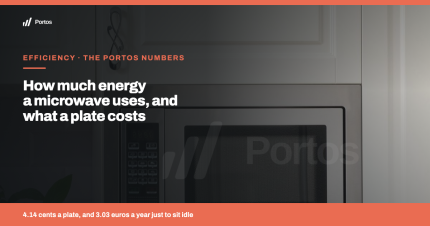
Reheating a ready meal in the microwave costs 4.14 cents. Leaving the appliance plugged in for a year without cooking anything costs up to 3.03 euros, as much as reheating 73 plates. Neither figure appears on any label, because the microwave is the one kitchen appliance that does not have one.
We at PortosEunostos worked them out from the data Bosch publishes for the BEL523MS0 and from the ARERA electricity tariff for the fourth quarter of 2026. And in the user manual we found a sentence that explains why the second figure exists at all: this appliance, the manufacturer writes, has neither an off state nor a stand-by state.
No label, but not no data
The microwave has no energy class and declares no annual consumption: we verified it in our guide on how to choose a microwave oven, where eight EU product fiches out of eight answer 404 and the official product-group list of the European Commission does not contain it.
The paradox is that on this appliance the manufacturer gives you more information than a label would. An oven declares a single number, the kWh of a normalised test cycle nobody ever cooks. The microwave manual lists fifty real dishes with the recommended power and the time in minutes. From there the consumption can be worked out, dish by dish.
The calculation can be made, and here is how
The Bosch spec sheet for the BEL523MS0 carries two figures: 800 W of maximum output power and 1,270 W of absorbed power. The first is the energy that reaches the food, the second is the one you pay for. The ratio between them is 1.5875: every watt delivered asks the socket for 1.59.
The intermediate levels (90, 180, 360, 600 W) have no declared absorbed power, so we estimate it proportionally. The estimate holds from two opposite directions: on a machine that alternates full power and pause, the energy of a cycle at 600 W is 1,270 W multiplied by 600/800; on an inverter machine, which modulates power instead of switching it off, the result is the same at equal efficiency. In long operations the maximum power drops to 600 W anyway, as the footnote on the spec sheet explains. The multiplier in the bill is the ARERA tariff in force since 1 October 2026, 0.4343 euros per kWh, the same one we use in all our running-cost calculations.
What it costs to heat, dish by dish
Power levels and times are the ones recommended by the Bosch manual, taken at the midpoint of the range when the manual gives two.
| Dish | Power | Time | Energy | Cost |
|---|---|---|---|---|
| Baby bottle, 200 ml | 360 W | 1.5 min | 0.014 kWh | 0.62 cents |
| Soup, one 200 g cup | 600 W | 2-3 min | 0.040 kWh | 1.72 cents |
| Drink, 200 ml | 800 W | 2-3 min | 0.053 kWh | 2.30 cents |
| Ready meal, 350-500 g | 600 W | 4-8 min | 0.095 kWh | 4.14 cents |
| Defrosting 1 kg of meat | 180 and 90 W | 20 + 20 min | 0.143 kWh | 6.21 cents |
| Frozen lasagne, 450 g | 600 W | 10-15 min | 0.198 kWh | 8.62 cents |
| Potato gratin, 1 kg | 360 W | 30-40 min | 0.333 kWh | 14.48 cents |
| Whole chicken, 1.2 kg | 600 W | 25-30 min | 0.437 kWh | 18.96 cents |
The thing worth noticing is that the cost is driven by time, not by the power level. The potato gratin runs at 360 W, the lowest level in the table after defrosting, and costs 68% more than the lasagne, which runs at 600: because it stays in there for 35 minutes instead of 12. Turning the power down to save money does not work, because the duration stretches more than the absorbed power falls.
The same dish in the oven costs three and a half times as much
Here the comparison can be made on figures declared by both sides. The EU fiches of the Bosch built-in ovens we read declare between 0.69 and 0.79 kWh per cycle in fan mode and between 0.87 and 0.98 in conventional mode: between 30 and 43 cents of electricity. The lasagne in the microwave costs 8.62 cents, the gratin 14.48.
The ratio runs from 3.5 to 4 times in the microwave's favour on the lasagne, and from 2.1 to 2.4 on the gratin. It is worth being precise about what is being compared: the oven cycle is a laboratory measurement under the EN 60350-1 standard, run on a standard load and not on a tray of lasagne, while ours is a calculation on declared power and declared time. They are not the same thing, and the order of magnitude does not change. If you want the oven detail, the figures are all in how much energy an oven uses. What the microwave does not give you is the result: no crust, no browning, unless you use the grill.
The microwave never switches off, and Bosch says so
In the energy-saving chapter of the manual there is the sentence that carries this article. We quote: «In accordance with EU ecodesign regulation 2023/826, this appliance is in a different state when it is switched off. By definition, therefore, there is neither an off state nor a stand-by state». Even with the main function idle the appliance draws power for three declared reasons: it watches the touch controls, it watches the door opening, and it keeps the clock running even when it is not showing it.
Regulation (EU) 2023/826, which since 9 May 2025 has replaced the old 1275/2008 and which explicitly lists microwave ovens, puts a ceiling on those states: 0.5 W if the appliance merely waits, 0.8 W if it shows information or a status, that is if it keeps the clock lit. No number is declared, but the ceiling is law, and over 8,708 hours a year it comes to 6.97 kWh, or 3.03 euros.
That is why the only energy-saving tip Bosch offers for the microwave is «hide the clock». Going from 0.8 to 0.5 W is worth 2.63 kWh and 1.14 euros a year: small change, but it is the only lever you have, and across the life of the appliance it becomes ten euros or so for a display you look at for three seconds a day.
The yearly bill
Take ordinary use: one plate reheated and one drink warmed every day. That is 54.08 kWh of cooking, 23.49 euros a year. The rest is the waiting: 6.97 kWh at the legal ceiling, 3.03 euros. Total 26.51 euros a year, of which 11.4% is spent while the appliance cooks nothing at all.
The figure that puts it all in scale is time: with that pattern the microwave cooks for 52 hours a year and stays plugged in for the other 8,708, which means it sits idle 99.4% of the time. And it is a cheap appliance: the least expensive one in the catalogue we surveyed sits at 138.00 euros, so over ten years the electricity costs almost twice the appliance. For once the purchase price is not the main line item.
PortosEunostos advice
On consumption: do not look for the energy class, it does not exist. Look at the absorbed watts on the spec sheet, not at the big number printed on the front panel: that one is the output power.
On use: for reheating and defrosting the microwave beats the oven with no argument. For cooking something that has to brown the balance flips, because you end up using both.
On saving: hide the clock if your model allows it, it is the only adjustment that moves the number. Unplugging works, but you lose the clock and the programmes.
On the seller: ask to see the spec sheet and the manual before you buy. If the shop does not have them, you will never have the figures to make this calculation.
The Portos verdict
The microwave is the appliance everybody argues about with no figures to hand, and the figures do exist: they are in the manual, not on the label. From the analysis of the specifications the conclusion is simple. For reheating it costs a few cents, between a quarter and half of what the oven costs; for cooking the margin narrows; and roughly one euro in nine goes to an appliance that is waiting.
If you are weighing up a purchase, it is worth comparing prices and availability on SniffaPrezzi, where microwaves number more than nine hundred. To see what is in the catalogue today you can browse the microwave range on OpportunityCommerce: on 5 November 2026 there are 147 models, from 138.00 to 2,349.00 euros, with a median of 506.35. The model the figures are based on, if you want it in detail, we analysed in Bosch BEL523MS0.
Sources and documentation
Bosch user manual for BEL523M.0 and BEL524M.0: defrosting, reheating and cooking tables with power and time, the «Environmental protection and saving» chapter, and the note on regulation 2023/826.
Bosch spec sheet BEL523MS0 and the product page on Bosch Italy: 800 W output, 1,270 W absorbed, five power levels.
Regulation (EU) 2023/826, Annex II (microwave ovens are on the list) and Annex III, point 1: ceilings of 0.5 and 0.8 W, applicable since 9 May 2025.
EU product fiche of the Bosch HBG7341B1 oven under delegated regulation (EU) 65/2014, for the per-cycle consumption used in the comparison.
ARERA press release on the fourth quarter of 2026: 0.4343 euros per kWh.
Prices and model counts surveyed on 5 November 2026 in the OpportunityCommerce microwave catalogue.