Since 1 October 2026 a kilowatt-hour costs 43.43 cents including taxes, against 31.63 in the previous quarter. Five appliances in an ordinary household go from 233.84 to 321.08 euros a year with nobody changing a single habit, and every payback calculation published before that date shortens by 27.2 per cent.
Since 1 October 2026 a kilowatt-hour costs 43.43 cents including taxes for vulnerable customers served under the Italian regulated tariff. In the previous quarter it cost 31.63. The increase, announced by the energy regulator ARERA on 29 September, is 37.3 per cent, and it does not concern a new service or a different consumption: it concerns exactly the same washing machines, the same fridges and the same ovens that were already in the house.
Translated into objects: a class A dishwasher cycle goes from 17.2 to 23.6 cents. A full laundry load, washing plus drying, goes from 53 to 73 cents. A fridge-freezer declaring 239 kWh a year goes from 75.60 to 103.80 euros of energy, and that number arrives without anyone having touched anything.
This article redoes the sums of everything Portos has published so far at the new tariff, using only the consumption declared in the EU information sheets of models actually in the catalogue. There is no estimate here: there are regulated kilowatt-hours multiplied by a price published in the official journal.
The short answer
Five appliances in a household that uses them normally, one fridge always on plus four cycle-based machines, consume 739.3 kWh a year. At the third-quarter tariff that was 233.84 euros. At the fourth-quarter tariff it is 321.08 euros: 87.24 euros more a year with absolutely no change in behaviour.
The practical consequence is not that you should wash less. It is that every payback calculation made before 1 October is wrong on the low side, and wrong by a precise amount: every payback on a premium paid for efficiency shortens by 27.2 per cent. A purchase that paid for itself in seven years now pays for itself in five. One that paid for itself in twenty-six now does so in nineteen, which is to say it still does not pay for itself.
In brief: what you will find in this guide
What changed on 1 October 2026
The ARERA press release of 29 September 2026 sets the reference price of electricity for the typical customer at 43.43 euro cents per kilowatt-hour, taxes included, with effect from 1 October. The change against the third quarter is plus 37.3 per cent.
Two clarifications that change the meaning of the number, and that almost nobody reports.
The first: the update concerns about 3 million vulnerable customers still on the regulated service, not every Italian household. Anyone on the free market has the price written in their own contract.
The second: ARERA itself puts the annual spend of the typical vulnerable customer at 665.38 euros for the period 1 January to 31 December 2026, up 9.3 per cent on the 608.72 euros of the previous year. The 37.3 per cent is a quarter-on-quarter change, not the increase over the year.
For a reader deciding whether to replace an appliance, though, what counts is the price of the kilowatt-hour they will pay from October onwards. And that is 43.43 cents.
Where the increase went: the five items on the bill
The reference price is not a single figure: ARERA publishes it broken down into five items. Lining up the third-quarter breakdown against the fourth-quarter one brings out something the headline does not say.
| Item | Q3 2026 | Q4 2026 | Difference | Share of the bill |
|---|---|---|---|---|
| Energy commodity | 16.92 cents | 27.64 cents | +10.72 | 63.7% |
| Retail marketing | 2.11 cents | 2.11 cents | 0.00 | 4.9% |
| Transport and metering | 6.18 cents | 6.18 cents | 0.00 | 14.2% |
| System charges | 3.32 cents | 3.32 cents | 0.00 | 7.6% |
| Taxes (VAT and excise) | 3.10 cents | 4.18 cents | +1.08 | 9.6% |
| Total | 31.63 cents | 43.43 cents | +11.80 | 100% |
The arithmetic closes to the cent: 16.92 plus 2.11 plus 6.18 plus 3.32 plus 3.10 is exactly 31.63; the five fourth-quarter items are exactly 43.43.
And this is the point. Of the five items, three did not move by a single cent: marketing, transport, system charges. The whole 11.80-cent increase is explained by the energy commodity (plus 10.72, that is 63.4 per cent) and by the taxes calculated on top of it (plus 1.08). One hundred per cent of the increase sits in two items out of five, and they are the two that depend on the wholesale price of energy, not on regulation.
The concrete consequence for the reader: there is no administrative item to dispute, no charge to have removed. The only lever left is the number of kilowatt-hours. Which is why it is worth knowing exactly where they go.
43.43 cents is not everyone's tariff
We repeat it because it is the most misunderstood part of the whole story. The 43.43 cents are the reference price of the Italian regulated service for vulnerable customers: people over 75, people receiving a social bonus, people with a disability or living in emergency housing. Everyone else is on the free market.
That does not make the number useless, quite the opposite. It is the only public, complete, tax-inclusive price that exists in Italy: it includes the commodity, transport, charges and taxes. A free-market offer advertising "0.12 euros per kWh" is almost always quoting the energy component alone, to which the other 15.79 cents of regulated items plus VAT must then be added.
So there is only one correct way to use this article: take the kilowatt-hours in the tables, which are regulated and do not change, and multiply them by your own price. At the end there is the four-step method for working it out from your bill.
What each single use costs now
Every value below comes from the EU information sheets of the models, that is from the document the manufacturer is required to publish, which reports consumption measured on the regulated programme. These are not Portos laboratory estimates: they are declared figures, verifiable by downloading the PDF.
| Use | Model | kWh | Before | Now |
|---|---|---|---|---|
| Wash, latest-generation class A washing machine | WGB24402IT | 0.248 | 7.8 cents | 10.8 cents |
| Wash, class A washing machine | WGG244ZRIT | 0.489 | 15.5 cents | 21.2 cents |
| Wash, class C built-in washing machine | WIW24342EU | 0.624 | 19.7 cents | 27.1 cents |
| Dishwashing, class A | SMH6YCX02E | 0.543 | 17.2 cents | 23.6 cents |
| Dishwashing, class D | SMV4HVX03E | 0.849 | 26.9 cents | 36.9 cents |
| Drying, class C | WQB245B0IT | 1.10 | 34.8 cents | 47.8 cents |
| Drying, class D | WTH8521EII | 1.19 | 37.6 cents | 51.7 cents |
| Drying, class E | WTH83208II | 1.38 | 43.6 cents | 59.9 cents |
| One bake, fan mode | HBA234BB3 | 0.69 | 21.8 cents | 30.0 cents |
| One bake, conventional mode | HBA234BB3 | 0.94 | 29.7 cents | 40.8 cents |
| One pyrolytic cycle | Bosch figure | 3.6 - 4.7 | 1.14 - 1.49 euros | 1.56 - 2.04 euros |
The line worth reading twice is the first against the second: two washing machines, same brand, same class A, same 9 kg, and consumption that differs by a factor of two. After the 2021 rescaling, the letter on the label covers a band so wide that in its upper part it no longer tells anything apart. We went through this in detail in how to read the energy label.
The household basket: five appliances, one year
Let us put a real household together. Five appliances, all in the catalogue on 4 October 2026, with the price recorded that same day. The usage frequencies are stated above the table and are those of a family doing nothing exceptional: four washes a week, five dishwasher cycles, three drying cycles, two bakes.
| Appliance | Model | Class | Sheet figure | Use per year | kWh/year | Before | Now |
|---|---|---|---|---|---|---|---|
| Fridge-freezer | KGN36NLEA | E | 239 kWh/year | always on | 239.0 | 75.60 | 103.80 |
| Washing machine | WGG244ZRIT | A | 0.489 kWh/cycle | 208 cycles | 101.7 | 32.17 | 44.17 |
| Dishwasher | SMH6YCX02E | A | 0.543 kWh/cycle | 260 cycles | 141.2 | 44.66 | 61.31 |
| Tumble dryer | WTH8521EII | D | 1.19 kWh/cycle | 156 cycles | 185.6 | 58.72 | 80.62 |
| Built-in oven | HBA234BB3 | A+ | 0.69 kWh/cycle | 104 bakes | 71.8 | 22.70 | 31.17 |
| Total | 739.3 | 233.84 | 321.08 |
Eighty-seven euros and twenty-four cents more a year, without a single habit having changed. To give the figure a scale: ARERA estimates the annual electricity spend of the typical vulnerable customer at 665.38 euros for 2026. The two values are not strictly comparable, because the ARERA estimate covers the whole year at different tariffs and includes lighting, electronics and everything else, but the order of magnitude says something clear: these five appliances are worth around half of a household's electricity bill.
The internal ranking is the useful part. The fridge, which nobody thinks of when they hear the word consumption, is the biggest item. The tumble dryer is second. The washing machine, the symbol of domestic saving, is only fourth.
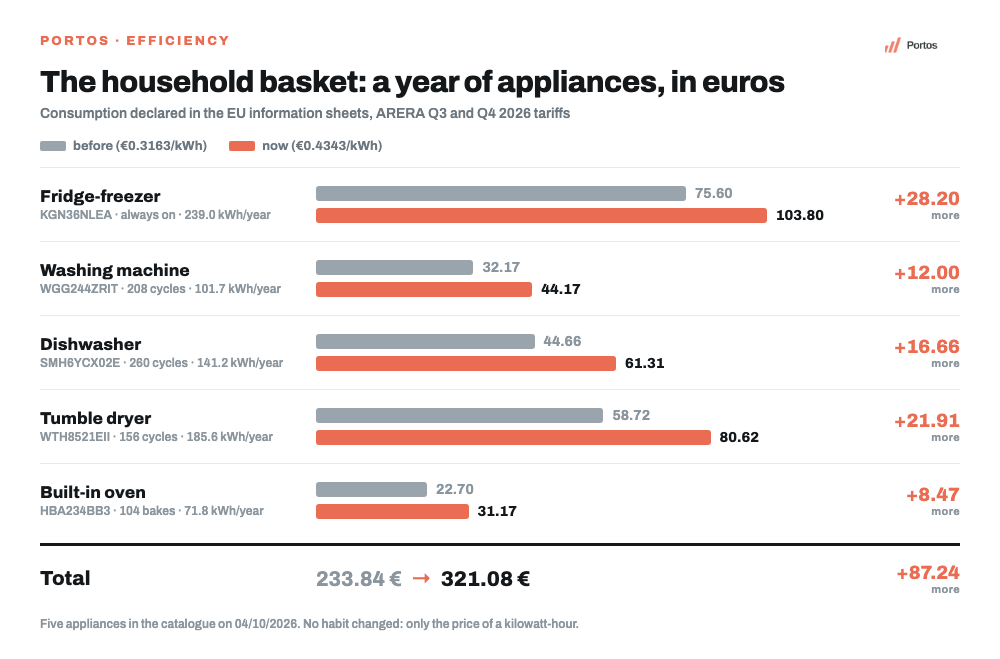
The household basket: 739.3 kWh a year, 87.24 euros more without changing a single habit.
A full laundry load now costs more than seventy cents
Readers do not do a wash: they do the laundry. Washing and drying the same load with the two models in the basket costs 0.489 plus 1.19 kWh, that is 1.679 kWh.
At the previous tariff that was 53.1 cents. Now it is 72.9 cents. Across 156 full laundry loads a year the spend goes from 82.85 to 113.75 euros.
Inside that figure there is a number we calculated in the article on what a tumble dryer costs to run for a year, and it now weighs more: a dryer spends about 0.20 kWh for every kilo of water it removes from the laundry, that is 8.7 cents per kilo. Every extra kilo of water the washing machine leaves in the drum, because the spin is slow or a delicate programme was chosen, is worth 13.55 euros a year over 156 cycles. It used to be 9.87.
This is why, in a household that uses a dryer, the washing machine's spin class matters as much as its energy class, and often more.
The fridge is the item you cannot switch off
The other four appliances have a frequency: you can wash less, bake less, hang the laundry out instead of drying it. The fridge cannot. Its 239 kWh are a consumption figure that is annual by definition, calculated under Delegated Regulation (EU) 2019/2016 over 365 days of operation.
It means the increase on the fridge, 28.20 euros a year, is the only item in the basket that behaviour cannot touch. You can only change appliance, or accept it.
It is worth recalling a figure we verified across 31 fridges in the catalogue: 22 models out of 31 declare an energy efficiency index of exactly 100, that is the upper limit of class E. In this category the class is not an outcome: it is a design target. The numbers that count are the kWh per year at the bottom left of the label, not the letter. The full discussion is in how much a fridge consumes in a year.
Ten years of energy against the purchase price
An appliance is bought once and paid for every day. The comparison below puts the purchase price recorded on 4 October 2026 next to ten years of energy at the new tariff, which is roughly the expected service life of these machines.
| Appliance | Price | Energy over 10 years | Energy / price | Was |
|---|---|---|---|---|
| Fridge KGN36NLEA | 695.69 | 1,037.98 | 149.2% | 108.7% |
| Dryer WTH8521EII | 725.05 | 806.23 | 111.2% | 81.0% |
| Dishwasher SMH6YCX02E | 775.90 | 613.14 | 79.0% | 57.5% |
| Oven HBA234BB3 | 480.38 | 311.65 | 64.9% | 47.3% |
| Washing machine WGG244ZRIT | 779.00 | 441.74 | 56.7% | 41.3% |
| Together | 3,456.02 | 3,210.78 | 92.9% | 67.7% |
On two appliances out of five the energy has overtaken the price. On the fridge it overtakes it by half.
The same thing can be put in a way that helps a decision: at what kilowatt-hour price do ten years of energy equal the purchase price? For the fridge in the basket the answer is 29.11 cents, a threshold already crossed in the previous quarter. For the dryer it is 39.07 cents, crossed now. For the dishwasher we are at 54.95 cents, for the oven 66.91, for the washing machine 76.60: still some way off.
That is the right way to read the table. Not "everything costs too much", but: on the fridge and the dryer the purchase price is now the lesser item, and they are worth choosing by looking at kilowatt-hours first; on the washing machine and the oven the price still weighs more than the energy and other criteria can decide.
The new rule: every payback shortens by 27.2 per cent
This is the part that genuinely changes decisions, and it is pure arithmetic.
A payback is calculated by dividing the premium paid by the annual saving in euros. The premium has not changed, the kilowatt-hours saved have not changed, but the value in euros of those kilowatt-hours has been multiplied by 1.3731. Dividing by a larger number gives a smaller one: 0.3163 divided by 0.4343 is 0.7283.
So every payback published before 1 October should be multiplied by 0.73. Ten years become seven years and three months. Twenty become fourteen and a half.
Here are the four cases already documented on Portos, recalculated on the prices of 4 October 2026.
| Comparison | Price difference | Annual saving before | Annual saving now | Payback before | Payback now |
|---|---|---|---|---|---|
| Dishwasher A against D SMH6YCX02E / SMV4HVX03E | +173.88 | 25.17 | 34.55 | 6.9 years | 5.0 years |
| Washing machine 0.248 against 0.489 kWh WGB24402IT / WGG244ZRIT | +413.00 | 15.86 | 21.77 | 26.0 years | 19.0 years |
| Dryer C against E WQB245B0IT / WTH83208II | +386.00 | 13.82 | 18.97 | 27.9 years | 20.3 years |
| Fridge No Frost against manual defrost KIN86VSE0 / KIV86VSE0 | +166.58 | none | none | does not exist | |
The last line deserves an explanation, because it is the most instructive case of all.
Where the energy class now really pays for itself
The dishwasher is the only case in the basket where the sum closes within the life of the product. Two models of the same brand, same width, same 14 place settings: one declares 0.543 kWh per cycle and the other 0.849. Over 260 cycles a year the difference is worth 79.56 kWh, that is 34.55 euros a year at the new tariff against 25.17 at the previous one.
The price difference is 173.88 euros. The payback drops from 6.9 to 5.0 years, on an appliance that comfortably lasts ten or twelve. After the fifth year that is 34.55 euros a year staying in your pocket.
There is a detail that makes the case sharper still, and it has to be stated because it is in the reader's favour: the class A model costs 775.90 euros, that is less than several class B models in the same range. Here the class jump is not even paid for at purchase. We had already noticed this comparing two Serie 6 machines eighteen euros apart, in Bosch SMI6ECS00E or SMI6ZCS10E.
The full context on consumption in this category is in how much a dishwasher consumes.
Where it still does not
The washing machine. The model that halves consumption, from 0.489 to 0.248 kWh per cycle, costs 413 euros more. The saving rises from 15.86 to 21.77 euros a year and the payback drops from twenty-six to nineteen years. No washing machine lasts nineteen years of daily use. The jump remains defensible for other reasons, from noise to features, but it does not pay for itself on the bill, and that has to be said even after a 37 per cent increase.
The tumble dryer. Moving from the class E model to the class C one saves 0.28 kWh per cycle, that is 18.97 euros a year. But the price rises by 386 euros: 20.3 years. Careful though, because here the conclusion is not symmetrical: those 386 euros also buy an extra kilo of capacity, less noise and a better condensation class. Anyone drying seven times a week instead of three halves the payback to a little over ten years, and at that point the discussion changes. The full grid by usage frequency is in the dedicated article.
The No Frost fridge. Here the payback simply does not exist, and it is worth understanding why. The two models are twins: same range, same width, identical except for the defrosting mode. The automatic one consumes 5 kWh a year more, not less, because the regulation itself grants it an increased defrosting factor, and it costs 166.58 euros more. What you buy is the convenience of never defrosting: 166.58 euros of price plus 2.17 euros a year of energy. That is a legitimate choice, but it is not an investment. The full figures and the cost per avoided defrost are in how often to defrost and clean the fridge.
The small items: stand-by, delayed start, pyrolysis
The EU information sheets also declare consumption when the appliance is not in use, and this is a chapter where a lot of nonsense gets written. Here are the real numbers, from the documents.
| State | Declared power | kWh/year if continuous | Before | Now |
|---|---|---|---|---|
| Off mode | 0.15 - 0.50 W | 1.3 - 4.4 | 0.42 - 1.39 | 0.57 - 1.90 |
| Stand-by mode | 0.50 W | 4.4 | 1.39 | 1.90 |
| Networked stand-by (connected appliance) | 2.00 W | 17.5 | 5.54 | 7.61 |
| Delayed start | 4.00 W | only while waiting | - | - |
Three observations that are worth making.
The first: off mode and plain stand-by move nothing. One or two euros a year per appliance. Unplugging the washing machine to save money is a gesture worth less than one coffee every six months.
The second: networked stand-by at 2.00 W is another matter. It is worth 7.61 euros a year per appliance, because the connection stays active twenty-four hours a day. In our sample only the connectable models declare it: the dishwasher, the latest-generation washing machine and the two upper-range dryers. Three connected appliances in a household come to 22.83 euros a year, more than the increase on the oven costs. If the remote functions are not used, switching off the module is the only stand-by measure that makes economic sense.
The third: delayed start declares 4.00 W, but you only pay for the hours actually spent waiting. Programming the dishwasher eight hours ahead costs about 1.4 cents. Irrelevant.
Pyrolysis is a different story. Bosch declares 3.6 - 4.7 kWh per cycle, a figure that appears on no label because Regulation 65/2014 does not require it. At the new tariff one cycle costs between 1.56 and 2.04 euros, against 1.14 - 1.49 before. Two pyrolysis cycles a year come to about 3.60 euros: little in absolute terms, but it is twelve per cent of that oven's entire annual running cost for two switch-ons. The alternatives, starting with hydrolysis at around ten cents, are in how to clean an oven without pyrolysis.
In an oven the cooking mode matters more than the class
This is the most counterintuitive result in our archive, and the new tariff widens it.
The same oven, the very same appliance, declares 0.94 kWh in conventional mode and 0.69 in fan mode. The difference is 0.25 kWh per bake, that is 10.9 cents. Over 104 bakes a year that is 11.29 euros, against 8.22 before.
The class jump between two different ovens, measured in the same fan mode, is worth 0.10 kWh per bake: 4.52 euros a year. In other words, turning a knob on the oven you already own is worth two and a half times the class jump, and it costs nothing.
The reason is regulatory and we verified it in the text of the regulation: the energy efficiency index of ovens is calculated on the more efficient of conventional and fan mode. The worse figure stays on the sheet but does not touch the letter on the label. The full analysis, across twenty sheets, is in how much energy an oven uses.
What a dish costs on an induction hob
Hobs are the only kitchen category with no energy label: Regulation 65/2014 covers ovens and hoods, not hobs. For these we had calculated consumption from physics, stating the method in the open. Recalculated at the new tariff:
bringing one litre of water to the boil: 0.11 kWh, that is 4.8 cents (it was 3.5);
pasta for four, from cold to plate: 0.52 kWh, that is 22.6 cents (it was 16.4);
100 grams of water evaporated because the pan has no lid: 0.063 kWh, that is 2.7 cents.
The last figure is the most useful of all: evaporating a hundred grams of water costs more than heating half a litre from twenty to a hundred degrees. On an induction hob the lid is the most effective lever there is, and it costs nothing. The full reasoning is in how much an induction hob consumes.
What is worth doing now
In order of result against effort required, on the figures in this article.
1. Check the cooking mode on the oven. Eleven euros a year, zero investment, zero sacrifice. The highest-return item on the list.
2. Switch off the connection on appliances you do not control remotely. 7.61 euros a year per connected appliance.
3. Use a full spin before drying. Every kilo of water left in the laundry costs 13.55 euros a year.
4. Fill the appliances. The eco programme is regulated at full load, and two half loads always cost more than one full one, in energy and in time: across eleven dryers a half load takes 57 to 67 per cent of the time of a full one, never half.
5. Look at the kilowatt-hours before the letter when buying. Two appliances of the same class can consume twice as much as one another.
6. Consider replacement only where the sum closes. At today's tariff the sum closes on the dishwasher, where the payback has dropped to five years; it does not close on the washing machine or the dryer, where nineteen and twenty years remain. If the replacement is needed anyway because the appliance is at the end of its life, then yes: at that point the premium to recover is not the whole price but only the difference between the efficient model and the basic one, and the payback shortens accordingly. To get a sense of current prices you can compare offers on 60 cm dishwashers; the models and prices quoted in this article are those recorded on 4 October 2026 in the OpportunityCommerce catalogue.
Mistakes to avoid
Applying the plus 37.3 per cent to the annual bill. It is a quarter-on-quarter change, not a yearly one. Over the year ARERA indicates plus 9.3 per cent.
Comparing 43.43 cents with the price of a free-market offer. The 43.43 include transport, charges and taxes; advertised prices almost never do. They are not numbers on the same scale.
Buying efficiency at any price. The increase shortens paybacks by 27.2 per cent, it does not cancel them. A twenty-six-year payback is still a nineteen-year payback.
Chasing stand-by. Two euros a year per appliance in normal stand-by. The only item worth removing is the permanent 2.00 W connection, and only if it is not used.
Trusting the letter. Two class A washing machines in this article consume 0.248 and 0.489 kWh per cycle. Same letter, twice the consumption.
Forgetting that the fridge does not switch off. It is the biggest item in the basket and the only one habit cannot touch.
How to redo these sums with your own bill
The kilowatt-hours in the tables are regulated and valid for anyone. The price is not. To get your own, in four steps.
First: take your latest bill and find the total amount due, VAT included, for a complete billing period.
Second: find the kWh consumed in the same period, normally in the consumption section or in the meter reading detail.
Third: divide the first number by the second. The result is the real, complete price of your kilowatt-hour, fixed charges included. It is almost always higher than the price advertised by the supplier.
Fourth: multiply the kilowatt-hours in the tables above by that number. The result is the real cost, in that household, of a wash, a bake, a year of refrigeration.
If the result is close to 0.4343 the figures in this article hold as they are. If it is lower, the paybacks lengthen proportionally; if it is higher, they shorten.
Correction note on figures published before 1 October
We write this because the reader deserves to know, and because no editorial archive updates itself.
Portos articles published up to 29 September 2026 contain euro figures calculated with two different conventions: the older ones with 0.25 euros per kWh, the more recent ones with 0.3163, the ARERA third-quarter tariff. Both were correct when they were written, and both now understate the spend.
The conversion is immediate and requires nothing to be redone:
an amount calculated with 0.3163 should be multiplied by 1.3731;
an amount calculated with 0.25 should be multiplied by 1.7372;
a payback time calculated with 0.3163 should be multiplied by 0.7283, that is shortened by 27.2 per cent.
The kilowatt-hours, the classes, the indices and every figure from the sheets remain valid: those do not depend on the price of energy. Only the final multiplier changes.
The Portos take
A 37.3 per cent increase does not suddenly make it worth buying the most efficient appliance on the market. It makes it worth no longer buying blind.
Three indications come out of the figures in this article, and they are worth more than any generic advice.
On the fridge and the dryer the purchase price is no longer the main item. Ten years of energy are worth 149 and 111 per cent of the price. In these two categories the kilowatt-hours on the label should be read before the price, and a premium for efficiency makes sense.
On the dishwasher the class jump pays for itself in five years, and in the case we measured it does not even cost more at purchase. It is the only case in the basket where the answer is simply yes.
On the washing machine and the oven the sum stays on the price side. A nineteen-year payback on the washing machine and 4.52 euros a year between two oven classes say that in these categories it is better to choose on capacity, noise, programmes and reliability, and to keep efficiency as a secondary criterion. With one free exception: use fan mode, which is worth more than the class jump and costs nothing.
And, above all, something that is not advice but a method: kilowatt-hours are a fact, the price is a variable. The next ARERA update will arrive in three months and these sums will have to be redone. The kilowatt-hours on the sheets, however, will still be the same.
Sources
ARERA, press release of 29 September 2026: reference price 43.43 cents/kWh from 1 October 2026 and the breakdown into five items.
ARERA, press release on Q3 2026: 31.63 cents/kWh, used as the term of comparison.
Bosch EU information sheets, the source of every consumption figure quoted: KGN36NLEA, WGG244ZRIT, SMH6YCX02E, WTH8521EII, HBA234BB3.
Delegated Regulations (EU) defining the parameters quoted: 2019/2014 washing machines, 2019/2016 refrigerating appliances, 2019/2017 dishwashers, 2023/2534 tumble dryers, 65/2014 ovens.
Bosch, pyrolytic oven cleaning: 3.6 - 4.7 kWh per cycle, the only figure published by the manufacturer.
Bosch, energy label archive and the European EPREL database, to verify the figures of any model independently.
Appliance prices: OpportunityCommerce, recorded on 4 October 2026 on the individual product pages. Prices change: they should be re-checked before any decision.
Method note. Portos does not physically own the appliances quoted and has not tested them. All consumption figures come from the manufacturers' EU information sheets, all energy prices from the ARERA press releases, all retail prices from the retailer's catalogue on the stated date. The calculations are arithmetic stated in the open: kilowatt-hours times price, price difference divided by annual saving. The usage frequencies are conventions set out in the text, not measurements.