The refrigerator compartment never needs manual defrosting: out of 31 refrigeration appliances actually on sale, all 28 with a fresh food compartment declare automatic defrosting. Manual defrosting applies to 5 models out of 26 among those with a freezer, almost all built-in units.
The maintenance that really matters is something else and takes two minutes: keep the drainage hole for defrost water clear. In this guide the actual timeframes indicated by the manufacturer, the correct method, the mistakes that can damage the refrigerant circuit and the cost in euros of an appliance that never needs defrosting.
The question "how often does a fridge defrost" has an answer that surprises almost everyone: in the vast majority of cases it never does. We downloaded the European product information sheets for 31 Bosch refrigerators and freezers actually on sale today. The fridge compartment defrosts automatically on all 28 models that have one, without exception. The freezer compartment only needs manual defrosting on 5 out of 26 models.
The real maintenance that matters is different, takes two minutes and almost no one does it: keeping the drainage hole for defrost water in the fridge compartment clear. All the water the appliance produces every day passes through there, and it's the point that creates the classic "wet bottom of the fridge" and most of the bad odors.
In this guide you'll find the actual times, the correct method, the mistakes that can puncture the refrigerant circuit, and one piece of information that is never written anywhere: how much it costs, in euros, to buy an appliance that never needs defrosting. On two pairs of twin models the difference is measurable to the cent.
The short answer
The fridge compartment never needs defrosting: defrosting is automatic on every appliance on the market, the water flows through the drainage hole and evaporates in a tray placed on the refrigeration unit. It should be cleaned once a month with lukewarm water and very little neutral pH detergent, and the drainage hole should be cleared more often, with a cotton swab.
The freezer compartment only needs defrosting if it has manual defrosting, and not on a fixed schedule: when a lot of ice has formed. If the appliance is No Frost, ice does not form and defrosting is not needed. The defrosting mode is written in the European product information sheet for the model, under the entry for the individual compartment.
Seals should be checked every two or three months and washed only with clean water, never with detergent. They are also the spare part with the longest availability required by law: ten years.
In brief: what you'll find in this guide
The fridge compartment defrosts automatically: on all 28 models
Which refrigerators still need manual defrosting: 5 out of 26
How much it costs not to defrost, and why the label doesn't say so
The two twins: how much it costs not to have to defrost anymore
The fridge compartment defrosts automatically: on all 28 models
Let's start with the data, because it's the only way to close the issue. We took 31 Bosch refrigeration appliances actually available today on OpportunityCommerce and for each one we read the product information sheet, the one required by Delegated Regulation (EU) 2019/2016. In that sheet each compartment is described line by line: type, volume, target temperature and defrosting mode, automatic or manual.
Twenty-eight of those 31 appliances have a compartment for fresh food, that is, the actual fridge. In all 28, the declared mode is automatic. Not a single fridge on the market, whether built-in or free-standing, undercounter or multi-door, requires manual defrosting in the cold section.
The mechanism is simple and worth knowing, because it explains the maintenance that is actually needed. During normal operation, condensation forms on the back wall of the fridge compartment. When the compressor stops, that condensation melts, flows down by gravity through a channel and passes through a drainage hole. From there it ends up in an evaporation tray positioned on the refrigeration unit, in the lower rear part of the appliance, where the heat from the motor causes it to evaporate. The Bosch instructions describe it this way: the defrost water flows through the drainage hole into an evaporation tray positioned on the rear side of the appliance.
Two practical consequences. First: the tray should never be emptied, it empties itself. The second, much more important: if the hole gets clogged, the water stays inside. This is exactly the fault that manuals list under "the bottom of the fridge compartment is wet", and the solution given is not a repair but a cleaning.
Which refrigerators still need manual defrosting: 5 out of 26
Twenty-six of the 31 appliances have a four-star freezer compartment. Of these, 21 declare automatic defrost and 5 manual defrost. These are the five, with prices recorded on 24 September 2026.
| Model | Type | Freezer | Defrost | Price |
|---|---|---|---|---|
| KIV86VSE0 | Built-in combination 54 cm, Series 4 | 84 l | Manual | 702.48 euros |
| KIV86NSE0 | Built-in combination 54 cm, Series 2 | 84 l | Manual | 651.30 euros |
| KIL82VFE0 | Single-door with freezer cell 56 cm | 34 l | Manual | 848.24 euros |
| KUL22VFD0 | Under-counter with freezer cell 60 cm | 17 l | Manual | 743.82 euros |
| KIL42NSE0 | Single-door with freezer cell 54 cm | 15 l | Manual | 742.61 euros |
The reading is interesting. Manual defrost survives almost exclusively in built-in appliances, and in three out of five cases on small freezer cells, from 15 to 34 litres, those found inside a single-door refrigerator or under-counter unit. These are the appliances where the ventilated system would cost too much in useful volume compared to the little there is to freeze.
The other five models in the group have no freezer compartment at all: they are pure single-door and an under-counter unit without a cell. There the issue of defrosting does not exist, just as it does not exist in the 21 combination units, multi-door and vertical freezers with automatic defrost. Among these is the 60 cm combination unit we analysed point by point in Bosch KGN36NLEA: datasheet in hand, automatic defrost on both compartments.
If you are considering a purchase and want to understand which of the two architectures makes sense for you, the systematic comparison can be found in No Frost or static refrigerator.
When to defrost the freezer: there is no schedule
Here something needs to be said that contradicts much of what is read online. The manufacturer does not specify a frequency. Bosch instructions say that the freezer compartment should be defrosted if a lot of ice has formed in it, and they stop there. There is no "twice a year" nor "when the layer exceeds five millimetres" that circulate as absolute rules: no manufacturer technical document contains them.
The reason is that the speed of ice formation depends on variables that change from house to house:
how many times the door is opened and for how long it remains open, because every opening allows humid air to enter;
the humidity of the environment, which in a kitchen where things are boiled often is much higher than average;
the door seal: a gasket that does not close properly allows air in continuously, and ice reforms in a few weeks;
unpackaged food introduced or still warm, which releases moisture;
the season: in summer, with warmer and more humid air, the phenomenon accelerates.
The correct criterion therefore is only one, and it is visual. You look inside: when the layer is thick enough to visibly reduce the space in the drawers, or to prevent a drawer from sliding, it is time. If you are defrosting every two months, the problem is not maintenance but the door seal, and the check is done on the gasket.
The instructions are explicit on this point too: if the freezer door is left open or does not close properly, frozen food thaws, the freezer forms a lot of ice and there is energy waste due to high electricity consumption. Abnormal ice and a high bill are the same symptom.
How much it costs not to defrost, and why the label does not say
This is the most technical point of the guide and it is also the one that nobody tells you about. The annual consumption you read on the energy label of a manually defrosted appliance is measured on an appliance free of frost. This is not a detail: it is an explicit choice of the regulation.
Delegated Regulation (EU) 2019/2016 calculates the energy efficiency index as the ratio between the measured consumption and a standard annual reference consumption. That reference is built by applying compensation factors, and among these is the defrost factor Ac. In table 5 of annex IV, for freezer compartments, Ac is 1.00 with manual defrost and 1.10 with automatic defrost.
Translated: the standard recognises that a ventilated system consumes more to operate, because it must power a periodic defrost cycle, and grants it a reference ten per cent higher on the freezer part. The manually defrosted appliance is granted nothing, because in the test there is no frost. The cost of the ice that accumulates in your home, simply, is not in the label number.
How much that cost is worth cannot be quantified from a primary source and we don't make it up: there is no standardized measure of the additional energy consumed by a frost-covered appliance. What does exist is the manufacturer's position, which in the instructions puts "defrost the freezer regularly" in the list of actions to save energy, alongside opening the door infrequently and not blocking ventilation openings. If you have an appliance with manual defrosting, the declared consumption is a conditional promise: it holds as long as you keep it defrosted.
To understand how to read the rest of the numbers on the label, the reference guide is how to read the energy label.
The two twins: how much it costs not to defrost anymore
In the group of 31 models there are two perfect couples: same series, same built-in niche, same total volume, same energy class, same noise class. Only one thing changes, the freezer defrosting mode. It's a rare case and allows you to isolate the exact price of a feature.
| Data (EU sheet) | KIN86VSE0 Series 4 | KIV86VSE0 Series 4 | KIN865SE0 Series 2 | KIV86NSE0 Series 2 |
|---|---|---|---|---|
| Freezer defrosting | Automatic | Manual | Automatic | Manual |
| Total volume | 260 l | 267 l | 260 l | 267 l |
| Fresh food | 184 l | 183 l | 184 l | 183 l |
| Freezer | 76 l | 84 l | 76 l | 84 l |
| Freezing capacity | 4.0 kg/24 h | 4.2 kg/24 h | 4.0 kg/24 h | 4.2 kg/24 h |
| Annual consumption | 234 kWh | 229 kWh | 234 kWh | 229 kWh |
| IEE index and class | 100, E | 100, E | 100, E | 100, E |
| Price 24/09/2026 | 869.06 euro | 702.48 euro | 716.72 euro | 651.30 euro |
The numbers tell three things, all verifiable on the sheets.
First: the ventilated system is paid for in volume. The appliance with manual defrosting has 8 liters more freezer space, 10.5 percent, with the same external dimensions. Those 8 liters are the space occupied by the air ducts and the ventilated evaporator. It also freezes 0.2 kg more in 24 hours.
Second: on the label manual defrosting consumes less, 229 versus 234 kWh per year. That's 5 kWh, which at the ARERA reference price for the third quarter of 2026, 0.3163 euros per kWh including taxes, amounts to 1.58 euros per year. It's not a purchase argument, but it's useful for deflating the opposite idea, very widespread, that No Frost is more efficient. It's not, and it's also the only of the two that the regulation grants the ten percent tolerance mentioned above.
Third, and this is the number that really counts: the price of convenience. In Series 4 the version that never needs to be defrosted costs 166.58 euros more; in Series 2 it costs 65.42 euros more. Adding ten years of higher consumption, 15.82 euros, the ventilated choice costs a total of 182.40 euros over ten years in Series 4 and 81.24 euros in Series 2.
If you defrosted twice a year, in ten years that's twenty defrostings: it means paying about 9.12 euros for each defrosting avoided in Series 4 and 4.06 euros in Series 2. If only one a year was needed, the account doubles: 18.24 and 8.12 euros. It's not a high or low figure in absolute terms, but finally it's a figure: everyone can decide whether an afternoon of work is worth that money.
A methodological note, for honesty: the comparison is valid between these four models, in these two pairs, at prices recorded on a specific day. It's not a general market rule. The same models can be compared with other sellers on SniffaPrezzi, and the sheets for the four appliances are at the bottom, in the sources.
How to defrost the freezer without damaging it
The procedure indicated by the manufacturer is this, in order. There are no safe shortcuts.
Turn off the appliance and unplug it, or switch off the safety switch. This is not just a formality: in the next step you'll be pouring water into an electrical appliance.
Remove frozen food and keep it cool. The instructions suggest wrapping it in newspaper and, if available, placing cold accumulators on top. A thermal bag or cooler will do the same job.
Remove drawers, shelves and accessories.
Leave the door open and wait. To speed things up, the instructions indicate just one method: place a pot of boiling water on a thermally insulated base inside the compartment. The steam will melt the frost from above.
Collect the water as it drips with a cloth or sponge. If the appliance has a dedicated drain for defrosting, open it and place a basin underneath.
Clean the compartment while it's empty: this is the only time it makes sense to do it.
Dry thoroughly with a dry cloth before turning back on. Residual water is the first frost of the next cycle.
Turn back on, wait for the temperature to drop and only then reintroduce the food.
No technical source gives a figure for the total time, because it depends on the thickness of the ice and the room temperature. What can be said is that the slow part is the thawing and it should be planned when the freezer is almost empty, typically before a big shopping trip, not after.
The mistakes that can puncture the refrigeration circuit
On this topic the instructions don't use cautious language, and it's worth reporting them almost verbatim because they talk about physical risks, not warranty.
Never remove frost or ice with pointed or sharp objects. Knives, screwdrivers, forks. The reason is that behind the wall is the evaporator: you risk puncturing it or damaging the connections of the refrigeration circuit. Domestic appliances contain a small amount of refrigerant R600a, a gas that is environmentally compatible but flammable; the instructions warn that gas escaping under pressure can cause inflammation to the eyes. In case of damage to the circuit, the procedure is to keep away from flames or ignition sources, ventilate the area well, turn off, unplug and call for service.
Never use electrical appliances inside the appliance. The instructions explicitly mention heating devices and electric ice makers, with the warning "risk of explosion". The hair dryer, which is the most commonly used object in household practice, falls into this category: it's a heating electrical appliance used inside a wet compartment.
Never defrost or clean with a steam cleaner or steam pressure cleaner: steam can reach electrical parts and cause a short circuit.
Be careful with defrosting sprays. The instructions don't ban them but flag them: they can form explosive gases, contain solvents or propellants that are harmful to synthetic materials and cause corrosion.
If a frozen food has stuck to the wall, the recommended solution is to detach it with a non-pointed object, such as a spoon. The same logic applies: never a blade.
How often to clean the refrigerator
Here a frequency exists, and it's written in the instructions: clean the refrigerator compartment once a month. The Bosch support page says the same thing in a more flexible way, at least every four to six weeks. It's the right rhythm for an appliance that stays closed, cold and humid all year round.
The procedure, from the official instructions:
turn off and unplug before starting;
remove the food and keep it cool;
remove shelves, ledges and drawers;
clean the appliance, accessories and seals with a soft cloth, lukewarm water and a minimal amount of neutral pH detergent;
dry thoroughly with a soft, dry cloth;
reassemble, reconnect, turn on and only then reinsert the food.
Two warnings that appear in bold in the instructions and that in household practice are almost always ignored. The first: cleaning water must not penetrate the drain hole, otherwise the evaporation tray may overflow. You clean around the hole, not inside it, and without pouring water into the compartment. The second: shelves and containers should never be washed in the dishwasher, as they can warp or discolor. The tempered glass of the shelves, moreover, doesn't like temperature changes.
On the hygiene side, the Ministry of Health reminds us that all surfaces in contact with food in the kitchen should be cleaned frequently, refrigerator included, and that raw and cooked foods should be kept separate and in closed containers: this is the first defense against cross-contamination, and in the home refrigerator it depends almost entirely on how you arrange things.
The drain hole: the maintenance that almost no one does
If we had to keep just one procedure from this entire guide, it would be this one. The defrost water channel and the drain hole at the bottom of the back wall of the refrigerator compartment must be cleaned regularly to ensure free water drainage. The instructions specify the tool: a cotton swab. The Bosch support page adds, as an alternative, a soft-bristled brush.
The user manual also indicates cleaning it more often than the rest of the compartment, which makes sense given its function: it's the only point in the appliance where water carrying residue passes through every day.
Recognizing the problem is immediate, because there's only one symptom: the bottom of the refrigerator compartment is wet, with a puddle under the vegetable drawer. In the manuals, this symptom is listed among anomalies and the cause given is a blocked channel or drain hole. The solution is to clear the hole with a cotton swab, not call for service. The same clogged hole is also one of the most common causes of persistent odor, because stagnant water becomes a breeding ground.
The door seal: water only, and it needs replacing every ten years
The door seal is the only component that the instructions treat differently from everything else: it should be washed with water only and dried carefully. No detergent, not even neutral detergent, because fats, oils and surfactants make the material porous and accelerate loss of elasticity. The Bosch support page recommends checking and cleaning it every two or three months, paying attention to the folds, which are where mold forms.
A seal that has lost its tightness is recognized by three concrete signs: ice reforming within a few weeks in a freshly defrosted freezer, condensation on the door edge, and the door not closing by itself when pushed gently. On modern combined units, the front of the appliance is slightly heated specifically to prevent condensation formation in the seal area: if you see condensation there, something is wrong.
The part that almost no one knows about is as follows, and it is law. Regulation (EU) 2019/2019 on ecodesign requirements for refrigeration appliances requires manufacturers to make available to professional repairers and end-users door seals for a minimum period of ten years from the market release of the last unit of the model. Handles, hinges, shelves and baskets must remain available for at least seven years; thermostats, temperature sensors, printed circuit boards and light sources for at least seven years to professional repairers.
The regulation adds two obligations that make the right enforceable: those parts must be replaceable using commonly available tools and without permanent damage to the appliance, and the list of spare parts with the ordering procedure must be publicly available on the manufacturer's website. In practice: a worn seal on an eight-year-old refrigerator is a spare part to order, not a reason to replace the appliance.
Ventilation and motor area
Two procedures that don't involve the interior and that directly affect consumption.
Air inlet and outlet openings must never be covered or blocked. The instructions explain this plainly: heated air must be able to flow out freely, otherwise the cooling unit must work harder and this increases electricity consumption. For built-in appliances, this means not blocking the base grille and not closing the top vent; for freestanding models, not pushing the appliance against the wall and not using its top as a shelf.
The motor area should be cleaned occasionally with a vacuum or brush, and here too the reason in the instructions is explicit: to prevent increased electricity consumption. It's the dust that deposits on the heat exchanger and compressor, behind and under the appliance. No source from the manufacturer specifies an exact frequency: once or twice a year, when you move the appliance to clean the floor, is a reasonable compromise.
If you want to understand how much these items really weigh on the annual total, the full calculation is in how much a refrigerator consumes in a year.
Odors: what to actually do
The procedure indicated by the manufacturer when the appliance emits an unpleasant odor is a sequence of five steps, and it contains none of the home remedies you read about:
dispose of all spoiled food;
prepare the appliance for cleaning, that is, switch it off, unplug it and empty it;
clean it;
clean all food packaging before putting it back, because often the odor is on the container and not in the refrigerator;
seal food that emits strong odor hermetically and recheck after 24 hours.
Points four and five are the ones that solve stubborn cases. If after 24 hours the odor has returned, it's not a matter of cleaning: typical causes are a blocked drain hole, food forgotten at the bottom of a drawer, or a moldy seal in the folds. Baking soda in a bowl absorbs some odor and does no harm, but it's not a remedy indicated by the manufacturer and above all doesn't address the cause.
What to clean with, and what not to
The list of prohibitions, entirely from official instructions, is more informative than any advice:
no abrasive products, solvents or acids, and no abrasive or scratching sponges: corrosion stains can form on metal surfaces;
no aggressive degreasers inside: they leave residues in a compartment that contains food;
no dishwasher for shelves, balconies and drawers;
no steam cleaners;
no water in the drain hole, controls and lighting unit;
no detergent on the seal.
What remains: a soft cloth, lukewarm water and very little neutral pH detergent. That's all. Baking soda dissolved in lukewarm water, often cited, is compatible with this instruction because it is mild and not acidic, but it adds nothing except a temporary deodorant effect.
The Portos maintenance calendar
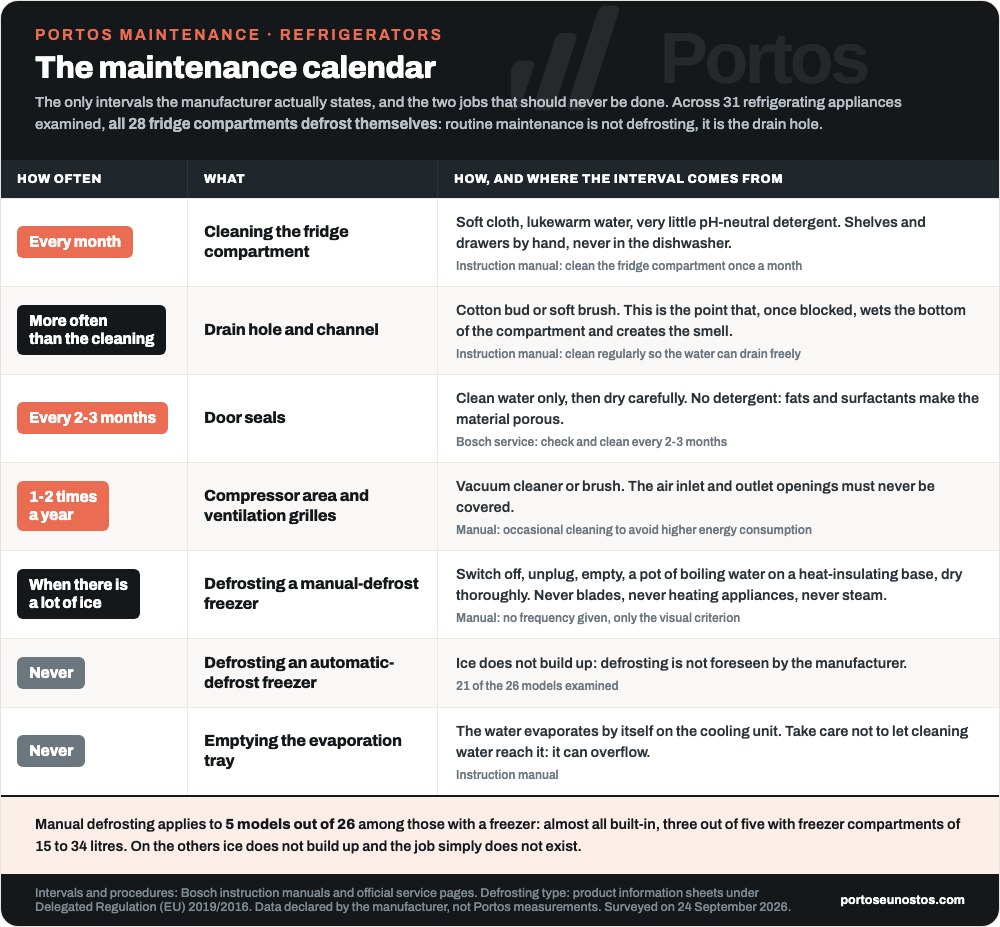
The maintenance calendar according to the manufacturer's instructions: what to do, when and how.
Operational summary, with the source of each frequency.
| Operation | Frequency | How |
|---|---|---|
| Drain hole and conveyor | More often than general cleaning | Cotton swab or soft brush |
| Cleaning the refrigerator compartment | Once a month | Soft cloth, lukewarm water, very little neutral pH detergent |
| Checking and cleaning seals | Every 2-3 months | Clean water only, then dry carefully |
| Engine area and ventilation grilles | Occasionally, 1-2 times a year | Vacuum cleaner or brush |
| Manual freezer defrosting | When a lot of ice has formed | Turn off, empty, bowl of boiling water, dry |
| Automatic freezer defrosting | Never | Not provided by the manufacturer |
| Empty the evaporation pan | Never | Water evaporates by itself on the refrigeration unit |
When maintenance is not enough
There are situations where continuing to defrost and clean does not solve the problem, and it's worth recognizing them before spending time.
Ice reforms in two or three weeks. This is not normal. The causes, in order of probability: seal that doesn't hold, door that doesn't close because the appliance is not level, loose hinge. The first two are solved with a replacement or an adjustment of the feet, the third with a screwdriver. These are all parts covered by the availability obligations mentioned above.
The bottom remains wet even after clearing the hole. At this point the problem could be a deformed conveyor or a clogged drain tube further down, and you need assistance.
The compressor barely ever stops. If it's not due to clogged ventilation openings or temperature set too low, it's a symptom you should have checked.
The appliance is many years old and consumes as declared. Here the issue is no longer maintenance. An appliance that is fifteen years old, even if in good order, works on an energy label that no longer exists and on electronics that don't modulate. In that case the comparison should be made on the overall cost and not on the price: the method is in how to choose the refrigerator and, for the size, in which capacity you really need. Current availability and prices of the models mentioned in this guide are on OpportunityCommerce.
The Portos evaluation
Refrigerator maintenance has been portrayed for years as a laborious ritual, defrosting, which today concerns a minority of appliances on sale: five out of twenty-six in the group we examined, almost all built-in and almost all with small freezer compartments. Meanwhile, the operation that really matters, clearing the drain hole with a swab, is barely mentioned in household discussions and takes two minutes a month.
Our practical advice is to reverse priorities: every month, when you clean the compartment, spend thirty seconds on the drain hole and a minute on the seal. These are the two parts that, if neglected, produce the symptoms that are then mistaken for faults: wet bottom, persistent odor, ice that returns, consumption that increases.
On the purchase decision, the numbers of the two twin pairs say something that no brochure will ever say: the system that prevents defrosting costs between 65 and 167 euros more, consumes 5 kWh per year more and returns 8 liters less freezer space. It's a function you buy for time, not for efficiency. Knowing this, the choice becomes personal and honest: those who open the freezer infrequently and can't bear the idea of defrosting pay that money with full knowledge; those who freeze little and have a small cell have no reason to do so.
Sources
Bosch, instruction manual for KGN series refrigerator/freezer combination: safety warnings, defrosting, cleaning and energy saving (PDF).
Bosch, instruction manual KGV 36V00/36V01: defrosting of the freezer compartment, auxiliary means and cleaning frequency (PDF).
Bosch, online manual, cleaning the defrost water conveyor and drain hole and energy saving during use.
Bosch, customer service: freezer defrosting, how to clean the refrigerator, cleaning and seals. Official website: bosch-home.com.
EU information sheets for the four models compared: KIN86VSE0, KIV86VSE0, KIN865SE0, KIV86NSE0 (PDF).
Delegated Regulation (EU) 2019/2016, energy labelling of refrigerating appliances, Annex IV table 5, defrosting factor Ac: official text.
Regulation (EU) 2019/2019, ecodesign and availability of spare parts: official text.
European product database EPREL.
ARERA, reference price of electricity, Q3 2026: 31.63 cents per kWh including taxes.
Ministry of Health, domestic food safety.
Prices and availability checked on 24 September 2026 on OpportunityCommerce: KIN86VSE0, KIV86VSE0, KIN865SE0, KIV86NSE0.
Portos analysis based on official manufacturer documentation and the regulatory texts cited. Portos has not carried out laboratory tests on the appliances mentioned. Data verified on 24 September 2026.