Of the 231 built-in ovens on sale, 170 have no pyrolysis. Yet of 15 Bosch technical data sheets that declare a cleaning system, 14 declare hydrolysis: the function you need is almost always there and almost nobody uses it. The official procedure, the real cost at the tariff that came into force today, and what still has to be cleaned by hand even on a self-cleaning oven.
Of the 231 built-in ovens currently listed on OpportunityCommerce, 170 have no pyrolytic function. That is almost three out of four. Below 400 euro the feature does not exist at all: there are 34 models in that bracket and not one of them is pyrolytic.
The consequence is that most people clean the oven by hand, convinced there is no alternative. But there is a figure that changes the picture. We decoded the technical data sheets of the 24 Bosch ovens currently in the catalogue and read the cleaning system field: of the 15 sheets that declare it, 14 declare hydrolysis. It is not a premium feature. It is a feature that is almost always there and that almost nobody uses.
This article explains what that function actually does, how to run it, what one cycle costs at the electricity tariff that came into force today, and what still has to be cleaned by hand even on an oven described as self-cleaning. Because one fact you will not find in a brochure is this: the catalytic coating is declared on one wall only, the rear one, on eight of the nine sheets that mention it.
The short answer. You do not need pyrolysis to clean an oven properly. You need to use the hydrolysis programme that almost every oven already has, 0.4 litres of water and a drop of washing-up liquid at 80 degrees for four minutes, and to know that the floor, the inside of the door and the accessories have to be done by hand in every case, pyrolysis included.
What you will find in this guide
How many ovens actually have pyrolysis
Before discussing procedures, it is worth sizing the problem. On 1 October 2026 we surveyed the OpportunityCommerce built-in oven catalogue brand by brand, using twenty different search queries so as not to stop at the 24 products the category page displays. The result is 231 ovens from twenty brands.
Of those, 61 are described as pyrolytic in the commercial name. That is 26.4%: pyrolysis is a minority feature, not the standard.
| Price bracket | Ovens in catalogue | Of which pyrolytic |
|---|---|---|
| under 400 euro | 34 | 0 |
| under 500 euro | 67 | 5 |
| under 700 euro | 99 | 16 |
| under 1,000 euro | 133 | 28 |
| whole catalogue | 231 | 61 (26.4%) |
The median price of a non-pyrolytic oven is 724.00 euro, that of a pyrolytic one 1,008.14 euro. The cheapest pyrolytic oven of any brand sits at 420 euro, the cheapest Bosch pyrolytic at 575.60 euro. Below that threshold, pyrolysis simply is not on sale.
This is why a guide to oven cleaning that starts from pyrolysis is speaking to 26% of readers. We are starting with the other 74%.
How to find out which cleaning system your oven has
The commercial name is not enough. An oven can be called simply built-in oven and carry two assisted cleaning systems on board. The field that matters is on the manufacturer's technical data sheet and it is called cleaning system.
For Bosch products that sheet is a public PDF, reachable from the model code. On the HBF133BR0, the cheapest oven in the Bosch catalogue at 308.83 euro, the field reads EcoClean cleaning programme. On the HBA234BB3 at 480.38 euro it reads EcoClean cleaning programme, Hydrolysis. On the HBG7741B1 at 922.75 euro it reads Pyrolysis + hydrolysis.
Three models, three different answers, and none of this information appears on the energy label. That is why it is worth taking your oven's model code, looking it up on the manufacturer's site and reading that field before buying a degreasing gel.
If your oven is not a Bosch the principle is the same: the entry exists on any serious technical data sheet, sometimes under the name cleaning type or cavity cleaning. If you cannot find it, the instruction manual always has a dedicated chapter, and that is the document that governs.
The systems declared on the 24 Bosch ovens in the catalogue
We downloaded the 24 Italian technical data sheets of the Bosch ovens in the catalogue and decoded them. Twenty can be read in full; four have a PDF our decoder does not open and are left out of the count. We say so because the numbers below hold on 20 sheets, not 24.
Of those twenty, fifteen explicitly declare the cleaning system field. The other five, all compact microwave combination ovens or steam ovens, report cleaning only in the feature list.
| System declared on the sheet | Models | How many |
|---|---|---|
| Pyrolysis + hydrolysis | HBA574ES3, HQA272BB3, HRG272EB3, HBG7741B1, HRG7761B1, HRG7784B1 | 6 |
| EcoClean cleaning programme, Hydrolysis | HBA234BB3, HQA534EB3, CBG7341B1, HBG7321W1, HBG7341B1, HBG7342B1 | 6 |
| Hydrolysis | HRA214BA0, HRG212BB3 | 2 |
| EcoClean cleaning programme | HBF133BR0 | 1 |
The count that matters is this: 14 sheets out of 15 declare hydrolysis, 6 out of 15 declare pyrolysis, and all six pyrolytic ovens also declare hydrolysis. No model has pyrolysis instead of hydrolysis: it has it in addition.
So the correct reading is not pyrolysis or scrubbing. It is: they all have low-temperature cleaning, and some also have the very-high-temperature kind. And the only one of the fifteen without hydrolysis is the cheapest in the catalogue, the HBF133BR0 at 308.83 euro, which does have the catalytic coating on the rear wall.
Hydrolysis: the function you already have and never use
Hydrolysis, in this context, means something very simple: water is evaporated inside the closed cavity, the steam condenses on the walls and softens the dried grease, which is then wiped off instead of scraped. Bosch also calls it assisted cleaning and describes it as an ecological cleaning programme that softens cooking residues so that they can be removed easily.
It is not self-cleaning. The oven does not stay clean by itself: it stays easy to clean. That distinction is worth keeping in mind because it also determines when to use it. The manufacturer is explicit about the scope: it is for when the oven is lightly soiled and you want a quick clean. On a floor encrusted for six months it is not enough.
The concrete benefit is the ratio between effort and result. Four minutes of programme and one wipe replace ten minutes of scrubbing with a degreaser, on an oven used regularly. The main limitation is that it has to be done often, ideally while the oven is still warm after cooking, and that it will not rescue an oven already left to itself.
The six-step procedure, according to Bosch
These are the steps published by the manufacturer, with the exact figures it gives. We report them as they are: we have run no tests of our own and we do not attribute to Portos measurements we did not make.
Remove all accessories from the cavity: shelves, trays, baking trays and, if the model allows, the side supports too.
Prepare the solution: 0.4 litres of water with one drop of washing-up liquid. The manufacturer specifies not to use distilled water.
Pour it in the centre of the cavity floor and close the door. On models with a shelf, the same instruction becomes roughly 400 ml on the lowest shelf.
Select bottom heat with the function selector. It is the mode that heats from below only, that is exactly where the water is.
Set 80 degrees with the temperature selector.
Set a duration of 4 minutes. At the end the oven sounds a signal.
After the signal, wait until the oven can be handled and wipe walls, floor and the inside of the glass with a damp cloth. The softened grease comes away without pressure. If something resists, that is a spot to treat separately, not a reason to run the cycle three times.
On ovens with a dedicated programme in the menu, steps 4, 5 and 6 are replaced by selecting the programme: the name depends on the model and is in the manual. On models with a catalytic coating the dedicated programme is called EcoClean Direct and, the manufacturer says, should be run if the oven is very dirty.
What cleaning an oven costs: four methods compared
An honest premise is needed here. The consumption of a hydrolysis cycle is not a regulated figure: it does not appear on the energy label and no manufacturer publishes it. What we can do is calculate a certain upper bound, and we do so in the way least favourable to hydrolysis.
The method: we take the maximum declared electrical input of the appliance and apply it to the whole duration of the cycle, as if the element worked at full load for all four minutes. That is a deliberately pessimistic assumption, because at 80 degrees with bottom heat alone no element draws as much as the whole oven heating up. On a 3,600 W oven that gives 0.24 kWh, on a 3,300 W one 0.22 kWh.
For pyrolysis, by contrast, the figure is published: Bosch declares about 3.6 to 4.7 kWh per cycle, reaching an internal temperature of around 500 degrees. It is the only official value in existence, because no regulation requires pyrolysis to be measured.
| Method | Energy per cycle | Cost per cycle | What is left to do |
|---|---|---|---|
| Hydrolysis / assisted cleaning 80 degrees, 4 minutes | at most 0.22-0.24 kWh | about 0.10 euro | wipe walls, floor and glass |
| Hand cleaning with gel or degreaser | 0 kWh | the product only | everything, with dwell times |
| Home-made steam bowl of water, 220 degrees, 20 minutes | 0.73-1.20 kWh | 0.32-0.52 euro | wipe, same as hydrolysis |
| Pyrolysis about 500 degrees, 1-2 hours | 3.6-4.7 kWh | 1.56-2.04 euro | remove the ash, wash accessories by hand |
The resulting ratio is clear: one pyrolysis cycle costs between sixteen and twenty times a hydrolysis cycle, even using the harshest estimate for hydrolysis. And it arrives after you have emptied the oven and waited an hour and a half.
Be careful, though, not to read more into that number than it says. At the frequency the manufacturer itself recommends for pyrolysis, a deep clean every 6 to 12 months, the cost on the bill is between 1.56 and 4.08 euro a year: negligible. Pyrolysis is not expensive to run. It is expensive to buy, and we come to that shortly with the twins.
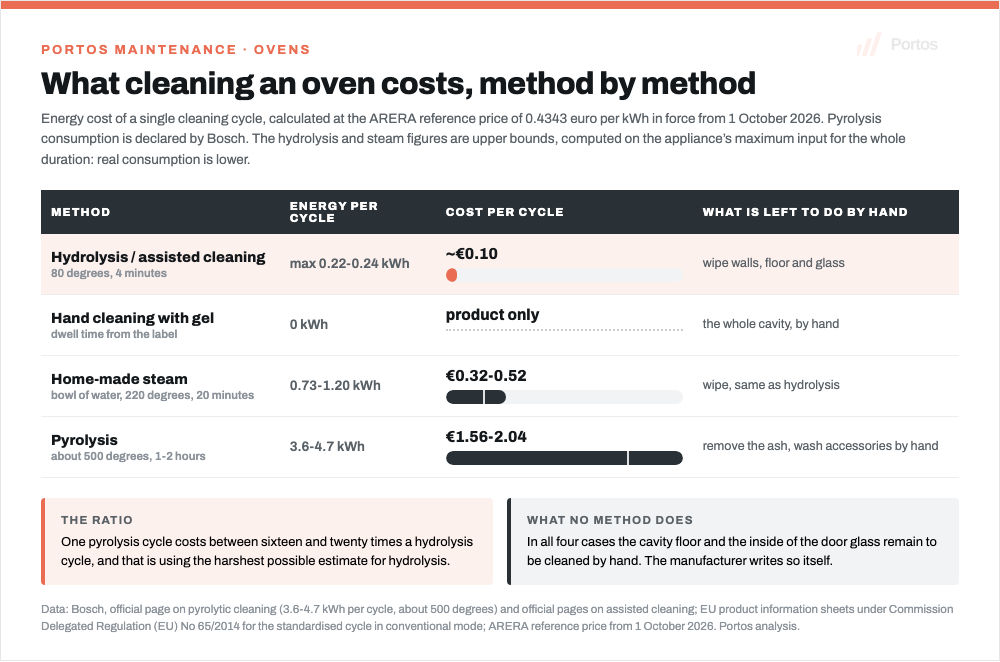
The four methods compared: one pyrolysis cycle costs between sixteen and twenty times a hydrolysis cycle, and in none of the four cases do the floor and the door glass clean themselves.
The tariff changed today: 0.4343 euro per kWh
All the costs on this page are calculated with the ARERA reference price for vulnerable customers under the regulated regime, which from 1 October 2026 is 43.43 euro cents per kilowatt-hour, taxes included. That is a 37.3% increase on the previous quarter, resolved on 29 September 2026.
We flag it because it changes the arithmetic in a way that is not marginal. Up to 30 September the reference was 31.63 cents: a pyrolysis cycle cost between 1.14 and 1.49 euro, today it costs between 1.56 and 2.04. Every running-cost calculation published before today, including on our own earlier articles, is understated by about a third. That holds for the oven as it does for any other appliance.
If you are on a different free-market tariff, the rule for redoing the arithmetic is simple: the kWh stay the same, only the multiplier changes.
Self-cleaning means one wall out of six
This is where the brochures and the technical data sheets say different things.
On the nine Bosch sheets that declare the CleanCoating catalytic coating, eight declare it on a single surface: the rear wall. The one exception is the HSG7584B1, a steam oven at 1,808.25 euro, which declares rear, upper and ceiling walls.
| Model | Coated surfaces, from the technical data sheet |
|---|---|
| HBF133BR0 | rear wall |
| HBA234BB3 | rear wall |
| HQA534EB3 | rear wall |
| CBG7341B1 | rear wall |
| HBG7321W1 | rear wall |
| HBG7341B1 | rear wall |
| HBG7342B1 | rear wall |
| HSG7361B1 | rear wall |
| HSG7584B1 | rear, upper and ceiling walls |
An oven cavity has six surfaces: floor, ceiling, two side walls, rear wall and the inside of the door. In the most common configuration the coating covers one. And it is not the one that gets dirty.
That is not our claim. It is the manufacturer's, describing how the coating works: once the oven has cooled down, grease and food stains only need to be removed from the floor and the inside of the door. Translated: the two surfaces the coating does not cover are exactly the two that remain to be cleaned by hand.
This does not make the coating useless, and we explain why in a moment. It does make the expectation misleading, namely that an oven with self-cleaning walls does not need cleaning.
What the catalytic coating does and does not do
The mechanism, in the official description, is this: a layer of ceramic microparticles in direct contact with the wall absorbs grease and breaks it down through oxidation while the oven cooks. No detergent and no dedicated cycle are needed: it happens during normal use. The manufacturer adds two points that matter for a buying decision: the coating regenerates every time the oven is switched on and stays active for the whole service life of the appliance.
The concrete benefit, then, is that the rear wall, the one the fan throws splashes against, does not build up a brown film over the years. That is a real and permanent benefit, and it asks nothing of the user.
The main limitation is twofold. First, the coverage: one surface out of six. Second, and more important in practice, the coating is damaged by abrasive sponges. The manufacturer's instruction is categorical: never use abrasive sponges on ovens with the EcoClean function, and avoid aggressive chemicals.
That is the paradox of the self-cleaning oven: the wall that cleans itself is also the only one you can ruin irreversibly by cleaning it. If you have an oven with a catalytic coating and you have been scrubbing the back wall with a scouring pad, that is why it no longer works.
The oven floor, where the dirt ends up by gravity
The floor is the critical surface and it is never coated. It receives everything that drips, and when grease dries on hot enamel it forms a crust that water will not shift.
The procedure that works, in increasing order of aggressiveness:
A hydrolysis cycle as described above, then a damp cloth. It deals with everything deposited in the last few weeks.
A gel cleaner made for ovens, spread on the floor and left for the time stated on the pack, then removed with a soft sponge and rinsed thoroughly. The manufacturer warns not to apply it to seals and plastic parts.
Repeat. On an old deposit, two gel applications with full dwell time achieve more than one scraping session, and they do not scratch the enamel.
What not to do: scrape with metal tools or glass scrapers. The enamel on the floor is the barrier that keeps the steel from corroding; once chipped, it cannot be restored.
Prevention, in this case, is worth more than any technique. The manufacturer suggests using trays to catch drips of fat and avoiding cooking very fatty food unprotected. Those are the two things that most reduce the later work.
The door glass, step by step
The inside of the door is the second surface that always stays manual, even on ovens with a coating and even on pyrolytic ones. It picks up splashes that go opaque as they cook and that, seen from outside, make the whole oven look dirty.
The quick route is a wipe with a wet cloth after every use, with the oven cold. Done regularly, nothing else is needed.
When the opacity has already formed, on some models the door panes can be taken out. The sequence indicated by the manufacturer is this:
open the door and press the two levers at the top of the door cover;
loosen the screws on the sides, under the cover;
fold a kitchen cloth several times and rest it on the door before closing it;
remove the front panel and lay it on a flat surface with the handle facing down;
clean the panes with a damp cloth and a suitable cleaner, rinse and dry with a soft cloth;
refit the panel, tighten the screws and put the top cover back in place.
Two warnings that matter. First: not all models allow it, and the manual should be read before starting, not afterwards. Second: an oven door has three or four panes, they must be refitted in the right order and the right way round, and getting a screen-printed pane the wrong way round leaves you with a panel that mists up. If in doubt, a service centre does the job in minutes and you do not risk the door.
Shelves, trays and telescopic rails
This is the part pyrolysis does not solve, and it is worth saying plainly because it is where expectation collides with the manual. In most cases the standard accessories have to be taken out of the oven before a pyrolysis cycle. So they get washed by hand. The manufacturer specifies that only some Series 8 trays and rails are pyrolysis-proof and may be left inside: otherwise, you have to take them out before cleaning.
The method for shelves and trays is the same on any oven:
soak them in a bowl of hot water with washing-up liquid;
scrub with a sponge, and with a brush on the more stubborn deposits;
rinse thoroughly before putting them back, because leftover detergent bakes on and smells.
The non-stick coated trays on recent ranges can go in the dishwasher: that is worth checking in your own manual, because repeated dishwasher cycles will dull the enamel on a traditional enamelled tray.
Telescopic rails need specific care: clean them closed, with a brush or a sponge damped with hot water, taking care not to remove the internal lubricant. A generous wash with degreaser on a telescopic rail will make it stiff within weeks, and the rail cannot be re-lubricated.
The door seal, the one part that really gets ruined
The rubber seal around the door is the component that incorrect cleaning destroys most often. It deforms, hardens, loses contact, and when it loses contact the oven loses heat and consumes more than it declares.
The instruction is simple and restrictive: a soft cloth damped with hot water, cleaning in place without removing it, no aggressive detergents. No degreaser, no oven gel, no alcohol.
The check worth doing once a year: with the oven cold, close the door on a sheet of paper and try to pull it out. If it slides out without resistance at some point, the seal no longer closes there. That is a spare part, not a repair, and on Bosch ovens it falls among the components for which Regulation (EU) 2019/2022 requires spare-part availability for ten years.
The home-made steam trick costs more than anything else
The method circulates in every form: a bowl of water in the hot oven, the steam dissolves the grease. It also exists in the manufacturer's own version, described like this: fill a heat-resistant glass bowl or a tray with hot water, put it in the oven, set the temperature to no less than 220 degrees and run it for 20 minutes, then switch off, let it cool and clean with a damp cloth.
It works. But look at what we are doing: twenty minutes at 220 degrees is, in energy terms, a cooking session. To put a cautious number on it, on the EU product information sheets of the Bosch ovens in the catalogue the consumption of one standardised cycle in conventional mode ranges from 0.73 to 0.98 kWh; the upper bound computed on maximum input for a full twenty minutes is 1.20 kWh. At today's tariff, between 0.32 and 0.52 euro.
The comparison with hydrolysis is the point of this section. The same result, that is softened grease to be wiped off, is obtained with four minutes at 80 degrees instead of twenty at 220, and at a cost three to five times lower. The home trick is not the cheap method: it is the do-it-yourself and more expensive version of a function the oven already has in its menu.
It makes sense in one case only: if your oven is among those without a hydrolysis programme and has no bottom-heat setting. Then it is the only way to get steam, and 220 degrees is the figure the manufacturer gives.
What to clean with and what never to use
The list below summarises the official instructions, surface by surface. It is not a generic list: every row answers a specific mistake visible on ruined ovens.
| Surface | What to use | What never to use |
|---|---|---|
| Enamelled walls and floor | hot water and washing-up liquid, cloth or soft sponge; oven gel on deposits | abrasive sponges, scouring pads, metal scrapers, glass scrapers |
| Wall with catalytic coating | damp cloth only and cleaners recommended by the manufacturer | any abrasive sponge, aggressive chemicals, oven gel |
| Door glass | damp cloth, cleaner made for oven glass | scrapers, high-alcohol products |
| Rubber seal | soft cloth and hot water only, in place | any detergent, degreaser, alcohol; do not remove it |
| Shelves and trays | soak in hot water with washing-up liquid, sponge, brush | the dishwasher, unless the manual allows it |
| Telescopic rails | brush or damp sponge, rail closed | soaking, degreasers: they remove the lubricant |
| Exterior and stainless steel | cloth wetted with hot water | abrasive products, which leave visible scratches |
Three categories of product to avoid in general, following the manufacturer's instructions: abrasive cleaners, those that are too aggressive or high in alcohol, and products for cleaning a hot oven. That last item is surprising and worth explaining: some sprays are formulated to act on a hot surface, and on modern enamel or a catalytic coating the heat accelerates the chemical attack on the surface rather than on the dirt.
The accessory that gives pyrolysis away
There is a detail in the technical data sheets that on its own shows how partial a solution pyrolysis is. Among the optional accessories, on nineteen of the twenty Bosch sheets we decoded, two codes appear: HEZ631070 tray suitable for pyrolysis and steam and HEZ632070 roasting tray suitable for pyrolysis and steam.
They cost money, and they are optional accessories. Which implies, by direct deduction, that the tray and the roasting tray supplied with the oven are not pyrolysis-proof: if they were, selling a dedicated version would make no sense.
The fact is consistent with the manufacturer's instruction already quoted, that accessories must be taken out before the cycle. It follows that whoever buys a pyrolytic oven and wants to leave the tray and roasting tray inside has to buy them separately; otherwise they wash them by hand exactly like someone with an oven without pyrolysis.
A methodological warning for anyone running these checks themselves, because we hit it: the word pyrolysis appears in the accessory list of almost every sheet, pyrolytic or not, precisely because of those two codes. Searching for pyrolysis inside a technical data sheet tells you nothing about the oven. The only field that governs is cleaning system.
Two pairs of twins: what pyrolysis costs on its own
To put a price on the function alone you need a pair of models identical in everything except that. There are two in the catalogue, and both are verifiable on the EU product information sheets.
| Comparison | Series 8 | Series 4 |
|---|---|---|
| Model without pyrolysis | HBG7341B1 EcoClean + Hydrolysis | HBA234BB3 EcoClean + Hydrolysis |
| Model with pyrolysis | HBG7741B1 Pyrolysis + hydrolysis | HBA574ES3 Pyrolysis + hydrolysis |
| Energy efficiency index | 81.2 on both | 81.2 on both |
| Energy class | A+ on both | A+ on both |
| Consumption per cycle, conventional | 0.87 kWh on both | 0.94 kWh on both |
| Consumption per cycle, fan-forced | 0.69 kWh on both | 0.69 kWh on both |
| Cavity volume | 71 l on both | 71 l on both |
| Mass | 34.1 against 37.3 kg | 32.7 against 35.4 kg |
| Price recorded on 1 October 2026 | 810.98 against 922.75 euro | 480.38 against 575.60 euro |
| Price difference | +111.77 euro | +95.22 euro |
| List price difference | +159.67 euro | +136.03 euro |
On every field of the EU product information sheet the two pairs are identical, with one exception: mass. The pyrolytic model weighs 3.2 kg more in Series 8 and 2.7 kg more in Series 4. Those three kilos are the extra insulation and the reinforced door needed to contain 500 degrees, and they are the only trace of the function that a regulated document lets you see.
The rest is arithmetic. Say you run two pyrolysis cycles a year, the frequency the manufacturer recommends, for ten years: twenty cycles. The 111.77 euro price difference, spread over twenty cycles, is 5.59 euro per cycle on Series 8 and 4.76 euro on Series 4. Energy, at today's tariff, adds 1.56 to 2.04 euro. Total per pyrolysis cycle actually used: 7.15-7.63 euro on Series 8, 6.32-6.80 on Series 4.
A hydrolysis cycle on the twin without pyrolysis, by contrast, costs about ten cents and required no purchase premium at all, because hydrolysis is on both.
This does not mean pyrolysis is not worth the price: it means you pay the price at the moment of purchase and not on the bill, and that it is worth knowing beforehand, because those 95 to 112 euro are the only part of that difference you can decide not to spend.
How often to clean the oven
There is no regulated figure, but there are two useful references. The first is the manufacturer's and concerns the deep clean: with the pyrolytic function, every 6 to 12 months. The second is mechanical common sense: dirt removed within a few days comes off with water, dirt left for three months needs a chemical.
| Task | Frequency | Time |
|---|---|---|
| Damp cloth on the glass and on visible drips | after every use, oven cold | 1 minute |
| Hydrolysis cycle plus a wipe | every 2 to 4 weeks, depending on use | 4 minutes of programme, 5 of wiping |
| Shelves and trays in a bowl | monthly, or when visibly greasy | 20 minutes with soaking |
| Gel cleaner on the floor | 2 to 3 times a year | as per the dwell time on the pack |
| Pyrolysis, if fitted | every 6 to 12 months | 1-2 hours plus cooling |
| Seal check with a sheet of paper | once a year | 1 minute |
Anyone who keeps to the first row does not need the fourth. That is why regularity, in this field, counts for more than technique and more than the oven's feature list.
Mistakes to avoid
Scrubbing the rear wall with a scouring pad. If the oven has a catalytic coating, you have just disabled it permanently over an area that cannot be restored.
Using a degreaser on the seal. The rubber hardens, loses its seal, the oven loses heat and consumes more than declared.
Soaking telescopic rails. It removes the internal lubricant, which cannot be replaced.
Scraping the enamel on the floor. Once chipped, the steel underneath is exposed and the damage is irreversible.
Using hot-oven cleaning products on modern enamel and catalytic coatings. The heat accelerates the attack on the surface, not on the dirt.
Not rinsing shelves and trays. Leftover detergent bakes on at the next use and leaves a smell in the food.
Running pyrolysis with the accessories inside, unless the manual states those parts are pyrolysis-proof.
Using distilled water for the hydrolysis cycle: the manufacturer explicitly says not to.
Assuming you do not have hydrolysis. Of 15 Bosch sheets that declare the cleaning system, 14 have it. It is worth checking before buying a gel.
When it makes sense to replace the oven
You do not replace an oven because it is hard to clean: you replace it when it is hard to clean and something else is wrong. The cases where it is worth considering:
Chipped enamel on the floor or corroded walls. This is not a cosmetic problem, it is a surface that can no longer be sanitised.
Seal unobtainable. If the model is outside the spare-parts availability window, a door that does not close cannot be fixed.
Door panes that mist permanently between two panels, from ingress. That is a repair that often costs more than the appliance is worth.
None of the assisted cleaning functions, on an oven used every day. In that case the time you spend is a legitimate argument.
If you get to that point, the thing to look at on the data sheet is not pyrolysis: it is the cleaning system field. An oven with hydrolysis and a catalytic coating at 480 euro gives you, in terms of daily effort, almost everything a pyrolytic one at 575 gives you, and you pay the difference only once.
To see what is on the market today you can start from the OpportunityCommerce oven category, where the models cited in this guide are available and where the commercial name distinguishes the pyrolytic ones. For a price comparison across sellers, the built-in oven search on SniffaPrezzi remains useful, bearing in mind that accessories also appear among the results.
The Portos view
Cleaning an oven without pyrolysis is not a fallback. It is what three out of four ovens on sale do, and in the great majority of cases the machine already has the right tool on board: a programme that at 80 degrees, in four minutes and for ten cents of electricity, softens the dirt for you.
What changes the outcome is not the technology, it is three habits. First: a damp cloth on the glass after every roast, one minute. Second: a hydrolysis cycle every two to four weeks, before the dirt turns into a crust. Third: never use anything abrasive, above all on the rear wall, which on eight sheets out of nine is the only coated one and the only one you can ruin for good.
If you are deciding which oven to buy, the advice that follows is to look at the cleaning system field before the commercial name. Hydrolysis is on 14 sheets out of 15 and costs nothing extra. Pyrolysis costs between 95 and 112 euro on the twins in the catalogue, weighs three kilos more in insulation, does not move the energy index by a tenth and is meant to be used once or twice a year. It makes sense if you cook a lot, often with meat and open trays, and if an hour and a half of self-cleaning saves you a gel session you hate. It does not make sense as insurance against cleaning: that does not exist, because the floor, the glass and the accessories still have to be done by hand, pyrolysis included.
Also worth reading
How to choose a built-in oven, the general guide to volumes, functions and features.
Pyrolytic or catalytic oven: which is better, the comparison between the two families from a buying perspective.
How much energy does an oven use, consumption measured across twenty EU product information sheets, mode by mode.
How often to defrost and clean the refrigerator, the same approach applied to cooling.
How to read the energy label, to understand what the label does not tell you.
Sources
Bosch, Italian technical data sheets of the ovens in the catalogue, PDFs published by the manufacturer and consulted on 1 October 2026. Cleaning system field, Cleaning feature list, optional accessories and masses: 24 sheets downloaded, 20 decoded, 15 with the field declared.
Bosch, product information sheets under Commission Delegated Regulation (EU) No 65/2014 on the energy labelling of ovens: efficiency index, class, consumption per cycle in conventional and fan-forced mode, volume and mass of the HBG7341B1, HBG7741B1, HBA234BB3 and HBA574ES3.
Bosch, how to clean the oven quickly and simply: quick cleaning procedure with 0.4 l of water at 80 degrees for 4 minutes, cleaning the door glass, shelves, sliding rails and seals, the bowl method at 220 degrees for 20 minutes and the products to avoid.
Bosch, self-cleaning ovens: description of assisted cleaning with roughly 400 ml of water and a drop of washing-up liquid, how the EcoClean Direct coating works and regenerates, which surfaces remain to be cleaned by hand.
Bosch, keeping the oven clean: recommended frequency of the deep clean with pyrolysis, pyrolysis-proof accessories, prohibition of abrasive sponges on ovens with EcoClean.
Bosch, pyrolytic oven cleaning: internal temperature of around 500 degrees and declared consumption of about 3.6 to 4.7 kWh per cycle, three programme levels.
Bosch support, how to clean the oven, and Bosch manual search, where the instruction manual is downloaded by entering the model code.
ARERA, press release of 29 September 2026: from 1 October 2026 the reference price of electricity for the typical vulnerable customer under the regulated regime is 43.43 euro cents per kWh including taxes, up 37.3% on the third quarter. This is the value used for every cost calculation on this page.
Commission Regulation (EU) 2019/2022, ecodesign requirements: spare-part availability obligations, including seals.
OpportunityCommerce catalogue, built-in oven survey of 1 October 2026: 231 references from twenty brands collected with twenty search queries, of which 61 declared pyrolytic; prices of the models cited recorded and verified on the product page.
Portos editorial assessment based on the manufacturer's documentation and on catalogue data recorded on the date stated. The appliances were not tested in a laboratory: we do not claim measurements of our own and we flag explicitly which figures are upper-bound estimates. Next review due by 30 December 2026, updating prices, catalogue and the ARERA tariff.