Choose a built-in oven starting from the unit, not from the technical specifications: if the niche isn't the right one, nothing else matters. Measurements, capacity, cooking modes, energy consumption and cleaning system, in the order that makes sense.
A built-in oven is one of the few appliances you buy once and keep for ten or fifteen years, often without being able to move it an inch. For this reason the choice starts from the cabinet, not from the technical specifications: if the niche isn't the right one, everything else is irrelevant.
Once you've met the size constraint, the parameters that really make the difference are few: the cavity capacity, the cooking modes you'll actually use, the cleaning system and the stated consumption per cycle. Everything else, from automatic programmes to connectivity, is secondary: pleasant, but rarely decisive.
In this guide we lay out the criteria in the order they matter, with verifiable data from the label and installation manual, so you can go to the shop or product sheet knowing what to look for.
The short answer
For most Italian kitchens the coherent choice is an electric multifunctional oven, 60 cm wide, fan-assisted, with a cavity around 70 litres, high energy class and a cleaning system suited to how much you cook. This configuration works well for leavened bakes, roasts, baking trays and multi-level cooking without paying for features that would go unused.
You move away from this formula in two cases. If vertical space is tight or the oven is a second appliance, a compact model 45 cm tall makes sense, often combined with microwave or steam. If instead you cook a lot and for many people, and your kitchen allows it, a 90 cm model offers a noticeably larger cavity.
In brief: what you'll find in this guide
The dimensions: where it all starts
A built-in oven has two sets of dimensions that shouldn't be confused. The external dimensions are the appliance's overall size: in a standard 60 cm model they're around 59.4 cm wide and 59.5 cm tall, slightly less than the nominal size to fit in the cabinet. The niche dimensions are instead the space the cabinet must provide: generally 56-57 cm wide, 58.5-60 cm tall and at least 55 cm deep, with exact values indicated in each model's installation manual.
Before looking at any product sheet, measure the niche at three points: internal width, internal height and usable depth. If you're replacing an old oven, don't assume the new one will fit: standards have become more uniform over the years, but custom cabinets and older kitchens may have slightly different spaces.
Two details that you discover late and cost effort should also be checked: the space for the door to open, which in a niche below the worktop often meets the drawer or door next to it, and the electrical outlet, which must be outside the oven's footprint but reachable. The manual always indicates the ventilation openings to leave clear: sealing the space around the oven is one of the most common mistakes.
Standard, compact or extra-large
The formats on the market are essentially three and respond to different needs.
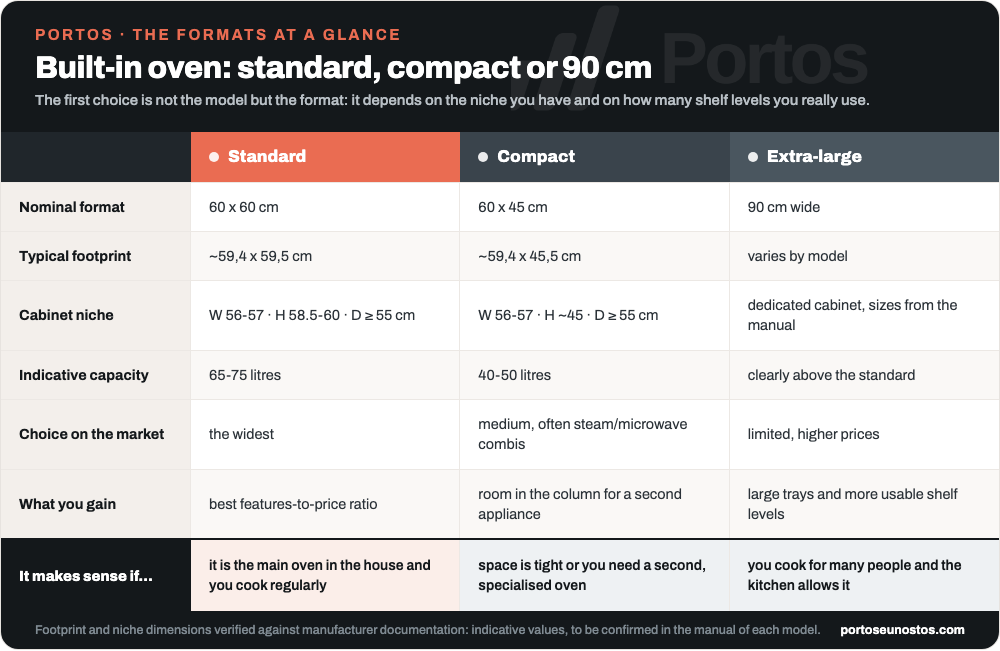
The three built-in oven formats compared: dimensions, indicative capacity and most suitable use.
The 60x60 is the reference standard and the format with the broadest range: it's the one manufacturers focus their ranges on, so it's also where you find the best balance between features and price. The compact 45 cm tall maintains the same width but reduces the cavity, and is used especially when you need to free up vertical space or when you want to place a second appliance next to it, for example a steam oven or a microwave combination. Models 90 cm wide are a niche: they require a dedicated cabinet and have a higher price, but offer a noticeably larger cavity for big baking trays.
How many litres you really need
The cavity volume is stated in litres on the energy label and is the data that best describes how much fits inside. A standard 60 cm oven generally falls between 65 and 75 litres; a 45 cm compact typically stays between 40 and 50 litres. European regulations, not surprisingly, separate compact ovens (up to 50 litres) from medium and large ones.
The practical criterion is simple: count the levels you use at the same time. Someone who bakes one tray at a time doesn't gain anything from an extra-large cavity. Those who cook on two or three levels, prepare leavened goods that need to rise, or put a large baking tray in occasionally—from 70 liters and up—have a margin that you can feel. Pay attention to a detail that's often overlooked: internal usable width matters more than total volume, because it's what determines whether a 40 cm tray fits or not.
Static, convection, steam: the modes that matter
Cooking modes are the part of the data sheet where manufacturers have fun with commercial names, but the real families are few.
Static: heat comes from upper and lower heating elements, without a fan. It's traditional cooking, indicated for bread, pizza, leavened cakes and anything that needs to rise gradually.
Convection (hot air): a fan distributes heat more evenly and allows cooking on multiple levels at once. Manufacturers generally indicate lowering the temperature by about 20 °C compared to a recipe designed for a static oven.
Grill and convection grill: heat from above, for gratinating and browning the surface.
Steam: here we need to distinguish between two different things. Added steam introduces moisture during traditional cooking and is useful for bread and roasts; a true steam oven cooks with steam autonomously and is an appliance of a higher category and price.
Air fry cooking: more intense ventilation that dries the surface, present in the latest ranges of various manufacturers.
The number of functions on the knob is not an indicator of quality. Almost everyone ends up using three or four modes: static, convection, grill, and if available, steam. An oven with twelve programs that cooks poorly on convection is a worse choice than one with six well-calibrated programs.
Consumption and energy class
Ovens haven't yet switched to the A-G scale introduced in 2021 for refrigerators, washing machines and dishwashers: they continue to use the scale from the 2014 European regulation, which goes from A+++ to D. It's an important difference to keep in mind when comparing labels of different appliances, because the same letter doesn't have the same meaning. If you want to understand how to read the values shown, we've dedicated a separate guide to the new energy label.
On an oven's label you'll find the energy consumption per cycle expressed in kWh, indicated separately for conventional cooking and forced air cooking, along with the cavity volume. It's the data with which to compare two models honestly: the class summarizes, the kWh value measures.
To get an idea of the order of magnitude: the difference between a very efficient oven and a mediocre one is measured in about 0.3-0.4 kWh per cycle. Someone who turns on the oven three times a week does about 150 cycles a year, so we're talking about 45-60 kWh difference, which at 0.25 euros per kWh is worth between 12 and 15 euros a year. It's not a figure that alone justifies a much more expensive oven, but it's a useful criterion for choosing between two similar models.
The factor that weighs most on the bill, however, is not the class but habit: preheating when not needed, opening the door often and cooking one tray at a time have more impact than any difference between two models in the same range.
The cleaning system
It's the criterion that varies the price most for equal cooking performance. The options are three: pyrolysis, a dedicated cycle at very high temperature that reduces residue to ash; catalysis, porous panels that absorb fats during normal cooking; hydrolysis or steam cleaning, a short program at low temperature that softens light dirt.
The choice depends almost solely on how much and how you cook, not on budget. We've compared the two main systems, with temperatures, consumption and real limits, in our in-depth article on pyrolytic or catalytic oven: it's the right read if you're hesitating between two models that differ mainly on this.
Built-in or freestanding, and electrical connection
A distinction that's rarely explained in stores. A freestanding oven has its own controls and can be installed where you want, typically in a column. A built-in oven also integrates the cooktop knobs on its front: it must be positioned under the cooktop and matched with a compatible cooktop, generally from the same manufacturer. If you're replacing just the oven in an existing kitchen, check which one you have: it's the most common cause of wrong purchases.
On the electrical front, a built-in oven generally declares a power between 2.5 and 3.6 kW. It's not a detail: it requires an adequate line and a connection compliant with what's indicated in the installation manual, which specifies cable section and necessary protection. If you have a 3 kW meter at home and use the oven together with other power-hungry appliances, take that into account.
Useful functions and ancillary functions
Some details really improve everyday use, others mainly serve to justify the list price. Among those that prove useful over time:
Telescopic guides: allow you to extract the tray without tipping it. On a frequently used oven, they change the experience more than many cooking functions.
Meat thermometer: if you roast meat, it's the tool that removes the luck factor.
Multi-pane door and tangential ventilation: reduce the external temperature of the door, a relevant aspect with children in the house.
Decent lighting and readable display: trivial, but they're the details you notice every day.
Instead, functions that should be evaluated without emphasis are very specific automatic programs, integrated recipe books and connectivity: they can be convenient, but rarely justify a price jump on their own. The real advantage comes when you use them; if you already know you won't, they're a cost you pay and don't recover.
When a basic oven is enough
An entry-level model, fan-assisted, with catalytic or steam cleaning and average energy rating, is more than sufficient if the oven is used a few times a week for simple cooking, if you don't make demanding leavened bakes and if occasional manual cleaning doesn't bother you.
It makes sense especially in a second home, in a small kitchen or when the budget is better spent elsewhere, for example on a cooktop or a hood that you'll use much more. Adding features that will remain unused doesn't improve anyone's kitchen.
When it makes sense to upgrade
Upgrading becomes a rational choice when at least one of these conditions applies: you use the oven almost every day, you often cook on multiple levels, you make leavened bakes or roasts that require precise temperature control, or you hate cleaning and pyrolysis would save you hours every year.
In these cases the real advantage is not in the number of programs but in even cooking, in temperature stability and in accessories that make daily use convenient. There are more appropriate alternatives to the top-of-the-range model when your need is single and specific, for example steam: in that case a dedicated compact oven alongside a good quality standard oven can be a more sensible solution.
Once you've identified the configuration you need, the next step is to understand how much it actually costs on the market: you can compare prices and availability of built-in ovens on SniffaPrezzi or check the oven category on OpportunityCommerce to see what's actually available. Technical specifications, on the other hand, should always be read on the manufacturer's website: you can find them for example in Bosch's oven section.
Mistakes to avoid
Buying before measuring the niche. It's the most expensive mistake because you often discover it after delivery. Width, height and useful depth should be verified on the cabinet, not inferred from the old oven.
Confusing energy classes between different appliances. An oven in class A and a refrigerator in class A don't mean the same thing: ovens still use the A+++/D scale.
Choosing based on the number of programs. In practice you use three or four. What matters more is how it cooks in the modes you'll actually use.
Ignoring the type of controls. A built-in oven bought to replace a standalone one, or vice versa, creates installation problems and compatibility issues with the cooktop.
Underestimating cabinet ventilation. Closing the openings indicated by the manual worsens performance and shortens the life of electronic components.
Paying for pyrolysis and then not using it. It's an excellent system, but it makes sense if you cook often and make a lot of mess: otherwise it's a feature that sits idle.
Portos's choice
In Portos's evaluation the order of criteria matters as much as the criteria themselves. You start with the niche measurements, which exclude or allow models; then you choose the size based on available space; then the capacity, thinking about how many levels you actually use. Only at this point do you look at cooking modes, cleaning system and consumption per cycle, which serve to choose within an already consistent range.
For most families the balance point remains a 60x60 fan-assisted oven in the mid-range, around 70 liters, with telescopic guides and a cleaning system chosen based on how much you cook. Above this configuration you mainly pay for finishing, evenness and convenience: these are real advantages, but they should be chosen consciously, not accepted at the shop.
The rule that applies to everyone: first identify the price range you need, then compare two or three actual models within that range by reading the energy label and installation manual. That's where the data is that you need to decide.
Sources
Delegated Regulation (EU) No. 65/2014 on energy labelling of ovens and kitchen hoods, consolidated text on EUR-Lex (scale A+++/D, consumption per cycle, cavity volume).
EPREL, European product database with energy labelling: official datasheets of models on the market.
Bosch, built-in oven range: sizes 60x60, compact 60x45 and extra-large 90 cm, cooking and cleaning functions.
Installation manuals from manufacturers for niche measurements, declared power and ventilation requirements. The values shown are indicative and must be verified for the specific model.
Also worth reading: if you're redoing your entire cooktop block, the hob is chosen using different criteria than the oven. We lay them out in induction or gas hob: costs, consumption and differences.
The other half of the cooktop block: the oven has an energy label, the hob doesn't. How much an induction hob consumes and costs you'll find in this consumption analysis.