Pyrolytic and catalytic are two very different oven self-cleaning systems, not two versions of the same one. The pyrolytic system burns off dirt in a dedicated high-temperature cycle, while the catalytic system absorbs grease as you cook. Here's how they work, how much they cost, and which one suits your habits best.
The question almost always comes up in front of the built-in oven: is it worth spending more on a pyrolytic model, which cleans itself, or is a catalytic oven enough? These are two very different self-cleaning systems, not two versions of the same thing, and the choice affects the purchase price, energy consumption, and the effort you'll put in over the coming years.
The difference in one line: the pyrolytic uses a dedicated cycle at very high temperature that reduces dirt to ash, the catalytic has special walls that absorb grease while you cook, without a dedicated program. The first is more effective and more expensive, the second is cheaper but has specific limits.
There's no absolute winner: it depends on how much you use the oven and how much cleaning it bothers you. Let's see how they really work, so you can understand which one makes sense for your habits even before looking at the model or the price.
The short answer
If you cook often, roast meat, make leavened dishes and baking trays that splatter, and want an oven that stays clean with very little effort, the pyrolytic is usually the most consistent choice: complete cleaning, on all walls, with just the gesture of removing the ash. Expect a higher purchase cost and high consumption during the cycle, which however only runs a few times a year.
If instead you use the oven rarely, especially for dishes that don't get it very dirty, and want to keep the initial cost down, the catalytic is more than enough: it works on its own while you cook and doesn't require energy-intensive cycles. The limit is that it handles grease well but not sugars and liquids, it doesn't cover the door and bottom, and the panels need to be replaced after a few years.
In brief: what you'll find in this guide
Two cleaning philosophies compared
Before going into detail, it's worth putting the two systems side by side. They don't tackle dirt at the same time or in the same way: one acts afterwards, on command; the other works continuously, during cooking.
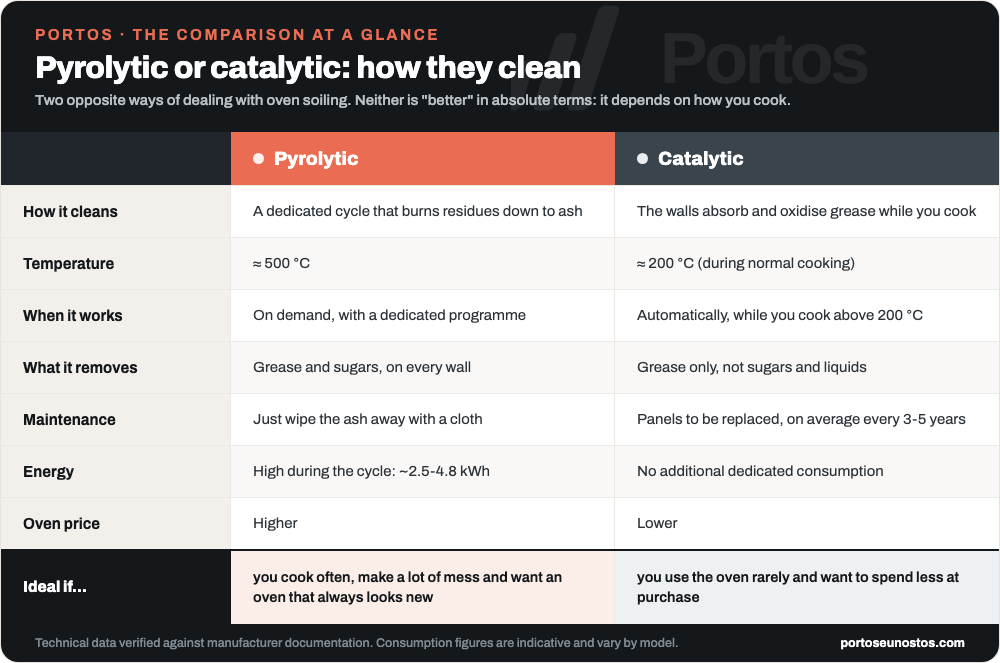
Pyrolytic vs catalytic compared: two opposite ways of dealing with oven dirt.
As you can see, it's not a point-by-point contest: these are two approaches designed for different needs. The pyrolytic focuses entirely on complete on-demand cleaning, the catalytic on simplicity and low cost. The rest of the guide explains what this means in everyday life.
The pyrolytic oven: how it really works
Pyrolysis is a self-cleaning cycle that brings the oven cavity to very high temperatures, around 500 °C. At that heat, food residues, grease and splatters are completely carbonized and reduced to a very fine ash. Once the oven has cooled down, just wipe the bottom with a damp cloth to remove it. During the cycle the door remains locked for safety, precisely because the temperatures involved are very high.
The concrete advantage is the most complete cleaning that exists among automatic systems: it acts on all walls, on the bottom and generally also on the inner part of the door, and above all it removes not only grease but also caramelized sugars, the ones that remain stuck and hardened after a tart or a tray of vegetables. To withstand that heat, however, the oven is built differently: door with more layers of glass, reinforced insulation, dedicated components. That's why a pyrolytic oven costs more to buy.
The main limit is the consumption during the cycle, which generally lasts from one to three hours depending on the level of dirt selected. However, it's not a daily consumption: pyrolysis only starts when needed, in many households once a month or even less. In Portos's assessment it's the right solution for those who cook a lot and don't want to scrub anymore, provided they accept a higher initial cost.
Pros: complete cleaning on all surfaces; removes grease and sugars; maintenance reduced to a minimum.
Cons: more expensive oven; high consumption during the cycle; the cavity stays hot and unusable for a couple of hours.
The catalytic oven: how it really works
The catalytic system doesn't have a dedicated cycle. It works thanks to panels coated with a microporous enamel, rough to the touch, generally applied to the back wall and possibly to the side walls. This enamel contains substances that, heating up during normal cooking, promote the oxidation of grease: droplets of fat are absorbed by the pores and progressively broken down. The process starts to activate at around 140 °C and becomes effective as it approaches 200 °C, that is, at the temperatures of many roasts and oven-baked dishes.
The concrete advantage is simplicity: you don't have to start any program or use extra energy: while you cook, the oven stays clean on its own. And a catalytic oven costs less than a comparable pyrolytic one. It's a sensible solution for those who use the oven in moderation.
However, the limitations need to be known before buying. Catalytic enamel acts only on grease: it doesn't handle sugars, sauces and spilled liquids, which still need to be cleaned by hand. The panels cover the treated walls, but not the bottom, the door glass and the uncoated areas, which remain to be washed manually. Furthermore, the enamel progressively loses its absorption capacity: catalytic panels should be considered a consumable material and on average need replacing every 3-5 years, depending on how much you use the oven.
Pros: cheaper oven; no cycle and no dedicated consumption; automatic cleaning while cooking.
Cons: acts only on grease, not on sugars and liquids; doesn't clean the bottom and door; panels need replacing after a few years.
What about steam cleaning (hydrolysis)?
Alongside the two main systems there is a third one, often present as an additional function: steam cleaning, also called hydrolysis. A small amount of water is poured onto the bottom of the oven and a short low-temperature program is started (generally below 100 °C): the steam softens light dirt, which is then removed with a cloth.
It's a low-consumption, gentle system, but it's designed for routine maintenance, not for baked-on dirt. Several mid-range ovens offer it as a complement to catalytic cleaning. If you find it on a model, consider it a useful extra for small jobs, not an alternative to the deep cleaning of pyrolysis.
Consumption and costs compared
The comparison on consumption is where most misunderstandings arise. A pyrolysis cycle absorbs quite a lot of energy, roughly between 2.5 and 4.8 kWh depending on the model and the duration chosen. This is a high figure if looked at on its own, but it needs context: pyrolysis is started only a few times a year, so the overall impact on the bill remains limited for most households. The catalytic system, on the other hand, has no dedicated consumption, because it uses the heat from cooking you would do anyway.
Cost needs to be considered over time. Pyrolytic ovens start from a higher purchase price, but don't require any parts related to cleaning. Catalytic ovens cost less at the start, but factor in the periodic replacement of the panels, a recurring expense not to be forgotten in the overall calculation. If you want to get an idea of the price differences between the models on the market, you can compare prices and availability on SniffaPrezzi.
One last note: on the oven's energy label you'll find the efficiency class and the declared consumption for cooking. This figure relates to daily use of the oven, not the self-cleaning system, and it's a criterion that matters regardless of the choice between pyrolysis and catalysis.
When a pyrolytic oven is worth it
A pyrolytic oven makes sense when the oven is an appliance used frequently. If you cook several times a week, roast, gratin and prepare leavened dishes, the dirt that builds up is exactly what a catalytic oven doesn't handle well: caramelized sugars, spilled sauces, crusted residue on the bottom and door.
It's especially suited for those who:
use the oven often and for "messy" cooking (meat, filled trays, cakes that can overflow);
don't want to spend time scrubbing and prefer a quick action at the end of the cycle;
want an oven that stays like new over the years, with no materials to replace.
If you fit this profile, it makes sense to look at the pyrolytic models available and their features: you can see the built-in ovens and their spec sheets on OpportunityCommerce.
When a catalytic oven is worth it
A catalytic oven is the reasonable choice when the oven is used in moderation. If you turn it on a few times a week for simple cooking, for reheating or for dishes that don't get very messy, its limitations weigh much less and the savings on purchase become the main advantage.
It's especially suited for those who:
cook in the oven occasionally and don't do cooking that splatters much;
want to keep the initial expense down and aren't willing to pay for pyrolysis;
accept cleaning the bottom and door by hand, and replacing the panels every few years.
In these cases, a pyrolytic oven risks being an extra expense for a function that would rarely be used. There are more appropriate alternatives, such as a good catalytic oven possibly paired with steam cleaning for light maintenance.
Mistakes to avoid
Some misunderstandings come up often and lead to wrong choices or disappointment after purchase.
Thinking the catalytic oven never needs cleaning. It handles grease on the treated walls, but the base, glass and sugary residues still need to be cleaned by hand. "Self-cleaning" doesn't mean "maintenance-free".
Overlooking panel replacement. They are a consumable material: they need to be replaced after a few years. Factor this in when comparing prices.
Fearing the pyrolytic cycle's energy bill. The cycle uses a lot of power, but it only runs a few times a year: over the year, the impact is almost always limited.
Leaving accessories and trays in during pyrolysis. At the cycle's temperatures, all accessories not declared suitable by the manufacturer must be removed, as stated in the manual.
Choosing based only on the cleaning system. Capacity, cooking functions, energy class and evenness of cooking still matter: cleaning is one criterion, not the only one.
The Portos choice
In Portos's assessment, the rule is simple and starts from your habits, not the spec sheet. If the oven is central to your kitchen and you use it often, the pyrolytic option pays back the extra cost with years of effortless cleaning and no replacement parts. If instead it's an appliance you switch on occasionally, the catalytic option gives you what you need at a lower initial cost, as long as you understand its limits.
The practical advice is not to let the self-cleaning system alone make the decision: first identify the oven range you need in terms of capacity and functions, then, within that range, choose the cleaning system that matches how much you cook. This way you avoid both paying for pyrolysis you wouldn't use, and ending up scrubbing an oven you actually use every day.
Sources
Bosch — Pyrolytic cleaning of ovens (how the pyrolytic cycle works).
Technical documentation from built-in oven manufacturers regarding how catalytic panels and steam cleaning work.
Consumption and temperature data verified against manufacturers' technical specifications; the pyrolytic cycle's consumption values are indicative and vary by model and programme duration.
The main guide: the cleaning system is just one of the criteria. For the full picture, from niche measurements to consumption, see how to choose a built-in oven.