Induction transfers 85-90% of energy to the pan, gas 40-55%. But a kWh of electricity costs about two and a half times more than a kWh of gas: the most efficient cooktop isn't automatically the most economical. Here's the full calculation with the explicit method.
Induction is far more efficient than gas: there's no debate about that. The issue is that efficiency and cost are not the same thing, because in Italy a kWh of electricity costs about two and a half times as much as a kWh of gas. The result is that the most efficient hob is not automatically the one that weighs least on your bill.
To decide, you therefore need two calculations, not one: how much energy is lost and how much the energy you use costs. To these are added two constraints that often come after purchase, when it's too late: the power available at your meter and the pots you have at home.
Here we lay everything out, with the explicit calculation method, so you can redo the math with your own prices instead of relying on an average.
The short answer
If you already have gas at home for heating and hot water, and you pay for electricity at the full network rate, the gas hob typically remains the most economical to use, despite dispersing over half the heat. Induction's efficiency advantage is not enough to close the price gap between the two energy sources.
Induction makes sense when the context changes: if you have a photovoltaic system with good self-consumption, if you're removing gas from your home (and thus eliminating the fixed costs of your gas bill), if you're renovating and don't want permanent ventilation openings in the kitchen, or if you prioritize speed, cleanliness and safety over cost per meal.
In brief: what you'll find in this guide
Two opposite ways to heat a pot
A gas burner produces a flame. The flame heats the bottom of the pot, but also the sides, the air around it, the grill and the hob itself. Heat is generated outside the pot and only part of it enters it.
An induction hob does not produce heat. Beneath the glass is a coil that generates a varying magnetic field; when you place a pot with a ferromagnetic bottom on it, the field induces currents in the metal and it's the bottom of the pot that heats up. The glass only warms through contact, indirectly. Without a suitable pot on top, the hob doesn't heat anything.
This difference explains everything that follows: efficiency, speed, safety, cleanliness and even the pot constraint. It's not a matter of brand or price range, it's physics.
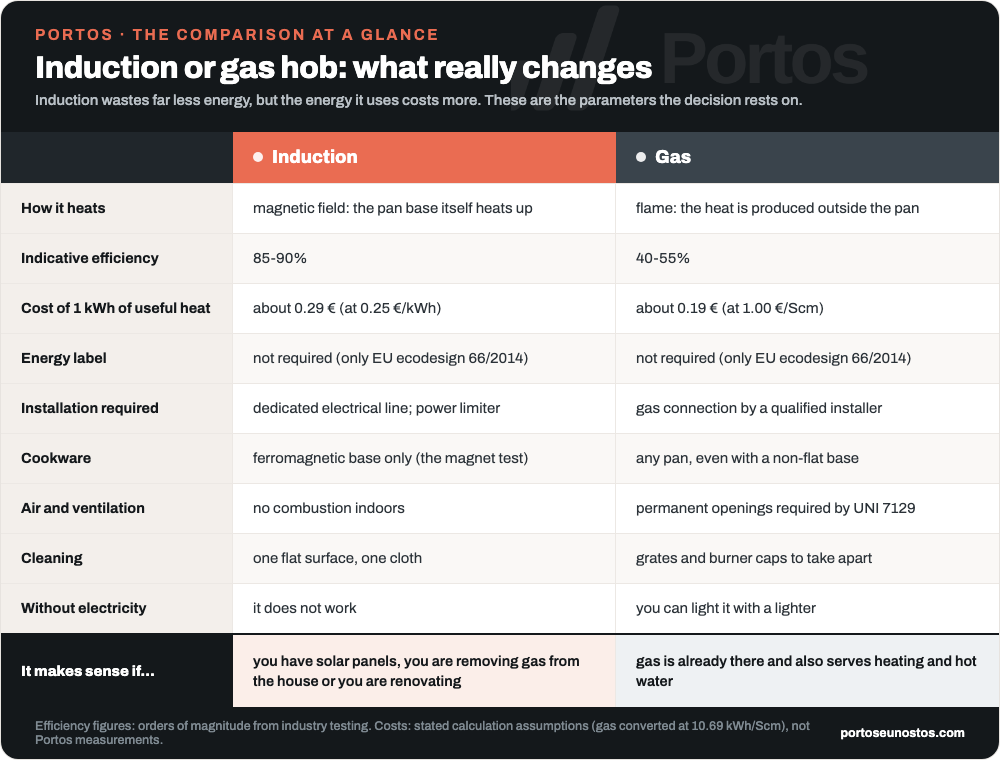
Induction and gas compared on the parameters that affect the decision.
Efficiency: where energy really goes
Technical sources dealing with kitchen efficiency point to consistent values: an induction hob transfers to the pot approximately 85-90% of the energy absorbed, while a gas burner typically falls in the range of 40-55%. The rest, in the case of gas, heats up the kitchen.
It should be said precisely what these numbers mean. They are not Portos laboratory measurements and they are not nameplate data from a specific model: they are orders of magnitude derived from industry standardized tests. The actual value of your hob depends on the diameter of the pot relative to the zone, the lid, how well the flame is regulated and the flatness of the bottom.
The data is robust in direction though: with the same amount of heat that actually reaches the food, induction absorbs almost half the energy of a gas burner. Keeping this point firm is useful for the next step, which is where most comparisons stop too early.
How much cooking costs: the calculation, step by step
To honestly compare two different energy sources, you need a common unit. We use kWh of useful heat, that is the energy that actually enters the pot, and calculate how much it costs to produce it with one and the other.
The method is this:
Induction: cost = electricity price (€/kWh) divided by the hob's efficiency.
Gas: first convert the price from €/Smc to €/kWh by dividing by calorific value, then divide by the burner's efficiency.
For gas conversion you need the superior calorific value. ARERA adopts a conventional reference value of approximately 10.69 kWh/Smc; the actual value for your area is shown on your bill and typically ranges between 9.6 and 11 kWh/Smc.
The assumptions we use, declared so you can change them: induction efficiency 85%, gas efficiency 50%, electricity €0.25/kWh (the convention used throughout Portos content on consumption), gas €1.00/Smc all-inclusive. The price of gas per cubic meter is volatile data, updated by ARERA on a monthly basis for customers in protected service: it should be taken as a scenario, not as a certainty.
Applying the method:
| Scenario | Energy price | Efficiency | Cost of 1 kWh of useful heat |
|---|---|---|---|
| Gas, low price | €0.80/Smc | 50% | approximately €0.15 |
| Gas, central scenario | €1.00/Smc | 50% | approximately €0.19 |
| Gas, high price | €1.20/Smc | 50% | approximately €0.22 |
| Induction, favorable rate | €0.20/kWh | 85% | approximately €0.24 |
| Induction, central scenario | €0.25/kWh | 85% | approximately €0.29 |
| Induction, high rate | €0.30/kWh | 85% | approximately €0.35 |
The comparison is clearer with a concrete example. Bringing two liters of water from 20 to 100 degrees requires approximately 0.19 kWh of useful heat. With the central assumptions above, that's about 3.5 cents with gas and about 5.5 cents with induction.
On an annual basis the difference remains modest but visible: assuming 300 kWh of useful heat in a year, the central scenario gives approximately €56 with gas against approximately €88 with induction, meaning a difference of about thirty euros. It's not the item that decides a household budget, and that's exactly the point: on pure energy cost the gap is too small to be the only selection criterion.
The scenarios that reverse the comparison
The numbers above apply to the most common situation: home connected to gas, electricity purchased from the grid at full price. However, there are three cases in which the conclusion changes, and it's worth checking if you're in one of these.
Photovoltaic with self-consumption. If you cook during daytime hours with energy produced by your system, the cost of electricity for that consumption drops well below the grid price. In this case the superior efficiency of induction is no longer offset by the cost of the energy source and the reversal is clear.
Fully electric home. If the cooktop is the last gas appliance left, removing it means you can close the gas meter. Here you don't just save on raw materials: you also eliminate the fixed costs on your gas bill, which you pay even consuming very little. It's often the most significant item in the entire operation, and should be calculated by looking at your actual bill.
Gas used only for cooking. This is the mirror situation of the previous one and is the one that penalizes gas the most: keeping an account active with its fixed charges to consume only a few cubic meters per year is almost always uneconomical. If this is your situation, the cost comparison per meal is secondary compared to the account for fixed charges.
If instead you need gas anyway for heating and hot water, you pay the fixed costs in any case and the comparison returns to that of the table.
Power at the meter: the constraint you discover too late
A 60 cm induction cooktop with four zones declares a connection power much higher than that of a standard 3 kW residential meter. This is why there's a widespread belief that an increase in contracted power is necessarily required.
It's not, and the reason is that the declared power is the theoretical sum of all zones at maximum simultaneously, a condition that in real use almost never occurs. Moreover every modern induction cooktop integrates a power management or limitation function, adjustable at installation: you set a maximum ceiling for the appliance and the cooktop redistributes power internally among active zones, reducing intensity instead of tripping the meter.
How to think about it in practice:
With 3 kW you can cook, by setting the limiter and paying attention to overlaps with oven, dishwasher, dryer or electric water heater.
The step up to 4.5 kW is the most sensible compromise for those who often use two or three zones together and don't want to think about it.
Going up to 6 kW makes sense only if you have other significant loads, for example a heat pump or charging an electric car.
The second aspect is the installation, not the contract: an induction cooktop must be powered by a dedicated line, dimensioned and protected according to the installation manual instructions, and must be connected by a qualified installer. There are no shortcuts on this, and it's a cost to include in the estimate if you're switching from gas.
Cookware: what you need to change
Induction only works with pots with a ferromagnetic bottom. The check is simple and takes thirty seconds: place a magnet on the bottom. If it sticks firmly, the pot is fine.
Generally stainless steel with suitable bottom, cast iron and iron pass the test. Pure aluminium, copper, glass and ceramics don't work, unless they have a ferromagnetic disk applied to the bottom. Also note that some pots declared compatible work but poorly, because the bottom is thin or not perfectly flat.
Two details that matter more than they seem. The diameter of the bottom must match the cooking zone: a pot too small on a large zone may not be recognized, and in any case reduces efficiency. And the bottom must be flat: pots deformed from use on gas often give irregular results on induction.
On cost, replacing the set is not always necessary, but should be budgeted. It's a one-time expense to add to the price of the cooktop when comparing the two scenarios, especially if you currently cook with aluminium pots.
Safety, indoor air and ventilation
This is the difference that weighs most in renovations and that almost no one considers when only looking at price.
A gas cooktop is a combustion appliance: it burns methane and produces combustion products that end up in the kitchen air. For this reason, the installation of gas appliances in homes is regulated in Italy by the technical standard UNI 7129, which for cooktops (type A appliances, that is without external fume discharge) requires permanent ventilation and air openings in the room, with requirements on free section and position. The standard provides specific conditions in which the ventilation opening can be avoided, typically related to the presence of a hood that actually exhausts to the outside.
Translated into practice: a kitchen with a gas cooktop must have an opening to the outside that cannot be closed. In a well-insulated apartment it is a permanent heat dispersal point, and in the renovation phase it is often the real reason for switching to induction.
Induction eliminates the open flame, so no risk of leaks, no combustion in the environment and no obligation of permanent openings for this reason. The hood remains useful for cooking vapors and odors.
The downside should also be said. The induction surface remains hot from contact with the pot and can burn even after switching off: the residual heat indicator should be watched. And induction cooktop manufacturers report in the manuals specific indications for users of implantable medical devices, such as pacemakers, recommending to consult the doctor or the device manufacturer. It is not an alarm, it is a precaution to verify in the manual of the model.
Cleaning and maintenance
On a gas cooktop, grills, flame dividers and burner caps must be removed and washed; the flame outlet holes become clogged and must be kept clear, otherwise the flame becomes irregular and efficiency worsens even more. It is ordinary maintenance, but requires time and consistency.
On induction the surface is a continuous glass-ceramic plane: it is cleaned with a cloth, and since the glass is much less hot than the pot bottom, splatters tend not to carbonize immediately. The limit is fragility: the glass fears impacts from sharp edges and pots dragged with abrasive residues underneath. Melted sugars must be removed immediately with a scraper, when the cooktop is still warm, because as they cool they can damage the surface.
In the balance of daily use, the induction advantage over cleaning is tangible and is often mentioned by those who made the switch, more than energy savings.
What the regulations say (and why there is no energy label)
If you look for the energy label of a cooktop you won't find it, and it is not an oversight by the seller. The delegated regulation that governs energy labeling in this product family, Regulation (EU) 65/2014, concerns ovens and kitchen hoods for domestic use. Cooktops are not included.
Cooktops are instead subject to Regulation (EU) 66/2014 on ecodesign, which sets mandatory minimum requirements to place the product on the market: a maximum energy consumption limit for electric cooktops, expressed in Wh/kg, and a minimum energy efficiency limit for gas cooktops. Mixed gas and electric cooktops are treated as two separate appliances, applying to each part the respective provisions.
The practical consequence for the buyer is clear: there is no A-G class to compare at a glance between two cooktops. The comparison is made on the type, on the technical sheet and on the power of the zones, not on a label. Anyone showing you an energy class of a cooktop is confusing the product with the oven below it.
If you want to understand how labels work where they actually do exist, you'll find everything in our guide on how to read the energy label of electrical appliances.
The practical side: control, speed, habits
Induction brings water to a boil noticeably faster, and the temporary maximum power function (called booster or power boost depending on the brand) widens the gap even further. Control is stepped and the response is immediate: when you lower the level, the power drops instantly, without the inertia of a traditional electric plate.
Gas offers a different type of control, visual and continuous: you adjust it by looking at the flame, and on very low flames the modulation is gradual. Those who cook with woks, non-flat-bottomed pots or techniques that exploit the flame licking the sides find in gas a response that induction cannot replicate, except with dedicated cooktops.
Then there's a point to consider: when switching to induction your cooking habits need to be recalibrated. With the same knob at the midpoint, things heat much faster, and in the first weeks you may burn something. It's not a defect, it's a real adjustment period that lasts a short time but does exist.
Finally the electrical aspect that often goes unnoticed: in case of a blackout the induction cooktop doesn't work, while a gas cooktop can be lit with a lighter even without power. Marginal in the city, less so where power cuts are frequent.
When to choose induction
Induction is recommended especially in these cases:
You have a photovoltaic system and cook mainly during the day.
You're removing gas from your home, or you would only need gas for cooking.
You're renovating and want to avoid the permanent ventilation openings required for gas appliances.
There are children or elderly people in the house and an open flame is a real concern.
You prioritize speed and ease of cleaning, and consider energy costs one factor among others.
You have an open-plan kitchen, where the heat dispersed by the burners and combustion products spread into the living area.
When to choose gas
Gas remains the most appropriate choice when:
Gas is already there and you need it anyway for heating and hot water, so you pay the fixed costs either way.
You want to keep the initial expense down: cooktop, installation and cookware have a lower overall cost.
You cook with woks, non-flat pots or non-ferromagnetic cookware that you don't want to give up.
You don't want to redo the electrical wiring or consider increasing the power capacity.
You live in an area with frequent power outages.
You're replacing a faulty cooktop and want a simple job, without touching the electrical system.
Mistakes to avoid
Comparing efficiency rates and stopping there. 85% versus 50% tells you who wastes less energy, not who spends less. Without the price of the energy source the comparison is incomplete and leads to the wrong conclusion.
Assuming you need a power increase. First set the limiter and test actual use. The increase should be evaluated later, based on your own consumption, not beforehand for safety.
Forgetting cookware in the estimate. If your current set is aluminum, replacing it may cost as much as the price difference between the two cooktops.
Looking for the energy class of the cooktop. It doesn't exist. If you see it listed, it almost always belongs to the paired oven.
Choosing all large zones. A cooktop with four 21 cm zones seems generous, but if you often cook with a small pot you're paying for surface you won't use and reducing flexibility.
Installing it yourself. This applies both to gas, where you need a qualified installer with a declaration of conformity, and to induction, which requires correctly sized electrical wiring.
Portos' choice
If we had to sum it up in one line: choose induction for the context, not for utility bill savings. Energy savings do exist in terms of kWh, but the price of electricity eats up nearly all of it, unless you generate the energy yourself or eliminate your gas service entirely.
This is not an argument against induction. It's an argument against the wrong reason for choosing it. There are solid reasons to switch, and they're different: no combustion in your home, no mandatory ventilation openings, much faster cleaning, superior safety with children around, shorter cooking times. Those who make the switch for these reasons generally don't go back.
Those who already have gas connected for heating, cook with cookware that works well and have no renovation constraints, don't have an economic reason to change. In that case the decision should only be made if one of the practical needs mentioned above is really important to you.
One final tip on the approach: before deciding, take your utility bill and replace our values with yours, particularly the price of gas per cubic meter, the price of electricity and the fixed charges. The calculation that matters is always the one done with your own numbers.
To navigate the real market, you can compare prices and availability of induction cooktops on SniffaPrezzi, or check the gas and induction cooktop category on OpportunityCommerce to see which configurations and widths are actually available.
Sources
Regulation (EU) No. 66/2014, specifications for ecodesign of ovens, cooktops and range hoods for household use.
Delegated Regulation (EU) No. 65/2014, energy labelling of ovens and range hoods for household use.
UNI 7129-2:2015, gas systems for household use: installation, ventilation and aeration of rooms.
ARERA, natural gas price updates and conventional value of gross calorific power.
Bosch, induction, electric and gas cooktops, for formats, power ratings and functions as declared by the manufacturer.
The efficiency values and energy prices used on this page are declared calculation assumptions, not measurements taken by Portos. The method is explained so you can recalculate using your own data.
Also read: how to choose a built-in oven, useful if you're renovating your cooking area, and pyrolytic or catalytic oven for the oven cleaning system included.
The plate-by-plate account: how much a pasta dish, sauce or steak really weighs on your meter we've calculated, with the stated assumptions, in how much an induction cooktop consumes.