A 71-litre built-in oven declares 0.69 kWh per cycle in fan-forced mode and up to 0.98 kWh in conventional mode: between 22 and 31 cents per bake. Small figures, and that is why the oven is almost always left out of the conversation about household energy.
We read the EU product fiches of the twenty Bosch ovens on sale and lined up the numbers: the gap between conventional and fan-forced on the same appliance is worth more than a step up in class, fifteen models out of twenty declare exactly the same index, and a single pyrolytic cleaning cycle uses as much as five to seven bakes.
A 71-litre built-in oven declares 0.69 kWh per cycle in fan-forced mode and up to 0.98 kWh in conventional mode. On your bill that is between 22 and 31 cents per bake. The figure looks small, and that is exactly why the oven is almost always left out of the conversation about household energy.
The picture changes once you look at three things the energy label does not highlight: the gap between conventional and fan-forced cooking on the very same appliance, the fact that almost every oven on sale declares the same index, and the pyrolytic cleaning cycle, which on its own uses as much as five to seven bakes.
We took the twenty EU product fiches of the Bosch ovens listed on OpportunityCommerce as of 27 September 2026, read them one by one and lined up the numbers. Here is what came out.
The short answer
A standard-size built-in electric oven uses between 0.61 and 1.11 kWh per standard cycle, that is between 19 and 35 cents at the reference energy price. Anyone who switches the oven on twice a week spends between 20 and 37 euros a year; at five times a week the range is 50 to 91 euros.
Within those orders of magnitude, the real levers are, by weight:
how often you use it, which multiplies everything else;
the cooking mode: on the same oven, switching from conventional heating to fan-forced is worth up to 27% less per cycle;
pyrolytic cleaning, which Bosch declares at 3.6 to 4.7 kWh per cycle: running it monthly uses more than a whole year of weekly cooking.
The energy class, in real use, is the weakest of the four. In our sample, moving from A to A+ is worth just under 4 euros a year at two bakes a week.
In short: what this guide covers
What the number on the label actually measures
The declared consumption of an oven is not the average of a family's cooking. It is the result of a laboratory test defined by Commission Delegated Regulation (EU) No 65/2014 and measured to EN 60350-1.
The text of the regulation is explicit on two points that change how any fiche should be read.
First: the test is run by heating a standardised load soaked in water. Not a roast, not a tray of biscuits. A standard wet block, identical for every manufacturer, whose only job is to make different appliances comparable. It is a yardstick, not a bill forecast.
Second: when an oven offers both conventional and fan-forced heating, the regulation states that the index must be calculated using the energy consumption per cycle of the more efficient mode. The worse figure stays on the fiche, but it affects neither the index nor the class. That is why two ovens carrying the same letter can cost you different amounts, as we will see shortly.
If you want to understand the rest of the label, we devoted a whole article to it: how to read the energy label.
Declared consumption of twenty ovens on sale
We started from the Bosch ovens actually available in the OpportunityCommerce ovens category and downloaded the EU product fiche filed by the manufacturer for each model. Twenty models out of twenty-four have one: the four compact microwave combination ovens fall outside the scope of the labelling regulation.
This is the summary, with prices recorded on OpportunityCommerce on 27 September 2026.
| Model | Volume | Conventional | Fan-forced | Index | Class | Price recorded |
|---|---|---|---|---|---|---|
| CBG7341B1 (45 cm compact) | 47 l | 0.73 kWh | 0.61 kWh | 81.3 | A+ | 735.36 euros |
| HBG7341B1 (Series 8) | 71 l | 0.87 kWh | 0.69 kWh | 81.2 | A+ | 810.98 euros |
| HBG7741B1 (Series 8 pyrolytic) | 71 l | 0.87 kWh | 0.69 kWh | 81.2 | A+ | 922.75 euros |
| HBA234BB3 (Series 4) | 71 l | 0.94 kWh | 0.69 kWh | 81.2 | A+ | 480.38 euros |
| HBA234BA0 (Series 4) | 71 l | 0.97 kWh | 0.81 kWh | 95.3 | A | 439.00 euros |
| HBF133BR0 (Series 2) | 66 l | 0.98 kWh | 0.79 kWh | 95.2 | A | 308.83 euros |
| VBC5580S0 (90 cm) | 85 l | 0.74 kWh | 1.11 kWh | 81.3 | A+ | 1,228.51 euros |
In bold, on each row, the value the regulation uses to calculate the index. The remaining thirteen models in the sample repeat figures already in the table: twelve declare 0.69 kWh fan-forced with 0.87 or 0.94 conventional, one declares 0.81.
Conventional or fan-forced: the gap on the same oven
The most useful figure in the whole set is not a comparison between different models, but between two cooking modes of the same appliance.
On standard-size models the gap between top-and-bottom heating and hot air runs from 16% to 27% per cycle:
Series 4 HBA234BB3: from 0.94 to 0.69 kWh, that is 0.25 kWh less per bake, 26.6%;
Series 8 HBG7341B1: from 0.87 to 0.69 kWh, 0.18 kWh, 20.7%;
Series 2 HBF133BR0: from 0.98 to 0.79 kWh, 0.19 kWh, 19.4%.
At two bakes a week, those 0.25 kWh become 26 kWh a year, that is 8.22 euros; at three bakes a week they rise to 12.34 euros. That is money you move by turning a dial, not by changing oven.
The physics is well known and has nothing magical about it: the fan moves hot air, shortens the time the whole cavity needs to reach temperature and allows cooking on several shelves at once. Fewer minutes with the elements on means fewer kilowatt-hours.
The limit of this lever is just as concrete. Some dishes come out worse with the fan on, because surfaces dry out sooner: that is why many recipes still call for conventional heating. The right reading is not "always use the fan", but "know what choosing conventional costs you when you do not need it".
The case that turns the rule upside down: the 90 cm oven
One model in the sample behaves the opposite way to all the others. The VBC5580S0, a 90 cm oven with an 85-litre cavity, declares 0.74 kWh in conventional mode and 1.11 kWh in fan-forced mode: here hot air costs 50% more than traditional heating.
There are two consequences, both verifiable on the fiche.
The first: this oven's efficiency index, 81.3, is calculated on the conventional figure, because that is the more efficient of the two. The A+ class on the label therefore describes a cooking mode that is not the fan-forced one.
The second: if you use the fan, this is the most expensive oven in the sample, at 1.11 kWh against the 0.69 of the 71-litre Series 8. That is 61% more per bake, with the same letter on the label.
It is a single model and not enough to make a category rule, but it illustrates the point of this article well: the class alone does not tell you what you will spend, because it does not know how you cook.
Why fifteen ovens out of twenty share the same index
In the sample, fifteen models out of twenty declare exactly the same energy efficiency index, 81.2, and two more stop at 81.3. The A+ threshold is set at 82: below that number you are A+, from 82 upwards you drop to A.
The full scale of Regulation 65/2014 for ovens is this one, and it has never been rescaled the way fridges and washing machines were:
| Class | Energy efficiency index |
|---|---|
| A+++ | below 45 |
| A++ | 45 to below 62 |
| A+ | 62 to below 82 |
| A | 82 to below 107 |
| B | 107 to below 132 |
| C | 132 to below 159 |
| D | 159 and above |
Seventeen models out of twenty sit between 81.2 and 81.3, less than a point from the upper limit of the class. That is no accident: it is design tuned to the boundary. The practical result is that the A+ class on an oven distinguishes almost nothing, because almost the whole mid and upper market declares it.
There is a second reason the letter is misleading. The index is not the consumption: it is consumption measured against a reference value that grows with the volume of the cavity. The sample shows it clearly: 47 litres at 0.61 kWh give 81.3; 71 litres at 0.69 kWh give 81.2; 85 litres at 0.74 kWh give 81.3 again. Three different consumptions, the same letter. The larger the oven, the more kilowatt-hours it may draw while staying in the same class.
What a single bake costs
At the reference electricity price of 0.3163 euros per kWh, the cost per standard cycle is this.
| Declared consumption | Cost per cycle | Where it appears in the sample |
|---|---|---|
| 0.61 kWh | 19.3 cents | 45 cm compact, fan-forced |
| 0.69 kWh | 21.8 cents | fifteen 71 l models, fan-forced |
| 0.74 kWh | 23.4 cents | 90 cm oven, conventional |
| 0.81 kWh | 25.6 cents | class A 71 l, fan-forced |
| 0.87 kWh | 27.5 cents | Series 8, conventional |
| 0.94 kWh | 29.7 cents | Series 4, conventional |
| 1.11 kWh | 35.1 cents | 90 cm oven, fan-forced |
Between the cheapest and the most expensive cycle in the sample there are 15.8 cents. Over a single dinner that is not a figure that changes a decision. Over a year of heavy use it becomes the difference between 50 and 91 euros.
What the oven costs over a year
Turning cents into euros a year depends on a number no label declares: how many times you switch the oven on. Rather than invent an average, we built the full grid.
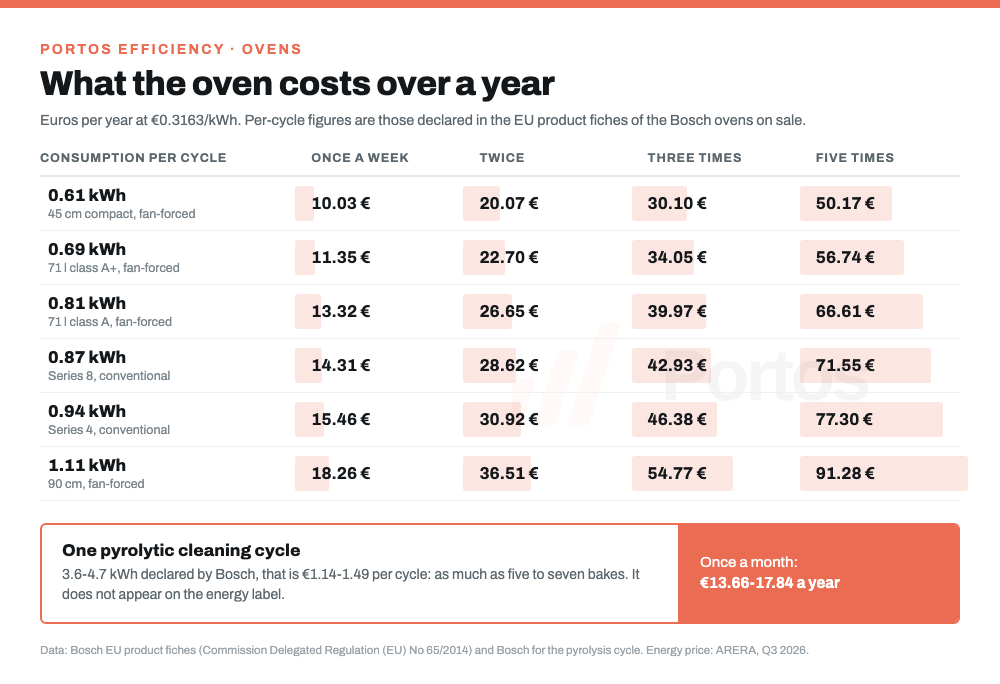
Annual oven running cost by usage frequency and consumption per cycle, at 0.3163 euros per kWh.
| Consumption per cycle | Once a week | Twice | Three times | Five times |
|---|---|---|---|---|
| 0.61 kWh | 10.03 euros | 20.07 euros | 30.10 euros | 50.17 euros |
| 0.69 kWh | 11.35 euros | 22.70 euros | 34.05 euros | 56.74 euros |
| 0.81 kWh | 13.32 euros | 26.65 euros | 39.97 euros | 66.61 euros |
| 0.87 kWh | 14.31 euros | 28.62 euros | 42.93 euros | 71.55 euros |
| 0.94 kWh | 15.46 euros | 30.92 euros | 46.38 euros | 77.30 euros |
| 1.11 kWh | 18.26 euros | 36.51 euros | 54.77 euros | 91.28 euros |
The most instructive comparison reads down and across at the same time. Moving down a row, that is changing oven or mode, shifts a few euros. Moving across a column, that is using the oven one more time a week, shifts many more. On the same appliance, going from two to five bakes a week costs 34 euros a year more. Choosing the most efficient oven in the sample instead of the least efficient, while staying at two bakes a week, saves 16.44: half as much.
It is worth putting these numbers next to the rest of the kitchen. An induction hob, over the same range of domestic use, moves figures of the same order: we covered it in how much an induction hob uses. The oven is not the energy hog of the house, but it is not a negligible item either when it is used often.
Class A or A+: what the step up is worth
The sample contains one pair that lets us put a price on the letter. Two 71-litre Series 4 ovens, both on sale:
HBA234BA0, class A, index 95.3, 0.81 kWh fan-forced, 439.00 euros;
HBA234BB3, class A+, index 81.2, 0.69 kWh fan-forced, 480.38 euros.
The difference in consumption is 0.12 kWh per cycle. At two bakes a week that is 12.5 kWh a year, or 3.95 euros; at three bakes a week, 5.92 euros.
The difference in price is 41.38 euros. The step up in class therefore pays for itself in about ten and a half years at two bakes a week, in seven years at three. They are not twin models, since styling and equipment differ too, so the calculation does not isolate the class alone: the order of magnitude, however, is clear, and on ovens the letter on the label is not an investment that pays back quickly.
One practical consequence follows. If you are choosing an oven, the class deserves attention only when everything else is equal. We wrote the full guide on what to look at first: how to choose a built-in oven.
Pyrolysis: the consumption the label cannot see
The EU product fiche of an oven fits in a few lines: brand, model, index, class, the two consumption figures per cycle, number of cavities, heat source, volume, oven type, mass and measurement method. The pyrolytic self-cleaning cycle is not among those entries. It does not appear as consumption, it does not appear as a feature, and it has no effect whatsoever on the index or the class.
The figure does exist, though, and it is the manufacturer who declares it. On its official page about pyrolytic cleaning, Bosch states a consumption of roughly 3.6 to 4.7 kWh for a full cycle, with the cavity taken to around 500 degrees.
Set against the cooking figures, the comparison is stark:
one pyrolysis cycle costs between 1.14 and 1.49 euros;
it is the equivalent of five to seven bakes in fan-forced mode;
running it once a month means 43 to 56 kWh a year, that is between 13.66 and 17.84 euros.
That last line is worth reading twice. One pyrolysis cycle a month uses more than a whole year of cooking for someone who switches the oven on once a week, which stops at 35.9 kWh and 11.35 euros. The function that sits outside the label weighs more than everything the label measures.
This is not an argument against pyrolysis, which remains the most effective way to remove baked-on sugar and hardened fat. It is an argument against using it on autopilot: four cycles a year cost 4.55 to 5.95 euros and are a negligible amount, twelve cycles a year are not. If you want the comparison with the other cleaning systems, we covered it in pyrolytic or catalytic oven.
Two twin ovens, one pyrolytic
The sample offers the cleanest proof of what we have just said. Two 60 cm Series 8 ovens, both available on OpportunityCommerce:
HBG7341B1, with CleanCoating on the back wall, 810.98 euros;
HBG7741B1, with pyrolytic self-cleaning, 922.75 euros.
The two EU fiches match on every single field: 71 litres of cavity, index 81.2, class A+, 0.87 kWh conventional, 0.69 fan-forced, same measurement method. The technical data sheets also match on rated power, 3.6 kW, and on external dimensions, 595 x 594 x 548 mm.
Pyrolysis therefore costs 111.77 euros of list price plus the energy of the cycles you will run, and it does not move the cooking consumption by a single decimal. Anyone comparing the two models by the energy label alone sees two identical appliances: and from the point of view of that measurement, they really are.
The 45 cm compact oven
The CBG7341B1 is the only model in the sample with a reduced cavity, 47 litres against the standard 71. It declares 0.73 kWh conventional and 0.61 fan-forced, with a rated power of 2.9 kW instead of 3.6.
That is 0.08 kWh less per cycle than the 71-litre oven of the same series, or 11.6%: 2.63 euros a year at two bakes a week. Little, in absolute terms. The interesting point, though, is another one: the compact gets the same A+ class while using less, because the index penalises it for the reduced volume. Anyone who often cooks a single tray pays less energy with the small cavity, while facing the same letter in the shop.
The flip side is just as simple: two trays on different shelves do not fit in 47 litres, and cooking in two rounds wipes out the saving immediately.
3.6 kW is not the consumption
The technical data sheets carry a number far larger than any seen so far: maximum electrical load 3.6 kW for the 71-litre models, 3.3 kW for the 66-litre Series 2, 2.9 kW for the compact.
That is the rated power, in other words how much the appliance can draw when all the elements work together. It is not the consumption of a cooking session. If an oven drew 3.6 kW without interruption, in an hour it would use 3.6 kWh: more than five times the declared figure for the standard cycle.
The difference lies in the thermostat, which switches the elements on and off to hold the temperature. The peak is needed during the heat-up phase, after which average draw collapses. The useful number for sizing your supply is 3.6 kW; the useful number for estimating the bill is 0.69.
What the label does not tell you
In fairness to the reader, here are the limits of the declared figure, all of them stemming from the nature of the laboratory test.
It does not say how long a cycle lasts. The fiche reports kilowatt-hours, not minutes. Two ovens with the same declared consumption may take different times over the same dish.
It does not say what preheating costs. The heat-up phase is included in the standardised test, but in real life it depends on how long you wait before putting the food in.
It does not account for opening the door. Every opening lets hot air out and forces the elements back on.
It does not measure cooking on several shelves. The most concrete advantage of fan-forced mode, two trays in a single bake, sits outside the scope of the test.
It does not include pyrolysis, as we have seen, nor the standby consumption of the clock and display.
The number on the label, in short, is an excellent tool for comparing two ovens with each other and a mediocre one for predicting your bill. Use it for the first job, not the second.
Five habits that really move the bill
None of these requires changing appliance.
Use fan-forced mode whenever the recipe allows. It is the biggest lever available: up to 0.25 kWh per bake, up to 12.34 euros a year at three bakes a week.
Fill the oven. Consumption depends on the cavity being heated, not on how much food it holds. Two trays in a single bake cost the same as one.
Cut pointless preheating. For roasts, gratins and long cooking, starting from a cold oven changes the result very little and removes minutes with the elements on.
Schedule pyrolysis, do not just endure it. Four cycles a year cost less than six euros, twelve cost up to eighteen. If you wipe up spills straight away, the frequency drops by itself.
Switch off a few minutes early. The cavity is insulated and stays hot: in the final minutes the stored heat does the work anyway.
Mistakes to avoid
Choosing an oven by the class alone. In the sample fifteen models out of twenty share the same index: the letter discriminates almost nothing and says nothing about how the appliance behaves in the mode you will actually use.
Paying for class A+ as if it were an investment. With a payback of around ten years at two bakes a week, the class is not an economic argument. The equipment may be, the letter is not.
Confusing power with consumption. The 3.6 kW on the rating plate is for the electrician, not for your bill forecast.
Treating pyrolysis as free. It is the single heaviest item in the oven's whole energy balance, and it does not appear on the label.
Assuming fan-forced always uses less. One model in the sample declares the opposite, by 50%. Check the fiche of the oven you are considering, not the general rule.
The Portos take
On oven consumption, our summary is this.
The oven on its own is a modest item: for normal use of two bakes a week we are talking about twenty to thirty euros a year. Anyone looking for substantial savings in the kitchen will find them elsewhere first.
Within that item, though, the order of the levers is counter-intuitive. First how often you use it, then the cooking mode, then pyrolysis, and only last the energy class. The first three depend on whoever is cooking; the only one you buy in a shop is also the least effective.
The criterion that follows is simple: choose the oven for the cavity, the equipment and the cleaning system you actually need, not for the letter. And once it is in your kitchen, look at the mode dial before you look at the label.
If you are comparing prices and availability across models, you can see offers from different sellers in the oven search on SniffaPrezzi and the pages of the models mentioned here in the OpportunityCommerce ovens category.
Method and assumptions
All the per-cycle consumption figures in this article come from the EU product fiches filed by the manufacturer under Commission Delegated Regulation (EU) No 65/2014, downloaded on 27 September 2026. They are not Portos measurements: we did not physically test these ovens.
Costs are calculated as consumption per cycle multiplied by the number of cycles and by 0.3163 euros per kWh, the reference electricity price for vulnerable customers on the Italian regulated tariff, updated by ARERA for the third quarter of 2026, taxes included. On the free market the value to use is the one on your own bill: the calculation is redone by replacing a single number.
The usage frequencies, one, two, three and five bakes a week, are stated scenarios, not statistical averages. The consumption of pyrolysis cycles is the figure declared by Bosch in its own documentation, not a regulated one.
The prices shown are those recorded on OpportunityCommerce on 27 September 2026 and change over time: they are there to give the comparisons an order of magnitude, not to photograph the market.
Sources
Commission Delegated Regulation (EU) No 65/2014, energy labelling of domestic ovens and range hoods: classes, definition of the index and the standardised load test.
Bosch EU product fiches, downloaded from the manufacturer's site: HBG7341B1, HBG7741B1, VBC5580S0.
Bosch, pyrolytic oven cleaning: consumption and temperature of the self-cleaning cycle.
Bosch, energy labels and product fiches and the official Bosch Italy site.
EPREL, the European product database for energy labelling.
ARERA, reference electricity price for the third quarter of 2026.
Catalogue and prices: OpportunityCommerce, ovens category, recorded on 27 September 2026.