Three Bosch Serie 8 ovens that look identical cost 783.58, 810.98 and 922.75 euros, and the EU information sheet tells them apart by weight alone. The real differences are ten, and the pyrolytic model is not simply the one with an extra function: it loses the catalytic coating and two compatible accessories.
There are currently three Bosch Serie 8 built-in ovens on the OpportunityCommerce catalogue, all 60x60 cm, same black finish, same looks, same display. They cost 783.58, 810.98 and 922.75 euros. Between the first and the last there are 139.17 euros, close to a fifth of the price.
The EU product information sheet, the only document the manufacturer is required to publish, tells them apart on a single line: the weight. Energy efficiency index 81.2 on all three, class A+ on all three, 0.87 kWh in conventional mode and 0.69 in fan mode on all three, 71 litre volume on all three. What changes is the mass of the appliance: 34.1, 35.1 and 37.3 kilograms. Nothing else.
This article compares the three models by reading the documents the EU sheet does not replace, that is the Bosch technical data sheets and the specifications published on the official product pages, and answers the question that brings people to search for HBG7341B1 or HBG7741B1: what pyrolysis is worth, at what price, and above all what the buyer gives up. Because the answer is not the expected one: the pyrolytic model is not the same oven with one extra function. It is a trade, and there is also a third model that neither of the usual comparisons considers.
The answer in one line. Pyrolysis costs 111.77 euros more than the twin without it, but in exchange you lose the catalytic coating on the rear wall, two compatible accessory references and the option of fitting the standard telescopic rails; the cheapest of the three, HBG7342B1 at 783.58 euros, is the only one with a built-in meat probe, so before choosing between the two in the title it is worth looking at that one too.
What you will find in this guide
They are not two models, they are three
The most frequent search compares two codes, HBG7341B1 and HBG7741B1, because they are the textbook case: two ovens from the same range that look identical and differ by pyrolytic self-cleaning. That is true, and it is why this pair is interesting. But on the same shelf, with the same finish and the same casing, there is a third model that costs less than both.
It is called HBG7342B1 and on 3 October 2026 it is in stock at 783.58 euros, that is 27.40 euros less than the HBG7341B1 and 139.17 less than the HBG7741B1. The model number does not rank the equipment, and this is the first fact to keep in mind: a higher number does not automatically mean more features.
All three are in the manufacturer's current range. The product pages on bosch-home.com open normally with the commercial name, and not with the discontinued-product notice Bosch shows on models that are out of production. All three are in stock at the retailer, with the same discount: 783.58 on 1,119.40, 810.98 on 1,158.54 and 922.75 on 1,318.21 euros, which is exactly 30% off on all three. The discount is not a selection criterion, because it is identical.
What the EU sheet says: the weight and nothing more
The product information sheet required by Commission Delegated Regulation (EU) No 65/2014 is the reference document for ovens. It is the one the manufacturer must complete, the one that is legally binding and the one that ends up in price comparison engines. We downloaded and decoded the three sheets, all issued on 21 September 2026, and compared them line by line.
This is the complete content, identical on all three except where indicated:
| EU sheet field | HBG7342B1 | HBG7341B1 | HBG7741B1 |
|---|---|---|---|
| Brand | Bosch | Bosch | Bosch |
| Energy efficiency index | 81.2 | 81.2 | 81.2 |
| Energy efficiency class | A+ | A+ | A+ |
| Energy consumption per cycle, conventional mode | 0.87 kWh | 0.87 kWh | 0.87 kWh |
| Energy consumption per cycle, fan-forced mode | 0.69 kWh | 0.69 kWh | 0.69 kWh |
| Number of cavities | 1 | 1 | 1 |
| Heat source | Electricity | Electricity | Electricity |
| Volume | 71 l | 71 l | 71 l |
| Type of oven | Built-in | Built-in | Built-in |
| Mass of the appliance | 35.1 kg | 34.1 kg | 37.3 kg |
| Measurement method | EN 60350-1 | EN 60350-1 | EN 60350-1 |
Eleven fields, ten identical, one different. Anyone buying on the strength of the energy label, or of a comparison engine that reports label data, sees three indistinguishable products separated by 139.17 euros. This is not a fault of the three ovens: it is a limit of the document. Regulation 65/2014 asks for energy performance, not for equipment, and the result is that the difference between a pyrolytic oven and one that is not appears nowhere in the mandatory document.
We had already run into the same limit across twenty Bosch ovens when we worked out how much energy an oven really uses: fifteen models out of twenty declare exactly the same index, 81.2. Here the sample is smaller but the phenomenon is the same, taken to its extreme.
The three data sheets side by side
What the EU sheet does not say is in the technical data sheet Bosch publishes for every model, a longer and more detailed commercial document, and in the structured specifications of the official product pages. We read both sources for the three models and compared them. The product pages declare between 58 and 60 properties each: among the shared ones, six differ; the technical data sheet, which is richer, exposes ten.
Here are the three sheets in the format we use for product analyses.
HBG7342B1, the cheapest
Product: Bosch Serie 8 HBG7342B1, black built-in oven 60x60 cm
EAN code: 4242005326396
Cleaning system: EcoClean cleaning programme, hydrolysis
Coating: CleanCoating on the rear wall
Sensors: single meat probe, PerfectRoast thermal probe
Door: 3 panes, glass inner door, CoolTouch, declared maximum temperature 40 degrees
Energy class: A+, index 81.2
Mass: 35.1 kg
Price recorded: 783.58 euros, list price 1,119.40
Verification date: 3 October 2026
HBG7341B1, the twin without pyrolysis
Product: Bosch Serie 8 HBG7341B1, black built-in oven 60x60 cm
EAN code: 4242005326334
Cleaning system: EcoClean cleaning programme, hydrolysis
Coating: CleanCoating on the rear wall
Sensors: not available
Door: 3 panes, glass inner door, CoolTouch, declared maximum temperature 40 degrees
Energy class: A+, index 81.2
Mass: 34.1 kg
Price recorded: 810.98 euros, list price 1,158.54
Verification date: 3 October 2026
HBG7741B1, the pyrolytic one
Product: Bosch Serie 8 HBG7741B1, black pyrolytic built-in oven 60x60 cm
EAN code: 4242005326563
Cleaning system: pyrolysis plus hydrolysis
Coating: no CleanCoating declared
Sensors: not available
Door: 4 panes, full-glass inner door, CoolTouch, declared maximum temperature 30 degrees, electronic door lock
Energy class: A+, index 81.2
Mass: 37.3 kg
Price recorded: 922.75 euros, list price 1,318.21
Verification date: 3 October 2026
The ten items on which the three ovens actually differ
This is the table the EU sheet cannot give you. Every value comes from Bosch documentation: the model's technical data sheet and the specifications of the official product page, which agree on every item.
| Item | HBG7342B1 | HBG7341B1 | HBG7741B1 |
|---|---|---|---|
| Price recorded on 03/10/2026 | 783.58 euros | 810.98 euros | 922.75 euros |
| Cleaning system | EcoClean + hydrolysis | EcoClean + hydrolysis | Pyrolysis + hydrolysis |
| Pyrolytic self-cleaning | no | no | yes |
| CleanCoating | rear wall | rear wall | not declared |
| Built-in meat probe | yes, PerfectRoast | no | no |
| Door panes | 3 | 3 | 4 |
| Maximum door temperature | 40 degrees | 40 degrees | 30 degrees |
| Electronic door lock | no | no | yes |
| Pyrolysis-proof shelf support | no | no | yes |
| Compatible optional accessories | 16 references | 16 references | 14 references |
| Mass of the appliance | 35.1 kg | 34.1 kg | 37.3 kg |
Read this way, the table says something the title of this page does not suggest: moving to the pyrolytic model you gain four items (pyrolysis, the fourth pane, the door lock, the shelf support) and you lose three (CleanCoating, two accessory references, and against the 7342 the meat probe as well). It is not a superior model: it is a different one.
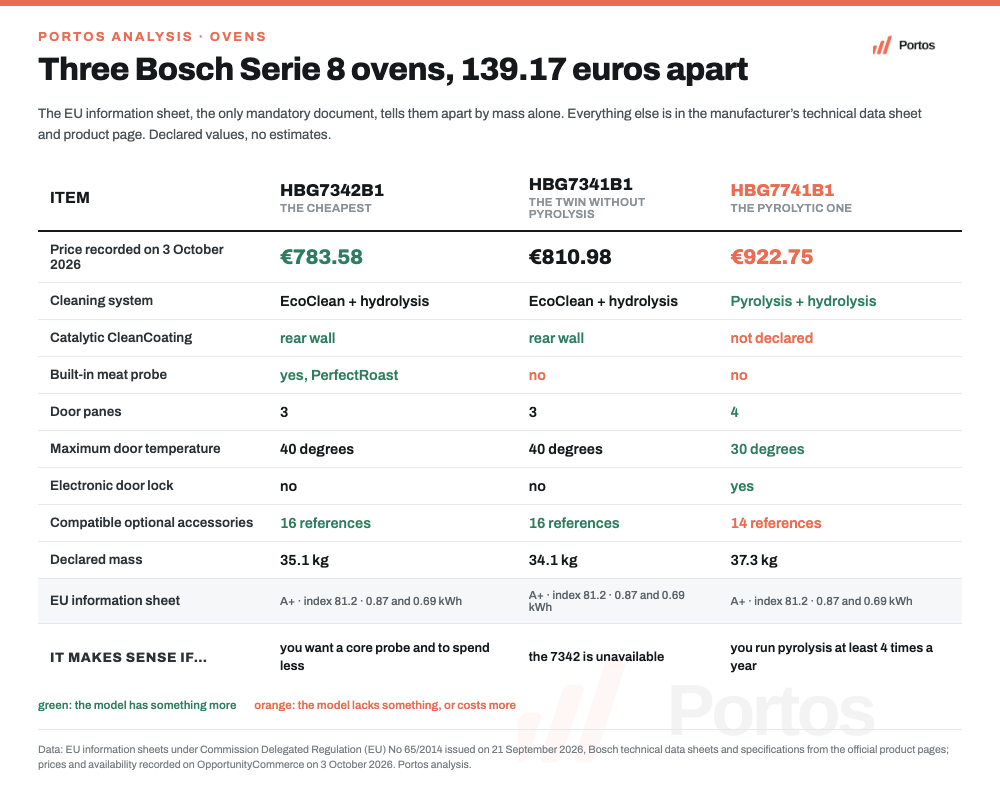
The items on which the three models differ. Data recorded on 3 October 2026 from the Bosch technical data sheet, the official product page and the retailer catalogue.
The door: four panes against three
The most substantial hardware difference between the pyrolytic model and the other two is not the cleaning programme: it is the door. The technical data sheet of the HBG7741B1 declares four panes and a full-glass inner door; those of the HBG7341B1 and HBG7342B1 declare three and a glass inner door.
The consequence is in a line that is easy to skim past and deserves attention. The declared maximum door temperature is 30 degrees on the pyrolytic model and 40 degrees on the other two. The oven that reaches around 500 degrees inside during self-cleaning has, in use, a door ten degrees cooler than the siblings that never get anywhere near that temperature.
The physical explanation is as simple as it gets: one more pane is one more air gap, that is more insulation. But the practical effect does not only concern the pyrolytic cycle, which happens twice a year with the kitchen shut. It concerns every time the oven is on, and in a home with small children, or with the oven installed under the worktop and within reach, ten degrees less on the surface you touch is a concrete argument. And, we would add, it is the only advantage of the pyrolytic model that you enjoy every day rather than twice a year.
The pyrolytic model also has an electronic door lock, which the Bosch product page lists among the safety devices alongside the child lock present on all three. Its purpose is to prevent opening during the high-temperature cycle, so it is a consequence of the function rather than a benefit in itself. That is where the 3.2 extra kilograms declared in the EU sheet end up, together with the fourth pane and the reinforced shelf support.
What the pyrolytic model does not have
This is the finding we did not expect and it changes the meaning of the comparison. The technical data sheets of the HBG7341B1 and HBG7342B1 both declare, under Cleaning, CleanCoating on the rear wall. The HBG7741B1 sheet does not declare it: in its place there is the line Pyrolytic self-cleaning. The Cleaning system field, which is the summary entry, confirms it: EcoClean cleaning programme, Hydrolysis on the two cheaper models, Pyrolysis + hydrolysis on the pyrolytic one.
CleanCoating is the catalytic coating, a microporous enamelled surface that oxidises fat during normal cooking. When we surveyed the Bosch ovens in the catalogue to understand how to clean an oven without pyrolysis, we found that of nine sheets declaring CleanCoating, eight declare it on the rear wall only: it is partial coverage, not a self-cleaning oven. It is still one wall out of six that cleans itself, and these two models have it while the pyrolytic one does not.
The industrial logic is understandable. Catalytic enamel works at intermediate temperatures and is not designed to withstand a 500 degree cycle: on a pyrolytic oven the cavity has to be smooth and enamelled to survive pyrolysis, not microporous. The two systems do not coexist. The editorial point is a different one: neither brochure tells the buyer. Anyone moving to the pyrolytic model thinking they are adding a function is also removing one, and only finds out by putting two technical data sheets side by side.
For balance it must be said that the trade, in practice, favours the pyrolytic model: a high-temperature cycle reduces all the soil on all the walls to ash, while the catalytic coating acts only on fat and only on one wall. But it is a trade, and it should be known.
The accessory catalogue gets smaller
A third difference no comparison engine reports: the number of compatible optional accessories. The technical data sheets list the references that can be bought for each model. HBG7341B1 and HBG7342B1 have sixteen; HBG7741B1 has fourteen. Twelve are common to all three.
Three references disappear on the pyrolytic model: the two slim baking trays of the HEZ530000 set and the telescopic rails HEZ538000 and HEZ638000. In their place only one appears, HEZ638070, which is the pyrolysis-proof version of the single-level telescopic rails.
The practical result matters to anyone who wants to add pull-out rails, which on all three models are an additional accessory and are not included: the Bosch product page states this explicitly, with the Pull-out rail system entry set to Additional accessory. Whoever buys the pyrolytic model has a single possible reference; whoever buys the other two has two to choose from, plus the slim trays that are not offered on the pyrolytic model.
There is also a corollary we had already observed in the Bosch accessory catalogue and that is clearer here: references HEZ631070 and HEZ632070, described as a baking tray and a roasting tray suitable for pyrolysis and steam, are listed as paid options on all three models, the pyrolytic one included. That means the four accessories supplied in the box, identical on the three ovens, are not declared pyrolysis-proof even on the pyrolytic oven: they still have to be taken out before the cycle and washed by hand.
The cheapest one is the only one with a meat probe
On the Bosch product page the Sensors field declares Single meat probe for the HBG7342B1 and Not available for the HBG7341B1 and HBG7741B1. The 7342 technical data sheet confirms it with the commercial name: PerfectRoast thermal probe, listed among the main features alongside the AirFry function.
On the other two models the probe exists, but as an accessory: reference HEZ32WA00, wireless thermal probe, appears in the list of paid options on all three, the 7342 included.
This is the most awkward point of the comparison, and it is worth saying plainly: the oven that costs the least of the three is the only one that measures the core temperature of a roast. Anyone who cooks meat or bread with any regularity knows that this function, when it is there, changes the result more than a cleaning programme does. In every other respect the 7342 is identical to the 7341: same fourteen cooking functions, same display, same Home Connect, same EcoClean, same door.
A note of transparency on a minor figure. The declared weight of the 7342 is 35.1 kg against the 34.1 of the 7341: one kilogram more on two ovens that are otherwise identical in size, which is consistent with the presence of the sensor and its wiring but which we cannot attribute to it with certainty. We report it as data, not as an explanation.
What a pyrolytic cycle costs today
Bosch declares a consumption of 3.6-4.7 kWh for the pyrolytic cycle and an internal temperature of around 500 degrees. It is the only figure published by the manufacturer, because pyrolysis is not a regulated parameter and does not appear in the EU sheet.
The price of energy changed a few days ago. Since 1 October 2026 the ARERA reference for the typical vulnerable customer under the regulated tariff is 0.4343 euros per kWh including taxes, up 37.3% on the previous quarter. At that value:
| Operation | Energy | Cost at 0.4343 euros/kWh |
|---|---|---|
| One pyrolytic cycle | 3.6-4.7 kWh | 1.56-2.04 euros |
| One hydrolysis cycle (Cleaning Assistance) | at most 0.24 kWh | at most 0.10 euros |
| One bake in fan-forced mode | 0.69 kWh | 0.30 euros |
| One bake in conventional mode | 0.87 kWh | 0.38 euros |
The hydrolysis figure is an upper-bound estimate, not a declared value, and should be read as such. The official Bosch procedure calls for about 400 ml of water with a drop of washing-up liquid, bottom heat, 80 degrees for four minutes. Four minutes at the appliance's maximum rated draw, 3.6 kW, come to 0.24 kWh: real consumption is lower, because only the bottom element works and not the appliance at full power. The number gives a ceiling, and the ceiling is ten cents.
We had already quantified the ratio between the two methods in the article on cleaning without pyrolysis: one pyrolytic cycle costs sixteen to twenty times one hydrolysis cycle. What matters here is a different calculation, and a more useful one for someone choosing an oven.
The premium per cycle, at four usage frequencies
The real cost of pyrolysis is not the energy of the cycle: it is the purchase price spread over the number of times you use it. The calculation depends on two stated choices: which model you compare against, and how many pyrolytic cycles you actually run per year.
The classic comparison is with the twin HBG7341B1, which has the same equipment: 111.77 euros of difference (159.67 at list price). But the honest comparison for someone about to spend is with the cheapest equivalent model, HBG7342B1: 139.17 euros (198.81 at list price). We give both, over a ten-year horizon.
| Pyrolytic cycles per year | Cycles in 10 years | Price share per cycle, against HBG7341B1 | Price share per cycle, against HBG7342B1 | Full cost per cycle, against HBG7342B1 |
|---|---|---|---|---|
| 1 | 10 | 11.18 euros | 13.92 euros | 15.48-15.96 euros |
| 2 | 20 | 5.59 euros | 6.96 euros | 8.52-9.00 euros |
| 4 | 40 | 2.79 euros | 3.48 euros | 5.04-5.52 euros |
| 6 | 60 | 1.86 euros | 2.32 euros | 3.88-4.36 euros |
The right-hand column is the one that counts, because it adds the price share and the energy of the cycle. It says something clear: pyrolysis pays off for those who use it often, and the break point sits around four times a year. Anyone running it twice a year, which is the frequency Bosch itself suggests for deep cleaning, pays between 8.52 and 9.00 euros every time they use it.
There is an even more direct way to put it. The energy for all twenty pyrolytic cycles of ten years costs between 31.27 and 40.82 euros. The purchase premium is 139.17. That means you pay for the function three to four times before you even switch it on, and that almost all the cost of pyrolysis is in the price of the oven, not in the electricity bill. Anyone choosing on the basis of the cycle's consumption is looking at the small item.
The ten-year sum
Let us put purchase and use together, over ten years, with two deep cleans a year and the current tariff. Cooking does not enter the sum because it is identical on the three models: same declared consumption, therefore same bill.
| Item | HBG7342B1 | HBG7341B1 | HBG7741B1 |
|---|---|---|---|
| Purchase price | 783.58 euros | 810.98 euros | 922.75 euros |
| 20 deep cleaning cycles | 2.08 euros of hydrolysis | 2.08 euros of hydrolysis | 31.27-40.82 euros of pyrolysis |
| Ten-year total | 785.66 euros | 813.06 euros | 954.02-963.57 euros |
| Manual work required | 20 cleans by hand | 20 cleans by hand | none, except floor, glass and accessories |
The difference between the cheapest and the pyrolytic model, over ten years, is 168.36-177.91 euros. Divided by the twenty manual cleans you avoid, that is 8.42-8.90 euros for every clean saved.
This is the number to decide on, and it has no objective answer. If half an hour of unpleasant work, twice a year, is worth more than nine euros, the pyrolytic model pays for itself. If it is worth less, it does not. Portos has no position on what a reader's time is worth: it has the number.
One warning for honesty, because we have documented it and it should not be hidden: pyrolysis does not remove manual work entirely. Bosch itself states that the floor of the cavity and the inside of the door glass still have to be cleaned by hand, and that the supplied accessories have to be taken out before the cycle. The twenty cleans saved are twenty deep cleans of the walls, not twenty complete cleans.
The cooking mode weighs as much as the pyrolysis premium
A comparison that helps put all the numbers above into scale. The price premium of pyrolysis against the twin, 111.77 euros spread over ten years, is worth 11.18 euros a year.
On the same ovens, the difference between baking in conventional mode and baking in fan-forced mode is 0.18 kWh per bake. At two bakes a week, that is 104 a year, it comes to 18.72 kWh, that is 8.13 euros a year.
These are quantities of the same order. Choosing the right button on the panel, on any of the three ovens, is worth almost as much as the 111.77 euro decision taken in the shop. It is a way of remembering that the energy performance of these three appliances is identical and that the saving, if it matters, is in daily use and not in the model code. We explained why the cooking mode does not enter the class in our analysis of oven consumption: Regulation 65/2014 calculates the index on the more efficient of conventional and fan-forced mode, so the worse value stays on the sheet but does not touch the letter on the label.
The fifteen things they have in common
For completeness, and because it shows how narrow the comparison is, here is what does not change between the three models. Everything that follows is declared identical on the three technical data sheets and the three product pages.
14 cooking functions, with the same list: 3D HotAir multi-cooking, top and bottom heat, fan grilling, large and small area grill, pizza setting, bottom heat, low-temperature cooking, defrost, pre-heating, keep warm, gentle hot air, gentle top and bottom heat, AirFry.
Temperature range from 30 to 300 degrees.
Usable volume 71 litres, anthracite enamelled cavity, 5 shelf levels.
Dimensions 595x594x548 mm, niche 585-595 x 560-568 x 550 mm, packed 670x670x680 mm. They fit the same openings, under the worktop or in a tall unit.
Power 3.6 kW, 16 A, 220-240 V, Schuko plug, 120 cm cable, single phase with neutral.
Full Touch display with a digital control ring.
Home Connect over Wi-Fi, with remote diagnostics, monitoring and remote control.
Cooking assistant with voice control, DishAssist, preset recipes, automatic switch-off.
AirFry function and AirFry tray included.
Drop-down door with SoftClose and SoftMove, CoolTouch glass.
Halogen lighting that can be switched off, tangential cooling fan.
Rapid heat-up and Cleaning Assistance, that is the assisted hydrolysis procedure.
Child safety lock, residual heat indicator, door contact switch.
Accessories included: one enamelled baking tray, one combination rack, one deep enamelled universal tray, one AirFry tray.
Telescopic rails not included on any of the three: they are a paid additional accessory.
Fifteen identical items and ten different ones: that is the real relationship between three ovens separated by 139.17 euros.
When HBG7741B1 makes sense
It makes sense to buy it if at least two of these conditions apply.
You often cook with fat and at high temperature: roasts, uncovered trays, gratins. That is the kind of soil hydrolysis softens but does not remove, and that needs scrubbing.
You expect to run pyrolysis at least four times a year. Below that threshold the cost per cycle stays above five euros and the function is expensive.
The oven is installed under the worktop, within reach of children. Here the fourth pane and the 30 declared degrees on the door are a daily advantage, independent of cleaning.
You do not use a meat probe and do not plan to buy one.
You are not interested in the catalytic coating on the rear wall, which this model does not have.
One piece of context, which is not proof of quality but is real information: on the Bosch product page this model collects 814 reviews with an average of 4.9, against 44 for the 7341 and 28 for the 7342. It is the oven in the range that sells, and therefore the one with the largest number of published user reports. We report it as an indicator of how widespread it is, not as a measure of performance.
When HBG7342B1 makes sense
It is, in our reading, the model with the best ratio between what it costs and what it declares. It makes sense to buy it if:
You cook meat, fish or bread and want a core probe. It is the only one of the three that has it built in, and the optional wireless reference HEZ32WA00 on the other two is an additional cost.
You accept cleaning the walls by hand twice a year, helped by the hydrolysis cycle that costs ten cents.
You want the catalytic coating on the rear wall, which reduces fat build-up on the surface most exposed to splashes.
You want the standard telescopic rails or the slim trays, which on this model are among the compatible references.
You want to spend less without giving up anything that defines the Serie 8: display, Home Connect, AirFry, 14 functions.
When HBG7341B1 makes sense, and why it is the hardest to justify
Here we have to be direct, because it is the least comfortable conclusion of this analysis. The HBG7341B1 costs 27.40 euros more than the HBG7342B1 and, on the basis of the documentation we have read, offers nothing the 7342 does not have: same cleaning system, same CleanCoating, same door, same functions, same display, same compatible accessories, same consumption. On top of that it lacks the meat probe.
It makes sense to buy it in two concrete cases:
If the HBG7342B1 is unavailable at the chosen retailer, or if the price difference reverses, which on a list discounted by 30% can happen at any moment.
If you find it significantly below the 783.58 euros of the 7342: in that case the comparison flips and the meat probe becomes the only thing you give up.
Outside these two cases, the editorial advice is to compare the two codes before ordering, because the only thing that separates them today is in favour of the cheaper one. It is the kind of situation in which a higher model number is misleading.
Alternatives outside the Serie 8
If pyrolysis is the priority but 922.75 euros is too much, the Bosch catalogue offers pyrolytic models in lower ranges at different prices. The retailer's built-in oven survey includes several from the Serie 4 and Serie 6, as well as the Serie 8 steam models. The differences against the Serie 8 do not concern pyrolysis itself, but the display, connectivity, number of functions and finishes.
Three warnings before moving across ranges.
The energy class does not help you tell them apart. Of twenty Bosch ovens we analysed, fifteen declare the same index, 81.2, and seventeen out of twenty sit between 81.2 and 81.3. The letter on the label, in this product category, is not a selection criterion.
Going down a range you lose cooking functions and connectivity, not efficiency. It is worth checking on the technical data sheet which of the fourteen functions remain.
The field to read is always the same. On the technical data sheet, the Cleaning system entry. It is the only place where pyrolysis is declared unambiguously. Searching for the word pyrolysis elsewhere in the document produces false positives, because the optional accessories HEZ631070 and HEZ632070 are called a baking tray and a roasting tray suitable for pyrolysis and steam and appear on ovens that have no pyrolysis at all.
If instead steam cooking is the priority, the Serie 8 has pyrolytic models with steam that are different appliances and not comparable with these three: the cavity, the tank, the programmes and the price all change.
Mistakes to avoid
Choosing on the energy class. The three models are A+ with exactly the same index. The label decides nothing here.
Assuming the most expensive model has everything the others have. In this case it does not: the pyrolytic one has neither the CleanCoating nor the meat probe, and has two fewer compatible accessories.
Buying pyrolysis and not using it. At once a year the cost per cycle exceeds fifteen euros against the cheapest model. That is the condition that makes the purchase worst.
Assuming the telescopic rails are included. They are not, on any of the three, and on the pyrolytic model only one compatible reference exists.
Thinking pyrolysis removes all manual cleaning. The floor, the inner door glass and the accessories stay manual, and the accessories have to be taken out before the cycle.
Comparing list prices instead of real ones. On these three the list is discounted by 30% uniformly, so the ratios hold, but that is not a general rule.
Trusting the model number. Here the 7342 costs less than the 7341 and has one feature more.
What we could not verify
We write this for transparency, because an analysis based on documents has precise boundaries.
The duration of the pyrolytic cycle is not declared in any of the documents we read. Bosch publishes the consumption, 3.6-4.7 kWh, and mentions three programme levels, but not the minutes. The consumption is the figure the calculation needs, the duration is not.
The real consumption of the hydrolysis cycle is not declared. Our figure is an upper bound calculated on the appliance's maximum rated draw, not a measurement.
We did not test the three ovens. Portos does not own the appliances: everything on this page comes from the manufacturer's documentation and the retailer's catalogue, with the recording dates stated. We do not claim tests, measurements or trials of our own.
Noise is not declared for built-in ovens, neither in the EU sheet nor in the technical data sheet: it is not a regulated parameter for this category.
The reason for the one kilogram difference between the 7342 and the 7341 is not documented. It is consistent with the sensor, but we do not assert it.
The review count reported is the one published by the manufacturer on its own product page on 3 October 2026. It is an indicator of how widespread a model is, not an independent assessment.
The Portos assessment
An editorial assessment built on documentation, not on a test: we assign a score across eight criteria, each with the same weight, and give the reason for each. Where the three models are identical, the score is identical: that is as it should be.
| Criterion | HBG7342B1 | HBG7341B1 | HBG7741B1 |
|---|---|---|---|
| Declared energy performance | 8 | 8 | 8 |
| Cooking equipment | 10 | 9 | 9 |
| Cleaning system | 7 | 7 | 10 |
| Door and safety | 8 | 8 | 10 |
| Accessories and expandability | 9 | 9 | 7 |
| Connectivity and interface | 10 | 10 | 10 |
| Price to equipment ratio | 10 | 6 | 7 |
| Transparency of documentation | 8 | 8 | 7 |
| Total out of 80 | 70 | 65 | 68 |
The reasons for the items that differ. Cooking equipment: the 7342 takes one extra point for the built-in meat probe, the only functional cooking difference among the three. Cleaning system: pyrolysis takes full marks, because it deals with soil on every wall rather than on one; the other two stop at seven, with hydrolysis plus a partial catalytic coating. Door and safety: four panes, 30 declared degrees and an electronic lock are worth full marks. Accessories and expandability: the pyrolytic model drops for the two missing references and the single compatible telescopic rail. Price to equipment ratio: the 7342 is the best buy of the three by a clear margin; the 7341 is penalised because it costs more than the 7342 without offering anything in return; the pyrolytic model sits in between because the 139.17 euros buy something real. Transparency: the pyrolytic model loses a point because the loss of the CleanCoating is not declared in any commercial material and can only be found by comparing two technical data sheets.
The Portos choice. Between the two models in the title, if you use pyrolysis at least four times a year or if the oven sits under the worktop in a home with children, HBG7741B1 is the right call and the 111.77 euros are well spent. In every other case the question is badly posed, because the oven to look at is neither of the two: it is HBG7342B1, which costs less than both, has exactly the same equipment as the 7341 plus the meat probe, and leaves 139.17 euros in your pocket, enough for the telescopic rails and a couple of accessories. The HBG7341B1, as long as the price stays where we found it, is the hardest of the three to defend.
Price and availability
All three models are in stock. Prices recorded on 3 October 2026 on the product page, all three discounted by exactly 30% off list.
Bosch HBG7342B1: see the specifications and availability on OpportunityCommerce, 783.58 euros.
Bosch HBG7341B1: see the specifications and availability on OpportunityCommerce, 810.98 euros.
Bosch HBG7741B1: see the specifications and availability on OpportunityCommerce, 922.75 euros.
To look beyond the Serie 8: the Ovens category on OpportunityCommerce.
Compare prices and availability of Bosch pyrolytic ovens on SniffaPrezzi: on 3 October 2026 the search returns nine real models, including the HBG7741B1 of this page.
Prices in this category move. The relationship between the three models, which is the useful content of this analysis, holds as long as the ordering holds: it is worth checking the three codes together before ordering.
Documentation
The primary sources, directly accessible.
Official Bosch product pages: HBG7342B1, HBG7341B1, HBG7741B1.
EU product information sheets in PDF: HBG7342B1, HBG7341B1, HBG7741B1.
Technical data sheets in PDF, where the Cleaning system field is found: HBG7342B1, HBG7341B1, HBG7741B1.
Bosch manual search: the instruction booklet is downloaded by entering the model code.
Also worth reading
How to choose a built-in oven: formats, niche, capacity and what to look at before the model.
Pyrolytic or catalytic oven: which is better: the comparison between the two systems, before getting down to models.
How to clean an oven without pyrolysis: the hydrolysis procedure step by step and what stays manual.
How much energy does an oven use: conventional, fan and pyrolysis: the dataset of twenty EU sheets the 81.2 index comes from.
How to read the energy label: why ovens are still on the A+++ scale and what it actually measures.
Sources
Bosch product information sheets under Commission Delegated Regulation (EU) No 65/2014, models HBG7342B1, HBG7341B1 and HBG7741B1, issued on 21 September 2026, measurement method EN 60350-1. Source for the index, class, consumption per cycle, volume and mass.
Bosch technical data sheets for the three models, the source of the Cleaning system field, the number of door panes, the maximum door temperature, the presence of CleanCoating and of the electronic door lock, the list of compatible optional accessories and the EAN codes.
Official Bosch product pages for the three models, consulted on 3 October 2026: between 58 and 60 declared properties each, which confirm the technical data sheet comparison and add the Sensors, Safety device and Pull-out rail system entries. All three pages open with the commercial product name, so the models are in the current range.
Bosch, pyrolytic oven cleaning: internal temperature of around 500 degrees and declared consumption of 3.6-4.7 kWh per cycle. It is the only figure published by the manufacturer on the consumption of pyrolysis, which is not a regulated parameter.
Commission Delegated Regulation (EU) No 65/2014, energy labelling of domestic ovens and range hoods: mandatory content of the information sheet, class scale from A+++ to D and calculation of the index on the more efficient mode.
ARERA, press release of 29 September 2026: from 1 October 2026 the reference price of electricity for the typical vulnerable customer under the regulated tariff is 43.43 euro cents per kWh including taxes, up 37.3%. This is the value used for every cost calculation on this page.
OpportunityCommerce catalogue, recorded on 3 October 2026: prices, list prices and availability of the three models, verified on the product page with matching title and price.
SniffaPrezzi, search for forno pirolitico bosch on 3 October 2026: nine real results, verified product by product rather than on the result counter.
Portos editorial assessment based on the manufacturer's documentation and on catalogue data recorded on the date stated. The appliances were not tested in a laboratory: we do not claim measurements of our own and we flag explicitly which figures are upper-bound estimates. Next review due by 1 January 2027, covering prices, availability and the ARERA tariff.