The kilowatts listed in the manual are the installation's maximum capacity, not consumption. Normal cooking uses between 0.1 and 0.5 kWh, and a year of cooking between 180 and 450 kWh. Here are the data manufacturers must declare, plate-by-plate estimates, and the cost in euros, with the calculation method fully explained.
In the manual of an induction cooktop there's often a large number, frequently over 7 kW. It's the sum of all zones turned on at maximum power at the same moment—a condition that almost never happens in real life. It's not the consumption: it's the system capacity ceiling.
The actual consumption of an induction cooktop is much smaller than that number suggests, and depends almost entirely on two things: how many minutes you keep a zone on and at what power. Everything else—the differences between one model and another—matters very little.
Here you'll find the data that manufacturers are required to declare: how much a plate of pasta actually costs to cook, how much your cooktop uses in a year, and what it costs in euros. The calculation method is fully explained, so you can redo the math with your own electricity price.
The short answer
A normal cooking session on an induction cooktop almost always falls between 0.1 and 0.5 kWh. Bringing a liter of water to a boil costs about 0.11 kWh, pasta for four people about 0.5 kWh, a low-heat sauce for two hours about 0.5 kWh.
On an annual basis, a couple cooking one hot meal a day stays roughly between 180 and 250 kWh; a family of four cooking twice a day reaches 350-450 kWh. At the regulated reference price for September 2026, that's respectively 57-79 euros and 111-142 euros per year.
The difference in consumption between one cooktop and another is almost irrelevant: the declared values we verified fall between 175.0 and 178.3 Wh/kg, meaning less than 2% variation. Choosing a cooktop based on this number doesn't make much sense; changing two cooking habits shifts consumption much more.
In brief: what you'll find in this guide
Why the power written on the cooktop isn't the consumption
Power is measured in kilowatts (kW) and tells you how much energy the device can draw in a single moment. Consumption is measured in kilowatt-hours (kWh) and tells you how much energy you actually used: it's power multiplied by time.
A 2 kW zone kept on at maximum for half an hour uses 1 kWh. The same zone, used at the level needed to keep a sauce at a gentle simmer, might draw 250 W: in two hours it uses 0.5 kWh, half as much.
That's why the power consumption declared in the manual tells you nothing about actual consumption. It's there for the electrician to size the line correctly, not for you to estimate your bill. A cooktop with four powerful zones and one with three modest zones, used to cook the same dishes, use very similar amounts of energy.
There's also something gas doesn't have: an induction cooktop stays powered even when off, because the touch controls and residual heat indicator need current. It's a small draw that varies from model to model, and manufacturers aren't required to declare it: we don't quantify it because we don't have verifiable data, but it's worth knowing it exists.
The number manufacturers actually declare: Wh/kg
There is one mandatory figure, and that's what you should look at. Regulation (EU) 66/2014 on ecodesign requires manufacturers to declare the energy consumption of an electric cooktop in watt-hours per kilogram (Wh/kg): the energy needed to heat one kilogram of load in a standardized test, measured according to the technical standard EN 60350-2.
The test isn't real cooking. It starts at room temperature, heats at maximum power to 70 °C, then steps down to about a quarter of the power up to 90 °C, and finally maintains the temperature for a defined period. The pot, load, and procedure are the same for everyone, and that's what makes the numbers comparable.
Two clarifications to avoid misinterpretation.
First: the Wh/kg value isn't the energy for a single dish. It includes a maintenance phase, and the energy goes into heating the pot as well as the water. Bringing one kilogram of water from 20 to 90 °C, theoretically, requires about 81 Wh; the declared value is more than twice that because it measures a complete cycle, not just pure heating.
Second: you can't derive the cooktop's efficiency from this number. It's an index for comparing appliances subjected to the same test, not a measure of how much energy goes into the food. The efficiency of induction, around 85-90% versus 40-55% for a gas burner, is something else entirely, and we covered it in our comparison between induction and gas cooktops.
What official datasheets say: three models compared
We have read the product information that Bosch publishes in accordance with Regulation (EU) 66/2014 for three induction cooktops of different formats and configurations. These are official manufacturer documents, not shop sheets.
| Model | Format and zones | Cooktop consumption | Consumption per zone |
|---|---|---|---|
| PUE611BB5J | 60 cm, 4 circular zones (21.0 / 18.0 / 18.0 / 14.5 cm) | 175.0 Wh/kg | 175.0 on all four |
| PVS631FB5E | 60 cm, 3 zones including one flexible area 38.0 x 21.0 cm (plus 18.0 and 14.5 cm) | 178.3 Wh/kg | 185.0 / 175.0 / 175.0 |
| PVS831HB1E | 80 cm, 3 zones including one flexible area 38.0 x 21.0 cm (plus 28.0 and 14.5 cm) | 178.3 Wh/kg | 185.0 / 175.0 / 175.0 |
From these numbers three concrete things emerge.
The cooktop value is the average of those in the zones. In the three-zone model: 185.0 plus 175.0 plus 175.0 divided by three equals 178.3. In the four-zone model, all at 175.0, the cooktop declares 175.0. This is not a weighted average based on actual use, so a cooktop with many efficient zones and one less efficient one is penalized just as much as one that never uses that zone.
Format does not change the declared consumption. The 80 cm cooktop and the 60 cm cooktop with the same zone configuration declare exactly the same value, 178.3 Wh/kg. This makes sense: the figure is per kilogram of load, not per appliance. A wider cooktop doesn't consume more, it just offers more space.
Differences between models are minimal. Between 175.0 and 178.3 Wh/kg there are less than two percentage points. For external reference, the Topten.it portal, which selects the most efficient products on the Italian market, includes on its lists cooktops with consumption below 171.5 Wh/kg, and the models listed are between 152.5 and 166.2 Wh/kg. Even taking the extremes, between a cooktop of 152 and one of 185 Wh/kg the difference is around 20% on a bill item worth a few tens of euros per year.
The flexible zone consumes a bit more
This is the most interesting detail that emerges from the sheets. In the two models equipped with a flexible area, that large rectangular surface of 38.0 x 21.0 cm that allows you to place an oval pot or two pans side by side, the declared consumption is 185.0 Wh/kg compared to 175.0 for circular zones. About 6% more with the same test.
The reason is intuitive: the flexible area must recognize and power pans of any shape and position, and to do so it activates more inductors under the glass. Part of the field operates where there is no pan, or where it only partially covers.
This is not a defect and it is an excellent reason not to give up the flexible zone, which solves real problems with fish cookware and baking dishes. But it is a good reason not to use it as the default zone for the water pot: for that there is the circular zone of the right diameter, and it consumes a bit less.
How much a dish consumes, cooking by cooking
We are not reporting laboratory measurements here, because Portos has not physically tested these appliances. We report a calculation, with all hypotheses stated, which you can check line by line.
The starting point is elementary physics: heating one kilogram of water by one degree requires 1.163 watt-hours. Bringing one liter from 20 to 100 °C therefore requires 93 Wh of useful energy. Since induction transfers to the pan approximately 85-90% of the energy it absorbs, we divided the useful energy by an efficiency of 87% to obtain the energy drawn from the grid. For pan cooking, where there is no simple thermodynamic calculation, we assumed an average power absorbed and wrote it next to it.
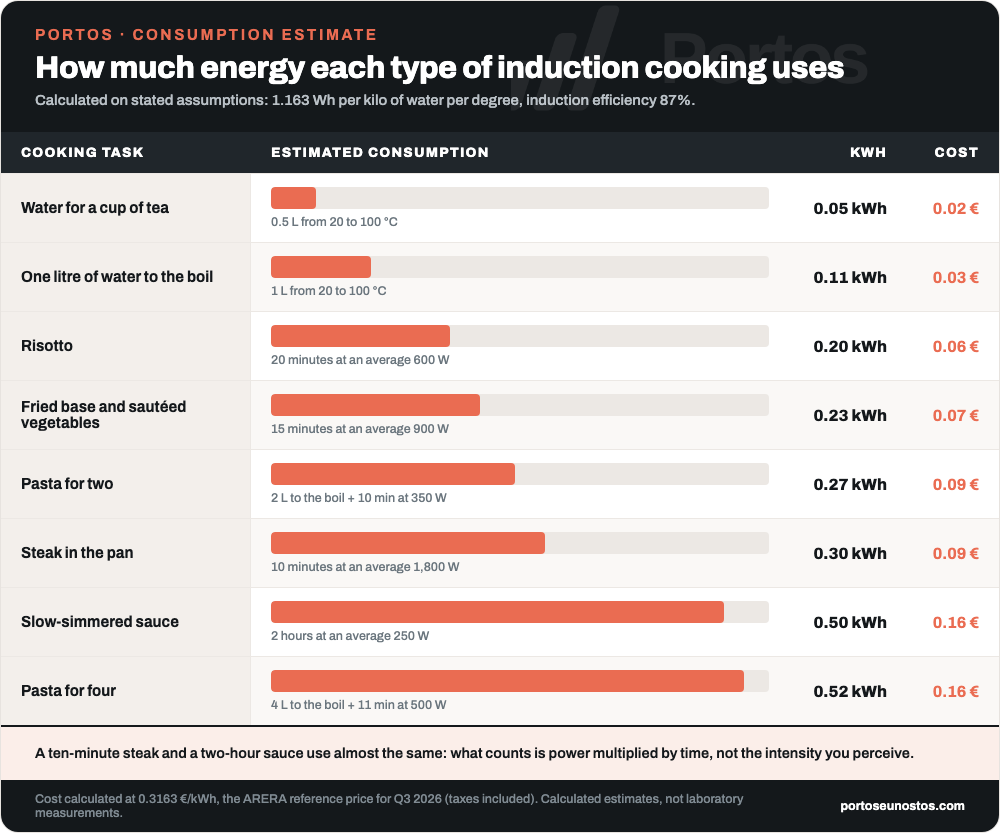
Portos estimate: consumption and euro equivalent of the most common cookings, using the calculation method described in the text.
| Cooking | Scenario | Estimated consumption | Cost at €0.32/kWh |
|---|---|---|---|
| Water for an herbal tea | 0.5 L from 20 to 100 °C | 0.05 kWh | €0.02 |
| One litre of boiling water | 1 L from 20 to 100 °C | 0.11 kWh | €0.03 |
| Risotto | 20 minutes at average 600 W | 0.20 kWh | €0.06 |
| Sauté base and stir-fried vegetables | 15 minutes at average 900 W | 0.23 kWh | €0.07 |
| Pasta for two | 2 L boiling plus 10 minutes cooking at 350 W | 0.27 kWh | €0.09 |
| Steak in a pan | 10 minutes at average 1,800 W | 0.30 kWh | €0.09 |
| Sauce on low heat | 2 hours at average 250 W | 0.50 kWh | €0.16 |
| Pasta for four | 4 L boiling plus 11 minutes cooking at 500 W | 0.52 kWh | €0.16 |
Here's the useful takeaway: short cooking sessions at high power and long cooking sessions at low power end up in the same order of magnitude. A ten-minute steak and a two-hour sauce consume almost the same amount. It's the product of power and time that matters, not the perceived intensity of the flame.
How much in a year
Adding up the cooking from a typical day gets you to annual consumption. A dinner for two with pasta and a side dish cooked in a pan is roughly 0.5 kWh; a day for a family of four with lunch and dinner cooked comes to around 1.1 kWh.
| How you cook | Estimated annual consumption |
|---|---|
| One person, one meal a day | 120-180 kWh |
| Couple, one hot meal a day | 180-250 kWh |
| Family of four, lunch and dinner | 350-450 kWh |
An independent check: Topten.it estimates the operating cost of cooktops assuming one hour of use per day. Three hundred and sixty-five hours a year at an average power draw of around 0.9 kW gives roughly 330 kWh, within the range we indicated for a larger family.
To give perspective: these are figures comparable to those of a dishwasher or a modern refrigerator, and significantly lower than those of a clothes dryer. A cooktop is never the main item on a household's electricity bill.
How much in euros
A clarification is needed here, because the price of electricity is not a single number. From July 1, 2026, the reference price set by ARERA for the typical customer is 31.63 euro cents per kWh, taxes included, an increase of 4.6% compared to the previous quarter. But note: that price applies to vulnerable customers served under Standard Offer Protection, about three million users. If you have a contract on the free market, your price is the one written on your bill and can be significantly different.
That's why we're giving the account on two levels instead of one.
| Annual consumption | At €0.25/kWh | At €0.3163/kWh |
|---|---|---|
| 150 kWh | €38 | €47 |
| 250 kWh | €63 | €79 |
| 350 kWh | €88 | €111 |
| 450 kWh | €113 | €142 |
The most honest way to read this table is to compare the two columns. Going from €0.25 to €0.32 per kWh matters more than any difference between cooktop models: on the same consumption of 350 kWh, that's €23 a year, while between the most efficient cooktop and the least efficient one we found the difference stops at just a few euros. The price you pay counts more than the appliance you buy.
What really shifts consumption
Four habits are worth more than any choice of model.
The lid
It's the most underestimated lever. Making water evaporate is expensive: it takes roughly 627 watt-hours to turn one kilogram of water already at 100 °C into vapor. That means every hundred grams that escape as steam from an uncovered pot carry away about 63 Wh, more than it takes to heat half a litre of water from 20 to 100 °C. The lid reduces evaporation and cuts cooking times: it's the gesture with the best ratio between effort and savings.
The amount of water
Every liter of water saved in the pasta pot means 93 watt-hours of useful energy saved, roughly 0.11 kWh drawn from the grid. For 200 grams of pasta you don't need four liters: two are enough, with the lid on until it boils.
The diameter of the pot
On induction, the magnetic field couples with the ferromagnetic bottom. If the pot is smaller than the zone, part of the inductor works empty and efficiency drops; if it's too small, the zone won't even recognize it. The practical rule is simple: the bottom must cover the zone, not the other way around. This is why 14.5 cm zones exist and should be used with small pots.
Residual heat
The glass under the pot stays hot and the pot itself accumulates heat. Turning off two or three minutes before the end, with the lid on, finishes many dishes without consuming more energy. The residual heat indicator exists precisely to make this reserve visible.
Does the booster use more energy?
It's the most frequent question and the answer is counterintuitive: no, or at least not in the way you'd think.
The booster function, which Bosch calls PowerBoost and claims delivers up to 50% more power, temporarily takes power from other zones to concentrate it on one. It consumes more, but for less time. The energy needed to bring a liter of water to a boil is always the same: what changes is how many minutes you draw it over.
In fact, by reducing the time you also reduce dispersal to the environment and evaporation, so the overall balance tends to be slightly in favor of the booster during the heating phase. The problem arises when the booster remains on after the water boils: at that point you're paying for power to evaporate water, not to cook. The booster is meant to reach boiling point, not maintain it.
The electricity meter: is 3 kW enough?
In the vast majority of cases yes, and it's a more widespread concern than necessary. The power rating declared on the cooktop is the theoretical sum of all zones at maximum simultaneously, a condition that doesn't occur during normal cooking.
All modern induction cooktops also have a power limiting or management function, which is set once during installation: you set a cap and the electronics redistribute the available power among the active zones, reducing the secondary one instead of tripping the meter.
With 3 kW, attention should be paid to simultaneous use: cooktop on while the oven, dishwasher or dryer start. Upgrading to 4.5 kW is the most sensible compromise for those who often cook on three zones at once; 6 kW only makes sense if your home also has a heat pump or electric car charging. Remember that increasing power consumption raises the fixed portion of your electricity bill, so it's not a free choice.
Why the cooktop doesn't have an energy class
If you're looking for the A-G class for your cooktop, you won't find it, and it's not the seller's oversight. Delegated Regulation (EU) 65/2014, which introduced the energy label for this product family, concerns ovens and range hoods for domestic use: cooktops are not included.
Cooktops are only subject to Regulation (EU) 66/2014 on ecodesign, which sets mandatory minimum requirements to sell the product in Europe and requires the declaration of consumption in Wh/kg. Minimum requirements, not a scale of merit visible to consumers.
So, when you see an energy class listed next to a cooktop in an advertisement, it almost always belongs to the oven bundled in the same offer. If you want to understand how the A-G scale really works and where it applies, we explained it in the guide to reading the energy label.
Mistakes to avoid
Comparing kilowatts instead of Wh/kg. Connection power says nothing about consumption. If you really want to compare two cooktops on this basis, the only homogeneous data is that declared under Regulation 66/2014.
Thinking that an 80 cm cooktop uses more than a 60 cm one. Official data says the opposite: with the same zone configuration, the declared value is identical. Format is a choice of space and ergonomics.
Looking for the energy class of the cooktop. It doesn't exist. If a seller indicates one for you, they're describing something else.
Using the flexible area as a default zone. It's meant for difficult pots. For the everyday water pot there's the right circular zone, and it declares a few percentage points less.
Keeping the booster on after boiling. It doesn't speed up pasta cooking, which happens at 100 °C anyway: it just makes water evaporate faster.
Deriving efficiency from Wh/kg. The value measures a complete test cycle, pot included. It's not the percentage of energy that ends up in the food.
The Portos choice
On consumption, the honest conclusion is that induction cooktops are very similar. Less than two percentage points between the models we checked, and even broadening to the best on the market you stay within a range that, converted to euros, amounts to a few coins a year. Anyone choosing a cooktop based on Wh/kg is optimizing the wrong variable.
The right variables are two, and neither of them is on the energy label. The first is how much and how you cook: lid, amount of water, pot diameter and residual heat shift annual consumption much more than any difference between appliances. The second is what you pay per kWh, which over the course of two quarters can change more than one model differs from another.
So choose the cooktop for the things you'll use every day: the number and diameter of the zones compared to your pots, the presence of a flexible area if you cook with baking sheets and fish kettles, the quality of the controls, the power limitation function if you have 3 kW at the meter. Then, if you're still deciding between the two technologies, the real calculation to make is not on consumption but on the cost of the energy source: you'll find it in the comparison between induction cooktop and gas cooktop. And if you're changing the oven along with the cooktop, the energy label actually exists there and it's worth reading: we talk about it in the guide to choosing a built-in oven.
Sources
Product information pursuant to Regulation (EU) 66/2014, Bosch: PUE611BB5J, PVS631FB5E, PVS831HB1E
Regulation (EU) no. 66/2014 of the Commission, specifications for ecodesign of ovens, cooktops and kitchen hoods for domestic use (EUR-Lex)
Bosch Italia, induction cooktops: description of the PowerBoost function
ARERA, update of the economic conditions of Standard Offer for the III quarter 2026
Topten.it, selection criteria for cooktops
Standard EN 60350-2, measurement methods of the performance of electric cooktops for domestic use
Data verified on the sources indicated in September 2026. Consumption for single cooking is estimated using the method described in the text, not laboratory measurements: Portos has not physically tested the appliances mentioned.