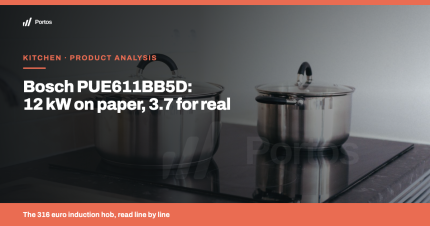
The Bosch PUE611BB5D spec sheet lists four cooking zones rated 1,800, 1,800, 2,200 and 1,400 W, rising to 3,100, 3,100, 3,700 and 2,200 W with PowerBoost. Add them up and you get 12.1 kW. Then, two lines further down, the same document states that the appliance draws a maximum of 3,700 W.
That is not a typo, and it is the single most useful thing to understand before buying an induction hob. At PortosEunostos we started here because the PUE611BB5D is the cheapest Bosch induction hob in the catalogue (316.25 euros on 17 October 2026) and the only one of the five 60 cm models we checked that ships with its plug already fitted.
The spec sheet in six lines
Product: Bosch PUE611BB5D, Series 4, 60 cm frameless induction hob, EAN 4242005286089.
Zones: 4, all round: two at 18.0 cm, one at 21.0, one at 14.5. No flexible zone.
Maximum power draw: 3,700 W, with an EnergyTutor function that caps it from 1 kW upwards.
Power supply: 220-240 V, Schuko plug, 110 cm cable.
Dimensions: 51 x 592 x 522 mm, cut-out 51 x 560 x 490-500 mm, worktop at least 16 mm thick, weight 11.9 kg.
Checked on: 17 October 2026, against the Bosch spec sheet and user manual.
Why the zone wattage does not add up
Those zone figures are maximums for each zone, measured with the standard pans described in IEC/EN 60335-2-6, not power levels that coexist. The appliance ceiling is 3,700 W and it is shared out across whatever you have switched on. The manual says it bluntly about PowerBoost: it is available on every zone provided the other zone on the same side is not in use. In practice, the two left-hand rings, or the two right-hand ones, never run flat out together.
This is not a flaw in the model, it is its design. The proof sits one step up the range: the PWP611BB5E has exactly the same four zones, same diameters and same wattage, yet declares a 4,600 W draw. The zones are identical, the ceiling is not, and that is where the price difference lies.
The Schuko plug is not a detail
For the PUE611BB5D Bosch declares "Plug type: Schuko", while for every other 60 cm hob in the same family it writes "no plug, electrical connection by an electrician". Those 3,700 W are not a random number: they are roughly what fits on a domestic circuit protected by a 16 A socket. The low ceiling and the plug are the same design decision.
This is not an invitation to do it yourself: the same manual requires the connection to be made by a qualified technician and points out that the appliance is protection class 1, so it needs an earth conductor. What changes is that you do not have to lay in a dedicated higher-rated circuit, and in a rented flat or an existing kitchen that is worth more than a flexible zone.
What it costs to move up in power
We lined up the five 60 cm Bosch hobs available on OpportunityCommerce, with prices recorded on 17 October 2026.
| Model | Price | Power draw | Plug | Flexible zones |
|---|---|---|---|---|
| PUE611BB5D, Series 4 | 316.25 € | 3,700 W | Schuko | no, 4 round |
| PWP611BB5E, Series 4 | 450.11 € | 4,600 W | electrician | CombiZone |
| PVS61AHC1E | 471.43 € | 6,900 W | electrician | CombiZone |
| PVS631FB5E, Series 6 | 609.00 € | 6,900 W | electrician | CombiZone |
| PXE675DC1E, Series 8 | 826.39 € | 7,400 W | electrician | FlexInduction |
The first step up costs 133.86 euros and buys 900 W of simultaneous power plus the option of bridging two zones. We should also flag a genuine pricing anomaly: the PVS61AHC1E costs 137.57 euros less than the PVS631FB5E despite the same 6,900 W and the same zone layout, giving up only the energy consumption readout.
Where you can fit it, and where you cannot
This is the part that derails most installations, and it sits in the manual nobody opens. The hob may be fitted only above drawers or ovens with forced ventilation: no fridges, dishwashers, washing machines or unventilated ovens underneath. The cabinet must withstand at least 90 °C and the worktop must carry around 60 kg. You need 65 mm between the worktop surface and the top of the drawer below, 30 mm above an oven with at least 5 mm of clearance between the two appliances, and 20 mm of air behind the cabinet. Measurements to check before ordering.
Strengths and limits
In its favour: 17 power settings, which are really the 9 base levels plus a half step for each; PowerBoost on every zone; residual heat shown zone by zone; a child lock; automatic shut-off after 20 seconds with all zones idle, and ReStart to recover your settings if you switch back on within 4 seconds. Spare parts are guaranteed for at least 10 years for the components covered by Ecodesign, and up to 15 years for other functional parts.
Against, plainly: no flexible zone, so fish kettles and rectangular griddles are out; no energy readout; no connectivity; and the 3,700 W ceiling makes itself felt when you are cooking in four pans. The manual also warns that the electronics may reduce the power level by themselves if they overheat, and that humming, whistling and fan noise are normal on any induction hob.
Who we recommend it to, and who we do not
It makes sense if you are replacing an old electric hob in an existing kitchen, if you cook with two or three pans at most, if you want to move to induction cheaply without touching the wiring. On the comparison between the two technologies we wrote Induction or gas cooktop: costs, consumption and differences, and we worked out the real running costs in How much does an induction cooktop consume.
It is not for you if you often cook with four rings going, if you use oval pans or griddles, if you want app control, or if you are designing a new kitchen where a dedicated circuit costs you nothing extra: there the jump to 6,900 W is something you will actually use.
PortosEunostos advice
Look at the appliance power draw, not the sum of the zones. It is the line that decides how much you can cook at once, and almost the only one catalogues leave out.
Check the plug type before the price. No plug means calling an electrician: a cost the listed price does not include.
Measure the base of your pans, not the rim. The Bosch manual warns that cookware makers often quote the top diameter, which is wider than the part that sits on the glass.
Vet the seller the way you vet the product: delivery times, returns, warranty handling. On this model OpportunityCommerce states immediate availability.
The Portos choice
The PUE611BB5D is not the most capable hob in the catalogue, and rightly so: at 316.25 euros it is the cheapest way to stop cooking on gas, provided you accept a power ceiling that almost no dinner ever reaches. Anyone cooking with two or three pans will not see the difference against a 600 euro model; anyone who fills the hob will see it on the first Sunday. You can check the specifications and availability on OpportunityCommerce or compare prices and alternatives on SniffaPrezzi.
Sources
Bosch PUE...BB.. user manual and installation instructions: zone ratings, PowerBoost, fitting constraints, spare parts.
Regulations (EU) 66/2014 on ecodesign requirements for hobs and (EU) 2023/826 on standby consumption, cited by the manufacturer in the product documentation.
Prices and availability recorded on 17 October 2026 on OpportunityCommerce, 525 induction hobs in the catalogue.
Why a hob has no energy class: How to read the energy label. On fitting above an oven: How to choose a built-in oven.