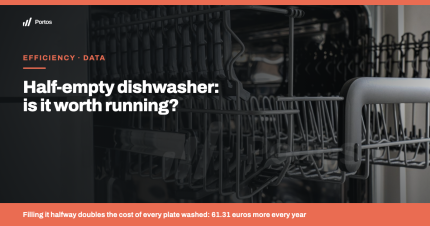
A dishwasher uses exactly the same number of kWh and litres on every cycle, full or half empty: all that changes is how many plates come out. Filling it halfway exactly doubles the cost of each place setting washed, and from there you can work out the right format. We decoded 29 EU product information sheets, 18 of them 60 cm wide and 11 slim 45 cm models, and went back to Annex IV of the regulation: the class of a slim is calculated with a different formula, so the two letters are not comparable. The result is a precise threshold, 76% load, below which the large machine loses to the small one.
A 14-place-setting dishwasher in energy class A uses 0.543 kWh per cycle. Run it full and every place setting costs you 1.68 cents. Run it half empty and the same place setting costs 3.37 cents: exactly double. The machine does not notice and neither does the meter, because the figure declared on the label is a single number and it refers to a full load.
That is why the question "how many place settings do I need" has no answer that depends on how many people live in the house. It depends on how often you manage to fill it. A 60 cm machine rated 14 place settings, run half full, washes at a worse cost per plate than a 45 cm slim run full, and the point where the advantage flips can be worked out precisely.
To do that we decoded 29 EU product information sheets for Bosch dishwashers currently on the market, 18 of them 60 cm wide and 11 slim 45 cm models, and we went back to Annex IV of the regulation that sets out how the energy class is calculated. There is something in there that changes the way you read the label: for narrow dishwashers the regulation uses a different formula, which means the letter on a 45 cm machine and the letter on a 60 cm machine are not measured against the same yardstick.
The short answer
Running the dishwasher half empty doubles the cost of every plate washed, in energy and in water. For the same amount of crockery over a year, the same machine goes from 61.31 to 122.63 euros of electricity: exactly twice as much.
It follows that the right size is not the largest one that fits the kitchen, but the largest one you can fill. In the figures below, a 60 cm machine rated 14 place settings in class A stays the better choice as long as you fill it to at least 76 per cent, that is around ten place settings out of fourteen. Below that threshold a 45 cm slim rated 10 place settings, used full, washes for less.
There is one case, though, where the letter cancels out the advantage of the format: a 60 cm machine in class C never reaches the energy efficiency per place setting of a slim in class B, not even filled to the last glass. On water, however, it stays ahead. Two classes of difference offset fifteen centimetres of width on one resource and not on the other, and as we will see that changes the conclusion.
In brief: what you will find in this guide
The half load option: what the label says and what it does not
How many place settings you need: count the days, not the people
What a place setting is, according to the regulation
A place setting is not a person and it is not a meal. Commission Delegated Regulation (EU) 2019/2017, the one that governs energy labelling for household dishwashers, defines it bluntly: a place setting is the set of tableware intended for use by one person, excluding serving items. Serving items are a separate entry: pots, bowls, serving cutlery and a tray.
Rated capacity, which is the number you see in the listing, is defined immediately afterwards as the maximum number of place settings, including serving items, that the machine can wash, rinse and dry in one cycle when loaded as the manufacturer instructs. In plain terms: a machine rated 14 place settings is tested with fourteen sets of tableware plus one set of serving items, loaded in the optimal way.
Two practical consequences, and they are the ones that matter.
First: the place setting is a unit for comparing two machines, not for counting your family. The exact composition of the set is fixed in the harmonised technical standard, which is not a public document, so nobody can tell you with certainty how many plates and how many glasses make up a place setting. What can be said with certainty is that two machines rated 10 and 14 place settings were tested with the same type of load, in a 10 to 14 ratio. That is a reliable ratio, not a measurement of your sink.
Second: the test load is always the full one. Every number on the label, energy, water and duration, is measured at full rated capacity on the eco programme. Nowhere is there an official figure for how much the same machine uses when loaded halfway. Consumption per cycle, on the other hand, stays essentially the same: it is the programme that decides how much water to heat, not the weight of the crockery inside.
Two different formulas for the same letter
The energy class of a dishwasher is not an absolute measure of consumption: it is a ratio. The energy efficiency index is calculated as the eco programme consumption divided by a reference consumption, multiplied by one hundred. The reference grows with capacity, and rightly so: a machine that washes more plates is entitled to use more energy for the same mark.
The point is how it grows. Annex IV of the regulation sets out two formulas.
| Case | Reference consumption formula | Which machines fall under it |
|---|---|---|
| Capacity of 10 place settings or more and width over 50 cm | 0.025 x place settings + 1.350 | every 60 cm machine rated 10 place settings or more |
| Capacity of 9 place settings or fewer or width of 50 cm or less | 0.090 x place settings + 0.450 | every 45 cm slim, whatever its capacity, and any machine rated 9 place settings or fewer |
A 45 cm slim always falls under the second one, because the width criterion triggers on its own. And the second formula has a far steeper slope, 0.090 against 0.025 per place setting, on a much lower base. The result is that the two yardsticks diverge, and they diverge precisely in the range where the real machines sit.
| Place settings | Reference, first formula | Reference, second formula | Second yardstick against the first |
|---|---|---|---|
| 9 | 1.575 kWh | 1.260 kWh | 80.0 per cent |
| 10 | 1.600 kWh | 1.350 kWh | 84.4 per cent |
| 12 | 1.650 kWh | 1.530 kWh | 92.7 per cent |
| 13 | 1.675 kWh | 1.620 kWh | 96.7 per cent |
| 14 | 1.700 kWh | 1.710 kWh | 100.6 per cent |
| 16 | 1.750 kWh | 1.890 kWh | 108.0 per cent |
The two lines cross at 13.85 place settings. Below that value the reference under the second formula is lower, so the mark is harsher: for the same real consumption, a machine judged by the second formula gets a worse letter. At 10 place settings the reference is 15.6 per cent lower, and that 15.6 per cent is borne entirely by slim machines.
This is not a legislative mistake and it is not a conspiracy against narrow machines. It is how the regulation accounts for the fact that a small tub has less room for efficiency per plate. But it has a consequence nobody writes in the showroom: the letter on a 45 cm machine and the letter on a 60 cm machine are not the same letter. If you want to know which scale you are looking at, our guide on how to read the energy label explains how the A to G scale works after the 2021 rescaling.
The cross-check: 29 sheets out of 29
A formula lifted from a legal text is worth little unless it holds up on real products. We applied it to the 29 EU product information sheets we decoded, taking the declared consumption and the declared capacity and recalculating the index. All 29 times the result matches the index declared by the manufacturer, to the first decimal place.
| Model | Width | Place settings | kWh per cycle | Reference | Index recalculated | Index declared | Class |
|---|---|---|---|---|---|---|---|
| SMH4ECX28E | 60 cm | 14 | 0.543 | 1.700 | 31.9 | 31.9 | A |
| SMH6YCX02E | 60 cm | 14 | 0.543 | 1.700 | 31.9 | 31.9 | A |
| SPT4EMX17E | 45 cm | 10 | 0.512 | 1.350 | 37.9 | 37.9 | B |
| SMH6ZCX10E | 60 cm | 14 | 0.645 | 1.700 | 37.9 | 37.9 | B |
| SPV6ZMX23E | 45 cm | 10 | 0.593 | 1.350 | 43.9 | 43.9 | C |
| SMH4HVX14E | 60 cm | 14 | 0.747 | 1.700 | 43.9 | 43.9 | C |
| SPH4HMX12E | 45 cm | 10 | 0.674 | 1.350 | 49.9 | 49.9 | D |
| SMS4HVI33E | 60 cm | 13 | 0.836 | 1.675 | 49.9 | 49.9 | D |
| SPV2HKX39E | 45 cm | 9 | 0.704 | 1.260 | 55.9 | 55.9 | E |
| SMV25AX06E | 60 cm | 12 | 0.923 | 1.650 | 55.9 | 55.9 | E |
| SMV46KX55E | 60 cm | 13 | 0.937 | 1.675 | 55.9 | 55.9 | E |
Looking down the column of declared indices, one thing stands out: they all end in nine. The class thresholds are 32, 38, 44, 50 and 56, and the 29 models declare either 31.9 or 37.9 or 43.9 or 49.9 or 55.9. No exceptions, no values in between.
The meaning for a buyer is very concrete. The letter does not tell you where the model sits inside its band: it tells you that it is just below the ceiling of the band. A class B is not "some class B": it is a B that sits one tenth away from becoming a C. It also follows that, for the same format and the same class, the declared consumption is literally the same number, and that changes how much weight it makes sense to give the letter when choosing between two models from the same manufacturer.
Energy per place setting, not per cycle
The number in the showroom is consumption per cycle, or per hundred cycles on the label. That number systematically favours small machines, because a cycle that washes ten place settings uses less than one that washes fourteen. It is true and it is useless: what you care about is the cost of washing your plates, not the cost of switching the machine on.
The division is trivial, and it is the same arithmetic we used on water when comparing 45 and 60 cm dishwashers. Here we run it on both resources and one energy class at a time, because that is how you really compare two machines.
| Class | Energy per place setting, 60 cm | Energy per place setting, 45 cm | Difference | Water per place setting, 60 cm | Water per place setting, 45 cm | Difference |
|---|---|---|---|---|---|---|
| A | 0.0388 kWh | no model | - | 0.643 litres | no model | - |
| B | 0.0461 kWh | 0.0512 kWh | +11.1 per cent | 0.649 litres | 0.860 litres | +32.6 per cent |
| C | 0.0534 kWh | 0.0593 kWh | +11.1 per cent | 0.652 litres | 0.950 litres | +45.8 per cent |
| D | 0.0625 kWh | 0.0674 kWh | +7.9 per cent | 0.687 litres | 0.930 litres | +35.4 per cent |
| E | 0.0737 kWh | 0.0762 kWh | +3.4 per cent | 0.751 litres | 0.919 litres | +22.3 per cent |
On energy the gap is contained and it follows directly from the formula: between a slim rated 10 place settings and a 60 cm rated 14 assessed at the same index, the ratio of consumption per place setting is exactly 1.112. That is 11.2 per cent, which is the figure you find in rows B and C of the table. If the slim is rated 9 place settings the penalty rises to 15.3 per cent.
On class A, however, there is a void: of the 11 slim machines we examined none reaches A, while three of the 18 sixty-centimetre machines do. That is not a law of physics and we are not writing it as one: it is what this range shows. But you can see why it is hard, looking at the yardstick: to earn an A, a slim rated 10 place settings would have to drop below 0.432 kWh per cycle, whereas a 60 cm rated 14 only has to stay below 0.544.
At the same energy class the slim uses more energy and much more water for every place setting washed. But the larger machine keeps its advantage only if you fill it.
Water, where the gap is much wider
Here the scale of the argument changes. On energy the difference between the formats is of the order of ten per cent; on water it reaches 45.8 per cent in class C. The reason is simple: water is not normalised by capacity under any formula. It has no class, no index, no A to G scale. On the sheet it appears bare, in litres per cycle.
And in litres per cycle the two families are almost identical. The 60 cm machines declare between 9.0 and 9.5 litres; the 45 cm slims declare between 8.5 and 9.5. At best the slim saves half a litre per cycle. But it washes four place settings fewer. A machine that uses almost the same water to wash 30 per cent fewer plates is, inevitably, less efficient per plate.
In litres per year, for the same amount of crockery washed, the difference becomes visible: a slim rated 10 place settings used for the same place-setting total as a 60 cm rated 14 consumes around 830 litres more per year, a little under a cubic metre. Over ten years that is eight cubic metres.
We are not putting a euro figure on that water, and not out of laziness: Italian water tariffs are set locally and the same quantity costs different amounts depending on the operator and the consumption band. Anyone who wants the number gets it in a moment from their own bill, multiplying the rate per cubic metre by the eight cubic metres over ten years. What can be said without inventing anything is that water is the one item where the format matters more than the class.
What it costs to fill it halfway
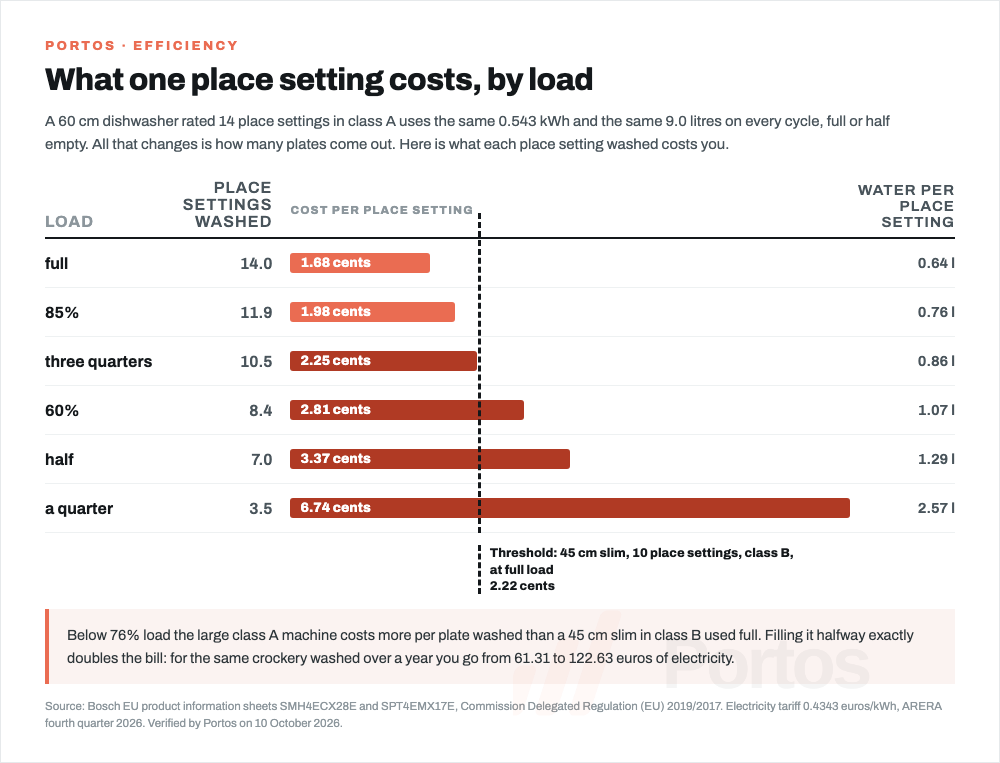
Now to the point that gives this guide its title. Take the best machine in our group, a 60 cm rated 14 place settings in class A that declares 0.543 kWh and 9.0 litres per cycle, and see how the cost of a single place setting changes with the load. The tariff is 0.4343 euros per kWh, the ARERA reference for the fourth quarter of 2026, in force since 1 October.
| Load | Place settings washed | Energy per place setting | Water per place setting | Cost per place setting |
|---|---|---|---|---|
| full | 14.0 | 0.0388 kWh | 0.643 litres | 1.68 cents |
| 85 per cent | 11.9 | 0.0456 kWh | 0.756 litres | 1.98 cents |
| three quarters | 10.5 | 0.0517 kWh | 0.857 litres | 2.25 cents |
| 60 per cent | 8.4 | 0.0646 kWh | 1.071 litres | 2.81 cents |
| half | 7.0 | 0.0776 kWh | 1.286 litres | 3.37 cents |
| a quarter | 3.5 | 0.1551 kWh | 2.571 litres | 6.74 cents |
The relationship is inverse and unforgiving: halving the load doubles the cost per plate, cutting it to a quarter quadruples it. No technology corrects this, because declared consumption is a property of the programme, not of the load.
Carried over a year, with a fixed amount of crockery equal to that of a machine run full five times a week, the arithmetic looks like this.
| Habit | Cycles per year | Energy | Electricity cost | Water |
|---|---|---|---|---|
| always full | 260 | 141.2 kWh | 61.31 euros | 2,340 litres |
| filled to three quarters | 347 | 188.2 kWh | 81.75 euros | 3,120 litres |
| always half empty | 520 | 282.4 kWh | 122.63 euros | 4,680 litres |
That is 61.31 euros of difference per year, on the same machine, with the same crockery to wash. It is worth more than a jump of two energy classes: between the best 60 cm in class A and a class B of identical capacity, with the same habit, the difference is 11.52 euros per year. The habit weighs more than five times the letter. It is the same hierarchy that emerged on tumble dryers, where usage weighed more than twice the class: here the ratio is even more lopsided, and the reason is that the annual cost of an appliance always depends on the product of consumption per cycle and number of cycles, and here you decide the second factor.
The threshold that decides: 76 per cent
If filling it halfway costs double, then there is a point at which a large machine used badly loses to a small machine used well. That point can be calculated: it is the load at which the 60 cm machine's consumption per place setting reaches that of the slim at full load.
| 60 cm machine | Compared with slim | Threshold on energy | Threshold on water |
|---|---|---|---|
| 14 place settings, class A (0.543 kWh) | 10 place settings, class B (0.512 kWh) | 75.8 per cent, that is 10.6 out of 14 | 73.9 per cent, that is 10.3 out of 14 |
| 14 place settings, class B (0.645 kWh) | 10 place settings, class B (0.512 kWh) | 90.0 per cent, that is 12.6 out of 14 | 73.9 per cent, that is 10.3 out of 14 |
| 14 place settings, class C (0.747 kWh) | 10 place settings, class B (0.512 kWh) | never reached | 73.9 per cent, that is 10.3 out of 14 |
| 13 place settings, class E (0.937 kWh) | 10 place settings, class D (0.674 kWh) | never reached | 82.1 per cent, that is 10.7 out of 13 |
The first row is the most common case and the most useful. If you buy the better 60 cm and fill it at least three quarters of the way, you have made the right choice with a comfortable margin. If instead you typically run it half full, you are paying more per plate than someone who bought a slim and fills it.
Note that the water threshold is stable at around 74 per cent in every case, whatever the class. It depends only on the ratio between the declared litres, which are almost identical across the two formats, and on the ratio between capacities. Water cannot be corrected by technology: only by the load.
When two classes offset the format
The third row of the table above deserves a section of its own, because it challenges the rule everyone takes for granted. A 60 cm rated 14 place settings in class C declares 0.747 kWh, that is 0.0534 kWh per place setting at full load. A 45 cm slim rated 10 place settings in class B declares 0.512 kWh, that is 0.0512 per place setting. On energy the slim wins, and it wins even if the 60 cm is filled to the last available slot: the threshold would come out at 104 per cent of rated capacity, which does not exist.
But the win is narrow, and it should be stated with its number. For the same crockery washed over a year, the slim in class B spends 80.94 euros of electricity against 84.35 for the 60 cm in class C: 3.41 euros of advantage per year. Over the same year it uses 827 litres more water. On energy the slim is ahead, on water it is behind, and by a lot.
So the advice "when in doubt take the 60 cm" still holds, but not for the reason people think: it rests on water, not on energy. Rewritten so that it stays true:
Between two machines of equal or similar class, the 60 cm is the better choice if you fill it. Between a mediocre 60 cm and a good slim, the slim wins on energy, but the margin is a few euros a year and the 60 cm stays ahead on water: at that point space and price decide, not consumption.
This is a case where an honest comparison does not produce a clear winner, and saying so is more useful than forcing a ranking. The same applies between two models of the same width, except that there the distance between classes weighs with no trade-off: in our comparison of two Bosch 60 cm built-in dishwashers it mattered more than any difference in features.
Six models, the same declared consumption, 280 euros apart
Since the indices all end in nine, and since the reference depends only on capacity, two machines of the same width, the same capacity and the same class declare the same number. Not a similar number: the same one.
Our group contains six 60 cm models, 14 place settings, class B, all declaring 0.645 kWh per cycle. Five of them also declare the same 9.0 litres. These are the prices recorded on a real catalogue on 10 October 2026.
| Model | Declared energy | Water | Noise | Eco cycle length | Price recorded |
|---|---|---|---|---|---|
| SMH4EVX08E | 0.645 kWh | 9.0 litres | 44 dB(A) | 3:55 | 583.95 euros |
| SMH6ZCX10E | 0.645 kWh | 9.0 litres | 40 dB(A) | 3:35 | 772.39 euros |
| SMH6ZCX24E | 0.645 kWh | 9.0 litres | 40 dB(A) | 3:35 | 799.39 euros |
| SMI6ZCS10E | 0.645 kWh | 9.0 litres | 40 dB(A) | 3:35 | 863.68 euros |
Between the first and the last row there are 279.73 euros and zero difference in declared consumption. What actually changes is four decibels and twenty minutes of cycle. Those can be worth that much, if the dishwasher sits in a room open to the living area and you run it in the evening: four decibels are a difference you hear. They are not worth that much if you were looking for a machine that uses less, because on that front they are identical. We already took apart the difference between two models of the same series with a visible control panel in our analysis of two Series 6 compared.
This is, in practice, why it pays to choose the format and the class first and the model afterwards: on consumption, within the same format and class pairing, there is nothing left to choose.
The half load option: what the label says and what it does not
Many dishwashers have an option called half load, or reduced load, which works on a single basket or shortens the phases. It is a real and useful function. But what the manufacturer does not declare needs saying clearly.
The regulation requires energy, water and duration to be declared for the eco programme alone, at full rated capacity. The EU product information sheet has no field for the half load, and in the 29 sheets we decoded no value whatsoever refers to that function. So the saving from a half load is not a figure you can verify on the label: there is no official number to compare across models, as there is for the eco programme.
That does not mean it is useless. It means two operational things. First: if you have to choose between two machines, the half load is not a parameter you can put in a table, because nobody quantifies it. Second, and more important: even assuming the half load saves something, the benchmark to beat is still the full cycle, which is unbeatable on cost per plate. The half load is a remedy, not a strategy.
There is also a hygiene point worth making here, because it shapes the decision: letting crockery pile up for two days in a closed tub instead of washing it straight away has a cost in odours and in dried-on residue, and dried-on residue is why people then resort to rinsing by hand and to intensive cycles that cost more than the eco cycle they saved. If filling it means waiting three days, the machine is too big for you, and the problem will show up on the filter before it shows up on the bill: you see it in practice in how often the filter needs cleaning and in what becomes of your glasses.
How many place settings you need: count the days, not the people
Putting it all together, the opening question is restated as follows: how much capacity do I need in order to always be able to run a full cycle, at a frequency I accept?
Capacity does not buy washed plates: it buys days of accumulation. And it is a ratio, not an absolute value.
| Step up in capacity | Extra accumulation before you have to run a cycle |
|---|---|
| from 9 to 10 place settings | +11.1 per cent |
| from 13 to 14 place settings | +7.7 per cent |
| from 10 to 13 place settings | +30.0 per cent |
| from 10 to 14 place settings | +40.0 per cent |
| from 9 to 14 place settings | +55.6 per cent |
Two things read straight off. First: the step from 13 to 14 place settings is worth 7.7 per cent, which is next to nothing, and on real models it costs nothing, because the cabinet opening is the same and the price depends on the series. If you are choosing between two 60 cm machines, capacity is not the criterion. Second: the step from 10 to 14 is worth 40 per cent, which in practice is the difference between running a cycle every day and a half and running it every two days.
The practical method, to be done on your own sink and not on a generic table, is this. For one week, keep a note of how many times you ran the dishwasher and how full it was, roughly, in quarters. If the average is below 70 per cent, the format you have, or the one you are about to buy, is larger than you need, and a better class will not fix it. If the average is above 90 per cent and you regularly have to leave the pots out, you need capacity.
The rest of the parameters that go into the choice, from baskets to programmes, are in our guide on how to choose a dishwasher, and the absolute consumption figures are in the one on how much a dishwasher uses.
When to choose a 45 cm slim
The slim makes sense in three situations, and in all three the reason is concrete.
When the width is not there. That is the obvious case and it remains the most common: fifteen centimetres of kitchen are fifteen centimetres, and no energy calculation gives them back. One widespread expectation needs deflating though, because the 29 sheets are unambiguous: a slim is not also shallower and not lower. Height and depth depend only on the installation type, not on the width. Every built-in machine, slim or 60 cm, declares 82 cm of height and 55 cm of depth, with the sole exception of the two models with a visible control panel which reach 57. Every freestanding machine, slim or 60 cm, declares 85 cm of height and 60 of depth. So the slim saves you fifteen centimetres, and only those.
When you could not fill a 60 cm. If on your own figures the average load of a 14-place-setting machine would stay below 74 per cent, a slim rated 10 place settings used full washes for less, on both energy and water. That is the reversal we quantified above, and it is not a theoretical case: it is the normal condition of one or two people.
When you find a slim in a good class. A slim in class B beats a 60 cm in class C on energy per place setting, whatever the load of the latter. If your budget puts you in front of that choice, take the better slim rather than the worse large machine, keeping in mind that on water the trade-off is the other way round.
The limit to accept without illusions is water: at the same class the slim uses between 22 and 46 per cent more water per place setting, and that gap is never recovered. And a practical limit: a narrow tub struggles with pots, oven trays and large lids, which are precisely the items excluded from the definition of a place setting and which therefore no rated capacity helps you predict.
When to choose a 60 cm rated 13 or 14 place settings
When you fill it. That is the condition, not a detail. Filled at least three quarters of the way, a 60 cm in class A is the cheapest machine per plate washed in the whole group we examined: 1.68 cents per place setting, against 2.22 for the best slim.
When you wash pots and oven trays. Here rated capacity is the wrong parameter and real space is the right one. A 60 cm tub takes an oven tray lying flat; a 45 cm one usually does not. Since serving items are excluded from the definition of a place setting, this difference appears in no figure on the label and has to be checked by looking at the baskets.
When you want class A. Among the 29 machines we read, A exists only in the 60 cm, 14-place-setting format. If your criterion is to take the best class available, the width is already decided.
The step between 13 and 14 place settings, on the other hand, is not a criterion: it is worth 7.7 per cent of accumulation and on real machines it depends on the series, not on the size. Choose on class and on noise, not on that one extra place setting.
The compact dishwasher: what is left on the market
The compact dishwasher, the countertop or under-sink type rated 6 to 8 place settings, used to be the third classic format. It is worth saying where it stands today, because anyone looking for a solution for a tiny kitchen puts it on the list.
On the catalogue we scanned, 238 products in the dishwasher section, the "compact dishwashers" category exists but is empty: zero products. And on the Bosch codes of the old compact family, eleven attempts against the manufacturer's official archive of EU product information sheets return no document at all. What is sold under the "compact" label turns out to be machines 55 cm wide, an intermediate format, not countertop appliances.
From a regulatory standpoint there is an interesting consequence. A machine rated up to 9 place settings falls under the second formula by capacity, even if it is more than 50 cm wide. And at 9 place settings the reference drops to 1.260 kWh, the harshest of all: to earn a B, a machine rated 9 place settings has to stay below 0.479 kWh per cycle. That is the technical reason small formats struggle to show good letters, and probably one of the reasons they have disappeared from the listings.
We neither recommend nor advise against buying one: having found no models on sale with verifiable documentation, on this format we have no data to go on.
Cycle length and noise
On the declared durations of the eco programme, the two families behave differently from what one would imagine. The 60 cm machines range from 3:30 to 5:20; the slims from 3:30 to 4:35. The most efficient machine per place setting in the whole group declares 4:55, so it is also among the slowest, while the quickest of all, at 3:30, is a class E.
It is the same rule that applies to every appliance that heats and rinses: efficiency is bought with time, because a long cycle at a lower temperature uses less than a short cycle at a high one. If you run it in the evening, those extra two hours are invisible. If you need the cycle finished within three hours, you have to accept a worse class or a programme other than eco, which however is not the one consumption is declared on.
On noise, the class thresholds set by the regulation are A below 39 dB(A), B from 39 to 45, C from 45 to 51, D from 51 up. Our 29 machines sit between 40 and 48 dB(A), so in classes B and C: no class A at all. The quietest, at 40 dB(A), are three 60 cm models; the slims start at 43. If the dishwasher sits in a room open to the living area, those three decibels are perceptible and count for more than an energy class.
The standby nobody counts
Twenty-six of the 29 models declare a networked standby of 2.00 W. That is the state a connected machine sits in while waiting for commands, and it is the normal state twenty-four hours a day if connectivity is enabled. Kept that way all year it amounts to 17.5 kWh, that is 7.61 euros at today's tariff.
To give the measure: that is the equivalent of 32 eco cycles of the best machine, meaning 452 place settings washed for nothing. It is not the item that decides a purchase, but it is worth more than the difference between two adjacent classes over a year on a lightly used machine, and it goes to zero by disabling connectivity when it is not needed.
The three models that declare 0.10 W when off and 0.00 W in networked standby are also the three cheapest in the group and are all in class E. A zero in that field reads only one way: there is nothing to keep powered while waiting for commands. It is the rare case where an item on the label tells you something about the feature set that the label does not list.
Mistakes to avoid
Comparing the class of a 45 cm with that of a 60 cm. They are calculated with two different formulas and they only cross at 13.85 place settings. Below that threshold the slim is judged by a yardstick around 15 per cent harsher.
Choosing the slim to save money. It saves per cycle and spends per plate. It makes sense for the space and it makes sense if you cannot fill a 60 cm, which are two different reasons and should be kept apart.
Buying large "to be on the safe side". The large machine only saves you money if you fill it. Filled halfway, it costs double per plate and uses more than a small one filled properly.
Running a cycle for a few items because the machine is quiet or because there is a delayed start. Declared consumption does not change with the load: a nearly empty cycle costs as much as a full one.
Counting on the half load as though it were a figure. It is not declared in any field of the EU product information sheet. It cannot be compared across models and should not go into purchase calculations.
Choosing the model before the format and the class. Within the same format and class pairing the declared consumption is the same number. Choosing the model means choosing noise, duration and features, not consumption.
Looking only at the rated place settings if you wash pots. Serving items are excluded from the place setting by definition: room for trays and pots has to be checked on the baskets, not on the number.
The Portos choice
The right format is the largest one you can fill, and not one more. The parameter to estimate before looking at any model is not the number of people in the house: it is the average load you can achieve at the start frequency you accept.
If that average load on a 14-place-setting machine would stay above 75 per cent, take a 60 cm rated 13 or 14 place settings in the best class the budget allows, and then choose on noise. That is the solution that washes at the lowest cost per plate and the only one in which class A exists.
If that average load would stay below 75 per cent, or if the width is simply not there, take a 45 cm slim rated 10 place settings, in class B or C, and use it full. In exchange, accept between 22 and 46 per cent more water per place setting and the difficulty with large pots. Do not take a slim rated 9 place settings if the same machine exists rated 10: the regulatory yardstick at 9 place settings is the harshest and the extra accumulation costs little.
In neither case should you choose on the basis of the per-cycle consumption shown in the showroom. Always divide it by the place settings, because that is the figure you pay.
A note on data and method
Portos does not own the machines it writes about and has not tested them. Every figure for consumption, water, duration, noise and dimensions in this article is a value declared by the manufacturer in the EU product information sheets required by Commission Delegated Regulation (EU) 2019/2017, downloaded from the manufacturer's official archive and decoded one by one. The energy and noise class thresholds and the two reference consumption formulas were read directly in the text of the regulation as published on EUR-Lex.
The figures in euros use 0.4343 euros per kWh, the ARERA reference for the fourth quarter of 2026 for vulnerable customers on the regulated tariff, in force since 1 October 2026. Anyone on a different tariff can redo the proportion in one step. The convention of 260 cycles a year, five a week, serves only to make the models comparable with each other: the absolute value changes with your habits, the ratios do not.
The calculations on partial loads assume that consumption per cycle stays at the declared value even when the tub is not full. That is an assumption, stated here openly, and it follows from the fact that the eco programme heats and rinses a quantity of water set by the cycle. Machines with a load sensor may reduce something, but by how much there is no official figure: no field of the EU product information sheet reports it, so we have not quantified it.
Prices were recorded on 10 October 2026 on a real catalogue and they change. They are there to give the scale of the differences, not as a price list.
Prices and availability
Most of the models cited in this article are on sale. To compare offers and sellers across the formats we have discussed, the useful pages are those for the two widths: compare prices and availability of 45 cm dishwashers on SniffaPrezzi.
To check features and availability of the models, the reference categories are 45 cm slim dishwashers on OpportunityCommerce and the full dishwasher section. The two Bosch slims whose data we have published are the SPT4EMX17E, class B at 672.79 euros and the SPH4HMX12E, class D at 611.20 euros; the 60 cm in class A is the SMH4ECX28E at 724.91 euros.
It is worth reading those three numbers alongside the earlier calculations. Between the class B slim and the class A 60 cm there are 52.12 euros of price difference. For the same crockery washed over a year, the 60 cm uses 19.63 euros less electricity and 827 litres less water: the price difference is recovered in two years and eight months counting electricity alone, and from then on the advantage stays. On condition that you fill it.
Sources
Commission Delegated Regulation (EU) 2019/2017 on energy labelling of household dishwashers: definitions of place setting and rated capacity in Article 2, energy and noise class thresholds in Annex II, the two reference consumption formulas in Annex IV, content of the product information sheet in Annex V.
ELI identifier of the regulation in the Official Journal of the European Union.
EU product information sheets for the models cited, from the manufacturer's archive: SPT4EMX17E, SMH4ECX28E, SPV2HKX39E, SMV25AX06E.
Official product pages from the manufacturer: SPT4EMX17E and SMH4ECX28E, on bosch-home.com; energy labels at bosch-home.com/energylabel.
EPREL, the European product database for energy labelling, where every model on the market is registered with its own label and information sheet.
ARERA, press release on the fourth quarter of 2026 for the electricity price used in the calculations.
More from Portos
How to choose a dishwasher: place settings, consumption and programmes, the reference guide to all the other parameters.
45 or 60 cm dishwashers: which one is really right for you, the comparison between the two formats on footprint and loading comfort.
How much energy does a dishwasher consume, the absolute energy and water figures and the cost of a cycle.
How to read the energy label, to know what the letter actually measures.
What it costs to run your appliances, with the updated tariff and the figures for every appliance in the house.