Two Bosch Series 6 built-in dishwashers with visible front panel, same width and same steel, separated by 18.10 euros. The information sheets filed by the manufacturer match on every standard parameter: same efficiency rating, same 0.645 kWh per cycle, same 9.0 litres of water, same duration, same drying rating. The only different data is two decibels, within the same noise class.
The real difference lies outside the label: the drying system changes, the number of programs changes, and the way you load the lower basket changes. In this comparison we line up the data from the Bosch technical sheets and tell you, line by line, what those 18 euros buy and who it's worth spending them on.
Two Bosch Series 6 built-in dishwashers with visible panel front, same width, same brushed steel, same retailer. Between one and the other there are 18.10 euros. If you try to understand the difference by looking at the energy label, you can't: the two information sheets filed by Bosch show the same energy efficiency index, the same energy consumption, the same water, the same eco programme duration and even the same drying index.
The only regulated parameter on which the two documents differ is sound emissions: 42 dB(A) versus 40. Two decibels, within the same noise class. Eighteen euros for two decibels would be a bad deal, if that were really the point.
It's not. The difference between the SMI6ECS00E and the SMI6ZCS10E is real and lies entirely outside the label: the drying system changes, the number of programmes changes, the way you load the lower basket changes. Here we list the data from the manufacturer's technical sheets and try to say, line by line, what those 18 euros buy and who should spend them.
In short: what you'll find in this comparison
The short answer
The SMI6ZCS10E makes sense if the problem you want to solve is drying, particularly drying plastics, and if the dishwasher is in an open space or near a sleeping area. The 18.10 euros buy the zeolite system and two decibels less. They don't buy lower consumption: that's identical.
The SMI6ECS00E makes sense if you load heavily and variably. It costs less and has two more programmes, the intensive wash zone in the upper basket and six folding racks in the lower basket instead of two. In practice it's the more flexible of the two, and it's also the lighter one to handle during installation: 36.6 kg versus 46.0.
If neither of these two criteria applies to you clearly, the honest answer is that 18 euros out of around 860 is not a difference that should keep you awake: it amounts to 2.1% of the price and less than four months of energy. In that case it's worth looking at the third way, because by giving up the visible panel front you get under 800 euros with the same zeolite, or you reach class A by spending less than both.
The two sheets, line by line
All the values that follow come from the product information sheets filed by Bosch in accordance with Delegated Regulation (EU) 2019/2017 and from the technical sheets of the two appliances. They are data declared by the manufacturer and measured on the eco programme, the only one regulated: they are not our measurements.
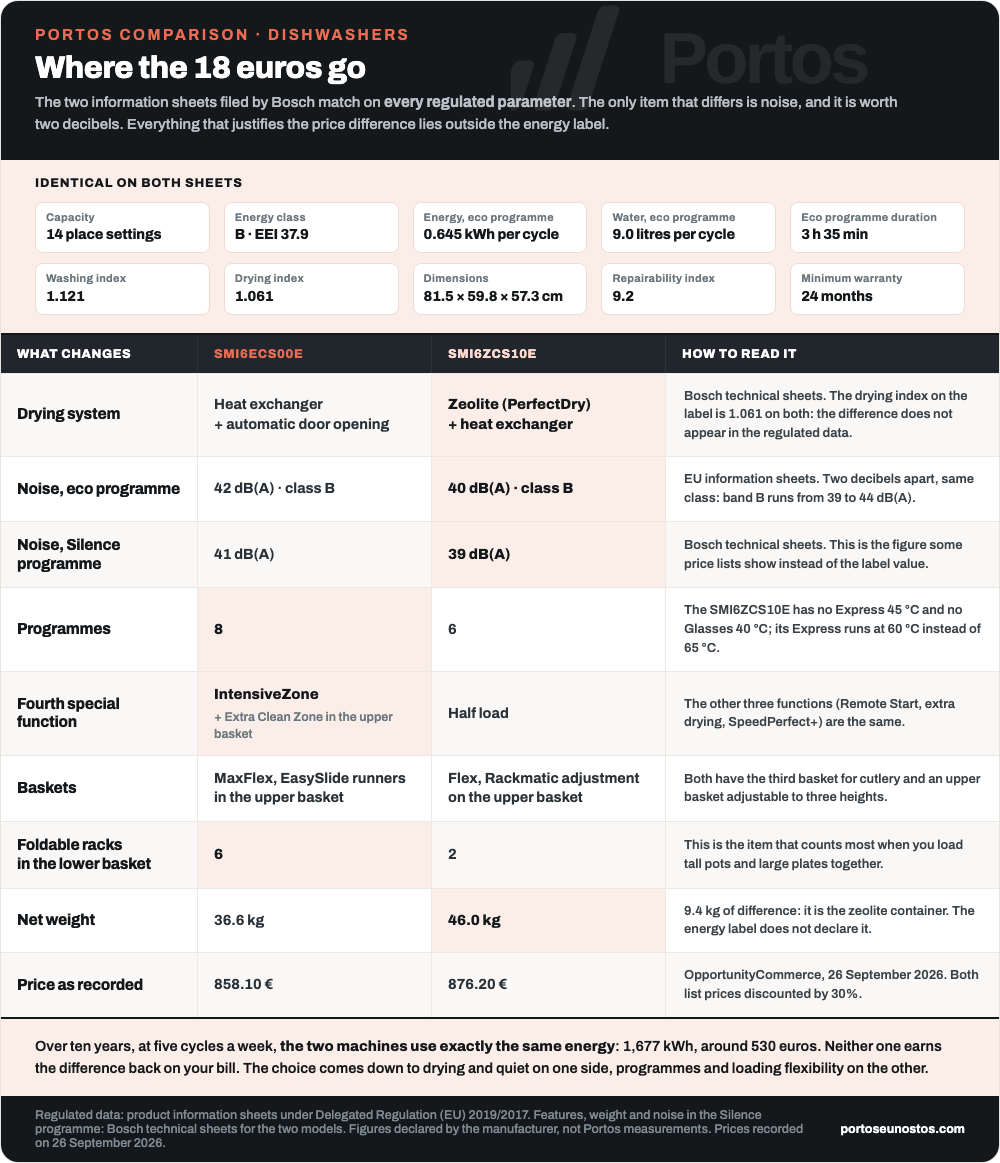
The two sheets match on every regulated parameter except noise. Everything that justifies the price difference lies outside the energy label.
| Parameter | SMI6ECS00E | SMI6ZCS10E |
|---|---|---|
| Type | Built-in with visible front panel | Built-in with visible front panel |
| Nominal capacity | 14 place settings | 14 place settings |
| Energy efficiency index | 37.9 | 37.9 |
| Energy class | B | B |
| Energy, eco programme | 0.645 kWh per cycle | 0.645 kWh per cycle |
| Water, eco programme | 9.0 litres per cycle | 9.0 litres per cycle |
| Duration, eco programme | 3:35 | 3:35 |
| Washing efficiency index | 1.121 | 1.121 |
| Drying efficiency index | 1.061 | 1.061 |
| Airborne noise emissions | 42 dB(A) | 40 dB(A) |
| Noise class | B | B |
| Stand-by mode | 0.50 W | 0.50 W |
| Stand-by in network | 2.00 W | 2.00 W |
| Delayed start | 4.00 W | 4.00 W |
| Minimum declared warranty | 24 months | 24 months |
| Drying system | Heat exchanger and automatic door opening | Zeolite and heat exchanger |
| Programmes | 8 | 6 |
| Noise in Silence programme | 41 dB(A) | 39 dB(A) |
| Net weight | 36.6 kg | 46.0 kg |
| Repairability index | 9.2 | 9.2 |
| Price as of 26/09/2026 | 858.10 euro | 876.20 euro |
Why the energy label doesn't distinguish them
The figure worth stopping to look at is the drying efficiency index: 1.061 on both. One of the two dries by opening the door at the end of the cycle, the other with a zeolite container that releases heat. These are two different technologies, and the parameter that should measure drying itself returns the same number to the third decimal place.
It's not a manufacturing error. The drying index of the regulation compares the result of the appliance with that of a reference on a normalised load, in a laboratory test that runs on the eco programme with standard tableware. Above a certain threshold the systems are equivalent in the test, even when in everyday use they are not equivalent at all, because the differences are seen especially on plastic and concave pieces that the protocol weighs little.
The practical consequence is simple: between two models in the same series the label is not a selection tool. It serves to compare distant machines, not close machines. We have already encountered a similar case with the washing index, identical on seven different Bosch models, in the comparison between SMV4HVX03E and SMH6YCX02E. If you want to understand how it works and what it really declares, we have a dedicated guide on how to read the energy label.
Drying: door opening versus zeolite
Here is the real difference between the two machines, and it's worth explaining without shortcuts.
What the SMI6ECS00E does
The technical sheet describes it as equipped with heat exchanger and automatic door opening, the system that Bosch calls EfficientDry. At the end of the cycle the door opens slightly by itself and the moisture escapes; the heat exchanger, a water tank on the internal wall, keeps the surface cooler than the vapour and promotes condensation during the cycle.
The concrete advantage is that there is nothing to regenerate and nothing that can be exhausted. The main limitation is that it works well only if the door has room to open: under a work surface with a protruding shelf, or with a kitchen handle that interferes, the benefit is reduced. And the vapour that escapes goes somewhere, which is a non-trivial detail if the dishwasher is under a laminate cabinet.
What the SMI6ZCS10E does
The technical sheet declares a zeolite drying system, which Bosch markets as PerfectDry, also accompanied by a heat exchanger. Zeolite is a porous mineral that absorbs moisture and, in absorbing it, releases heat: that heat is returned to the chamber in the final phase and dries the dishes with the door closed. The material regenerates during the heating of the next cycle, so it does not need to be replaced.
On the benefit, Bosch declares drying results up to twice as good on plastic compared to a similar Bosch dishwasher without this technology, and on the sheet it specifies the method: plastic dishes for domestic use, eco programme at 50 °C, Finish Ultimate Plus detergent. It is a party claim, declared with its own methodology, and as such we report it: we have not verified it ourselves.
The main limitation is weight. The SMI6ZCS10E weighs 46.0 kg against the 36.6 of the SMI6ECS00E: a 9.4 kg difference, which is essentially the zeolite container. It changes nothing in use, but it changes quite a lot if you have to fit the appliance by yourself into an already installed space.
Those 9.4 kg are also the only way to recognize zeolite at a glance on a sheet, because the "net weight" field is on the manufacturer's technical sheet and not on the energy label.
The drying scale, four models compared
Lining up four 60 cm Bosch dishwashers from the same Series 6, you see something that neither of the two sheets, taken alone, suggests.
| Drying system | Model | Energy per cycle | Class |
|---|---|---|---|
| Heat exchanger and door opening | SMI6ECS00E | 0.645 kWh | B |
| Zeolite and heat exchanger | SMI6ZCS10E | 0.645 kWh | B |
| Zeolite and heat exchanger | SMH6ZCX10E | 0.645 kWh | B |
| Zeolite and door opening | SMH6YCX02E | 0.543 kWh | A |
The two technologies, taken individually, lead to the exact same declared consumption. Class A is reached only on the model that has both of them. It's a reading worth keeping in mind when a price list presents zeolite as a synonym for a more efficient appliance: on its own, on the data filed by Bosch, it does not shift the class by a level.
A necessary clarification: the SMH6YCX02E and the SMH6ZCX10E are fully integrated, not with a visible fascia, so the comparison is between machines of the same series and the same width but with a different door type. We return to this point in the section on the third way.
Noise: how much two decibels are worth
The declared emissions are 42 dB(A) for the SMI6ECS00E and 40 for the SMI6ZCS10E. They are the only regulated parameter on which the two sheets differ, so it is fair to understand how much they really matter.
According to the regulation, noise class A stops below 39 dB(A) and class B covers from 39 to 44 inclusive. Both machines are in class B, and the SMI6ZCS10E misses class A by just one decibel. On the label, therefore, the noise pictogram shows the same letter.
Decibels are a logarithmic scale: two decibels less correspond to about 37% less sound power. Put that way it sounds like a lot, but sound power is not perceived noise, which increases much more slowly: the practical rule common in acoustics is that about 10 dB of difference is needed for a sound to be perceived as "half". Two decibels are noticeable, in a quiet house at night; they do not transform a noisy dishwasher into a quiet one.
It is worth adding that neither is a noisy machine. For comparison, on the same scale a Series 4 like the SMV4HVX03E declares 46 dB(A), which is class C.
Why you find 39 or 40 dB depending on where you look
It happens often, and it is a source of legitimate confusion: some price lists indicate the SMI6ZCS10E at 39 dB(A), the EU information sheet declares 40. They do not contradict each other, they measure two different things.
40 dB(A) is the regulated value, measured on the eco programme: it is the one that ends up on the energy label and determines the noise class.
39 dB(A) is the level declared in the Silence programme, which the Bosch technical sheet reports separately.
The same one-decibel gap is also on the other model: 42 dB(A) in eco and 41 in the Silence programme. When comparing two sheets from different sellers, therefore, the first thing to check is whether the number refers to the eco programme or the quiet one, otherwise you risk comparing incomparable quantities.
Programmes: the cheapest model has two more of them
Here the relationship reverses, and it is the reason why the comparison does not close with "spend 18 euros and get the best".
| SMI6ECS00E, 8 programmes | SMI6ZCS10E, 6 programmes |
|---|---|
| Eco 50 °C | Eco 50 °C |
| Auto 45-65 °C | Auto 45-65 °C |
| Intensive 70 °C | Intensive 70 °C |
| Express 65 °C | Express 60 °C |
| Express 45 °C | not available |
| Glasses 40 °C | not available |
| Silent 50 °C | Silent 50 °C |
| Favourite | Favourite |
The two programmes missing from the SMI6ZCS10E are Express 45 °C and Glasses 40 °C. The latter is the most important for those who frequently wash delicate glassware, because it works at low temperature and reduces thermal stress: this is precisely the situation where cloudy glasses form, damage that in most cases is irreversible.
The special functions also differ. Both have Remote Start, extra drying and SpeedPerfect+; the fourth is IntensiveZone on the SMI6ECS00E, which intensifies washing in one area of the basket, and half load on the SMI6ZCS10E. The SMI6ECS00E also adds Extra Clean Zone in the upper basket.
These are two different philosophies: one focuses on the ability to wash heavily soiled items alongside lightly soiled ones, the other on the ability to run small loads. Knowing which of these situations happens to you more often matters more than any specification comparison.
Loading: six foldable racks versus two
A feature that almost never appears in online comparisons but is felt every day: there are six foldable racks on the lower basket of the SMI6ECS00E and two on the SMI6ZCS10E. These are the prongs that fold down to make space for pans, skillets and serving dishes.
The basket type also changes. The SMI6ECS00E has MaxFlex baskets and EasySlide sliding system in the upper basket; the SMI6ZCS10E has Flex baskets and Rackmatic adjustment in the upper basket. The third basket for cutlery and the upper basket adjustable on three levels are available on both.
If your typical day involves large pans, baking trays and tableware of different shapes in the same load, four additional foldable racks are a concrete daily advantage, and you pay less for it. If instead you mainly load plates, glasses and cutlery, you'll never notice the difference. This is the kind of evaluation we also make in the guide on how to choose a dishwasher.
Operating cost: identical, and this changes the logic of choice
When comparing models of different classes, the sensible approach is payback calculation: how many years it takes for the more efficient model to offset the price difference in utility bills. That approach cannot be applied here, and it must be stated clearly: the two machines declare the same consumption, so neither one ever pays back against the other.
To establish the order of magnitude, we count five cycles per week, that is 260 cycles per year, and we use the reference electricity price for vulnerable customers with greater protection updated by ARERA for the third quarter of 2026, equal to 0.3163 euros per kWh taxes included. Those with a free market contract should use the value from their own bill, so we also provide a second column at 0.25 euros per kWh.
| Item | SMI6ECS00E | SMI6ZCS10E |
|---|---|---|
| Energy per cycle | 0.645 kWh | 0.645 kWh |
| Energy in one year, 260 cycles | 167.7 kWh | 167.7 kWh |
| Annual cost at 0.3163 euros/kWh | 53.04 euros | 53.04 euros |
| Annual cost at 0.25 euros/kWh | 41.93 euros | 41.93 euros |
| Energy in ten years | 1,677 kWh | 1,677 kWh |
| Cost in ten years at 0.3163 euros/kWh | 530.43 euros | 530.43 euros |
| Water in one year | 2,340 litres | 2,340 litres |
Two useful readings. The first: over ten years energy costs approximately 530 euros, which is more than 60% of the purchase price. The second, which is the right way to size the problem: 18.10 euros equal 57 kWh, that is 89 eco cycles, just under four months of use. Looked at this way, the price difference between the two is not an investment to recover but a small premium for a function, and the question becomes whether you need that function.
If instead you're evaluating how much a dishwasher really weighs on your bill, regardless of the model, we have a dedicated article on how much a dishwasher consumes.
What they have in common
The list is long, and it serves to understand how much the two machines are actually the same platform:
14 place settings, width 60 cm, built-in installation with visible brushed steel panel;
product dimensions 81.5 x 59.8 x 57.3 cm, installation space 815 to 875 mm in height by 600 in width and 550 in depth, depth with door open at 90 degrees of 1,150 mm;
power 2,400 W, 10 A, 220-240 V, maximum incoming water hardness 50 °dH;
power cable 175 cm, inlet hose 165 cm, outlet hose 190 cm, Schuko plug;
Home Connect with remote control and diagnostics, brushless SilentPowerDrive motor, AquaSensor;
third cutlery basket, top basket adjustable on three levels, DosageAssist detergent compartment, two flip grilles in the top basket, stainless steel tub, steam protection;
three-level filter system, Machine Care maintenance program, delayed start from 1 to 24 hours;
AquaStop as flood protection and child safety;
repairability index 9.2 on both, with a declared minimum warranty of 24 months.
Regarding maintenance, therefore, the behavior is the same: for both, what is written in the guide on how to clean the dishwasher filter applies.
When the SMI6ECS00E makes sense
Various and full loads. Six flip grilles in the lower basket, Extra Clean Zone and IntensiveZone are meant for exactly this.
You often wash thin glassware. The Glasses program at 40 °C is only on this model.
You want short cycles at low temperature. The Express at 45 °C, absent on the other, is the program for lightly soiled dishes without raising the temperature.
You install it yourself in an already assembled space. 9.4 kg less makes a difference.
The dishwasher is in a separate kitchen and the two decibels don't concern you.
When the SMI6ZCS10E makes sense
Drying plastic is your recurring problem. Lids, containers and caps that come out wet are the typical use case for zeolite.
The kitchen is open to the living room or close to the bedrooms and you start the dishwasher in the evening: two decibels less, in that context, are noticeable.
You often run small loads. The half-load function is only here.
You don't want the door to open automatically at the end of the cycle. It's a legitimate preference when there's a delicate worktop above or children passing by.
The third option: if you don't need the visible panel
Both models in this comparison are partially built-in: the control panel remains visible above the cabinet door. It's an aesthetic and convenience choice, not a technical one. If you don't need it, the picture changes quite a bit, and it's worth knowing before deciding between 858 and 876 euros.
SMH6ZCX10E, fully integrated, found at 783.58 euros: same zeolite, same 40 dB(A), same class B and same consumption of 0.645 kWh as the SMI6ZCS10E. That's 92.62 euros less for the same technical features, with a slightly lower repairability index of 8.9.
SMH6YCX02E, fully integrated, found at 775.90 euros: it's in class A with 0.543 kWh per cycle, because it combines zeolite and automatic door opening. It costs less than both and consumes 26.5 kWh less per year on our 260 cycles, which is about 8.39 euros a year and 84 euros in ten. In return, it's noisier, 44 dB(A), uses half a liter more water per cycle and takes 4:55 instead of 3:35.
The price to pay, in both cases, is that you need a cabinet door panel to fit on the door and the controls are on the upper edge, visible only when the door is open. We analyzed it in detail in the comparison between SMV4HVX03E and SMH6YCX02E, where the constraint on the minimum weight of the door also comes into play.
Errors to avoid in this comparison
Thinking that 18 euros buy lower consumption. They don't: 0.645 kWh and 9.0 litres per cycle on both.
Using energy class to choose between the two. It's B on both, with the same index of 37.9.
Taking it for granted that zeolite means class A. On Bosch's filed data, it alone doesn't shift the class: automatic door opening is also needed.
Comparing decibels from different sources. First check whether the number is from the eco program or the Silence program: there's one decibel difference.
Overlooking programs. The cheaper model has two more, including one for glasses.
Deciding before you know if you need the visible control panel. Fully hidden, the same technology costs almost a hundred euros less.
Reading the drying index on the label as a judgment on drying systems. It's 1.061 on both.
Portos's choice
If we have to pick one between the two, and only between the two, our assessment goes to the SMI6ECS00E. Not because zeolite doesn't work, but because in this specific comparison the cheaper model also has two more programs, an intensive washing zone, four more fold-away racks in the lower basket and ten kilos less to handle. The SMI6ZCS10E asks for 18.10 euros and in return gives a better drying system for plastics and two decibels quieter, but loses something on flexibility and programs. It's a trade-off, not an improvement.
The trade-off is worth it in one precise case and we repeat it because it's the decisive criterion: if plastic dishes regularly come out wet and it bothers you, the SMI6ZCS10E is the right answer and 18 euros is a small price to solve a daily annoyance. In all other cases the SMI6ECS00E offers more for less.
With an honest caveat: if the visible control panel is not a requirement, neither of the two is the most rational choice. At the same technology level you spend less with a fully hidden panel, and you can reach class A staying below the price of both.
Price and availability
Prices recorded on 26 September 2026. Appliance prices change frequently: those below apply as a snapshot of the day, not as stable data.
| Model | List price | Recorded price | Discount |
|---|---|---|---|
| SMI6ECS00E | 1,225.86 euro | 858.10 euro | -30% |
| SMI6ZCS10E | 1,251.71 euro | 876.20 euro | -30% |
| SMH6ZCX10E | 1,119.40 euro | 783.58 euro | -30% |
| SMH6YCX02E | 1,108.43 euro | 775.90 euro | -30% |
At the time of recording the SMI6ECS00E was marked as ready for delivery, while the SMI6ZCS10E product sheet did not show that indication. If delivery timing is a constraint, it's an element to verify directly before deciding.
See features and availability of the Bosch SMI6ECS00E on OpportunityCommerce.
See features and availability of the Bosch SMI6ZCS10E on OpportunityCommerce.
The rest of the dishwasher category on OpportunityCommerce, if you want to look at fully hidden versions as well.
Compare prices and offers for Bosch Serie 6 dishwashers on SniffaPrezzi.
Method and limits of this comparison
Portos does not physically own these appliances and has not tested them. Everything you read above comes from manufacturer's documents and regulations:
regulated values (efficiency index, energy, water, durability, washing and drying indices, noise, stand-by, warranty) come from product information sheets filed pursuant to Delegated Regulation (EU) 2019/2017;
features, programs, special functions, net weight, repairability index and sound level in the Silence program come from Bosch technical sheets for individual models;
the thresholds for efficiency and noise classes were read directly from the regulation text published on EUR-Lex;
prices and availability are a point-in-time recording of 26 September 2026.
What this comparison cannot tell you: how much better it actually dries in practice with zeolite, because the manufacturer's data is declared with their own methodology and we haven't replicated it; how the two machines perform after a few years of use; how much you'll actually perceive the difference of two decibels in your kitchen, which depends on your room's acoustics. Where we don't have a source, we don't write a number.
Related content
How to choose a dishwasher, the general guide with the parameters that really matter.
Bosch SMV4HVX03E or SMH6YCX02E, the comparison between a Series 4 and a Series 6 fully integrated model.
Dishwashers 45 or 60 cm, if the width hasn't been decided yet.
How much a dishwasher costs to run, to estimate the running cost.
How to read the energy label, to understand what it states and what it doesn't.
Cloudy glasses in the dishwasher, where the low temperature cycle makes the difference.
Bosch or Electrolux, if the comparison you're interested in is between brands rather than models.
Sources and documentation
Product information sheet Bosch SMI6ECS00E (PDF), updated 02.12.2025.
Product information sheet Bosch SMI6ZCS10E (PDF), updated 12.12.2025.
Technical sheet Bosch SMI6ECS00E (PDF).
Technical sheet Bosch SMI6ZCS10E (PDF).
Product page Bosch SMI6ECS00E on the manufacturer's website.
Product page Bosch SMI6ZCS10E on the manufacturer's website.
Commission Delegated Regulation (EU) 2019/2017 on energy labelling of household dishwashers, text on EUR-Lex: tables of efficiency and noise classes.
EPREL, the European database for product energy labelling.
Bosch, energy label information and spare parts.
ARERA, update of economic conditions for the third quarter 2026, from which the price of 0.3163 euros per kWh.
Manufacturer's website: Bosch Household Appliances Italy.