Twenty-five kWh per hundred washes, compared to 49 from a Series 6 with the same Class A and the same capacity. The Bosch WGB24402IT at 9 kg is the most efficient washing machine we have analyzed, and the reason is in one line of the information sheet: in the eco cycle it brings fabrics to 27 degrees instead of 38. Analysis based on declared data, with a calculation of how much it actually costs in a year, the impact of the 2 watts of network standby and the limitations you should know about before spending 1,192 euros.
The Bosch WGB24402IT is a 9 kg front-load washing machine, 60 cm wide, in energy class A. The official energy label declares 25 kWh per 100 washes in the 40-60 eco programme, which equals 0.248 kWh per cycle, and 47 litres of water. As of 20 September 2026, it is offered at €1,192.00 on OpportunityCommerce.
Twenty-five kWh per hundred washes is an off-the-scale figure: the Bosch Series 6 with 9 kg capacity, same class A, declares 49. The point of this analysis is to understand where that halving comes from, why it's not magic, and why it doesn't automatically translate into bill savings. The answer lies in two lines of the data sheet that almost nobody reads: the temperature reached inside the fabrics and network standby power consumption.
This is not a laboratory test. It's a Portos analysis built on data that Bosch deposits by law in the product data sheet required by Delegated Regulation (EU) 2019/2014, on the energy label of the model and on the manufacturer's product sheet, cross-referenced with the energy price set by ARERA. Every number you read below comes from one of these documents, all linked at the bottom of the page.
In brief: what you'll find in this analysis
The sheet in summary
| Item | Declared data |
|---|---|
| Brand and model | Bosch WGB24402IT, Series 8 |
| EAN code | 4242005490059 |
| Type | Front-load washing machine, freestanding |
| Nominal capacity | 9.0 kg |
| Energy efficiency class | A (IEEW index 26.1) |
| Energy consumption, 40-60 eco | 0.248 kWh per cycle, 25 kWh per 100 cycles on label |
| Water consumption, 40-60 eco | 47 litres per cycle |
| Wash efficiency index | 1.031 |
| Rinsing effectiveness | 5.0 g/kg |
| Maximum temperature in fabrics, 40-60 eco | 27 °C at full load, 24 °C at half load, 22 °C at quarter load |
| Spin class and drying | B (residual moisture 53.0%) |
| Spin speed in eco programme | 1400 rpm at full load, at half load and at quarter load |
| Duration of 40-60 eco programme | 3 hours and 40 minutes at full load, 2:50 at half load, 2:35 at quarter load |
| Noise level | 47 dB(A) during washing, 71 dB(A) during spin, class A |
| Dimensions (H x W x D) | 84.5 x 59.8 x 59.0 cm |
| Depth with door open at 90 degrees | 109.0 cm |
| Weight | 82.4 kg |
| Off-cycle consumption | 0.50 W off, 0.50 W on standby, 2.00 W on network standby, 4.00 W with delayed start |
| Connectivity | Home Connect, Wi-Fi |
| Automatic dosing i-DOS | Not present |
| Minimum warranty declared by the supplier | 24 months |
| Date of product data sheet | 12 December 2025 |
| Price detected | €1,192.00 on 20 September 2026 |
What it actually offers
The WGB24402IT is the model with which Bosch covers the high end of its freestanding catalogue. The dimensions are standard, the declared basket capacity is 9 kg, the motor is the brushless SilentPower Drive, flood protection is AquaStop, for which Bosch declares water damage coverage extended for the entire life of the appliance.
The functions that distinguish it from lower-tier models, as described by the manufacturer, are five:
Home Connect. Control and monitoring from smartphone, end-of-programme notifications, remote diagnostics with assistance.
Iron Assist. A 20-minute steam cycle on already dry garments, which according to Bosch reduces creases by up to 50%.
4D Wash System. Direct water spray plus an additional drum rotation, designed to help water and detergent penetrate even when the drum is full.
Active Water Plus. Load sensors that regulate water intake: Bosch declares up to 50% less water on reduced loads.
Mini Option. A programme for single items up to 0.5 kg, which according to the manufacturer reduces energy consumption by up to 40% compared to a normal cycle.
There is also Hygiene Plus, which Bosch claims can eliminate 99.99% of the most common bacteria while maintaining constant temperature and adding an extra rinse, Speed Perfect to shorten cycles, Add Garment function, internal drum lighting and child lock. These are data declared by the manufacturer: Portos reports them, it has not measured them.
A clarification worth making straight away, because it is counterintuitive: this Series 8 does not have automatic detergent dosing i-DOS. The Bosch product sheet declares it absent, as does automatic soil level recognition and the dual hot and cold water connection. Anyone who associates the Series 8 designation with automatic dosing is thinking of other models in the same family.
Consumption: how much it costs in a year
The starting data is 0.248 kWh per cycle in the eco 40-60 programme at full load. With the ARERA reference price for the third quarter of 2026, equal to 0.3163 euros per kWh including taxes, a wash costs 7.8 cents, that is less than one cent per kilogram of laundry.
| Washes per week | Cycles in a year | Energy | Annual cost | Water |
|---|---|---|---|---|
| 2 | 104 | 25.8 kWh | €8.16 | 4,888 litres |
| 3 | 156 | 38.7 kWh | €12.24 | 7,332 litres |
| 4 | 208 | 51.6 kWh | €16.32 | 9,776 litres |
| 5 | 260 | 64.5 kWh | €20.40 | 12,220 litres |
| 7 | 364 | 90.3 kWh | €28.55 | 17,108 litres |
These are low figures overall. Even at seven washes per week, the washing machine item on your bill remains under €30 per year. The interesting comparison, however, is not with zero, but with what you would have spent buying a different machine: we return to this in the section dedicated to the range.
On water consumption it is worth noting: the 47 litres per cycle are a certain figure, their cost is not. Water tariffs in Italy vary from utility to utility and depend on the consumption brackets of the household, so Portos prefers to leave you with the litres and not convert them to euros with an average that would not describe your bill.
Where the 25 kWh come from: washing at 27 degrees
The product information sheet contains a field that rarely appears on commercial product sheets: the maximum temperature reached inside the fabric in the eco 40-60 programme. For the WGB24402IT it is 27 °C at full load. For the Series 6 WGG244ZRIT it is 38 °C. For the built-in washing machine WIW24342EU, which is in class C, it is 48 °C.
Lined up, the six Bosch models we compared show an almost perfect correspondence between temperature and consumption.
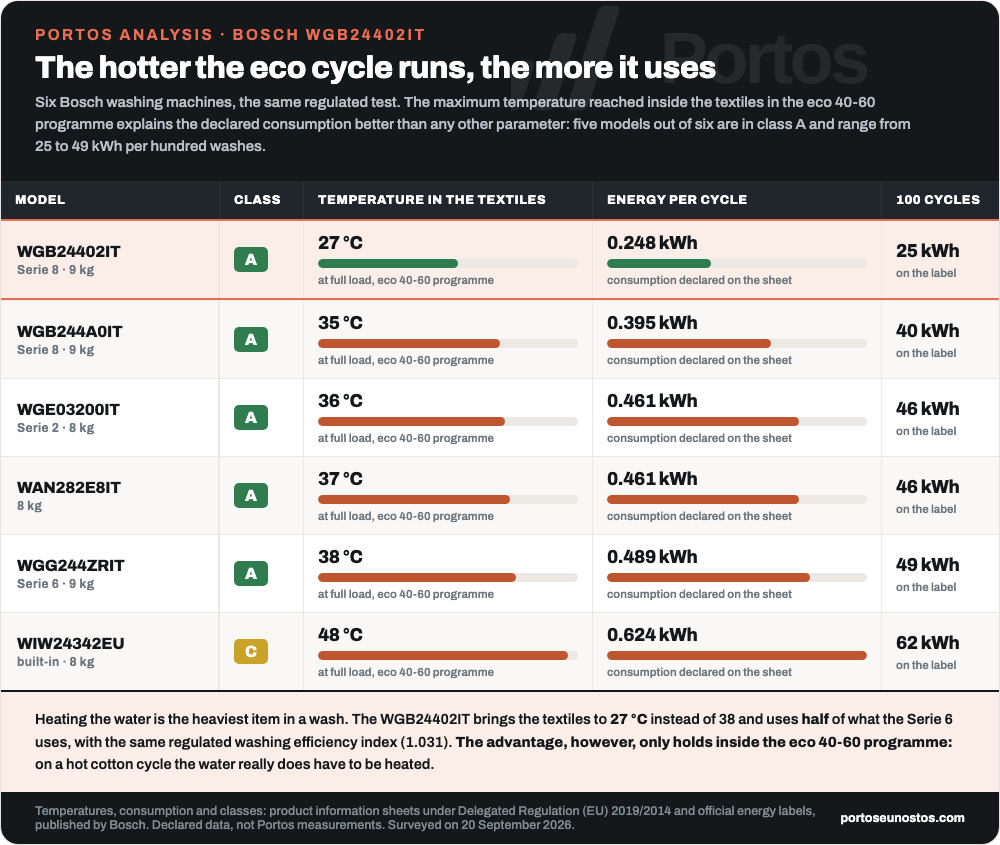
The actual temperature of the eco cycle explains the declared consumption better than any other parameter.
| Model | Fabric temperature | Energy per cycle | Label, 100 cycles |
|---|---|---|---|
| WGB24402IT, Series 8, 9 kg | 27 °C | 0.248 kWh | 25 kWh |
| WGB244A0IT, Series 8, 9 kg | 35 °C | 0.395 kWh | 40 kWh |
| WGE03200IT, Series 2, 8 kg | 36 °C | 0.461 kWh | 46 kWh |
| WAN282E8IT, 8 kg | 37 °C | 0.461 kWh | 46 kWh |
| WGG244ZRIT, Series 6, 9 kg | 38 °C | 0.489 kWh | 49 kWh |
| WIW24342EU, built-in, 8 kg | 48 °C | 0.624 kWh | 62 kWh |
Heating water is by far the heaviest item in a wash cycle: everything else, motor included, weighs little. A machine that brings fabrics to 27 degrees instead of 38 is using about half the energy for the same reason that a pot of lukewarm water costs less than a boiling one.
This does not mean it washes worse. The standardized washing efficiency index is 1.031 for all five free-standing models in the comparison, and the rinsing efficiency is 5.0 g/kg for all: according to the European test method the result is equivalent. The way to achieve it changes, and it changes in a precise direction: more time, more mechanical action, less heat.
From this follows the only concrete warning for those who use it. The 25 kWh is valid only in the 40-60 eco program. If you select a 60-degree cotton cycle, or Hygiene Plus for a sick person's laundry, or a 90-degree wash, the water really does get heated and consumption rises in proportion: this machine's advantage narrows exactly to the extent that you step out of eco mode. If your typical laundry is very dirty and you wash it hot out of habit, much of what you're paying for goes unused. We discuss this in more detail in how much a washing machine consumes per cycle and in a year.
The cost of Wi-Fi on all year
The same information sheet lists four off-cycle power levels. For the WGB24402IT they are 0.50 W when off, 0.50 W on standby, 2.00 W on network standby and 4.00 W with delayed start set. For the Series 6 WGG244ZRIT, which has no connectivity, the network standby item is 0.00 W and the off mode is 0.15 W.
Two watts seem like nothing. But a washing machine runs only a few hours a year and sits idle for all the others. At four washes a week the eco cycle takes up about 760 hours in twelve months: that leaves almost 8,000 hours in which the machine, if you leave it connected to your home network, consumes 2 watts. That's 16 kWh a year, or 5.06 euros. In the same period the Series 6 when off consumes 1.2, or 38 cents.
| Item, 208 cycles a year | WGB24402IT connected | WGB24402IT not connected | WGG244ZRIT |
|---|---|---|---|
| Wash energy | 51.6 kWh | 51.6 kWh | 101.7 kWh |
| Off-cycle energy | 16.0 kWh | 4.0 kWh | 1.2 kWh |
| Annual total | 67.6 kWh | 55.6 kWh | 102.9 kWh |
| Annual cost | 21.38 euros | 17.59 euros | 32.55 euros |
| Savings vs. Series 6 | 11.17 euros | 14.96 euros | - |
Here's the account: permanent connectivity eats up about a third of the energy advantage this machine has over the Series 6. A benefit remains, and it is real, but it needs to be put in perspective. In the analysis of the Series 6 we calculated that the 413 euro price difference is recovered in about twenty-six years counting only wash cycles. Counting network standby as well, payback stretches beyond thirty-five years.
The conclusion is not that connectivity should be avoided. It is that you don't buy this washing machine for the energy bill: you buy it for what it does, and much of what it does comes precisely from the connectivity. Choosing it and then keeping it offline to save five euros a year means paying for features and not using them.
The comparison within the Bosch range
There's a second piece of data that's worth more than many reviews: the series code doesn't tell you how much energy the machine uses. The WGB244A0IT is also a Series 8 with 9 kg capacity and the same external dimensions, but it uses 40 kWh per 100 cycles compared to 25 for this one. The difference between two models in the same series is bigger than the difference between Series 6 and Series 2.
| Model | Capacity | Class | IEEW | Energy, 100 cycles | Water | Eco spin |
|---|---|---|---|---|---|---|
| WGB24402IT, Series 8 | 9 kg | A | 26.1 | 25 kWh | 47 L | 1400 rpm |
| WGB244A0IT, Series 8 | 9 kg | A | 41.5 | 40 kWh | 50 L | 1257 rpm |
| WGE03200IT, Series 2 | 8 kg | A | 50.7 | 46 kWh | 47 L | 1200 rpm |
| WAN282E8IT | 8 kg | A | 50.7 | 46 kWh | 47 L | 1400 rpm |
| WGG244ZRIT, Series 6 | 9 kg | A | 51.4 | 49 kWh | 50 L | 1351 rpm |
| WIW24342EU, built-in | 8 kg | C | 68.6 | 62 kWh | 45 L | 1200 rpm |
Five of these six models are in class A, and within the same letter there are twenty-five IEEW index points—that's almost double the actual consumption. This is why at Portos we keep saying that the letter is a starting point and not a verdict: the number to look at is the IEEW index, and under the A letter there's a whole range from 26 to 51. We explained how to read it in our energy label guide.
Spin speed and residual moisture
Here the model shows its less brilliant side. The spin speed reaches 1400 rpm and the datasheet states that in the eco program it uses them at full load, half load, and quarter load. Despite this, the declared residual moisture is 53.0% and the spin and drying class is B.
The comparison is instructive: the Series 6 WGG244ZRIT in the eco cycle spins slower at 1351 rpm and leaves less water in the laundry, 51.4%. It's also in class B, but slightly better. This isn't a misreading and it's data worth knowing before buying, because choosing the speed alone isn't enough to predict how wet the laundry comes out: the drum profile, the length of the phase, and how the program manages it all matter.
In practice, on a full 9 kg load the 53.0% means about 4.8 kg of water remaining in the fabrics at the end of the cycle. On the Series 6 it would be 4.6. If you then dry in a tumble dryer, that 144-gram difference is worth about 6 kWh a year at four washes a week, less than two euros. If you air-dry, it translates to a few extra minutes on the drying rack. It's a real but small limitation, and should be weighed for what it is.
How long a cycle takes
The eco 40-60 program takes 3 hours and 40 minutes at full load, 2 hours and 50 minutes at half load, 2 hours and 35 minutes at quarter load. There's a detail that contradicts a common belief: the most efficient machines aren't necessarily the slowest. This is the most efficient in the group and at full load it's also eight minutes faster than the Series 6, which states 3 hours and 48 minutes.
But the rule applies that we find in all this type of data: half load doesn't halve the time. Here it takes 77% of the full cycle, quarter load takes 70%. Two half loads therefore cost more time and more energy than one full load, which is why capacity should be chosen based on the laundry you actually do, as we explain in our 8, 9 or 10 kg washing machine guide.
For those in a hurry there's Speed Perfect, which according to Bosch reduces the duration by up to 65% and can be combined with most programs. It's a useful function, but it's worth noting that shortening the cycle of a program designed to wash at a lukewarm temperature and for a long time means giving up precisely the mechanism that generates those 25 kWh.
Noise levels
The declared emissions are 71 dB(A) in the spin phase, with noise class A, and 47 dB(A) during washing according to the Bosch product sheet. The washing data is better than that of the Series 6, which states 50 dB(A); the spin speed data is one decibel worse, which is consistent with the fact that this one spins at 1400 rpm while the other uses 1351 in the eco cycle.
In practice, this means: during the three and a half hours of washing, it's a machine you barely notice, suitable for an open-plan living area or a night cycle, which is why the Night Wash option exists. The spin cycle remains the noisy phase, as with any washing machine: a few minutes where the noise level rises significantly. If the laundry room is next to a bedroom, the delayed start feature is more useful than the noise class.
Ease of use and programmes
The control panel has a dial for programmes, direct buttons for temperature, spin speed and options, and a display showing the remaining time. The programmes available on the machine cover normal uses: cotton, synthetics, mixed fabrics, delicates and silk, wool and hand wash, sports garments, quick 15 and 30 minutes, rinse, drain and spin, plus Hygiene Plus and a stain-busting function.
However, there's one thing to know, and it's the downside of connectivity. Some programmes are only available through the app. Bosch lists among the Home Connect programmes those for duvets, 30-degree curtains, towels, shirts, technical garments, drum cleaning with reminders and the Less Microplastics programme. On the machine itself, the shirt and duvet programmes are listed as absent when taken individually.
It's not a criticism of product quality: it's a condition of use. If you buy this washing machine with specialist programmes in mind, you need to account for installing the app, creating an account, connecting the appliance to your home Wi-Fi and keeping it connected. Those who don't want to do this will have an excellent machine but with a programme range not much richer than that of a Series 4.
Dimensions and installation
The measurements are 84.5 cm in height, 59.8 cm in width and 59.0 cm in depth, which become 109 cm with the door open at 90 degrees: this is the measurement that really matters in a narrow bathroom or cupboard, because it determines whether you can load the laundry while standing in front of the machine. The weight is 82.4 kg, the feet can be adjusted up to 12 mm and the power cord is 160 cm long.
Two practical notes from the manufacturer's technical sheet. First: the top surface is not removable, so the machine cannot be lowered to fit under a kitchen worktop; you need a clear space above it. Second: stacking installation is provided for, so you can stack a dryer on top using the appropriate connection kit, which is a separate accessory.
The 82 kilograms are not a minor detail: a heavy structure is what keeps the machine steady at 1400 rpm. However, they should be considered when transporting and if the floor is a wooden joist or an old uneven concrete base, where levelling the feet becomes the difference between a silent spin cycle and a machine that walks across the floor.
Maintenance and durability
Maintenance is the same as for any front-loading washing machine and on Portos we've described it step by step in how to clean the filter and seal: check the drain pump filter every few months, dry the rubber seal around the porthole, rinse the detergent drawer, leave the porthole slightly open between washes.
This machine's efficiency requires a bit more attention. An eco cycle that doesn't exceed 27 degrees doesn't sanitise the washing machine: detergent residues and bacteria that generate bad odours thrive at exactly those temperatures. If the regular programme is eco, the drum cleaning cycle at 60 or 90 degrees is not optional, it should be done regularly. It's the number one cause of the problem we describe in why your washing machine smells, and on this model the reminder comes from the app.
On warranty, a clarification is needed that we repeat in every review. The product information sheet states 24 months of minimum warranty from the supplier. The ten years of engine support that retailers often mention are a separate commercial condition, subject to product registration through Bosch channels within the required timeframe: it's different from legal warranty and should be verified at the time of purchase.
Strengths
Off-the-scale efficiency in class A. IEEW index 26.1 against a class limit set at 52: it's half the consumption of models with the same rating letter.
Low water consumption. 47 litres per cycle on a 9 kg machine, three less than the Series 6 with the same capacity.
Quiet during washing. 47 dB(A) declared and noise class A: you can run it in the evening without disturbing anyone.
Fast for its efficiency. 3 hours 40 minutes in the eco cycle, eight minutes less than the Series 6 which uses twice as much.
Complete and connected features. Home Connect with remote diagnostics, Iron Assist with steam, Speed Perfect, Add Clothes, Mini option for single items.
Construction. Brushless motor, 82.4 kg structure, AquaStop with water damage cover declared by Bosch for the entire lifetime of the appliance.
Limitations
The price doesn't pay back with energy savings. The €413 difference on Series 6 requires more than thirty-five years of washes to break even. Buy it for the features, not for the bill.
Network standby of 2.00 W. About 16 kWh a year, which erodes a third of the energy advantage. This is the price of connectivity and it's stated in the product sheet.
Residual humidity 53.0%. Despite the 1400 rpm in the eco cycle, it leaves more water in the laundry than Series 6 which spins more slowly.
No i-DOS. Automatic detergent dosing, which many take for granted on a Series 8, is not available; nor are soil level recognition and dual hot water inlet.
Several programs are only available through the app. Duvets, shirts, technical garments and curtains require Home Connect: without a smartphone the on-board features are reduced.
Non-removable top. At 84.5 cm high with a fixed top it doesn't fit under a standard work surface.
The 25 kWh only applies to the eco 40-60. On a warm cotton cycle the advantage is drastically reduced.
Who it's suitable for
For those who do many loads of normally soiled laundry. Families of four or more, five or six cycles a week, everyday clothing. This is the scenario where the warm eco cycle works best and where nine kilos avoid breaking loads into multiple washes.
For those who will actually use the app. If starting a wash from the office, receiving end-of-cycle notifications, or using additional programs is something you'll do, much of the premium is justified.
For those who keep the washing machine in the house rather than a separate room. At 47 dB(A) during washing and noise class A, it's compatible with a bathroom that adjoins the living area.
For those who iron rarely and reluctantly. Iron Assist is the most practical feature: a steam cycle on dry garments that, according to Bosch, reduces creases by up to half.
Who it's not suitable for
For those choosing it to save on the electricity bill. That's the wrong reason. With €779 you can get the Series 6, spend fifteen euros a year more on electricity and keep over four hundred euros in your pocket. The math only works in favour of the Series 8 if you count the features.
For those who mainly wash heavily soiled items or at high temperatures. Work overalls, hygiene-sensitive laundry, baby clothes washed hot: outside the eco 40-60 the specific advantage of this model diminishes and it's worth looking at other parameters.
For those who don't want to connect an appliance to Wi-Fi. Without the app you lose programs, reminders and remote diagnostics, that is a significant part of what you're paying for.
For those looking for automatic detergent dosing. This model doesn't have it: if that's your main criterion, you need to look at another model in the range.
For those who need to fit it under a work surface. Non-removable top and 84.5 cm height rule it out; built-in models are needed, but in Bosch's current catalogue they're on significantly worse energy classes.
Alternatives to consider
All three are models actually available in the catalogue, with prices recorded on 20 September 2026.
Bosch WGG244ZRIT, Series 6, 9 kg, €779.00. Same capacity and same class A, 49 kWh per 100 cycles, 50 litres, no connectivity. It's the rational alternative for those who want nine solid, quiet kilos without paying for features. We've analysed it in detail here.
Bosch WAN282E8IT, 8 kg, €607.15. One kilo less, class A with 46 kWh per 100 cycles, 47 litres, spin at 1400 rpm. For two or three people it's the choice with the best ratio between cost and features.
Bosch WGE03200IT, Series 2, 8 kg, €544.00. Same consumption as the previous one but spin at 1200 rpm and essential features. It makes sense if budget is tight and if laundry is line-dried rather than tumble-dried.
If the comparison you're interested in is between brands rather than models, the starting point is Bosch or Siemens: what are the real differences.
The Portos rating
The score that follows is based on the analysis of declared data and comparison with equivalent models. It is not the result of a laboratory test and should not be read as such.
| Criterion | Weight | Score | Rationale |
|---|---|---|---|
| Performance and functionality | 30 | 25 | Washing index 1.031 and rinsing 5.0 g/kg in line with the category, comprehensive equipment with steam and connectivity, but several programs are only available through the app and i-DOS is missing |
| Efficiency | 20 | 19 | IEEW 26.1 against a class limit of 52 and 47 liters per cycle: the best figure in the compared group, penalized only by 2.00 W of network stand-by |
| Usability | 15 | 12 | Display with remaining time, Add laundry, Speed Perfect, Mini option; dependence on the app for part of the programs remains a constraint |
| Quality and design | 15 | 13 | Brushless motor, 82.4 kg structure, AquaStop with lifetime coverage declared, 47 dB(A) during washing |
| Maintenance | 10 | 8 | Drum cleaning with reminder, filter and drawer accessible; the warm cycle requires more discipline on periodic maintenance |
| Features and price | 10 | 5 | 1,192 euros is a lot: energy savings don't justify it and in the same range you get nine kilos in A class at 779 |
| Total | 100 | 82 |
82 out of 100. On a technical level it is the best washing machine we have analyzed so far: it consumes half as much as machines with the same A class, it is quiet and not slow. It loses points where the market is stricter, namely on price: 1,192 euros are justified if you'll use the steam, the app and the additional programs, they're not justified by your utility bill. It's a machine to buy with your eyes open about what you're paying for.
Price and availability
On 20 September 2026 the WGB24402IT is offered at 1,192.00 euros, indicated as available for immediate delivery, compared to a list price of 1,702.86 euros. Appliance prices change frequently: before deciding it's always best to verify the updated value and compare multiple sellers.
View specifications and availability of the WGB24402IT on OpportunityCommerce.
Compare prices and offers for Bosch Series 8 on SniffaPrezzi.
Method and limitations of this analysis
Portos has not physically tested this washing machine and does not declare its own measurements. All technical values come from the product information sheet that Bosch files in accordance with Delegated Regulation (EU) 2019/2014, dated 12 December 2025, from the official energy label of the model and from the product sheet published by the manufacturer. Comparison data come from the information sheets of the other five models, all linked below.
Costs in euros are our calculations, made using the reference price for electricity set by ARERA for the third quarter of 2026, equal to 0.3163 euros per kWh including taxes for vulnerable customers on the standard tariff. Those on the free market must use the price from their own bill. The stand-by calculation assumes that the machine remains connected to the home network for all hours when it is not washing: it is a scenario, not a measurement.
The performances described as functions, from Iron Assist to Active Water Plus to the percentages of reduction of creases, water and bacteria, are manufacturer's declarations reported as such. The price is a point-in-time detection from 20 September 2026. This analysis will be reviewed by 19 December 2026 to update price, availability and documentation.
Sources
Product information sheet, Delegated Regulation (EU) 2019/2014, December 12, 2025.
Information sheets for the models used in the comparison: WGB244A0IT, WGG244ZRIT, WGE03200IT, WAN282E8IT and WIW24342EU.
Delegated Regulation (EU) 2019/2014, energy labelling of washing machines for household use.
Bosch, official page on energy label, indicated by the product information sheet.
EPREL, European database of products for energy labelling.
ARERA, reference price of electricity for the third quarter of 2026.