Two Bosch built-in fully integrated dishwashers, same niche, 14 place settings, third basket and Wi-Fi on both. Between the SMV4HVX03E from Series 4 and the SMH6YCX02E from Series 6 there is a difference of 173.88 euros and three energy efficiency class letters. That money buys one thing only, 36 percent less energy; everything else is either identical, or goes in the opposite direction: the efficient model uses half a litre more water and takes 25 minutes longer. Comparison based on data declared in the European product information sheets of seven Bosch models, including when the difference actually pays back.
They are two Bosch built-in fully integrated dishwashers, 60 cm wide, both with 14 place settings, both with third basket, Wi-Fi and AquaStop. They fit into the same niche. The SMV4HVX03E from Series 4 costs 602.02 euros, the SMH6YCX02E from Series 6 costs 775.90: a difference of 173.88 euros, almost 29 percent more.
The short answer is that those 173.88 euros buy one thing only and they really do buy it: consumption drops from 0.849 to 0.543 kWh per cycle, which is 36 percent. Everything else is either the same, or goes in the opposite direction: the more efficient model uses half a litre more water per cycle and takes 25 minutes longer to complete the eco programme.
This is not a laboratory test. It is a Portos comparison built on data that Bosch deposits by law in the product information sheets required by Delegated Regulation (EU) 2019/2017, cross-checked with the text of the regulation, with official energy labels and with prices recorded on 22 September 2026 on OpportunityCommerce. To provide context for the numbers, we have decoded the sheets of seven Bosch dishwashers, not just these two.
In brief: what you will find in this comparison
The short answer
The SMH6YCX02E makes sense if you wash frequently and keep the appliance for a long time. At five cycles a week it saves 25.16 euros of energy per year and returns the price difference in just under seven years; in ten years the net advantage is about 78 euros, plus two decibels quieter and noticeably better drying on plastics.
The SMV4HVX03E makes sense if you wash little, or if budget is the constraint. At three cycles a week the payback extends to eleven and a half years, which is beyond the reasonable useful life of a dishwasher: in that scenario the 173.88 euros don't come back. Plus it is available for immediate delivery, while Series 6 is indicated as on order, and it has a more permissive installation constraint on the front panel.
If the main criteria are speed or quietness, neither of these is the right answer: we'll see this in the section dedicated to the third option.
The two sheets compared
All values below come from the product information sheets filed by Bosch pursuant to Delegated Regulation (EU) 2019/2017. They are declared and measured data on the eco programme, the only one regulated, not data collected by us.
| Parameter | SMV4HVX03E (Series 4) | SMH6YCX02E (Series 6) |
|---|---|---|
| Type | Fully integrated | Fully integrated |
| Nominal capacity | 14 place settings | 14 place settings |
| Energy Efficiency Index (EEI) | 49.9 | 31.9 |
| Energy efficiency class | D | A |
| Energy, eco programme | 0.849 kWh per cycle (85 kWh/100 cycles) | 0.543 kWh per cycle (54 kWh/100 cycles) |
| Water, eco programme | 9.0 litres per cycle | 9.5 litres per cycle |
| Duration of eco programme | 4:30 | 4:55 |
| Washing efficiency index | 1.121 | 1.121 |
| Drying efficiency index | 1.061 | 1.061 |
| Airborne noise emissions | 46 dB(A), class C | 44 dB(A), class B |
| Declared dimensions (H x W x D) | 82 x 60 x 55 cm | 82 x 60 x 55 cm |
| Standby / network standby | 0.50 W / 2.00 W | 0.50 W / 2.00 W |
| Minimum supplier warranty | 24 months | 24 months |
| Drying system | Heat exchanger | Zeolite, heat exchanger, EfficientDry |
| Net weight | 34.8 kg | 42.0 kg |
| Price recorded on 22/09/2026 | 602.02 euro | 775.90 euro |
Class D versus class A: what really matters
The gap on the label seems enormous, three letters of difference. But the mechanism is simpler than it appears, and it's worth understanding because it's the same one that governs all dishwashers on sale today.
The class doesn't come from consumption, it comes from the Energy Efficiency Index, the EEI, which puts the appliance's consumption in relation to a reference consumption calculated based on its capacity in place settings. The lower the index, the better the class. Delegated Regulation (EU) 2019/2017 sets the thresholds rigidly:
| Class | Energy Efficiency Index |
|---|---|
| A | EEI less than 32 |
| B | from 32 to less than 38 |
| C | from 38 to less than 44 |
| D | from 44 to less than 50 |
| E | from 50 to less than 56 |
| F | from 56 to less than 62 |
| G | EEI equal to or greater than 62 |
Now look at the two declared indices: 49.9 for the SMV4HVX03E and 31.9 for the SMH6YCX02E. The first is a tenth below the class E threshold, the second is a tenth below the class B threshold. This is not an isolated case. In the seven Bosch datasheets we decoded, there are four different indices, and they are all a tenth away from the border:
| Model | Declared EEI | Threshold exceeded by a tenth | Class obtained |
|---|---|---|---|
| SMH6YCX02E | 31.9 | 32.0 (A/B limit) | A |
| SMH6ZCX10E, SMI6ECS00E, SMI6ZCS10E | 37.9 | 38.0 (B/C limit) | B |
| SMV4HVX03E, SMS4HVI33E | 49.9 | 50.0 (D/E limit) | D |
| SMV46KX55E | 55.9 | 56.0 (E/F limit) | E |
The correct interpretation is this: energy class is a design target, not a snapshot. The appliance is calibrated to stay just inside the letter that the manufacturer has decided to sell it as, not one point beyond. For buyers the consequence is concrete: a Class A model is not "much better" than a Class B model by definition, it is simply designed to sit on the other side of a boundary that someone drew up at a desk. The number to look at is not the letter, it's the kWh.
On how the complete scale works, with the pictograms and QR code that refers to the European database, we have written a dedicated guide: how to read the energy label of household appliances.
What the label doesn't say about washing quality
There is a second piece of data in the sheets that almost no one looks at, and which is decisive in this comparison: the washing efficiency index and the drying efficiency index. They are the two regulated parameters that measure how well the appliance cleans and dries in the eco programme.
On the SMV4HVX03E they are worth 1.121 and 1.061. On the SMH6YCX02E they are worth 1.121 and 1.061. Identical. And they are identical on the other five Bosch sheets we read, from the Series 4 SMV46KX55E to the Series 6 built-in models with panel: seven models, one single value.
This means that moving up a series doesn't buy better washing, at least not in a way that the regulation can measure. The two dishwashers, on the regulated cycle, wash and dry in the same way. What changes is how much energy it takes to get there, how long it takes and how much noise it makes. Anyone expecting cleaner plates by paying 173.88 euros more is buying something that doesn't exist in the official documentation.
Be careful not to flip the reasoning: the regulated index measures the eco programme under standard test conditions. Differences in features, such as additional jets or basket flexibility, can affect real and difficult loads. Simply, they are not measured by anyone and therefore we cannot declare them.
Consumption: how many years to recover the 173.88 euros
Here the Series 6 advantage is real and quantifiable. The difference is 0.306 kWh per cycle, i.e. 36 per cent less. Translating it to euros at the ARERA reference price for the third quarter of 2026, 0.3163 euros per kWh taxes included, you get three scenarios depending on how much you use the dishwasher.
| Usage scenario | SMV4HVX03E | SMH6YCX02E | Annual savings | Recovery of 173.88 euros |
|---|---|---|---|---|
| 3 cycles per week (156 per year) | 132.4 kWh, 41.89 euros | 84.7 kWh, 26.79 euros | 15.10 euros | 11.5 years |
| 5 cycles per week (260 per year) | 220.7 kWh, 69.82 euros | 141.2 kWh, 44.66 euros | 25.16 euros | 6.9 years |
| 1 cycle per day (365 per year) | 309.9 kWh, 98.02 euros | 198.2 kWh, 62.69 euros | 35.33 euros | 4.9 years |
The middle scenario, five cycles a week, is that of a family of three or four people who use the dishwasher every working day. In ten years the Series 4 consumes about 698 euros of energy, the Series 6 about 447: 251 euros difference, versus 173.88 euros higher price. The balance is positive by about 78 euros, but only if the appliance really lasts ten years and if the rate stays the same.
The low scenario tells the other side of the story. A couple that washes three times a week recovers the difference in eleven and a half years: at that point the dishwasher is past its prime and the account doesn't add up. For those who wash little, the Class D model is the economically correct choice, even if the label suggests otherwise.
A warning about the figures. These consumption figures apply to the eco programme. In real use almost no one uses only eco, and quick or intensive programmes consume much more. The comparison remains valid because it compares the two machines on the same regulated cycle, but the bill amount will be higher for both. We explained the mechanism in detail in how much a dishwasher really consumes.
A note on stand-by. Both declare 2.00 W of stand-by on the grid, the consumption of the appliance connected to Wi-Fi but idle: that's about 17.5 kWh per year, i.e. 5.54 euros, if the connection stays always active. Since the figure is identical on both machines, it doesn't shift the comparison, but it's good to know that it exists and that it is not included in the kWh on the label.
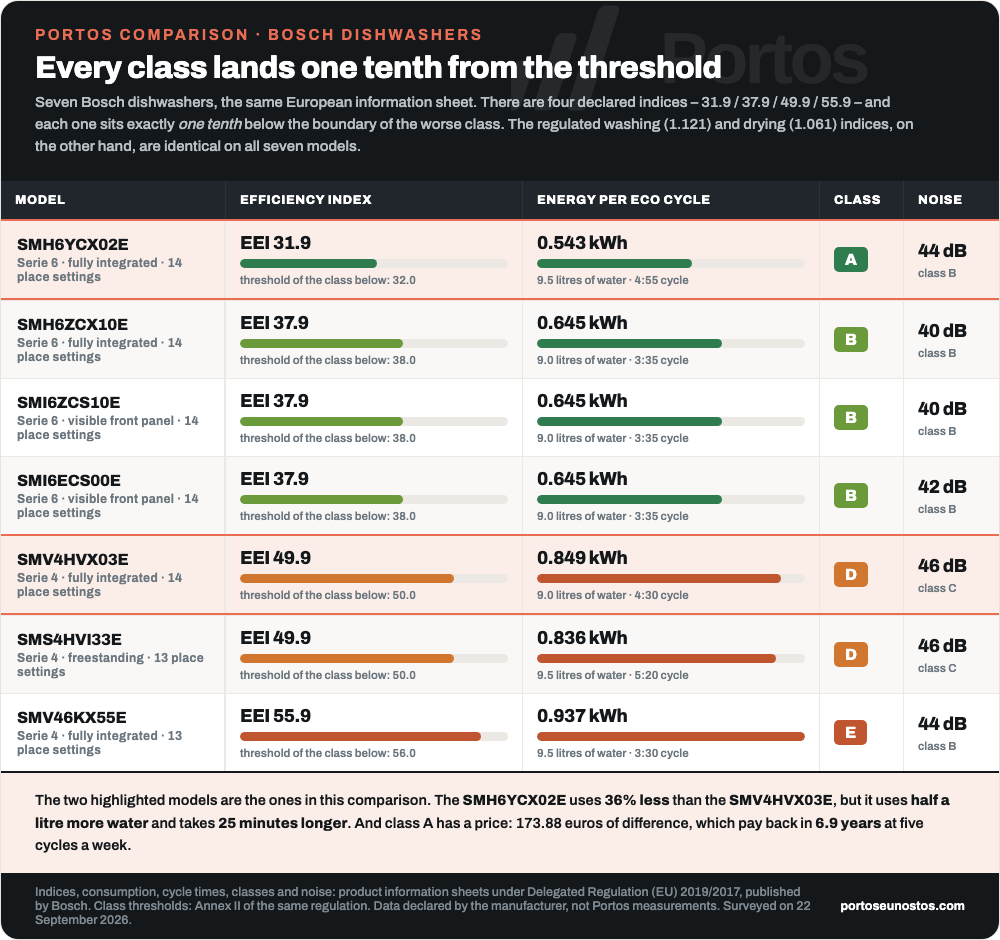
Seven Bosch dishwashers compared: each declared index falls exactly one tenth below the threshold of the higher class, while the washing and drying indices are identical across all models. Data declared in the European data sheets published by Bosch.
Water: the efficient model uses more of it
This is the data that turns intuition upside down. The SMV4HVX03E declares 9.0 litres per eco cycle, the SMH6YCX02E declares 9.5. Half a litre more per cycle, 5.6 per cent, on the A-class model.
It is not a printing error: energy class measures energy, not water, and the two quantities don't always go together. A longer cycle at lower temperatures, which is the way to lower kWh, may require a few extra rinses to maintain the same washing index.
At five cycles a week, the difference is 130 litres a year. On the bill it's just a few cents and it doesn't change the overall convenience, which remains on the side of the Series 6. But it's a data worth knowing if you choose an appliance also for water consumption reasons, or if you live in an area with particularly high water rates: in that case the energy advantage must be weighed against this item with the opposite sign.
Time: 4:30 versus 4:55
The eco programme of the Series 4 lasts 4 hours and 30 minutes, that of Series 6 4 hours and 55. Twenty-five minutes more, 9 per cent, on the model that should be superior.
This too is not a quirk, it's a direct consequence of the way energy is saved: extending the soaking phase and washing at lower temperatures costs time and gains kWh. It applies to all dishwashers, not just these two.
In daily practice five-hour cycles are managed by starting the machine in the evening, and neither of the two appliances has problems doing so: both have delayed start up to 24 hours and app controls. The problem arises if you need to get the dishes back quickly. On this ground Series 4 has a Quick programme, while Series 6 examined here has a 60-degree Express: two different approaches, both outside the standard cycle and therefore not comparable on official data.
Noise: 46 versus 44 dB(A)
The SMV4HVX03E declares 46 dB(A), the SMH6YCX02E 44 dB(A). A two-decibel difference, but it falls on either side of a threshold: the regulation sets four noise emission classes and the threshold between B and C is exactly 45 dB(A).
| Noise class | Declared emission |
|---|---|
| A | less than 39 dB(A) |
| B | from 39 to less than 45 dB(A) |
| C | from 45 to less than 51 dB(A) |
| D | 51 dB(A) and above |
So Series 4 is in class C by just one decibel, and Series 6 is in class B with two decibels of margin from the opposite threshold. In perceived terms, two decibels is a modest difference, audible but not dramatic. They become relevant in an open-plan kitchen overlooking the living room, where the appliance is running while you watch television, and are almost negligible in a kitchen separated by a door.
Those who prioritize silence should know that neither of these two is the optimal choice in the range: within the same Series 6 there are models rated at 40 dB(A), as we see further on.
Drying: heat exchanger versus zeolite
This is the most substantial technical difference between the two machines, and it's also the only one that can be verified by looking at an apparently irrelevant piece of data: weight.
The SMV4HVX03E dries with a heat exchanger: a cold surface against which steam condenses at the end of the cycle. It's the classic system, works well on ceramic and glass, which retain heat, and works worse on plastic, which cools quickly and remains wet.
The SMH6YCX02E declares zeolite, heat exchanger and EfficientDry. Zeolite is a mineral that absorbs moisture and in doing so releases heat: according to Bosch documentation it allows drying results up to twice as good on plastic. EfficientDry adds automatic door opening at the end of the cycle.
The proof that the zeolite container is really there is in the declared net weight: 34.8 kg for Series 4, 42.0 kg for Series 6. Seven and two-tenths kilos difference, with identical external dimensions, tub and baskets. In this range, weight is the quickest way to tell if a model is fitted with zeolite or not: the SMI6ZCS10E, another Series 6 with zeolite, declares 46.0.
For those who use many plastic containers, baby bottles, lids and trays, this is the item that justifies the price difference more than energy savings. For those who wash mostly dishes, glasses and pans, the advantage is considerably reduced. On the relationship between drying system and brand we have gone into detail in Bosch or Electrolux: which dishwasher to choose.
Installation: door weight is everything
This is the constraint that almost no product sheet highlights and it can make an otherwise perfect purchase impossible. Fully integrated dishwashers are mounted behind a door panel, and the hinges are calibrated for a precise weight range of that panel.
| Installation item | SMV4HVX03E | SMH6YCX02E |
|---|---|---|
| Door weight allowed | 2.5 to 8.5 kg | 4.5 to 11 kg |
| Sliding hinges | No | Yes |
| Recess (height) | 815 to 875 mm | 815 to 875 mm |
| Recess (width) | 600 to 608 mm | 600 to 608 mm |
| Recess (depth) | 550 mm | 550 mm |
| Depth with door open at 90 degrees | 1150 mm | 1150 mm |
| Column installation | Yes | Yes |
The detail to read twice is the lower limit. Series 6 requires a panel of at least 4.5 kg: a light, thin, or lightened-material front panel, perfectly compatible with Series 4 which starts at 2.5 kg, will not work on this machine. Anyone replacing an old dishwasher by reusing the kitchen door must weigh it before ordering, not after.
In return, Series 6 has sliding hinges, which allow the door to slide instead of rotating rigidly: they are the correct solution when the kitchen has a high plinth, recessed handles or panels that reach flush with the floor. Without sliding hinges, in those configurations, the door can interfere when opening.
Everything else is identical, recess included: anyone replacing an already installed 60 cm appliance doesn't need to change anything in the cabinet. If you're still deciding on the width, the matter is covered in 45 or 60 cm dishwashers.
What they have in common
The least visible part of the comparison is also the most useful for understanding how little separates the two ranges. Both declare:
14 place settings of nominal capacity and same installation recess;
standardized washing and drying indices identical, 1.121 and 1.061;
third basket and sliding cutlery drawer;
upper basket adjustable on three heights (RackMatic);
AquaStop, the flood protection;
AquaSensor, the sensor that evaluates water turbidity, and detergent recognition;
SilentPower Drive motor;
Home Connect for app control, with remote start;
delayed start up to 24 hours;
options for Extra Drying, Half load, varioSpeed Plus and Machine Care maintenance program;
minimum manufacturer warranty of 24 months.
The differences in features, excluding drying, are smaller than the jump of two series might suggest: Series 4 has the InfoLight indicator projected to the floor and a Quick program, Series 6 has the Express 60 degrees and a tub entirely in stainless steel against the Polinox base of Series 4.
When the SMV4HVX03E makes sense
Washing three times a week or less. In that scenario the higher price of Series 6 doesn't pay back within the appliance's useful life.
Budget is the main constraint. At €602.02 you get home a 14 place setting machine with third basket, AquaStop, Wi-Fi and the same standardized washing quality as the higher model.
It's needed right away. At the time of verification it is indicated as ready for delivery, while Series 6 is available to order.
The door panel is light. With a door under 4.5 kg, Series 6 is simply not compatible.
Mostly washing ceramics, glass and steel. The advantage of zeolite is seen especially on plastic.
With a caveat, which you'll find explained further down: the model appears to be out of catalog on the Bosch website, while still remaining available from the retailer.
When the SMH6YCX02E makes sense
Running five or more cycles a week. The payback drops below seven years and, over ten, the balance remains positive by about €78.
Using many plastic containers. Zeolite and EfficientDry are the most concrete technical difference between the two machines.
The kitchen is open to the living room. Two decibels less and noise class B instead of C are noticeable, even if they don't turn the machine into a silent appliance.
The kitchen has a high plinth or recessed handles. Sliding hinges are exactly for that.
Planning to keep it for a long time. All the advantage is cumulative: the more years pass, the more the price difference is absorbed.
The third way: SMH6ZCX10E
If the decisive criterion is silence or cycle duration, the correct choice is neither of the two. Within the same Series 6, always with total concealment and always 60 cm wide, there is a model with a completely different profile.
| Parameter | SMV4HVX03E | SMH6YCX02E | SMH6ZCX10E |
|---|---|---|---|
| Class (IEE) | D (49.9) | A (31.9) | B (37.9) |
| Energy per cycle | 0.849 kWh | 0.543 kWh | 0.645 kWh |
| Water per cycle | 9.0 L | 9.5 L | 9.0 L |
| Eco duration | 4:30 | 4:55 | 3:35 |
| Noise | 46 dB(A) | 44 dB(A) | 40 dB(A) |
| Drying | Heat exchanger | Zeolite, heat exchanger, EfficientDry | Zeolite, heat exchanger |
| Price detected on 22/09/2026 | 602.02 euro | 775.90 euro | 783.58 euro |
For 7.68 euros more than the SMH6YCX02E, the SMH6ZCX10E completes the eco cycle in one hour and twenty minutes less, produces four decibels less, returns to 9.0 litres of water and retains zeolite. In exchange it consumes 0.102 kWh more per cycle, which at five cycles per week amounts to approximately 8.39 euros per year.
In other words: those looking for the absolute minimum consumption choose the SMH6YCX02E, those seeking the balance between silence, time and consumption choose the SMH6ZCX10E, those looking for price choose the SMV4HVX03E. Three different answers to three different questions, and none is the best in absolute terms.
Something to know: Series 4 is out of Bosch catalog
At the time of verification, the official Bosch page for the SMV4HVX03E shows the wording "The product is no longer available". The technical sheet and documentation remain accessible, but the model is no longer part of the manufacturer's catalog. The two Series 6 models in this comparison, SMH6YCX02E and SMH6ZCX10E, do not have that indication. Consistently, the European information sheet for Series 4 is dated 4 December 2024, while that of the SMH6YCX02E is updated to 29 November 2025.
The retailer, however, still offers it with prompt delivery at 602.02 euros. This is not a contradiction: it is the normal tail end of distribution for a model that has ended production, and is also one of the reasons why the discount is what it is.
What this actually means in practice:
The warranty does not change. It remains as stated in the European sheet, 24 months minimum duration offered by the supplier, plus your legal rights against the seller.
Spare parts are guaranteed by law. Regulation (EU) 2019/2022 requires the manufacturer to make available to professional repairers motor, pumps, heating elements, circuit boards, valves, filters and AquaStop devices for at least seven years from the market release of the last unit; hinges, seals, spray arms, drain filters and baskets remain available to end users for at least ten years.
There will be no model update. If it matters to have a current-generation appliance, or if you plan to resell it, Series 6 starts at an advantage.
Availability can end at any moment. A model out of catalog simply runs out, and the current price will not return.
Our assessment: the end of catalog is not a reason to exclude the SMV4HVX03E, because the protections on warranty and spare parts are the same. However, it is an element that should be put on the table, especially if you choose that model precisely for the price.
Errors to avoid in this comparison
Read the letter instead of the kWh. The difference between A and D seems vast, but in euros it amounts to 15 to 35 per year depending on how often you wash. The frequency of use determines it, not the label.
Assume the most efficient model is better in everything. This one uses more water, takes 25 minutes longer and requires a heavier door.
Expect better washing when moving up the series. The standardised washing and drying indices are identical across all seven Bosch models examined.
Order without weighing the front panel. The Series 6's 4.5 kg limit rules out many lightweight doors already installed in kitchens.
Compare consumption on different programmes. Official data only apply to the eco cycle: a quick or intensive programme consume more on both machines.
Forget stand-by on the network. It's 2.00 W on both, about 17.5 kWh per year if Wi-Fi stays always connected, and it doesn't appear in the consumption declared on the label.
Overlook water if the local rate is high. Half a litre per cycle equals 130 litres per year at five cycles a week.
Don't check if the model is still in the manufacturer's catalogue. The SMV4HVX03E is no longer, even though it's for sale: it doesn't change warranty and spare parts, but you should know before ordering.
The Portos choice
The evaluations below are editorial and concern the ratio between what each machine declares and what it costs on the verification date. They are not scores from practical testing.
| Criterion | SMV4HVX03E | SMH6YCX02E |
|---|---|---|
| Energy efficiency | 5/10, class D with 0.849 kWh per cycle | 9/10, among the best in its category at 0.543 |
| Water consumption | 8/10, 9.0 litres | 7/10, 9.5 litres |
| Cycle duration | 6/10, 4:30 | 5/10, 4:55 |
| Quietness | 5/10, 46 dB(A), class C | 7/10, 44 dB(A), class B |
| Drying | 6/10, heat exchanger only | 9/10, zeolite and EfficientDry |
| Equipment and loading flexibility | 7/10, third basket, RackMatic, InfoLight | 7/10, third basket, RackMatic, flex basket |
| Installation ease | 8/10, door from 2.5 kg upwards | 6/10, minimum door 4.5 kg, but sliding hinges |
| Ratio between price and declared data | 8/10 at 602.02 euro | 7/10 at 775.90 euro |
| Portos evaluation | 72/100 | 78/100 |
The six-point gap tells exactly what the data sheets say: the Series 6 is the better machine, but by a narrower margin than the price distance and letter difference suggest, and the margin narrows further if you wash less. Our recommendation is the SMH6YCX02E above four cycles a week and with plastic containers in typical loads, the SMV4HVX03E below that threshold.
Price and availability
Prices detected on 22 September 2026 on OpportunityCommerce, VAT included, both discounted 30 per cent from the list price indicated in the catalogue.
| Model | Indicated list price | Detected price | Declared availability |
|---|---|---|---|
| SMV4HVX03E | 860.03 euro | 602.02 euro | Ready to ship |
| SMH6YCX02E | 1,108.43 euro | 775.90 euro | Orderable |
| SMH6ZCX10E | 1,119.40 euro | 783.58 euro | Ready to ship |
On both product cards a three-year warranty extension is offered separately at 57.90 euro, with a declared coverage cap of 1,000 euro. It's an optional item and should be evaluated as such: the supplier's legal warranty declared in the European card remains 24 months in any case.
You can view the two complete product cards here: Bosch SMV4HVX03E on OpportunityCommerce and Bosch SMH6YCX02E on OpportunityCommerce.
Before making a decision, it makes sense to also check what other retailers are offering: compare prices and availability of Bosch Series 6 dishwashers on SniffaPrezzi. Prices in this category often fluctuate, and the figure you see today may not be the same a month from now.
Method and limitations of this comparison
Portos has not physically tested these two dishwashers. All values reported are data declared by the manufacturer in the product information sheets and energy labels filed in accordance with Commission Delegated Regulation (EU) 2019/2017, each checked against the text of the regulation published on EUR-Lex.
Energy class and noise thresholds are those in Annex II of the regulation. The energy price used in the calculations is 0.3163 euros per kWh, ARERA reference for the third quarter of 2026 for vulnerable customers under standard protection: a different tariff would change the amounts proportionally but not the ratio between the two machines. The usage scenarios of 156, 260 and 365 cycles per year are our explicit assumptions, not test data.
Non-regulated features, such as the drying system, baskets, hinges and door weight, come from the technical specifications published by Bosch on its website. Where retailer data and manufacturer data do not match, the manufacturer's data applies. This analysis captures the situation as of 22 September 2026 and will be reviewed within 90 days.
Related content
How to choose a dishwasher, the general guide that precedes this comparison.
Dishwashers 45 or 60 cm, if the width is not yet decided.
How much a dishwasher really consumes, with details of programmes different from eco.
Bosch or Electrolux, the comparison between the two brands on drying systems.
How to clean the dishwasher filter, the maintenance that protects both.
Opaque glasses: causes and solutions, a problem that depends more on water than on the appliance.
How to read the energy label, to interpret future comparisons on your own.
The opposite case: here the two machines are in different classes and the comparison closes on the energy bill return. When instead the two models have the same class and the same declared consumption, the reasoning on return cannot be done and the choice is decided elsewhere: we verified this on two Series 6 built-in models 18 euros apart in Bosch SMI6ECS00E or SMI6ZCS10E.
Sources and documentation
Official product sheet Bosch SMV4HVX03E.
Official product sheet Bosch SMH6YCX02E.
Official product sheet Bosch SMH6ZCX10E.
Product information sheet in accordance with Regulation (EU) 2019/2017, SMV4HVX03E and SMH6YCX02E.
Official energy labels, SMV4HVX03E and SMH6YCX02E.
Commission Delegated Regulation (EU) 2019/2017, energy labelling of domestic dishwashers: energy class and noise thresholds, Annex II.
Commission Regulation (EU) 2019/2022, ecodesign requirements for domestic dishwashers: spare parts availability obligations, Annex II.
Bosch Domestic Appliances Italy, technical documentation and dishwasher catalogue.
Prices and availability collected from OpportunityCommerce on 22 September 2026.
Electricity price: ARERA economic conditions for the standard protection service, third quarter 2026.