Nine kilos, class A, €779. The Bosch WGG244ZRIT declares 0.489 kWh and 50 litres per cycle in the eco 40-60 programme, with a duration of 3 hours and 48 minutes. But its class A rating comes from an index of 51.4, just below the limit: in the same Bosch range there's a washing machine that, with the same letter rating and capacity, uses half the energy. Analysis of declared data, with cost calculations and full comparison.
The Bosch WGG244ZRIT is a 9 kg front-loading washing machine, 60 cm wide, in class A. The product datasheet that Bosch files by law declares 0.489 kWh and 50 litres of water per cycle in the eco 40-60 programme, with a duration of 3 hours and 48 minutes at full load. As of 19 September 2026, it is offered at €779.00 on OpportunityCommerce.
It is a well-built machine with almost all the features, but there is a detail worth checking before placing an order: its class A is achieved with an index of 51.4, that is just below the 52 limit beyond which it drops to class B. In the same Bosch range there is a model that, with the same class and capacity, consumes half as much energy.
This is not a laboratory test. It is a Portos analysis built on data declared by the manufacturer and on the product datasheet provided for by Delegated Regulation (EU) 2019/2014, cross-referenced with the energy price set by ARERA. Every figure you read below comes from one of these documents, and is linked at the bottom of the page.
In brief: what you will find in this analysis
The datasheet in summary
| Item | Declared data |
|---|---|
| Brand and model | Bosch WGG244ZRIT, Series 6 |
| EAN code | 4242005424283 |
| Type | Front-loading washing machine, freestanding installation |
| Nominal capacity | 9.0 kg |
| Energy efficiency class | A (IEEW index 51.4) |
| Energy consumption, eco 40-60 | 0.489 kWh per cycle |
| Water consumption, eco 40-60 | 50 litres per cycle |
| Washing efficiency index | 1.031 |
| Rinsing effectiveness | 5.0 g/kg |
| Spin and drying class | B (residual moisture 51.4%) |
| Maximum spin speed | 1400 rpm |
| Noise level | 50 dB(A) in washing, 70 dB(A) in spinning, class A |
| Dimensions (H x W x D) | 84.8 x 59.8 x 59.0 cm |
| Depth with door open at 90 degrees | 107.3 cm |
| Net weight | 74.5 kg |
| Colour | Cast iron grey |
| Connectivity | Absent |
| Minimum supplier warranty | 24 months |
| Data verification date | 19 September 2026 |
The data comes from the product datasheet filed by Bosch and updated on 29 November 2025, and from the official Bosch technical datasheet.
What it actually offers
The WGG244ZRIT sits in the middle range of the Bosch catalogue. It is the Series 6, which is where the brand stops making the essential machine and starts adding features, but without reaching the connectivity and automation of the Series 8.
The features declared by Bosch that really impact daily use are five.
Load sensor and waterPerfect Plus. The machine measures how much washing is inside and adjusts the water accordingly. Bosch claims savings of up to 50% water on reduced loads compared to full load in the eco 40-60 programme. It is the feature that more than any other explains why the real consumption in your home will never match the 50 litres on the datasheet.
SpeedPerfect. Reduces washing time by up to 65%, compatible with most programmes. Bosch gives the Mix programme as an example with 4 kg of laundry in 46 minutes. To be clear: this is a function that shortens time, not one that reduces consumption. The values stated on the label only apply to eco 40-60 without active options.
Iron Assist. A 20-minute steam cycle on already dry clothes, which according to Bosch reduces wrinkles by up to 50%. It doesn't wash and doesn't replace an iron, but on shirts and clothes already worn once it has concrete practical value.
Hygiene Plus. Maintains constant temperature throughout the cycle and adds an extra rinse. Bosch claims elimination of 99.99% of the most common bacteria already at 40 degrees. This is the function that matters to those with dust mite allergies or small children.
Add Garment Function. Opens the door while the programme is running so you can add a forgotten item. Trivial on paper, incredibly useful in reality.
What's missing is the entire connectivity chapter: no Home Connect, no Wi-Fi, no smartphone control. The data sheet confirms this indirectly and unambiguously, declaring 0.00 W in network standby mode: there is no network to stay connected to. Also missing is the automatic i-DOS detergent dosing, which on Bosch remains reserved for higher-end models.
Consumption: what it really costs per year
There is only one starting figure: 0.489 kWh per cycle in the eco 40-60 programme. This is the value that regulations require to be stated, measured under standard conditions, and is the only one comparable between different machines.
To convert it to euros, we need an energy price. We use 0.3163 euros per kWh, the reference price set by ARERA for vulnerable customers in Standard Offer from 1 July 2026. This is a public and verifiable reference, not your contract price: if you're on the free market, replace it with yours and recalculate.
One eco 40-60 cycle therefore costs 15.5 cents of energy. From here on, everything depends on how many times you do it.
| Washes per week | Cycles per year | Energy consumed | Annual cost | Water used |
|---|---|---|---|---|
| 3 | 156 | 76.3 kWh | €24.13 | 7.8 m³ |
| 4 | 208 | 101.7 kWh | €32.17 | 10.4 m³ |
| 5 | 260 | 127.1 kWh | €40.21 | 13.0 m³ |
| 7 | 364 | 178.0 kWh | €56.30 | 18.2 m³ |
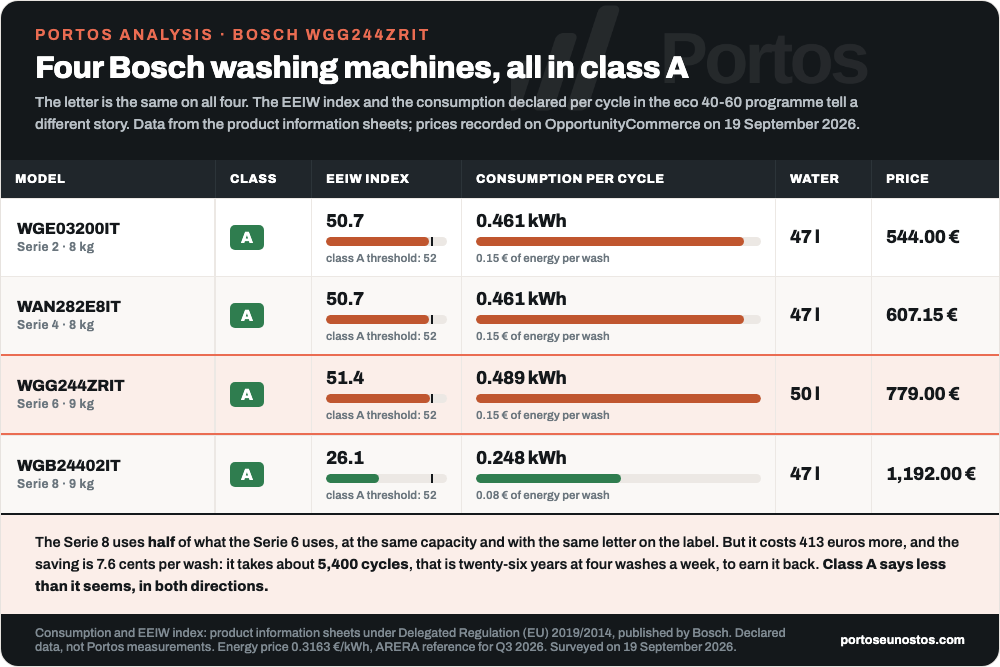
Four Bosch washing machines, all in class A. Declared consumption per cycle in the eco 40-60 programme and prices recorded on 19 September 2026.
A family of four doing four washes a week therefore spends just over €32 of energy per year with this machine. This is a figure that surprises those expecting a bigger impact on their bill, and is the reason why, as explained in the in-depth article on how much a washing machine consumes, the operating cost of a washing machine rarely justifies a large purchase price premium on its own.
Minor items count for little but it's worth clearing them up. Left plugged in all year in off mode, the machine draws 0.15 W: that's 1.3 kWh, or 42 cents a year. In standby it rises to 0.50 W, so €1.39. Delayed start draws 0.60 W while waiting. Unplugging is not a saving strategy.
Comparison within the Bosch range
This is where the part that isn't read in product sheets arrives, and in our opinion it's the main reason it's worth reading an analysis before buying.
We lined up the information sheets of four 60 cm Bosch washing machines actually available on OpportunityCommerce. All four are in class A.
| Model | Series | Capacity | IEEW Index | kWh per cycle | Litres per cycle | Price 19/09/2026 |
|---|---|---|---|---|---|---|
| WGE03200IT | Series 2 | 8 kg | 50.7 | 0.461 | 47 | 544.00 euro |
| WAN282E8IT | Series 4 | 8 kg | 50.7 | 0.461 | 47 | 607.15 euro |
| WGG244ZRIT | Series 6 | 9 kg | 51.4 | 0.489 | 50 | 779.00 euro |
| WGB24402IT | Series 8 | 9 kg | 26.1 | 0.248 | 47 | 1.192.00 euro |
Look at the last row. Series 8 declares 0.248 kWh per cycle against 0.489 for Series 6: with the same capacity and energy class, it consumes almost exactly half. The IEEW index makes it even clearer: 26.1 against 51.4. The letter A covers everything below 52, and within that letter there are machines that behave completely differently on your electricity bill. It's exactly the limit of the label we discuss in the guide on how to read the energy label.
That said, the commercial conclusion is not obvious. Let's do the full calculation.
Series 8's saving is 0.241 kWh per cycle, or 7.6 cents. The price difference between the two machines is 413 euro. So you need about 5,400 cycles to break even: at four washes a week that's twenty-six years, well beyond the realistic useful life of a washing machine. Even washing every day would take fifteen years.
Series 8 doesn't pay for itself with energy. You pay for connectivity, for washing that's three decibels quieter and for halved consumption in itself, if that's a value you care about. Not because it makes economic sense. Anyone telling you otherwise is doing the math wrong, and this is the kind of check we expect a reader to do before spending four hundred euro more.
The comparison downward is more insidious. The 8 kg Series 2 costs 235 euro less and declares slightly better consumption, but for 8 kg instead of 9. So the question is not which consumes less, but whether you need that extra kilogram: we cover it extensively in the guide on washing machine 8, 9 or 10 kg.
Spin and residual humidity
Maximum spin speed is 1400 rpm, but in the eco 40-60 programme the machine declares 1351 rpm: this is the actual value it reaches in the reference cycle, at full load, half and a quarter.
But the data that really matters is different, and it's residual humidity: 51.4%, which is class B. This means that at the end of spinning, the laundry carries with it a weight of water equal to 51.4% of its dry weight. On a full 9 kg load that's about 4.6 kg of water that has to go somewhere: into the air in your home if you hang dry indoors, or into the dryer.
And that's where the real surprise from the earlier comparison is found. Series 8 at 1,192 euro, despite spinning at 1400 rpm against 1351, declares residual humidity of 53.0%, which is slightly worse. On a full load the difference is about 150 grams of water: practically nothing, but in the opposite direction from what the price would suggest. More rpm doesn't automatically mean drier laundry.
If you have or are evaluating a dryer, this number goes directly into your drying cost: the full calculation is in the article on how much it costs to use a dryer in a year.
How long it lasts and what temperature it actually washes at
The eco 40-60 programme lasts 3 hours and 48 minutes at full load, 2 hours and 54 minutes at half load, 2 hours and 30 minutes at a quarter load. It's not a flaw in this machine: it's the mechanism of the European label itself, which rewards long cycles at low temperature because they consume less.
The second number is even more interesting and almost nobody talks about it. The maximum temperature reached inside the fabric in the eco 40-60 programme is 38 degrees at full load, 27 degrees at half load and 22 degrees at a quarter load. The programme is called eco 40-60 but doesn't reach 40 degrees, and with small loads it washes essentially at cold temperature.
The practical consequences are two, and they are concrete. The first: for normally dirty laundry it works just fine, and the declared washing efficiency index (1.031) confirms it. The second: if you need real temperatures, for example for delicate items or in case of allergies, you need to use another program, and in that case the energy consumption stated on the label no longer applies. For that there is Hygiene Plus, or the Resilient and Colored programs that go up to 90 degrees.
It's also why washing always and only at low temperatures leads to odors in the drum. The problem, and its solution, are explained in the article on why the washing machine smells.
Noise level
Bosch declares 50 dB(A) during the wash cycle and 70 dB(A) during spinning, with sound emission class A, the best provided for by the label.
Translated: the 50 decibels of the wash cycle are the sound of a calm conversation and you can easily live with it even in an apartment with the washing machine in the bathroom or kitchen. The 70 decibels of the spin cycle no: it's the level of a vacuum cleaner and lasts only a few minutes, but in a studio apartment or at night you'll hear it. If the laundry room is next to a bedroom, delayed start is more useful than class A.
A useful figure for comparison: among the four Bosch machines in the table, this is the only one with 70 dB during spinning. The other three, Series 8 included, declare 71. One decibel is a minimal difference, but it goes in the right direction and is explained by the anti-vibration design of the side walls and the weight: 74.5 kg of machine stands more still than a lighter one.
Ease of use
The interface is a program selector with LED display and remaining time indication. There is no color screen and no app: you set it and go.
The functions that simplify your day are delayed start, which you set here by indicating the time you want your laundry ready within the next 24 hours, child safety lock, end of cycle acoustic signal, and the already mentioned Add clothes.
The declared programs cover normal needs: Resilient and Colored from cold to 90 degrees, Easy Care from cold to 60, Delicate and Silk, Wool and hand wash, Mix, Quick 15 and 30 minutes, Rinse, Drain and spin, Drum cleaning. There are no programs dedicated to quilts, shirts, and sports wear, which are present on other machines.
One final note on dimensions, because it's the most frequent purchasing mistake. The machine is 59 cm deep, but with the door open at 90 degrees you need a free space of 107.3 cm. In a narrow bathroom or under stairs it's the number that decides whether the project works, much more than the energy class.
Maintenance and durability
The machine has a dedicated Drum cleaning program and, according to Bosch, automatically reminds you to run it after twenty 40-degree cycles. It's a function that seems marginal but instead prevents exactly the most common problem with modern washing machines, which wash almost always at low temperature.
On the fault front the AquaStop system deserves a line: double-walled hose, safety valve and collection pan with float, with Bosch warranty for water damage for the entire life of the appliance.
The motor, however, requires attention, because it's the point where commercial communication runs faster than the contract. The motor is a SilentPower Drive, brushless with permanent magnets, the same one that in old Bosch datasheets was called EcoSilence Drive. Bosch offers 10 years of motor support, but only to those who register the product on MyBosch within 60 days of purchase. The minimum warranty stated in the product information sheet remains 24 months. If you buy this machine, make a note to do the registration: it's free and worth eight more years of coverage on an expensive component.
For regular maintenance, follow the general indications you'll find in the guide on how to clean the washing machine filter and seal.
Strengths
Nine real kilos in a 59 cm deep machine, so compatible with most standard niches.
The quietest in the spin cycle among the 60 cm Bosch machines we compared, with 70 dB(A) and class A.
Residual moisture of 51.4%, better than that declared by the Series 8 model that costs 413 euros more.
Complete functional equipment with no obvious gaps: Hygiene Plus, Iron Assist, SpeedPerfect, Add clothes, load sensor.
Brushless motor with 10 years of support that can be activated for free and AquaStop guaranteed for life.
Contained and predictable operating cost: approximately 32 euros of energy per year with four washes a week.
Limitations
The IEEW index of 51.4 places it at the lower end of class A. On paper it's class A like the Series 8, in practice it uses twice as much.
It uses 50 liters of water per cycle, three more than the other three Bosch machines compared, which stop at 47.
No connectivity and no automatic detergent dosing.
The reference cycle lasts 3 hours and 48 minutes at full load, and does not exceed 38 degrees.
Missing programs dedicated to quilts, shirts, and sports wear.
The cast iron grey color is a precise aesthetic choice: in a laundry room with white appliances it stands out.
Suitable for
A family of three or four people who do three to five loads a week. It's exactly the workload for which 9 kg makes sense without becoming oversized.
For those who have the washing machine in a lived-in space, a kitchen or bathroom in an apartment, and consider noise a selection criterion.
For those looking for a complete machine but don't want to pay for connectivity. If you're not interested in the app, you won't pay for it here and won't miss it.
For those who value durability over the last fraction of consumption. Brushless motor, lifetime AquaStop and 74.5 kg of structure are concrete arguments over a ten-year horizon.
Not suitable for
Those who wash very little. With one or two loads a week, 9 kg remains almost always empty and an 8 kg machine costs 200 euros less.
Those who put energy consumption first and foremost. In that case the comparison should be made on the IEEW index, not the letter, and this machine is not the right choice in the range.
Those who want to control the washing machine from their phone. It's not provided and cannot be added.
Those with little space in front of the machine. The 107.3 cm required with the door open is a real constraint in many Italian bathrooms.
Those who often wash technical or sports garments and are looking for dedicated programs.
Alternatives to consider
Bosch WGE03200IT, Series 2, 8 kg. Found at 544.00 euros. Same A class with 50.7 index, 0.461 kWh and 47 litres per cycle, spin at 1200 rpm and eco cycle a quarter of an hour shorter. It makes sense if 8 kg is enough for you and if basic features don't bother you: that's 235 euros difference, which is much more than you'll ever save on your bill with the Series 6.
Bosch WAN282E8IT, Series 4, 8 kg. Found at 607.15 euros. Same consumption as Series 2 but with spin at 1400 rpm. It's the compromise for those who want full spin on an 8 kg machine.
Bosch WGB24402IT, Series 8, 9 kg. Found at 1,192.00 euros. It's the machine that uses half the energy, with Home Connect and washing at 47 dB(A). As we've seen, it doesn't pay back on your bill: it only makes sense if connectivity and halved consumption interest you for their own sake.
If you're also evaluating other brands, the comparison between the two that originate in the same industrial group is in the article on Bosch or Siemens.
The Portos evaluation
The score that follows comes from the analysis of declared data and comparison with equivalent models. It is not the result of a laboratory test and should not be read as such.
| Criterion | Weight | Score | Rationale |
|---|---|---|---|
| Performance and features | 30 | 23 | Washing index 1.031 and rinsing 5.0 g/kg in line with the category, extensive features, but no specialist programs |
| Efficiency | 20 | 13 | Class A obtained with 51.4 index, six tenths from the class limit; 50 litres per cycle are the highest in the compared group |
| Usability | 15 | 12 | Direct controls, remaining time, delayed start up to 24 hours, Add laundry; no connectivity |
| Quality and design | 15 | 12 | Brushless motor, lifetime AquaStop, anti-vibration design, 74.5 kg structure |
| Maintenance | 10 | 8 | Drum cleaning program with automatic reminder after twenty cycles |
| Features and price | 10 | 7 | 779 euros are consistent with the features, but in the same range you spend less with similar consumption |
| Total | 100 | 75 |
75 out of 100. It's a solid, quiet and well-equipped washing machine that loses points where the market is stricter today: the real efficiency behind the A letter. If criterion number one is consumption, this is not the Bosch to choose. If criterion number one is having nine reliable and quiet kilos without paying for features you won't use, it's a sensible choice.
Price and availability
At the time of verification, 19 September 2026, the model was offered at 779.00 euros on OpportunityCommerce, listed as in stock for immediate delivery. The price of an appliance is volatile data: it changes by seller, by promotion and by time of year, so it should always be checked at the time you buy.
See features and availability on OpportunityCommerce
Compare prices and sellers of Bosch Serie 6 washing machines on SniffaPrezzi
Method and limits of this analysis
Portos did not have this washing machine physically available. We did not test it, we did not measure anything and we do not report usage impressions. This is a Portos analysis: a critical reading of the data that the manufacturer declares by legal obligation, compared between equivalent models.
The sources are, in order of priority, the product information sheet provided by Delegated Regulation (EU) 2019/2014, the technical sheet published by Bosch and, only for price and availability, the seller's website. Where the two contradicted each other we kept the manufacturer's data: this is the case with the motor name, which OpportunityCommerce still reports as EcoSilence Drive while Bosch now calls it SilentPower Drive, and the height, indicated as 84.5 cm in the retailer's description and as 848 mm in the Bosch datasheet.
Costs in euros are estimates based on declared consumption and the ARERA price for the third quarter of 2026. They are not measurements of your actual consumption, which depends on the programs you use, water hardness, how full you load the drum and your supply contract. The data was verified on September 19, 2026 and will be rechecked within ninety days.
The model that consumes half, analyzed: the Bosch Serie 8 WGB24402IT declares 25 kWh per 100 washes compared to the 49 of this one, with equal class A and capacity. How it achieves this, how much the advantage really costs and why it doesn't offset the €413 difference are in the analysis of the Serie 8 WGB24402IT.
Sources
Bosch WGG244ZRIT product information sheet, updated November 29, 2025.
Information sheets of the models used in the comparison: WGB24402IT and WGE03200IT and WAN282E8IT.
Delegated Regulation (EU) 2019/2014, energy labelling of washing machines for domestic use.
Bosch, warranties and extensions on components, for the conditions of 10 years of assistance on the motor.
ARERA, reference price of electricity for the third quarter of 2026.
EPREL, European database of products for energy labelling.