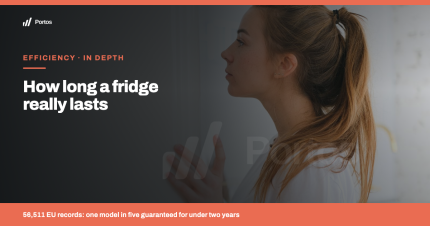
Nobody states how many years a fridge lasts. The energy label does not say it, the technical sheet does not say it, the European product registry does not say it. What is written down in black and white is something else: how long you can repair it, and how long somebody is answerable for a fault.
We at PortosEunostos read the 56,511 records of refrigerating appliances registered in EPREL, the European Commission database, together with the regulation that sets the spare parts obligations. Here are the numbers that actually matter when you have to decide between calling a technician and buying a new appliance.
The only official figure about lifespan is the guarantee
Every fridge sold in the European Union has to declare in the registry the minimum duration of the guarantee offered by the supplier. It is the only commitment on time that a manufacturer puts in writing, and it is also the only figure that can be compared across 1,556 different brands.
Across the 56,511 records the median is 24 months, and two models out of three (66.41%) declare exactly 24. The interesting part is at the edges: 21.32% declare less than two years, with 9,301 models stuck at 12 months and 2,099 declaring zero. Only 12.27% go beyond 24 months: 5,632 models reach 36, a thousand reach 60, just 140 reach 84 months. The brands with the largest catalogues are not the most generous: Beko and Amica have a median of 12 months, while all 1,179 models of the BSH group (Bosch, Siemens, Neff, Gaggenau) declare 24.
Do not mix up the two levels. The registry figure is the manufacturer's commercial guarantee. The two year legal guarantee is owed by the seller, under Directive (EU) 2019/771, and it applies even when the manufacturer declares twelve months or zero.
The real clock is spare parts: seven years, ten for the door gasket
The right question is not how long it lasts, but how long it stays repairable. Here Regulation (EU) 2019/2019 is precise. Thermostats, temperature sensors, printed circuit boards and light sources must remain available for at least seven years, but only to professional repairers. Door handles, hinges, trays and baskets must be available for seven years to you as the end user too, and door gaskets for ten years. Delivery is guaranteed within 15 working days and the parts must be replaceable with commonly available tools, without permanent damage to the appliance.
There is a detail nobody mentions: the countdown starts from the last unit of that model placed on the market, not from the day you buy it. And nobody publishes that date. In the registry only 8,054 models out of 56,511 indicate an end of marketing, and they are all future dates, some in 2050 and 2064: they are forecasts, not production end dates.
What the manufacturer promises on top
Above the legal minimum each brand adds its own terms, and they are worth reading before you buy. Bosch Italy states that spare parts for major appliances stay available for 15 years from the production date, with an asterisk that counts: only for coded functional spare parts. It then offers 10 years of service on the Inverter Compressor, but only on freestanding fridges and only if you register the product on MyBosch within 60 days of purchase. The same registration gives you one extra year of service on top of the 24 months.
In practice, the longest cover on the most expensive component excludes built-in models, which in the sample of 62 Bosch and Siemens records we analysed are 47 out of 62. If you are choosing a built-in appliance, those ten years do not apply to you.
The two year gap at the start
The regulation requires manufacturers to give independent repairers access to diagrams, error codes and repair instructions, but only after two years from the launch of the model. The list of parts reserved to professionals can also be published two years late. For the first two years, then, there is only one route: the official service network, which is also the one that costs you nothing while under guarantee. From the third year onwards competition opens up, and with it prices.
When replacing pays off: the figures in euros
There is only one way to run the numbers: how much you save per year on the bill, and in how many years the purchase pays for itself. Take a real new fridge freezer, the Bosch KGN36NLEA, 239 kWh per year declared on its EU product information sheet and 695.69 euros on OpportunityCommerce on 25 October 2026. At 0.4343 euros per kWh, the ARERA tariff in force since 1 October 2026, running it costs 103.80 euros a year. The annual consumption of your current appliance is printed on its label or in its manual: the gap between the two figures is all you need.
| Consumption gap | Yearly saving | What yours uses | Years to repay 695.69 euros |
|---|---|---|---|
| 50 kWh | 21.71 euros | 289 kWh | 32.0 |
| 100 kWh | 43.43 euros | 339 kWh | 16.0 |
| 150 kWh | 65.14 euros | 389 kWh | 10.7 |
| 200 kWh | 86.86 euros | 439 kWh | 8.0 |
| 300 kWh | 130.29 euros | 539 kWh | 5.3 |
| 400 kWh | 173.72 euros | 639 kWh | 4.0 |
Read the other way round, the table says one thing only: for the replacement to pay for itself within the seven years of guaranteed spare parts, your fridge has to use at least 468 kWh a year. To break even in ten years, 399 kWh are enough. Below that threshold you are not saving, you are buying a new appliance, which is a legitimate choice but not an investment on your energy bill.
When it does not pay off
It does not pay off to replace an appliance to gain one letter on the label. In our analysis of class E fridges we measured six pairs with the same brand and the same capacity: the premium for the better class is repaid in between 8.8 and 18.2 years, median 14.1. That is longer than the period in which the law guarantees you spare parts.
And it does not pay off to replace an appliance over a fault the law protects. A gasket that no longer seals, a hinge that gives way, a broken basket, a detached handle: these are all parts the manufacturer must supply for seven years, and the gasket for ten. Before you start browsing catalogues, ask for a quote on the part.
PortosEunostos tips
What to check on the product. The E-Nr code on the internal rating plate, which you need to order any spare part. The annual consumption in kWh, the only figure that makes the old appliance comparable with a new one. The guarantee declared by the manufacturer which, as you have seen, in one case out of five is below two years. If you buy a freestanding model, register it within 60 days: it is free and with Bosch it is worth ten years on the compressor.
How to judge the seller. The two year legal guarantee is an obligation, not a courtesy. Ask about real delivery times and whether the seller collects the old appliance, which on a 60 kilo unit is not a detail. Compare the price of the same model code across several shops before deciding: on SniffaPrezzi you see the offers side by side, while the product pages and availability of the models we mention are on OpportunityCommerce, including the KGN36NLEA used in these figures.
If you want to go on, here is how much a fridge really uses in a year, what appliance spare parts really cost and, if you are considering a purchase, our guide to choosing a fridge. On the maintenance that extends the life of the appliance we wrote how often to defrost and clean the fridge.
Sources
European EPREL registry, refrigerating appliances group: 56,511 records read on 25 October 2026.
Regulation (EU) 2019/2019, Annex II section 3: availability of spare parts, access to repair information, delivery time.
Directive (EU) 2019/771, Article 10: liability of the seller for two years.
Bosch spare parts search and component guarantees; official site bosch-home.com.
EU product information sheet of the Bosch KGN36NLEA and the other 61 Bosch and Siemens records in the sample.
ARERA, electricity tariff for the fourth quarter of 2026: 0.4343 euros per kWh.