Twenty fridges lined up in a store, twenty almost identical labels: nearly all of them show an E, occasionally a D, rarely anything better. The instinctive reaction is always the same, they must all be mediocre products.
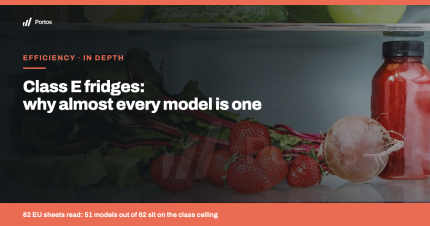
They are not. We read the EU product information sheets of 62 Bosch and Siemens refrigerators and freezers currently in the catalogue: 44 out of 62 are in class E, and 39 declare an energy efficiency index of exactly 100.0. Not 99.4, not 100.7. A round hundred, which is the last usable point before class F. That number is no accident: it is a design decision. Here is what it means for the buyer.
The short answer
Class E on a refrigerator does not signal a poor product. The 2021 A-G scale was recalibrated deliberately leaving the first letters empty, and today E is the middle of the market: we explained how the scale works in how to read the energy label.
The real issue is different: the letter alone does not tell you what you will spend. Within class E alone, in our sample annual consumption ranges from 93 to 333 kWh, that is from 40.39 to 144.62 euros a year at the ARERA tariff in force since 1 October 2026 (0.4343 euros per kWh). One hundred and four euros of difference every year, more than a thousand over ten years, with the same letter in the shop window.
The sample: 62 EU sheets, not impressions
The product information sheet is the document the manufacturer files under Commission Delegated Regulation (EU) 2019/2016. It is not promotional material: it carries volume, annual consumption, efficiency index, noise and minimum warranty. We downloaded them from the BSH document server and read them one by one.
The sample covers 62 appliances, 47 built-in and 15 freestanding, 33 Bosch and 29 Siemens. Distribution by class: none in A, 2 in B, none in C, 11 in D, 44 in E, 1 in F and 4 in G. Among built-ins alone, class E accounts for 33 out of 47, seven models out of ten.
The number that explains everything: 51 models out of 62 sit on the class ceiling
The regulation assigns the letter on the basis of the energy efficiency index (EEI), with precise bands: A up to 41, B from 41 to 51, C from 51 to 64, D from 64 to 80, E from 80 to 100, F from 100 to 125, G above 125. The upper limit is included in the band.
In the sample the declared indices take only nine different values: 51, 79, 80, 97, 99, 100, 124, 152 and 170. Three of them coincide exactly with a class ceiling: 51 closes B, 80 closes D, 100 closes E. Those three values account for 51 models out of 62, that is 82.3 per cent.
It is the clearest evidence of how a volume refrigerator is designed: the goal is not to consume as little as possible, it is to reach the upper limit of the chosen band. One tenth of a point more and the letter gets worse, so the design stays glued to the border. The buyer sees an E and reads a result scraped through by a hair: it is instead a bullseye.
Inside the same letter there are 104 euros of difference
The EEI is a ratio, not a consumption figure: it puts actual consumption over a reference consumption calculated from volume and compartment types. Two machines with the same index and different volumes consume wildly different amounts and stay in the same box.
The Siemens KU21RVFE0, 134 litres, is in class E and declares 93 kWh a year, that is 40.39 euros. The Bosch KFF96PIEP, 573 litres, is also class E and declares 333 kWh, that is 144.62 euros. Same letter, three and a half times the bill.
The opposite also holds, and this is the surprising part: thirteen of the 44 class E models consume less than the worst class D, which declares 204 kWh a year, that is 88.60 euros. The best D in the sample does 91 kWh, the best E does 93. Two kilowatt hours apart and one letter of difference on the shelf.
What one letter really costs
The practical question is one: how much do you pay for a better letter and how long does it take to pay back. We isolated pairs from the same brand with the same capacity and the same type, that is genuinely comparable machines, with prices recorded on OpportunityCommerce on 24 October 2026.
| Pair (same brand, same capacity) | Class and consumption | Price | Annual saving | Payback |
|---|---|---|---|---|
| Bosch KIR81ADD0 / KIR81VFE0, built-in 310 l | D 91 kWh / E 114 kWh | 922.93 / 772.62 € | 9.99 € | 15.0 years |
| Siemens KI81RADD0 / KI81RVFE0, built-in 310 l | D 91 kWh / E 114 kWh | 1,243.43 / 1,061.28 € | 9.99 € | 18.2 years |
| Bosch KIN96VFD0 / KIN96NSE0, built-in 290 l | D 184 kWh / E 231 kWh | 1,038.91 / 860.28 € | 20.41 € | 8.8 years |
| Siemens KI96NVFD0 / KI96NNSE0, built-in 290 l | D 184 kWh / E 231 kWh | 1,463.22 / 1,258.00 € | 20.41 € | 10.1 years |
| Bosch KIN86ADD0 / KIN86VSE0, built-in 260 l | D 186 kWh / E 234 kWh | 1,229.61 / 869.06 € | 20.85 € | 17.3 years |
| Bosch KIN86ADB0 / KIN865SE0, built-in 260 l | B 120 kWh / E 234 kWh | 1,372.72 / 716.72 € | 49.51 € | 13.2 years |
Payback runs from 8.8 to 18.2 years, median 14.1. On the 310 litre single door the arithmetic is merciless: 150.31 euros of extra cost to save 9.99 a year. On the 290 litre combi, instead, the jump pays for itself in under nine years.
Two honest caveats. Prices are a snapshot of one retailer on one day and discount bands move, as we documented in Bosch or Siemens, the same machine at two prices. And the better class model often brings other things with it, from noise to interior fittings: the energy bill is one part of the decision, not all of it.
When class E really is a problem
Two situations in which that letter deserves to be taken seriously.
Large freestanding units. In the sample class E reaches 333 kWh a year, nearly 145 euros: here every letter counts, because the baseline consumption is high. It is worth looking at annual consumption before capacity, a point we picked up in refrigerator with 300, 400 or 500 litres.
Small built-ins. The Siemens GI11VADE0, 72 litres, declares 167 kWh a year, that is 2.32 kWh per litre. The Bosch KIR81ADD0, 310 litres, declares 0.29: eight times as much for every litre cooled. The second fridge in the garage, the one you keep because it is small anyway, is often the worst line item in the house.
PortosEunostos tips
Read the annual consumption in kWh, not the letter. It is printed on the same label, just below the coloured scale.
Compare two models only at equal volume and compartment type. Outside that condition, comparing letters means nothing.
Multiply the kWh by 0.4343 and then by the years you expect to keep it: that is the appliance's second price. The full method is in what it costs to run your appliances after the 37.3 per cent increase.
Check the minimum warranty on the sheet. In the sample it is 24 months on every model: if a seller presents it as an exclusive advantage, it is not.
On the seller: realistic delivery times, cost of installation and old appliance removal, returns policy on a bulky product, and the full model code in the listing. Without the exact code you cannot trace the EU sheet, and without the EU sheet you are buying a letter.
The Portos choice
At PortosEunostos we do not regard class E as a defect: we regard it as incomplete information. When 82 per cent of a catalogue sits exactly on the ceiling of its own band, the letter stops separating products.
Paying for a better letter makes sense when the annual saving exceeds twenty euros and you expect to keep the appliance beyond ten years, in practice on large built-in combis. It does not make sense on a single door, where payback is over fifteen years. There is one case where it is worth moving anyway: replacing an old refrigerator, where the jump is not one letter but a whole generation of compressors (how much does a refrigerator consume in a year).
If you are choosing right now, start from the capacity you genuinely need with our guide to choosing a refrigerator, then set the kWh you are willing to pay for each year and only at the end look at prices. Compare prices and availability on SniffaPrezzi or browse the refrigerator category on OpportunityCommerce, where you will find the models cited here, including the Bosch KIR81ADD0 and the Bosch KIR81VFE0.
Sources
Commission Delegated Regulation (EU) 2019/2016, Annex II Table 1 (efficiency classes) and Annex IV points 4 and 5 (calculation of SAE and EEI).
Bosch and Siemens EU product information sheets: KIR81ADD0, KIR81VFE0, KIN86ADB0 and the other 59 in the sample.
Bosch Italy and the manufacturer's energylabel page.
EPREL, the European registry of products carrying an energy label.
ARERA, press release of 29 September 2026: 0.4343 euros per kWh from 1 October 2026.
Prices recorded on OpportunityCommerce on 24 October 2026.