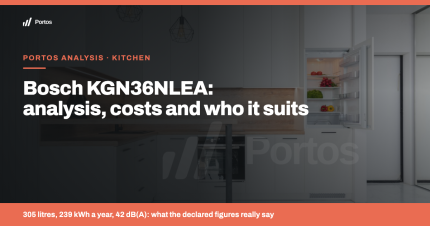
The Bosch KGN36NLEA declares 305 liters, 239 kWh per year, class E and 42 dB(A). Class E on a scale that goes up to A seems like a failure, and it isn't: in the six Bosch datasheets we read, five very different appliances have the exact same efficiency index and consume between 93 and 239 kWh. Analysis of the declared data, with an account of how much it costs over ten years, the measured price of No Frost and the 42 dB which is the only serious limitation of this model.
The Bosch KGN36NLEA is a freestanding combination refrigerator, 60 cm wide, 1.86 meters tall, stainless steel finish. The European product information sheet declares 305 liters total capacity (216 refrigerator and 89 freezer), 239 kWh per year, energy class E and 42 dB(A) noise level. As of September 21, 2026 it is offered at 695.69 euros on OpportunityCommerce, listed in the catalog as Series 2.
Class E on a scale that goes up to A: it looks like a failing grade. It isn't, and understanding why is the point of this analysis. The class doesn't measure how much a refrigerator consumes, it measures how efficient it is relative to its volume and the type of compartments it has: in the six Bosch sheets we reviewed, five appliances that are profoundly different from each other have the exact same index, IEE 100, and range from 93 to 239 kWh per year. The number that ends up on your bill is the other one.
This is not a laboratory test. It is a Portos analysis built on data that Bosch deposits by law in the product information sheet required by Delegated Regulation (EU) 2019/2016, cross-referenced with the regulation text and the energy price set by ARERA. Every number you read below comes from one of these documents, all linked at the bottom of the page.
In brief: what you'll find in this analysis
The fact sheet in summary
| Item | Declared data |
|---|---|
| Brand and model | Bosch KGN36NLEA |
| Type | Freestanding combination refrigerator, two doors |
| Total volume | 305 liters (216.0 fresh food + 89.0 4-star freezer) |
| Energy class | E (IEE 100) |
| Annual consumption declared | 239 kWh/year |
| Noise level | 42 dB(A) — emission class D |
| Defrosting | Automatic on both compartments |
| Freezing capacity | 10.0 kg in 24 hours, with fast freeze |
| Dimensions (H x W x D) | 1860 x 600 x 660 mm |
| Climate class | Extended temperate, temperate, subtropical, tropical (from 10 to 43 °C) |
| Internal lighting | LED, efficiency class G |
| Supplier minimum warranty | 24 months |
| Price detected | 695.69 euros on OpportunityCommerce |
| Verification date | September 21, 2026 (manufacturer's sheet updated July 20, 2026) |
What it really offers
It's the most common format in Italian kitchens: a 60 cm wide column, two doors, refrigerator on top and freezer on the bottom, freestanding and not built-in. The 305 liters total are divided into 216 liters of fresh food compartment, with recommended storage temperature of 4 °C, and 89 liters of 4-star freezer at -18 °C.
The substantial difference compared to entry-level models is that both compartments have automatic defrosting. In the European sheet this appears as a single letter, A, in the "defrosting mode" column: on the freezer it means that no ice block forms that you have to remove once a year. On the refrigerator it's now a universal feature; on the freezer no, and it's the feature that sets this appliance apart from several cheaper models.
The rest of the features don't appear in the European sheet, because the regulation only asks for energy, dimensional and acoustic parameters. For everything concerning shelves, drawers, materials and controls, the manufacturer's commercial documentation applies, not this analysis: for consistency with the Portos method, here we only discuss what is declared in a verifiable document.
Class E: what it really means
The A-G energy rating scale for refrigerators has been in effect since March 1, 2021 and assigns a letter based on the energy efficiency index, the EEI. Delegated Regulation (EU) 2019/2016 sets the thresholds clearly:
| Class | Energy Efficiency Index (EEI) |
|---|---|
| A | EEI ≤ 41 |
| B | 41 < EEI ≤ 51 |
| C | 51 < EEI ≤ 64 |
| D | 64 < EEI ≤ 80 |
| E | 80 < EEI ≤ 100 |
| F | 100 < EEI ≤ 125 |
| G | EEI > 125 |
The KGN36NLEA declares EEI 100: it is exactly the maximum value allowed in class E. A tenth more and it would be F. It's not an isolated case: five of the six Bosch datasheets we reviewed report the same exact 100, that is, the upper limit of the class. This is data that should be read for what it is, a design calibrated to the threshold, not a flaw of the individual model.
The part that almost no one explains is that the EEI is a ratio: it places the actual consumption of the appliance over a reference consumption calculated starting from the volume of its compartments, the type of compartments, the number of doors and other characteristics. A large refrigerator has a higher reference, so it can consume more and stay in the same class. That's why the letter is not the consumption: if you're comparing two appliances of different sizes, the letter alone tells you little. We explained the entire logic of the label in the guide on how to read the energy label of household appliances.
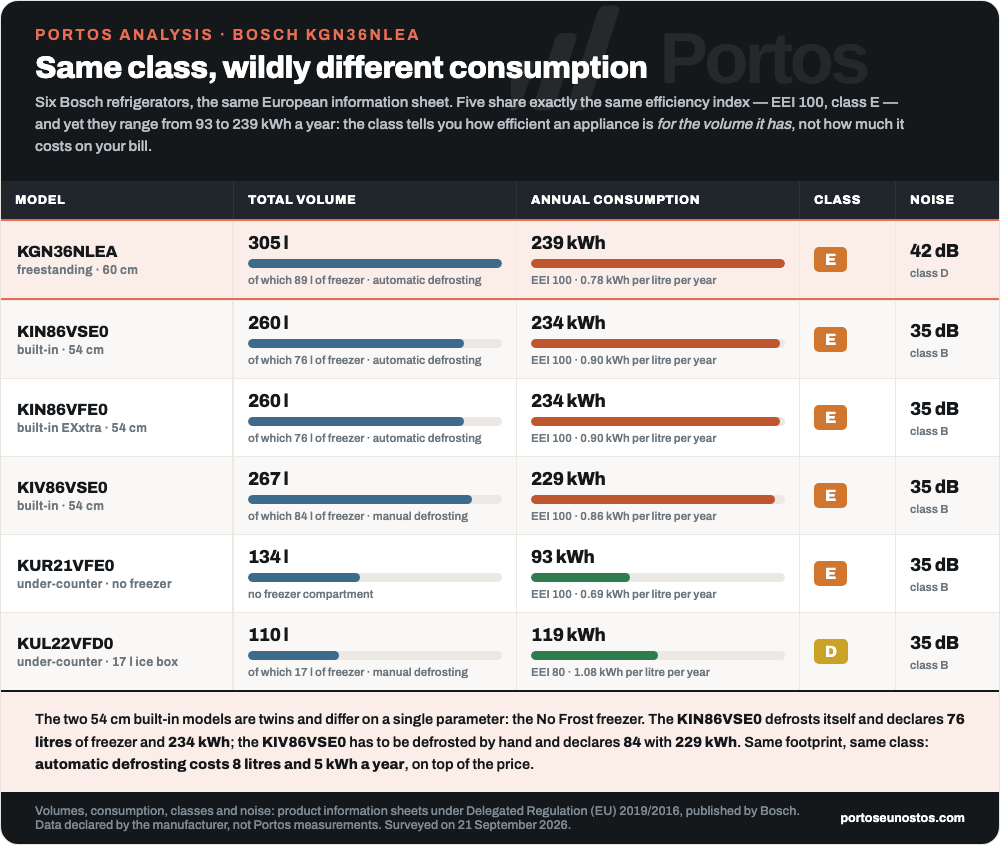
Five of the six models have the same index, EEI 100, and consumptions ranging from 93 to 239 kWh per year. Data declared in the European information sheets published by Bosch.
Consumption: how much it costs in a year
The declared 239 kWh corresponds to approximately 0.65 kWh per day. The cost in euros depends on how much you pay for energy; we use two references, as in all Portos analyses: 0.25 euros per kWh, a prudential value, and 0.3163 euros per kWh, the reference price set by ARERA for the third quarter of 2026, taxes included, for vulnerable customers still under standard protection.
| Timeframe | Energy | At 0.25 €/kWh | At 0.3163 €/kWh |
|---|---|---|---|
| One day | 0.65 kWh | 0.16 € | 0.21 € |
| One month | 19.9 kWh | 4.98 € | 6.30 € |
| One year | 239 kWh | 59.75 € | 75.60 € |
| Ten years | 2.390 kWh | 597.50 € | 756.00 € |
The number worth keeping in mind is the last one. At 0.3163 euros per kWh, over ten years of operation this refrigerator consumes more energy than it costs to buy it: 756 euros against the 695.69 price observed. It's not a flaw of the model, it applies to almost all refrigerators on the market, and it's the reason why faced with two similar appliances with 30 or 40 kWh difference per year it's worth doing the math over the entire useful life and not just on the purchase receipt.
An honest warning: 239 kWh is a standardized test value, measured at 16 and 32 °C ambient temperature with the compartment at target temperature. At home, actual consumption depends on how many times you open the door, how warm the room is, where the appliance is placed and how full you fill it. It's useful for comparing models with each other, not for predicting your bill to the cent. We collected the factors that really shift actual consumption in the in-depth article on how much a refrigerator consumes in a year.
216 liters of refrigerator, 89 of freezer
The 305 liters is the total volume declared according to the regulation method, not an inflated commercial measurement: it's the data that ends up on the energy label and is the same on which the class is calculated. The breakdown is 216 liters of refrigerator and 89 of freezer, that is, just under 30% of the volume dedicated to frozen foods.
It's a proportion for a family that regularly freezes: 89 liters are four full drawers, not the small service drawer you find on single-door models. Those who freeze little and prefer space for fresh food will pay for a part of the appliance they won't fully use. Those who shop once a week or meal prep will use it all.
We don't make up rules about actual needs: the right capacity depends on how many people you are and what type of shopping you do, and we've discussed this specifically in refrigerator with 300, 400 or 500 liters: what capacity you really need. Here it's enough to say that 305 liters total place the KGN36NLEA in the mid-range, the one that in an Italian kitchen serves two to four people well.
Freezing capacity: 10 kg in 24 hours
It's the most overlooked parameter on the datasheet and it's also the one where this model has the clearest edge. The declared freezing capacity is 10.0 kg in 24 hours, compared to 4.0-4.2 kg of the built-in models in the same range we reviewed: two and a half times more.
What it means in practice. Freezing capacity is the amount of fresh food the appliance can bring to -18 °C in a day without raising the temperature of what is already frozen. If you buy half a lamb, if you freeze the catch, if you prep portions for weeks, that number is the difference between rapid, clean freezing and slow freezing that ruins the texture of food already inside. If instead you use the freezer for ice cream and peas, ten kilos a day is capacity you'll never use. The datasheet also declares the presence of fast freezing, the function that temporarily lowers the temperature before a large load.
How much No Frost costs, measured on two twins
In the Bosch range on catalog there are two 54 cm built-in models that are identical in everything: same dimensions to the millimeter (1772 x 541 x 548 mm), same class E, same IEE 100, same noise level of 35 dB(A). They differ on only one parameter, freezer defrosting. And this allows a clean comparison, which normally is not possible to make.
| Declared parameter | KIN86VSE0 (automatic defrosting) | KIV86VSE0 (manual defrosting) |
|---|---|---|
| Total volume | 260 liters | 267 liters |
| Freezer | 76.0 liters | 84.0 liters |
| Annual consumption | 234 kWh | 229 kWh |
| Freezing capacity | 4.0 kg/24 h | 4.2 kg/24 h |
| Price detected | 869,06 € | 702,48 € |
Here's the count: automatic defrosting costs 8 liters of freezer, 5 kWh per year and 166.58 euros. The 8 liters are the space taken up by the evaporator and air circuit; the 5 kWh is the energy for the defrost cycle and ventilation; the 166 euros is the list price difference between two appliances that on paper are equivalent in everything else.
Put it even more directly: those 5 kWh extra are worth 1.58 euros a year at 0.3163 euros per kWh. No Frost doesn't pay for itself in the bill, and that's not the point. You pay for not having to empty the freezer anymore, unplug it and scrape the ice, and for not losing efficiency progressively as ice accumulates. It's a choice for convenience, and it should be made knowing it's a choice for convenience.
The European regulation, moreover, spells it out in its own way. In the calculation of reference consumption, the defrosting factor is 1.00 for a manually defrosting freezer and 1.10 for an automatically defrosting one: the standard recognizes that No Frost consumes more and grants it 10% more tolerance before penalizing it in class. On fresh food compartments, instead, the factor is 1.00 in both cases. If you're interested in the general comparison between the two technologies, we've developed it in No Frost or static refrigerator: what changes.
Noise level: 42 dB(A) is a threshold
The KGN36NLEA declares 42 dB(A) and falls into emission class D. It's not a subjective judgment: the regulation sets four bands and D is the last one.
| Airborne noise emission | Class |
|---|---|
| Less than 30 dB(A) | A |
| From 30 to less than 36 dB(A) | B |
| From 36 to less than 42 dB(A) | C |
| 42 dB(A) or more | D |
Forty-two is the first value in the worst class: one decibel less and it would have been class C. The other five Bosch appliances we read declare 35 dB(A), class B. That's a 7 decibel difference, and since the scale is logarithmic it's not a small gap: the value on the sheet is a sound power, and 7 dB more means roughly five times greater power.
This is the most concrete limit of the model, and it matters a lot or very little depending on where you put it. In a separate kitchen, with a closed door, 42 dB(A) is a hum you don't notice. In a studio apartment, in an open space with the sofa three metres away or in a house where you sleep near the kitchen, it's the kind of noise you notice hearing in the evening. It should be said that freestanding models are almost always noisier than built-in ones, which have the kitchen furniture acting as a screen: part of the difference is the format, not the design.
Dimensions, installation and ambient temperature
The overall dimensions declared are 1860 mm height, 600 width and 660 depth. Two practical observations. First: 66 cm depth is more than the 60 cm of a standard worktop, so the appliance will protrude a few centimetres from the furniture line, and it's the normal behaviour of a freestanding combined unit of this size. Second: the 1860 mm is the machine body, to which must be added the ventilation space above and behind as provided by the manufacturer, and you need space to open the door at 90 degrees if you want to pull out the drawers.
The declared climate class is temperate extended, temperate, subtropical and tropical, with an operating range from 10 to 43 °C ambient temperature. It's a wide range, which also includes kitchens that exceed 35 degrees in summer. The lower limit however remains 10 °C, and the sheet declares winter configuration: no. In other words: in a garage, in a cellar or in an unheated space that drops below 10 degrees in winter, this appliance is not given to function correctly, and it's a mistake often made when moving an old refrigerator to the garage.
Daily use and maintenance
With automatic defrosting on both compartments, ordinary maintenance is reduced to three things: clean the inside, keep the condensate drain hole at the bottom of the refrigerator clear and dust the condenser on the back. The latter is the most neglected and the most rewarding: a condenser covered in dust exchanges worse and makes the compressor work harder, with a direct effect on actual consumption, which no sheet can declare for you.
Internal lighting is LED and, on the scale dedicated to light sources, is classified G. On the five other models we read the class is E or F. It's a marginal item on overall consumption, and we cite it only because it appears on the sheet and should be read for what it is: data on the light bulb, not on the appliance.
The minimum warranty offered by the supplier declared on the sheet is 24 months. It's the legal minimum, and it's the same value declared on all the other models we read.
Strengths
Freezing capacity of 10.0 kg in 24 hours, two and a half times that of built-in models in the same range. If you do serious freezing, it's the most concrete advantage.
Automatic defrosting on both compartments, freezer included: no ice to scrape off.
305 litres in 60 cm width, with 216 litres of refrigerator: lots of space in standard dimensions.
The lowest consumption per litre among combined units: 0.78 kWh per litre per year, against 0.86 and 0.90 of the two built-in units. Only the undercounter without freezer does better, but that's a different appliance.
Climate class up to 43 °C, useful in kitchens that really heat up in summer.
Price: €695.69 is the lowest figure among the Bosch refrigerators we found in the catalogue, and it's a complete combined unit, not an undercounter model.
Limitations
42 dB(A), noise class D: the worst of the four, and it's the exact value where the class jumps. Seven decibels more than the other models in the range.
Energy class E with EEI 100, that is the upper limit of the band. In absolute terms it's not high consumption for 305 litres, but it's not an appliance that wins on savings.
239 kWh per year is the highest value among the six models we read: it's a consequence of the size, not inefficiency, but it's the number you pay.
66 cm depth: protrudes compared to a linear kitchen of 60 cm.
No winter configuration: not given for environments that drop below 10 °C.
The European sheet says nothing about shelves, drawers, materials, electronics and humidity management: on these items we have no verifiable data and we don't make them up.
Who we recommend it to
For those with a kitchen space for a 60 cm column freestanding appliance who don't want to build anything in. For families of two to four people who do weekly shopping and really use the freezer: the 89 litres and especially the 10 kg per day freezing capacity are the main reason to choose it. For those who want automatic defrosting on the freezer too without paying a premium price: it's included in an appliance under 700 euros. And for those who keep the fridge in a separate kitchen, where 42 dB(A) stays behind a door.
Who we don't recommend it to
For those living in a studio or open plan with the bedroom flowing into the kitchen: noise class D is a real limitation and at the same brand there are models at 35 dB(A). For those looking for the lowest possible energy consumption, because 239 kWh per year is the maximum for the group and a better class appliance, if budget allows, pays for itself over ten years. For those with a modular kitchen where the fridge must disappear behind a door: this is a freestanding model, not a built-in. For those placing it in an unheated garage or cellar, because it's not rated to work below 10 °C. And for those who freeze very little: you'd be paying for 89 litres and a freezing capacity you won't use.
Errors to avoid in comparison
Comparing ratings of appliances of different sizes. A 134 litre undercounter in class E uses 93 kWh, a 305 litre combination in the same class uses 239. The letter is not the consumption.
Using annual consumption to judge efficiency. It's the opposite: for efficiency use the IEE, for your bill use kWh/year. These are two different questions and the datasheet answers both.
Taking for granted that No Frost means lower consumption. On the two identical built-in twins the opposite happens, 5 kWh per year, and the regulation itself gives No Frost 10% extra tolerance.
Ignoring noise class. It's on the datasheet and label, it's one of the few items you'll perceive every day, and between 35 and 42 dB(A) there's more difference than the numbers suggest.
Stopping at purchase price. Over ten years the energy cost of this appliance equals the appliance itself.
Alternatives to consider
Staying with the same brand and same catalogue, with data taken from the same European datasheets, there are three sensible alternatives depending on what you need.
Bosch KIV86VSE0, built-in 54 cm, 267 litres (183 + 84), class E, 229 kWh per year, 35 dB(A) in class B, 702.48 euros. This is the choice for those who want the fridge hidden behind a door and above all who want silence: seven decibels less at the same price. In exchange the freezer needs manual defrosting and freezing capacity drops to 4.2 kg per day.
Bosch KIN86VSE0, same built-in but with automatic defrosting freezer: 260 litres, 234 kWh, 35 dB(A), 869.06 euros. This is the comfortable and quiet version, at the highest price of the three.
Bosch KUR21VFE0, 134 litre undercounter with no freezer compartment, 93 kWh per year, 35 dB(A). It's not an alternative for the same use: it's the choice for a second kitchen, an office or a single-person home, and we mention it because it clearly shows how much the freezer weighs on total consumption.
If you're still deciding on format before model, the starting point is our guide on how to choose a fridge.
The Portos evaluation
The KGN36NLEA is an honest fridge that does one thing better than all others in its range: it freezes. Ten kilos in twenty-four hours, automatic defrosting on the freezer too, 305 litres in 60 centimetres width and the best consumption per litre in the group, under 700 euros. For a family that fills the freezer it's the most rational choice in the Bosch catalogue we examined.
The price of all this is noise. Forty-two decibels in class D are not a technical detail: they're the only parameter on this datasheet you'll perceive physically every day, and they're seven decibels more than any other model we've read. The decision, in practice, comes down to just one question: does your kitchen have a door? If yes, this appliance is an excellent purchase. If the kitchen opens onto the living room or bedroom area, the KIV86VSE0 costs practically the same, uses a bit less, is much quieter and asks you in exchange to defrost the freezer occasionally.
Price and availability
As of 21 September 2026 the Bosch KGN36NLEA is offered at 695.69 euros and shown in stock. Appliance prices change constantly, so before deciding it's always worth checking twice.
Check the specifications and availability of the KGN36NLEA on OpportunityCommerce, where we found the price for this analysis.
Compare offers for this model on SniffaPrezzi to see if other retailers offer it at a lower price.
If instead you're still evaluating the format, the list of Bosch combination refrigerators on SniffaPrezzi and OpportunityCommerce's refrigerators category give you a complete picture of what's available.
Method and limits of this analysis
Portos does not own this appliance and has not tested it. We did not measure consumption, we did not record noise, we did not time a freezing cycle. All the values reported above are data declared by the manufacturer in the product information sheet that Delegated Regulation (EU) 2019/2016 requires to be published, supplemented with the regulation text for energy class thresholds and the ARERA reference for electricity price.
The information sheets are comparable to each other by design, because they derive from a standardized test that is the same for all manufacturers: this is what makes it sensible to line up six models. They are not, however, a prediction of what will happen in your home, and they do not cover everything that a refrigerator is: material quality, seal durability over time, drawer practicality, spare parts availability. On these items we have no verifiable data, so we do not judge them. The price was recorded on 21 September 2026 and changes.
Maintenance: the information sheet declares automatic defrost on both compartments, so on this model defrost is not needed. What remains is monthly cleaning, the drain hole and seals, with the frequencies indicated by the manufacturer: they are in how often to defrost and clean the refrigerator.
Sources and documentation
Bosch, product information sheet KGN36NLEA (PDF, updated 20 July 2026): primary source for all data on the model.
Product information sheets for the models used in the comparison: KIN86VSE0, KIV86VSE0, KIN86VFE0.
Delegated Regulation (EU) 2019/2016 on energy labeling of refrigeration appliances: thresholds for energy classes, air emission noise classes and compensation factors for calculating reference consumption.
Bosch, instruction manual search: for the user manual of the model.
EPREL, the European product registry for energy labeling.
ARERA, reference price for electricity in the third quarter of 2026.
Also read: how to choose a refrigerator, No Frost or static, how much a refrigerator consumes in a year and how to read the energy label.